Using pollen to make paper, sponges and more
At first glance, Nam-Joon Cho鈥檚 lab at Singapore鈥檚 Nanyang Technological University looks like a typical research facility 鈥� scientists toiling away, crowded workbenches, a hum of machinery in the background. But the orange-yellow stains on the lab coats slung on hooks hint at a less-usual subject matter under study.
The powdery stain is pollen: microscopic grains containing male reproductive cells that trees, weeds and grasses release seasonally. But Cho isn鈥檛 studying irksome effects like hay fever, or what pollen means for the plants that make it. Instead, the material scientist has spent a decade pioneering and refining techniques to remodel pollen鈥檚 rigid outer shell 鈥� made of a polymer so tough it鈥檚 sometimes called 鈥� transforming the grains to a jam-like consistency, reports.
This microgel, Cho believes, could be a versatile building block for many eco-friendly materials, including paper, film and sponges.
A lot of people think of , when it鈥檚 not fertilizing plants or feeding insects, as useless dust, but it has valuable applications if you know how to work with it, says Cho, who coauthored an overview of in the 2024 鈥淎nnual Review of Chemical and Biomolecular Engineering.鈥� He鈥檚 not the only scientist to think so. Noemi Csaba, a nanotechnology and drug delivery researcher at the University of Santiago de Compostela in Spain, wants to develop hollowed-out pollen shells into protective vehicles to deliver drugs to the eyes, lungs and stomach.
Researchers studying pollen鈥檚 usefulness to people are a rare breed, Csaba says. 鈥淚 find it a bit surprising,鈥� she says. 鈥淧ollen is a very, very interesting biomaterial.鈥�
Softening the shell
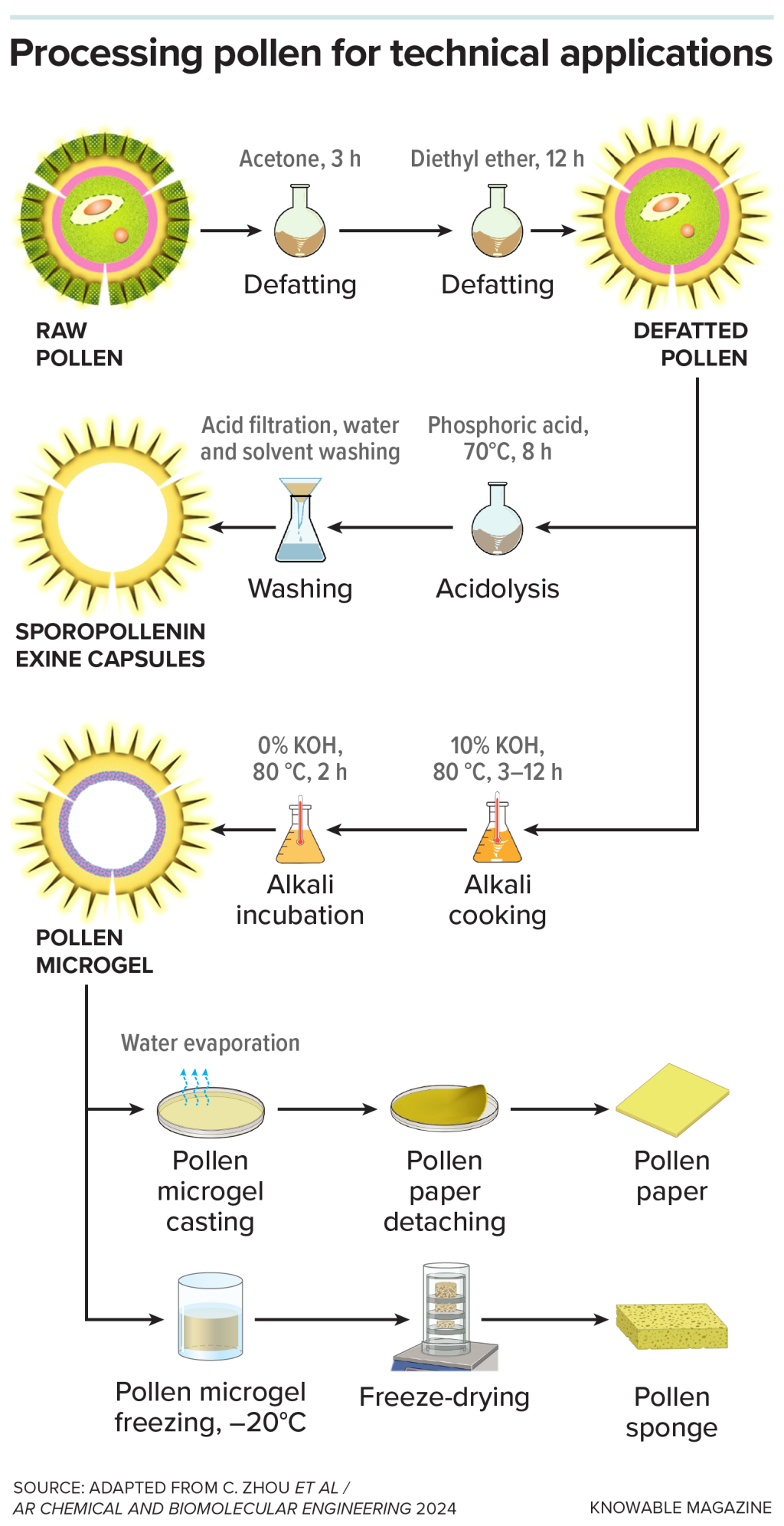
To begin working with pollen, scientists can remove the sticky coating around the grains in a process called defatting. Stripping away these lipids and allergenic proteins is the first step in creating the empty capsules for drug delivery that Csaba seeks. Beyond that, however, pollen鈥檚 seemingly impenetrable shell 鈥� made up of the biopolymer sporopollenin 鈥� had long stumped researchers and limited its use.
A breakthrough came in 2020, when Cho and his team reported that incubating pollen in an alkaline solution of potassium hydroxide at 80 degrees Celsius (176 degrees Fahrenheit) could , allowing them to readily absorb and retain water.
The resulting pollen is as pliable as Play-Doh, says Shahrudin Ibrahim, a research fellow in Cho鈥檚 lab who helped to develop the technique. Before the treatment, pollen grains are more like marbles: hard, inert and largely unreactive. After, the particles are so soft they stick together easily, allowing more complex structures to form. This opens up numerous applications, Ibrahim says, proudly holding up a vial of the yellow-brown slush in the lab.
When cast onto a flat mold and dried out, the microgel assembles into a paper or film, depending on the final thickness, that is strong yet flexible. It is also sensitive to external stimuli, including changes in pH and . Exposure to the alkaline solution causes pollen鈥檚 constituent polymers to become more hydrophilic, or water-loving, so depending on the conditions, the gel will swell or shrink due to the absorption or expulsion of water, explains Ibrahim.
This winning combination of properties, the Singaporean researchers believe, makes pollen-based film a prospect for many future applications: smart actuators that allow devices to detect and respond to changes in their surroundings, to monitor heart signals, and more. And because pollen is naturally UV-protective, there鈥檚 the possibility it could for certain photonically active substrates in perovskite solar cells and other optoelectronic devices.
Cho鈥檚 lab has also demonstrated that . It may be a sustainable alternative to traditional paper for writing, printing and packaging, according to Cho, who has patented the microgel鈥檚 production process. Producing traditional paper destroys trees and is resource-intensive, requiring for every page made. Pollen is naturally released in bulk from seed-producing plants, and deriving paper from it requires only a few simple steps. Ink can be removed with a simple alkaline solution wash 鈥� a process that lets the paper be reused.
Additionally, freeze-dried pollen microgel forms porous sponges. These could be made into such things as scaffolds for tissue engineering, or used to or to .
Cho鈥檚 team usually works with sunflower and camellia pollen that they purchase inexpensively as a bee pollen mixture, mainly from China. But they say their alkaline hydrolysis method would work well with a broad swath of plant species. Pollen is abundant, Cho adds 鈥� a single floret of the common sunflower, for instance, produces every summer. Moreover, it鈥檚 easy to collect from in commercial hives.
Pollen-based products have some way to go before reaching the market, Ibrahim adds; the key right now is to predict challenges and devise sustainable solutions. With other biomaterials researchers are working on, such as chitosan and cellulose, a crustacean or a tree must be destroyed. Compared with that, pollen is considerably less resource-intensive: 鈥淲e鈥檙e not destroying the plant,鈥� he says. 鈥淲e鈥檙e not even destroying the flowers.鈥�
was produced by and reviewed and distributed by 麻豆原创.