5 crowdfunding tips from founders who raised millions
5 crowdfunding tips from founders who raised millions
Funding a new business is a hurdle faced by many founders, especially when there have historically only been a few options for finding outside investment.
But in the late aughts, with the founding of Kickstarter, Indiegogo, and GoFundMe, crowdfunding emerged into the mainstream as a totally new way for entrepreneurs to bring their ideas to life. By harnessing the power of their audience, entrepreneurs can find their , build a community around their brand and products, and for growth.
As of January 2025, more than 651,000 projects had been launched worldwide on Kickstarter alone. Of these, only around two out of five were successfully funded, according to Statista research. Launching a successful crowdfunding campaign requires more than simply posting your idea online and hoping the money will start rolling in.
Successful crowdfunding campaigns from brands like Peak Design, IQBAR, Stonemaier Games, and ButcherBox are the result of strategic planning, persuasive storytelling, and building an engaged community. spoke with these founders about their best crowdfunding tips, so you can apply them to your own campaign strategy.
Study past crowdfunding successes
Jamey Stegmaier, the founder of board game publishing company Stonemaier Games, raised more than $3.2 million through eight Kickstarter campaigns and built the company into one of the most well-known independent game publishers in the market.
This started with his first campaign for the game Viticulture, which raised about $66,000, followed by the game Euphoria’s successful $310,000 campaign. Stegmaier credits Kickstarter as the only reason Stonemaier exists—and credits a large part of those campaigns’ success to his careful study of other campaigns, noting which tactics brought in the most backers.
“One of the biggest things I recommend to anyone—and something that I still do today—is really pay attention to how different creators are running their campaigns,” Stegmaier says on “.” “I pay attention to the things that they do that don’t interest me, or even frustrate me at times, so that I can avoid those things and emulate the things that they’re doing that excite me.”
Understand what you’re bringing to market
Peter Dering, founder of Peak Design, agrees that founders should come into their campaign armed with knowledge—including how their product fits into the market and solves a unique problem. With this strategy, the photography and travel accessories brand has run some of the most successful crowdfunding campaigns in the world. It’s raised more than $60 million on Kickstarter, and this year, Peak will surpass the $100 million revenue mark.
“It is not a place to test out ideas and say, ‘I wonder if people will like this,’” . If you’re not quite out of the testing phase yet, he recommends elsewhere: via interviews, friends and family, and retailers that handle a similar or complementary product. “Let this thing really just be a launch platform,” he says. “It’s a sales channel.”
When he reflects on his success with Kickstarter, Dering recognizes that the product he started with, the Capture Camera Clip that locks onto a strap, was a unique fit. “It solves an obvious problem,” he says. “I made a thing that made people go, ‘Oh yeah, of course. Why didn’t I think of that?’”
Set a goal you know you’ll hit on day one
Crowdfunding platforms favor campaigns with momentum out of the gate, which is why each of these successful founders set low funding goals they knew they would hit quickly.
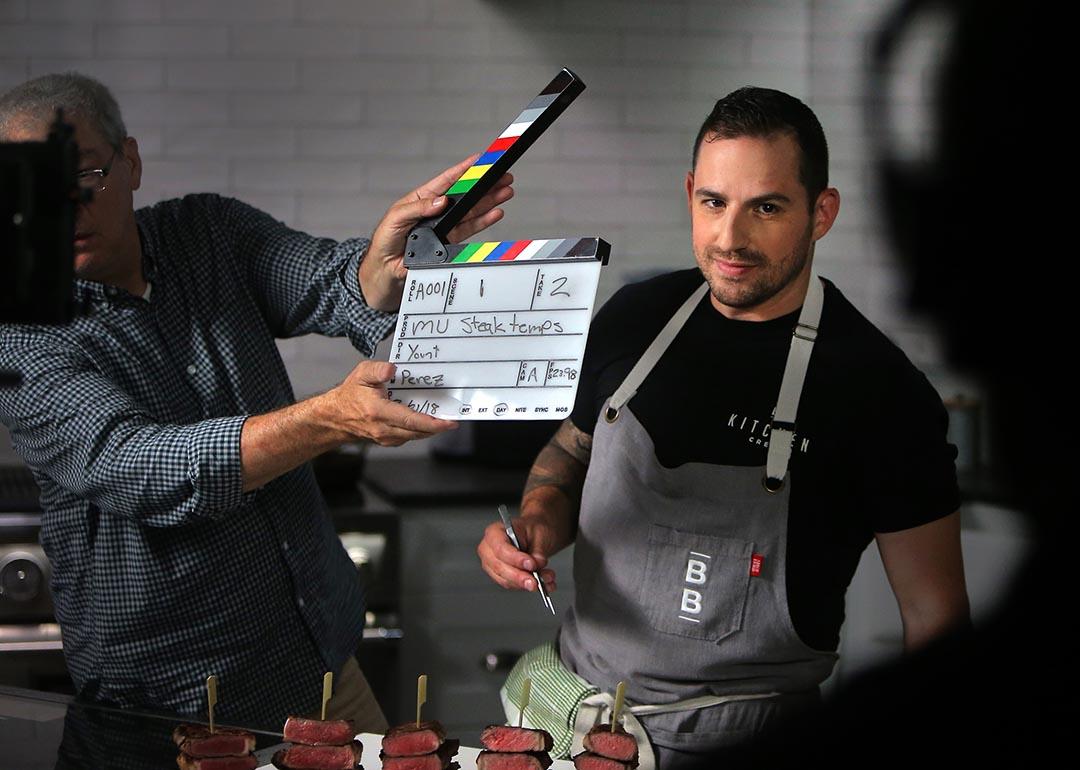
Mike Salguero, founder of meat and seafood delivery subscription service ButcherBox, brought his experience working with what he calls “two-sided marketplaces” like Etsy and eBay to the design of his crowdfunding campaign.
“There are these brief moments in time in two-sided marketplaces where there’s an arbitrage to be had if you know how to play by the rules—if you know how to game it. And I believed that Kickstarter was rife for gaming. We set out with a strategy to game Kickstarter,” .
Specifically, he analyzed what it took to win a Kickstarter “Projects We Love” badge, which afforded major benefits like placement on top of the Kickstarter homepage and email features.
“They do all of this stuff for you. They do the pushing rather than you having to get your audience to do it,” Salguero says.
Salguero determined that early momentum was a major driver for this badge, so he set ButcherBox’s goal at just $25,000: a milestone he felt he could hit on the first day. He also reached out to authors, bloggers, and proto-influencers—a novel approach in 2015, before the rise of the true influencer and creator economy.
“We noticed [things like] a nutritionist who told his audience to eat grass-fed beef, but he didn’t tell them where to go to buy it. And so we reached out and said, ‘Hey, would you mention our Kickstarter?’ He did, and we saw all these sign-ups happen,” Salguero says. “So then, we just started really trying to sign up all of these paleo authors and bloggers and newsletter writers to actively promote ButcherBox.”
ButcherBox blew past its goal and raised triple its $25,000 goal in the first day, and it soared to reach more than $210,000 by the end of the campaign.
Be shameless in sharing with your extended network
Just like Salguero, Will Nitze noticed that Kickstarter highlighted businesses with lots of momentum at the start. In preparing for the launch of IQBAR, a nutrition bar optimized for brain function and health, he wasn’t afraid to bend a few social norms to spread the word. This included email-blasting contacts he pulled from Harvard alumni Red Books. While plenty of his messages were sent to spam, he also made about $30,000 in orders from those emails alone.
“Truly, if ever there’s a time to be shameless, it’s when you’re running a Kickstarter,” Nitze says. “If you count on people just finding you and falling in love with your story, it will never work. You have to drag people kicking and screaming to your Kickstarter campaign and convince them to back you. And, by the way, if you do that in sufficient quantities of people, then you will be discoverable.”
He, too, set a relatively low goal of $10,000.
"You want to hit your goal on the first day—something you know you can reach with friends, neighbors, family, colleagues, and other people you’ve hit up,” Nitze says. “Find everyone tangentially relevant to you and tell them about it. Like, maybe we went to the same school. Maybe I live in Boston and you live in Boston.”
Nitze recommends extending your own network even further by connecting with other entrepreneurs on the platform. He did so to pitch cross-promotion, in which each campaign shouted out the other in their next update to backers.
Ultimately, IQBAR’s campaign surpassed its goal within a day and tripled it within two weeks, building early momentum. It raised about $90,000 between Kickstarter and Indiegogo.
Peak also started small by leveraging Dering’s network—no ads, no PR. “I just emailed the email addresses that I had accumulated. Not even photographers, just people in my life,” he says. “I was like, ‘Here’s this thing. Send it to any photographers who you might know.’” That early momentum helped the product rise in Kickstarter’s algorithm, making it discoverable to people outside Dering’s network. By the second or third day, the Capture Clip caught the attention of a writer at Gizmodo, whose article boosted the campaign’s awareness even more. “My net profit on that first year ended up being like $700,000 in sales, and I was profiting 30%,” Dering says.
Engage with fans who will champion your brand
While Peak has found continued success on Kickstarter, Dering recognizes the number of people coming to the platform has more or less plateaued. “I think Kickstarter was so successful at getting their brand out there that they netted the type of people who are willing to back projects," he says. However, there’s still plenty of opportunity to be had. Case in point: Peak’s latest crowdfunding campaign raised over $13 million.
“This is a very engaged community,” Dering says. “It’s absolutely substantial enough for us to still keep going back to that because it is a really active consumer base.” Today, Dering focuses on leveraging the power of community—both on and off the Kickstarter platform.
Peak has thrown parties for its backers in San Francisco, made its retail stores into community hubs, hosted photo walks and other in-person events, and leveraged Reddit to engage customers in authentic, two-way communication.
For Stegmaier, engaging with the crowdfunding community has been continually rewarding. He says one of the best uses of time and energy is engaging with customers and the Stonemaier community.
Stegmaier personally responds to comments and questions on the campaign page, on social media posts, and anywhere else a backer (or potential backer) chooses to engage. The feeling of connection and community is important in this space; personal and timely communication can help build trust with people who are considering giving money to a stranger. “The idea that I have the potential to have one-on-one interactions with anyone who is interested in talking about our board games—I want to let them know that I’m listening, that I’m reading along,” Stegmaier says.
was produced by and reviewed and distributed by Â鶹ԭ´´.