
8 in 10 prospective business owners say now is a good time to start a business
2025 has delivered mixed economic signals—some optimism, plenty of caution—but among Americans, the itch to start a business has not gone away.
Thinking about launching something of your own this year? surveyed 1,040 Americans who have expressed interest in business ownership to understand the real barriers and motivations behind that leap, from economic concerns to practical banking needs.
Here’s what stood out—and what could help more people move from concept to company.
Key takeaways
- 78.9% of respondents say now is a good time to start a business, yet even among the optimists, 47.9% still rank economic uncertainty in their top three concerns.
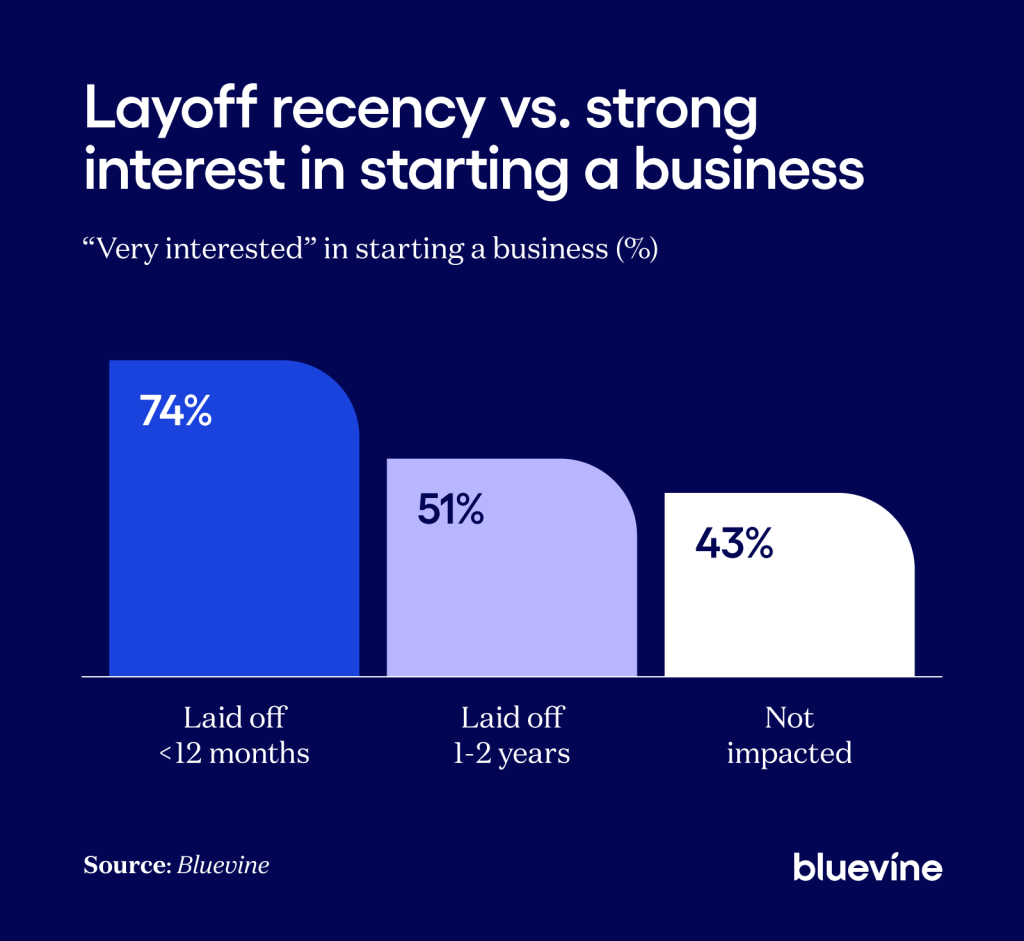
- 73.8% of those laid off in the past two years are very interested in starting a business, versus 42.7% of those not impacted by layoffs.
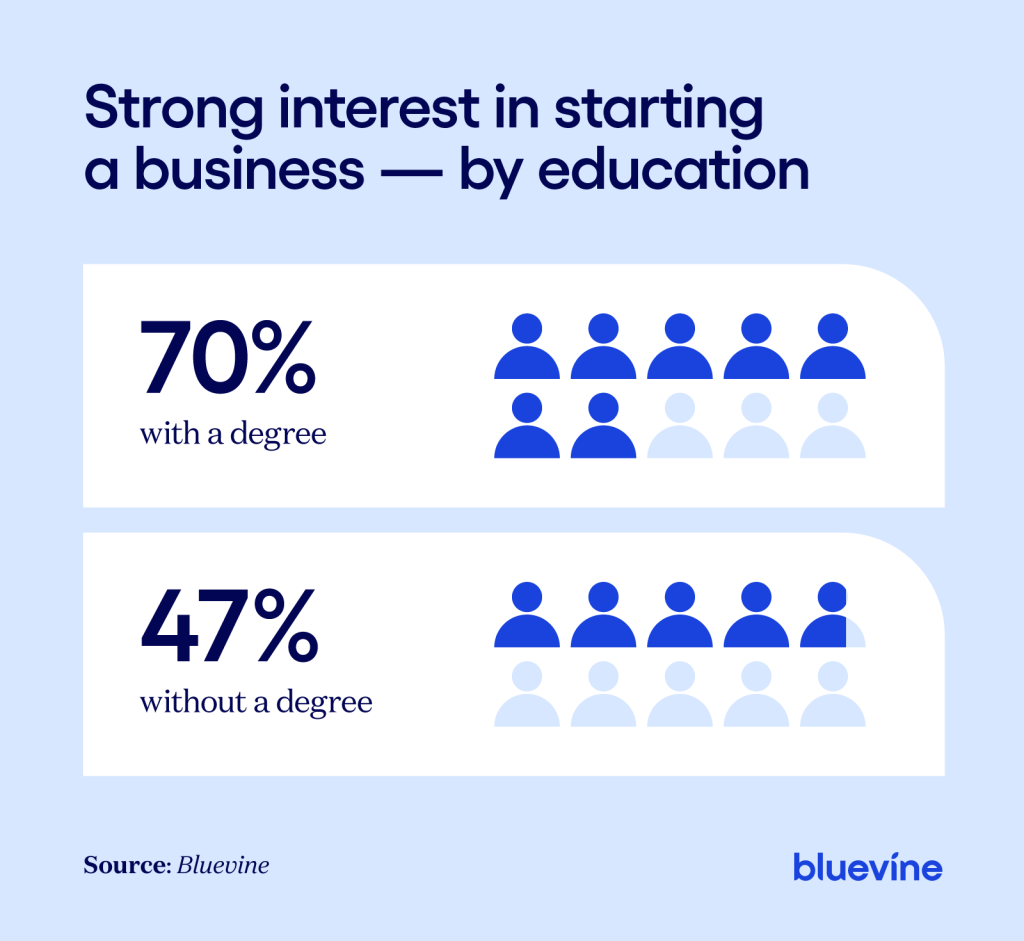
- Advanced degree holders show a 23-point edge in strong interest for starting a business (69.8%), compared to nondegree holders (46.8%).
- Potential business owners prefer fast payment processing/funds availability (56.2%) and easy access to credit/loans (54.5%) from their banking solution over no monthly fees (37.7%) and high-interest accounts (37%).
Economic uncertainty is the top worry—nearly half of respondents name it among their top 3
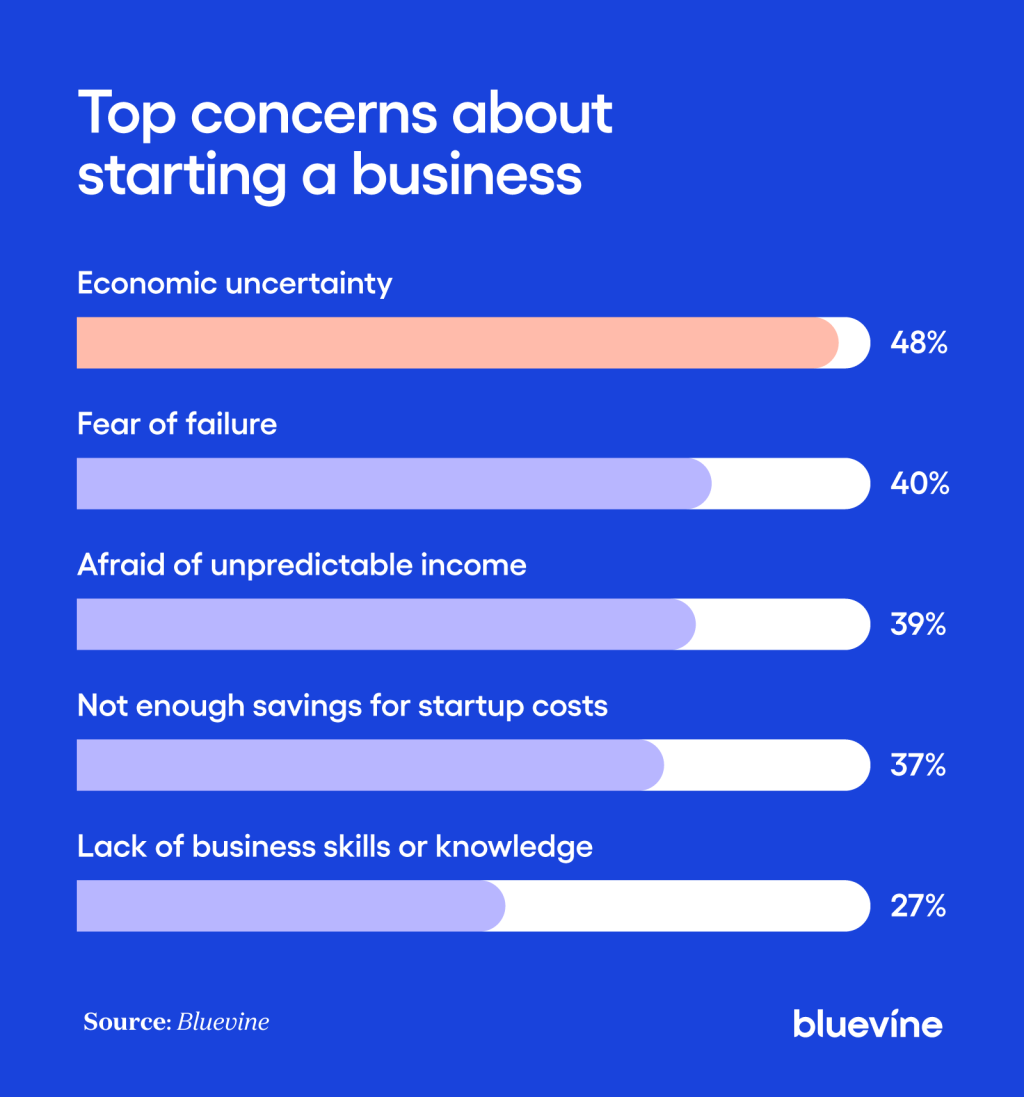
Nearly half of the would-be business founders surveyed listed “economic uncertainty” in their top three concerns for starting a business (47.9%), ahead of fear of failure (40%) and unpredictable income (38.5%).
That anxiety tracks the headlines: Small-business uncertainty , even as overall optimism ticked up, and the latest jobs report showed hiring nearly stalling with unemployment edging higher. Meanwhile, inflation is running at —which is moderate by recent standards—but 83.2% of respondents say lending rate cuts would make them more likely to start, a sign that uncertainty is still very real.
Money is also a common concern. Over one-third of respondents worry about not having enough savings for startup costs (36.9%) and unpredictable income (38.5%). Federal Reserve small-business reports show that access to capital remains a . Founders benefit from clearer, faster and cash-flow tools that steady early revenue swings.
Skills and information gaps are the next layer:
- 26.7% hesitate to take the next steps due to a lack of business know-how.
- 18.1% said they do not know enough about .
Pair that with practical life constraints, and the support brief writes itself:
- 25% worry about loss of benefits (health insurance/retirement).
- 23.8% cite time commitment.
- 23.9% are concerned about technological uncertainty.
Despite concerns, most Americans see now as a good time to start a business
Even though people are worried about the economy, most still see opportunity: In the survey, 78.9% said now is a good time to start a business (either broadly or in select industries).
There are a few reasons for this:
- Borrowing could get cheaper. Inflation has cooled ( for July), and the Fed just —both signals that financing and operating costs may ease.
- Owner sentiment is inching up. The MetLife-U.S. Chamber Small Business Index in Q2 2025, with more owners reporting good business health and comfort with cash flow.
- The tool stack is getting smarter. Small business financing software companies are rolling out features like and integration capabilities, providing hours back each month for new founders.
- Access to capital has some tailwinds. Recent (including higher caps for and Community Advantage lenders) broaden the runway for smaller, working-capital needs.
Layoffs correlate with a strong interest in starting a business
Layoffs are strongly linked to higher interest in starting a business. Among people laid off in the last 1-2 years, 64.9% say they are “very interested—actively making plans now” to start a business, compared with 42.7% of those not impacted by layoffs.
Recent layoff headlines and a still-active churn in parts of the economy help explain this—U.S. employers announced in August 2025—up 39% from July and the highest August since 2020. Recent high-profile cuts at UPS, ConocoPhillips, Oracle, and Dexcom kept the topic top of mind.
At the same time, new business applications remain high, suggesting many people are acting on that interest. The U.S. Census Bureau’s Business Formation Statistics show in July 2025 (+2.6% month over month). Of those, 168,155 were high-propensity applications (more likely to become employer firms).
It is clear that layoffs are a real catalyst for entrepreneurship, and follow-through is most likely when access to capital and early tools are within reach.
Advanced degree holders are over 33% more likely to start a business
While it should come as no surprise that individuals with higher education levels are more likely to chase entrepreneurial endeavors, the survey data uncovered that the gap may be much bigger than previously thought.
In the survey, 69.8% of master’s and doctoral degree holders say they are “very interested” in starting a business, compared with 46.8% of respondents without a degree—a 23-point gap.
So what explains the gap? The data points to a few common factors.
- National surveys show that among adults without college experience, with behaviors like having a retirement account differing sharply by education level—about vs. 37% with no college, according to the FINRA Foundation National Financial Capability Study released in July 2025.
- That confidence shows up in entrepreneurship, too. has been tied to perceived capabilities and lower fear of failure.
- Being assigned classmates with prior startup experience after graduation.
Taking a high-level look at the market, a 2020 report from the Ewing Marion Kauffman Foundation estimated that of U.S. entrepreneurs hold at least a bachelor’s degree.
The gap likely reflects three advantages common to advanced degrees—higher financial capability, structured exposure to entrepreneurial skills, and denser networks. You do not need a diploma to close it; practical training, mentorship, and simpler access to capital can deliver the same lift.
Men and younger adults are more likely to express strong interest and optimism
Education is not the only divider; who leans in also varies by gender and age.
In the survey data, men show higher intent than women (62.1% vs. 46.9% “very interested”), yet women in this sample are more likely to already be owners (2.5% of women vs. 0.1% of men).
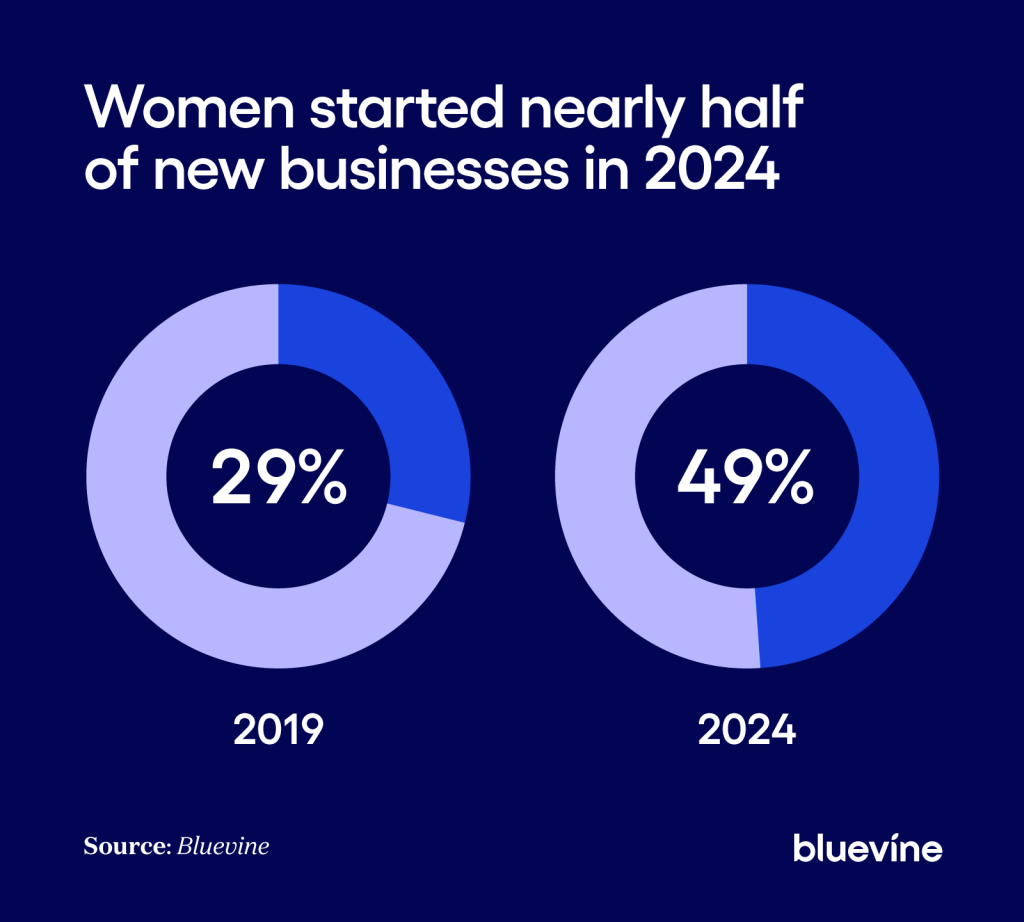
Historically, men start businesses at higher rates (in 2023, vs. 0.26% of women became new entrepreneurs). Still, women have been closing the gap: The latest formation reports from Gusto find women started about in 2024 (up from 29% in 2019).
By age, interest is strongest among 25-34 (58%) and 35-44 (56%) in Bluevine’s survey. That lines up with national indicators showing younger adults drive new firm creation: One 2021 report from GEM USA notes 18-24-year-olds are than older cohorts, echoing the “start younger” momentum we are seeing.
Over one-half of respondents would start a business with better funding options
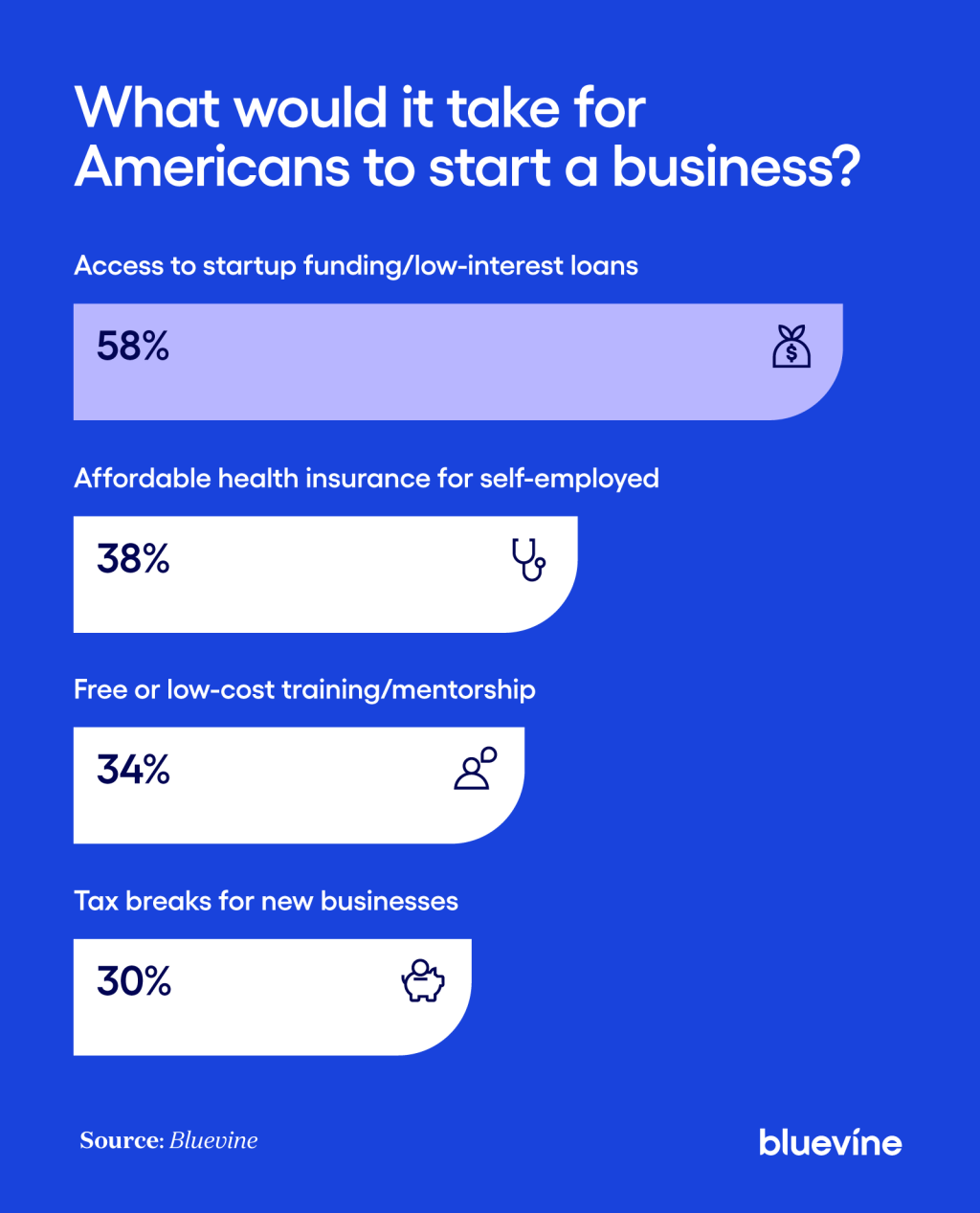
More than one-half of would-be founders say they would launch with better policy and product support—especially cheaper capital.
In Bluevine’s survey, 58.3% of respondents said access to or low-interest loans would make the biggest difference in starting a business.
That squares with the findings from : Many employer firms apply for relatively small amounts (half seek $100,000 or less) and a sizable share turn to higher-cost online lenders, where high interest rates and strict terms are common pain points. That shows evidence that lower-rate, faster credit could move people from intent to open.
Cost of coverage is the next obstacle, as 37.9% of our respondents say affordable health insurance for the self-employed would make starting feasible.
It’s understandable: ACA marketplace premiums are climbing—KFF reports that insurers filed for a for 2025—and broader reports show the steepest in 15 years, with even larger hikes projected for 2026.
Speed to cash and access to credit dominate business banking wishlists
A crucial early decision in starting a business is choosing a banking platform you trust—one that helps you get up and running fast and gives you the tools to grow at your own pace. Founders don’t just want perks; they want cash to move quickly and credit to be simple when it’s time to invest.
In the survey, would-be founders rank fast payment processing and funds availability (56.2%) and (54.5%) above all other business banking features.
Even 24/7 customer service (38.2%) outranks more traditional hooks, such as:
- No monthly fees (37.7%)
- High-interest checking/savings (37%)
- Accounting integration (29.7%)
Translation: When launching a business, quick cash and credit on tap matter more than perks.
Why this matters now
Real-world trends prove these priorities are rising for a reason:
- Instant‑money infrastructure is finally here—and scaling. FedNow, the Federal Reserve’s instant payment service for U.S. banks and credit unions, settled in Q2 2025 and now counts over participating institutions, roughly 95% of them community banks and credit unions. The Clearing House’s RTP network also logged a record across 343 million transactions in 2024. Together, the rails exist to turn incoming payments into real funds availability for small businesses.
- Credit access is strained and goodwill is fraying: The Fed’s on employer firms shows lender satisfaction declined even as application rates stayed flat, pointing to a need for simpler, faster paths to working capital.
- Cash-flow friction is widespread. Federal Reserve research finds that face payment-related challenges, underscoring why speed to cash ranks so high.
Methodology
on behalf of Bluevine conducted this survey of 1,040 Americans aged 25 and older who have researched business ownership in the past five years between Aug. 26 and Aug. 28, 2025. Data is unweighted, and the margin of error is approximately +/-3% for the overall sample with a 95% confidence level.
was produced by and reviewed and distributed by Â鶹ԭ´´.