
How to sell to CFOs: A data‑backed playbook for faster cash flow
Getting a chief financial officer to reply isn't about clever subject lines or bold fonts.
It’s about speaking the right language, at the right time, with numbers that actually add up.
analyzed hundreds of thousands of real sales touches targeting finance leaders using Pythia — Apollo’s proprietary language model trained on billions of interactions. The patterns are clear: Finance execs engage when the math makes sense and the message respects their calendar.
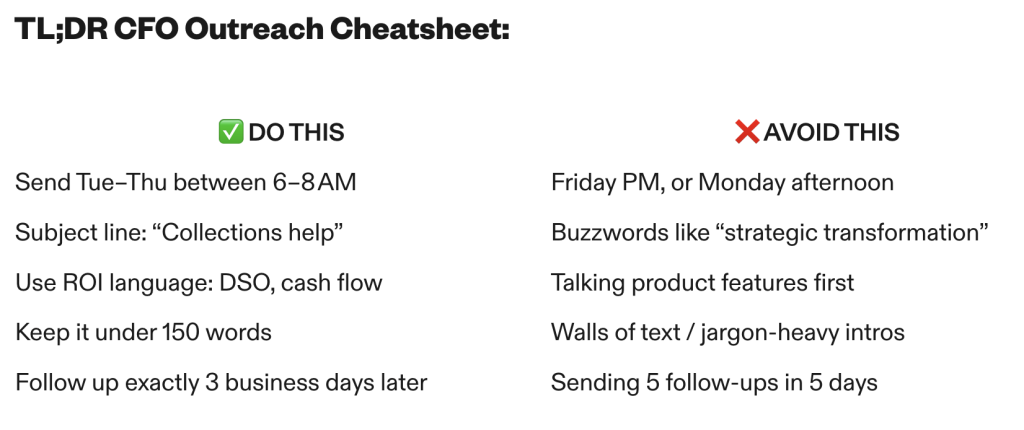
TL;DR: CFOs Reply When You...
- Email Tuesday to Thursday between 6 a.m. and 8 a.m.
- Lead with collections, days sales outstanding, and return-on-investment language.
- Use clear subject lines like “Collections help” — something specific to a CFO's executive responsibilities.
- Keep it tight: under 150 words.
- Follow up exactly three business days later — no sooner.
CFOs Don’t Browse — They Budget
Unlike CEOs or chief marketing officers who might entertain a big vision, CFOs prioritize precision and predictability. Their inbox is a wall of financial tools, overdue vendor asks, and budget approvals.
If your message isn’t ROI-tuned within the first few lines, it’s gone.
The good news? Once they engage, CFOs tend to convert faster. Why? Because they own the outcomes you’re promising: reduced days sales outstanding, faster collections, tighter receivables.
.
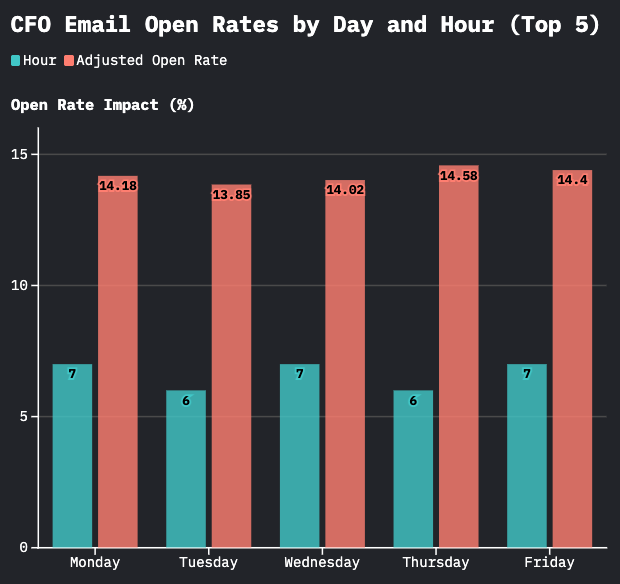
The Golden Hour: 6 a.m.-8 a.m.
Pythia’s pattern recognition across high-performing sequences revealed a clear behavioral rhythm: CFOs check email early — before their day becomes reactive.
Subject Lines That Work on CFOs
You’re not selling creativity — you’re selling cash control.
Top-performing subject lines didn’t try to be cute. They simply framed the offer in clear, financial terms.
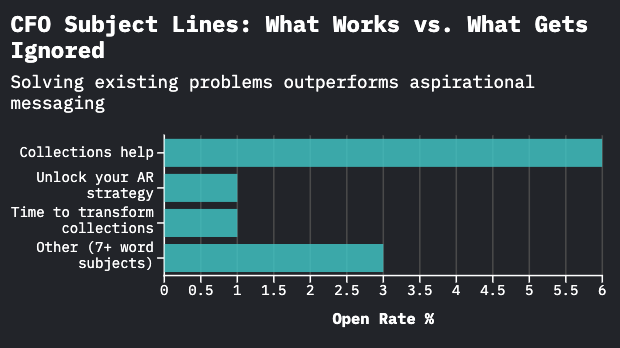
Winner: Collections help
It’s direct. It’s relevant. And it was used across all three of the top-converting CFO-targeted campaigns.
What Does ‘Collections Help’ Actually Mean?
It might sound unremarkable at first. That’s exactly why it works. “Collections help” is an that delivers immediate clarity. There’s no fluff, no jargon, no abstract promise — just a direct offer to assist with something every CFO thinks about: recovering money that’s already earned but hasn’t yet hit the account.
The phrase works on multiple levels.
First, it’s tactical. It signals to the recipient that what follows isn’t a broad value pitch, but a focused solution to a specific problem — aging receivables.
Second, it implies financial impact. A CFO reading “collections help” instantly connects it to improved cash flow, reduced days sales outstanding (DSO), and better working capital management.
Finally, it reads like something they’d send internally. It mirrors the kind of language that shows up in subject lines between a CFO and their accounts receivable or finance operations team. That familiarity builds credibility — and drives opens.
In a world of “revolutionary platform” subject lines, this one wins by keeping it simple and grounded in financial reality.
Pythia tracked six instances of this exact line across multiple steps and sequences — all resulting in above-benchmark open and reply rates.
What didn’t work?
- “Unlock your AR strategy”
- “Time to transform collections”
- Anything over seven words
The Body: Say Less, Show Impact
CFOs don’t skim — they triage.
Your first line had better answer: “Why now?”
High-converting email snippet:
“We’ve been streamlining collections for companies like {{company}} for 25 years — and you don’t pay us until your client pays you.”
That’s the winning formula: trust signal plus risk reversal plus upside.
Other strong language observed in replies and meetings booked:
- “25% improvement in cash flow”
- “No upfront cost”
- “Dedicated account team”
Pro Tip: Keep emails between 100 and 150 words. Anything over 200 saw reply rates drop nearly in half.
Follow-Up Frequency: 3-Day Rule Wins
We noticed a consistent pattern:
Day 1: The opener lands
Day 2: Silence
Day 3: Reply rates spike
The CFO buyer cycle isn’t fast — it’s filtered.
Your follow-up needs to land three business days after the first email. Not same day. Not a week later. Three.
Best practice:
- Maintain same subject line.
- Reference the initial message.
- Add one to two net new proof points (e.g., “Most clients see 40% fewer past-due accounts.”)
- End with a hard ask: “Would Tuesday or Wednesday at 2 p.m. work?”
Let’s break it down:
They’re not skimming for fun. They’re scanning for upside.
What Pythia Saw in the Data
Pythia’s cross-campaign comparison surfaced three rules that stood out:
- Timing rules engagement — 6 a.m.-8 a.m. sends outperformed all others by double-digit margins.
- Simplicity scales — “Collections help” beat every “creative” subject line tested
- Personalized financial outcomes win — Mentioning real metrics (cash flow, DSO, collection effectiveness index) led to 2.8 times more replies than generic “payment solution” framing.
The model learned this from patterns across thousands of CFO touches.
Want Replies That Pay?
Here’s the part most reps miss: CFOs will reply — when your email respects their metrics, their time, and their inbox.
But sending one-off shots won’t scale.
was produced by and reviewed and distributed by Â鶹ԭ´´.