This Kansas City neighborhood is transforming neglected housing and keeping control local
This Kansas City neighborhood is transforming neglected housing and keeping control local
In Northeast Kansas City, Missouri, one working-class neighborhood is using a multipronged approach to take control of its housing supply.
Since 2018, the Lykins Neighborhood Association has been taking on ambitious projects including using a state law to take control of abandoned homes, establishing a mixed-income neighborhood trust and partnering with Habitat for Humanity to construct 15-20 new houses. Their goal: enhancing the neighborhood’s livability, not maximizing property values.
As one of the most diverse sections of Kansas City, the Lykins neighborhood wants to revitalize its housing stock while preserving its blue-collar heritage, says Gregg Lombardi, executive director of nonprofit law firm Neighborhood Legal Support of Kansas City.
“There are a fair number of neighborhoods that are just trying to gentrify as fast as they can,” Lombardi says to . “Lykins is not like that.”
That means dealing with abandoned and dilapidated buildings. Lykins renter Fai Beal, who is a member of the neighborhood association’s development board, says absent landlords who defer maintenance are a real problem in Lykins and across the city.
In 2021, the reported that Lykins — which has a majority non-white population and a median income of about $24,000 — had the third-highest concentration of properties on the city’s “dangerous building list.”
But after eight years of resident-led efforts, Beal says it’s now difficult to find abandoned properties to renovate in Lykins. In the past, the neighborhood association has even offered a $100 reward for members who spot properties to rehab through Missouri’s Abandoned Housing Act.
“It’s just a way of helping keep members engaged and watching and eyes on the streets,” she says. “And also a way of helping hold slum lords accountable, because they know we’re out there watching and we’re not just letting houses sit around empty.”
Rehabbing abandoned homes
Under the , a nonprofit organization can file a lawsuit to take control of a home that has delinquent code violations and has not been legally occupied for at least six months.
After a suit is filed, the owner can renovate the property or pay for the nonprofit to do so. If the owner refuses to pay for renovations, the court can effectively give the property to the nonprofit to rehabilitate. Based on his experience overseeing cases for the past three decades, Lombardi estimates the policy has been used to restore around a thousand homes across Kansas City.
Programs exist to address distressed buildings nationwide, including in and , but do not require the properties be vacant. Lombardi says the law is unique because it allows nonprofit organizations like neighborhood associations to address blight without relying on city code enforcement.
“A lot of times there are out of state owners that the city can’t find — and you can write up as many citations as you like — and the property’s going to stay blighted,” Lombardi says. “But the Abandoned Housing Act actually takes that abandoned property and turns it into a good quality home. And that is something that no amount of code enforcement can do.”
When Lombardi was the executive director of Legal Aid of Western Missouri, the organization had funding from the local government to work on Abandoned Housing Act cases scattered around Kansas City. But Lombardi found the “shotgun” approach spotty.
“A lot of times, we’d have situations where we would get a house rehabbed and then there’d be a drug house nearby,” Lombardi says. “So people wouldn’t want to live in the rehabbed house.”
He wanted to focus on a specific neighborhood where the impact could be felt. That led him to Lykins, which already had an active neighborhood association.
The partnership between Neighborhood Legal Support and the neighborhood association began in 2018. Lombardi says the organizations worked with local rehabbers, planners and residents to go block-by-block identifying blight.
When they found an abandoned house and the owner wasn’t responsive, they would file a lawsuit under the Missouri Abandoned Housing Act. Lombardi tells Next City that the process allows them to get control of a property in about four to six months.
In Lykins, the neighborhood association enters into a contract with a rehabber who creates a plan to be approved by the court. The rehabber pays for the renovations and takes ownership of the property once the project is complete. The rehabber can sell the property or rent it out depending on the agreement with the neighborhood association.
At the end of 2025, Lombardi told the that his group restored around 100 homes in the neighborhood through the Abandoned Housing Act and “other civil litigation.”
That’s just one tool in Lykins residents’ toolbelt.
Preventing house-flipping
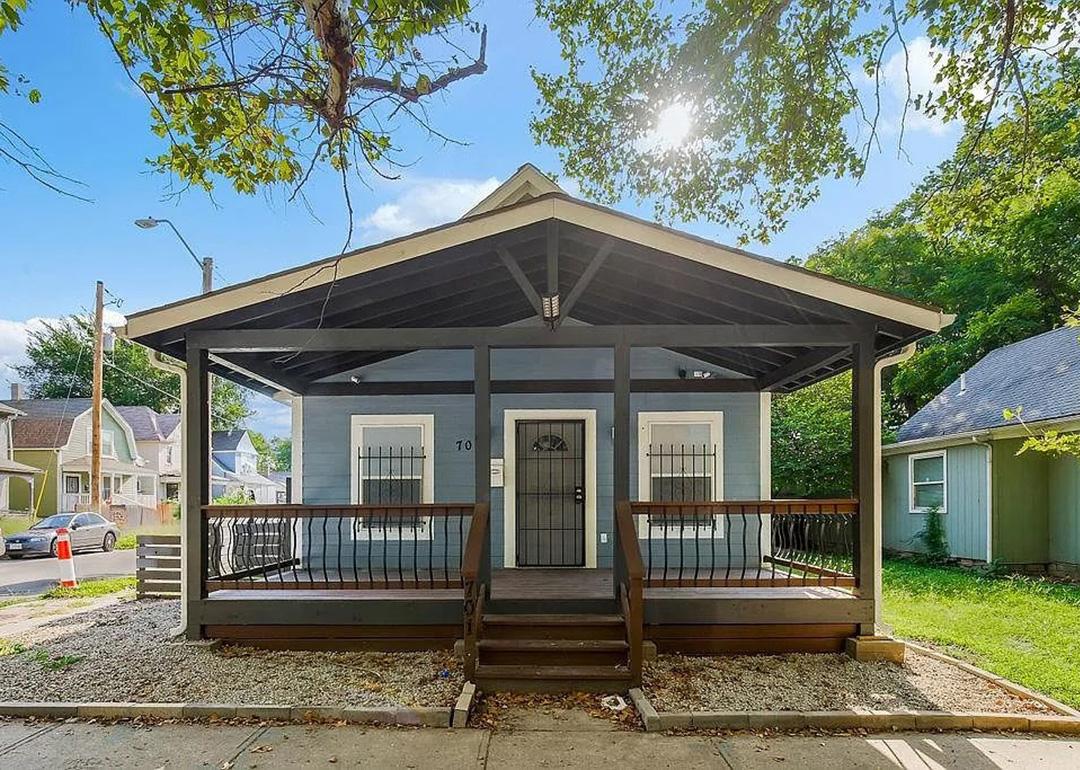
At the start of 2025, the Lykins Neighborhood Association launched its Urban Homesteaders program, designed to revitalize blighted homes and provide affordable housing to new homeowners willing to put in the work. Through this program, renters with technical skills in construction and renovation can enter into an agreement to “buy” a dilapidated home at no cost to them and receive a $15,000 loan for materials — as long as they agree to a scope of work for renovations and stay in the property for at least five years.
The homesteaders receive the home with no down payment. The neighborhood association also provides a mortgage, which the new owner doesn’t need to pay back if they stay in the home for at least 10 years. This stipulation is “essentially a lien on the property,” Lombardi explains. If the homesteader sells the property in the first five years, they have to pay the neighborhood association $50,000 from the sale. If they sell between five and 10 years, they have to pay back $30,000.
These incentives not to sell within the first decade are designed to guard against gentrification, both by preventing house-flipping and by limiting upward pressure on neighboring property values.
“When we started the (Abandoned Housing Act) project, the average house might sell for $70,000 in Lykins,” Lombardi recalls. Now, he says houses easily sell for $180,000.
“When you sell a house for $180,000, [for] all of the houses around it their value goes up, which is great for the 30% homeowners,” he says. “But for the 70% of renters, that drives rental prices up. Even for the owners, you’re going to pay higher property taxes.”
With the homesteader program delaying sales of rehabbed properties, the neighborhood has a tool to create viable housing without pricing out low-income renters or homeowners who can’t afford higher taxes.
Lombardi said homesteaders typically work together on their homes, making the process an even more collaborative effort.
“They’re staff for companies who do rehab work, but they know how to do all the rehab work themselves. Or they may be really good at electrical and roofing. They have a friend who’s really good at plumbing, a friend who’s really good at drywall, [a] friend who’s really good at foundations,” Lombardi says. “They bring them together, and [the homesteader] at the end of the day gets the house.”
Heber Villavoro is a homesteader in Lykins who works in construction. His family connected with the program through the youth soccer league in Lykins Square Park. Villavoro asked about the building at the edge of the park that headquarters both the neighborhood association and Neighborhood Legal Services. From there, he says he and his wife started attending meetings.
“I always thought that was cool that they were taking care of the neighborhood,” Villavoro says. “But I didn’t know they could help me rehab a house.”
While he rents in a nearby neighborhood, Villavoro says he’s scheduled to have the house move-in ready in May. With insulation in place before winter, he uses generators to heat the interior while he works through cold weather.
Ensuring local control of affordable rentals
While the Abandoned Housing Act allows the neighborhood to take properties away from absent landlords, a allows for local control of affordable rental housing.
In 2021, the Lykins Neighborhood Association partnered with the local nonprofit to launch the Northeast Neighborhood Trust, one of the country’s first MINTs.
A MINT is essentially a community-governed real estate company that develops and rents out housing in neighborhoods on the cusp of gentrification. As housing prices rise in the area, some rents in the portfolio rise with them. Those market-rate rents are intended to help subsidize affordable housing, which make up a majority of the portfolio.
The Northeast Neighborhood Trust’s mission is to target neglected properties for acquisition, says Beal, who is part of the trust stewardship committee that established the trust’s legal purpose and oversees the operating board.
This committee is made up of stakeholders from the neighborhood like renters and homeowners who set standards for how the MINT operates. The committee requires that the trust hire a responsive property manager in Kansas City, she says.
In 2023, , a property management firm focused on affordable housing, became the general manager of the Northeast Neighborhood Trust, overseeing the portfolio. Beal told that Integrity also works on renovating and rehabbing the properties they manage, “giving the company more skin in the game than typical property managers have.”
Working with Habitat for Humanity
When Lombardi started taking a block-by-block approach to address blight, Lykins Square Park stood out as a clear anchor for revitalization. When the project began, Lombardi says, only seven of the 45 properties neighboring the park were occupied.
“A lot of urban parks become, really, liabilities for the neighborhood,” Lombardi says. “Parks are a perfect place, if you’re a drug dealer, to set up shop because you’re not responsible for it at all.”
Where the park was once a hub for drug activity, redevelopment has created space for art markets on a central plaza and a youth soccer program in the field. Beal says kids now fill the park in the afternoons.
Next, Lykins wanted to add viable housing around the park. So in 2022, the neighborhood association put out a request for proposals for the development.
The housing and development committee had four developers in the running and went through a nine-month process before partnering with Habitat for Humanity on 15 to 20 new homes planned around the park. Eight of these are currently under construction.
“It took us about nine months of serious work with our residents and listening sessions and things to get to the point where we could vote and decide on who we wanted to come in there,” Beal says.
At least four families have already moved into the Habitat homes.
The Habitat for Humanity project and the Northeast Neighborhood Trust present two sides of the coin for affordable housing, Beal notes. While the Northeast Neighborhood Trust renovates properties to provide affordable rentals with high standards of quality, Habitat for Humanity builds affordable housing to be owner-occupied.
Working with unhoused neighbors
As the revitalization project progressed, Neighborhood Legal Services had to grapple with displacing people experiencing homelessness in Lykins. Lombardi tells Next City that telling people to move off a property wouldn’t really solve anything.
In 2021, the law firm contracted social worker Angie Curtis to develop an outreach program that would connect people with services and housing assistance.
“So instead of saying, ‘come on, you gotta go,’ I would come in as a social worker, provide resources, kind of meet them where they’re at,” Curtis says.
As part of her program, Curtis built relationships with people living on the streets in Lykins and plugged them into the Greater Kansas City Coalition to End Homelessness’s network and the local Continuum of Care, which could provide more long-term case management and housing resources. Lombardi says they paid some unhoused neighbors consulting fees for help building relationships.
Curtis managed grant funding to help pay for clients’ transportation or even a year of housing, she says.
The majority of the outreach program’s funding came from COVID-19 relief funds that dwindled by 2024. That year, the program ended and Curtis became the executive director of the Lykins Neighborhood Association.
As executive director, Curtis says she spends about a quarter of her time on social work but she would like to have more funding and more social workers for a street outreach arm.
was produced by , a nonprofit newsroom covering solutions for equitable cities, and reviewed and distributed by Â鶹ԭ´´.