Gun violence in this Midwestern city isn’t abating. Its leaders halted programs that could help.
Gun Violence in this Midwestern city isn’t abating. Its leaders halted programs that could help.
Just after midnight on July 5, on the heels of Independence Day fireworks, downtown Fort Wayne was crowded with lingering teenagers. Just around the corner from the city’s police headquarters, two groups of teens at Promenade Park ran into each other, started shouting, and soon, gunfire erupted.
All told, four teens between 15 and 18 years old were shot; Si’Montre Anthony Molargik, 16, died at the hospital. Two others were arrested a couple of days later on charges of murder and attempted murder.
While the shooting frightened many downtown residents and business owners, the violence was familiar to those from the boys’ southeast neighborhood, and others living in Fort Wayne’s most disenfranchised — and predominantly Black — neighborhoods. On June 1 at 2 a.m., two young men shot through a front door on the city’s southeast side, killing an 86-year-old woman whose great-grandson was reportedly the target. A few weeks later, on the southeast side, a domestic dispute ended in a fatal shootout, killing two people. Earlier this year, again in the southeast, a teenage girl was shot and killed by another teen during a botched exchange involving a pair of sneakers.
Gun homicide and shooting rates in Fort Wayne have remained steady even as other small cities across the Midwest have recorded post-pandemic , as highlighted by a Center for American Progress analysis of 2023 data. Of the 59 shootings recorded so far in 2025, 16 victims were under the age of 18. The city has no government-supported violence prevention or intervention program. Now, many local activists say there’s a growing gap in outreach to the young people most active in the streets, reports.
“I would compare the things that we’re dealing with right now to the severity of COVID when it first came around,” said Roderick Parker, an activist who runs Big Hearts Community Projects, an organization working directly with youth caught in the cycle of gun violence. Fort Wayne saw 40 homicides in 2020, its year since 2016. “The violence that we’re seeing in the city, especially the juvenile violence, is just out of control, and we’re not doing enough to stop it.”
Parker and other community activists point to several factors contributing to shootings, including a lack of strategy and coalition-building between different on-the-ground leaders, who remain divided on potential solutions.
“There was a time when there was a community and city effort to focus strategically and intentionally to provide support programs for people. Some of those are still going, but it’s not what it used to be,” said Anthony Payton, a local pastor in Fort Wayne. “The young people have lost a sense of hope, and so they’re gravitating toward everything around them that’s negative.”
The city’s worst year since 2019 was in 2021, with 42 homicides and 91 nonfatal shootings. While killings dipped in 2022 and 2023, similar to nearby cities like , Indianapolis, and , the trend in Fort Wayne was reversed in 2024. Victims under 18 accounted for 19% of homicides last year, up from 14% in 2023 and just 3% in 2019, according to police data.
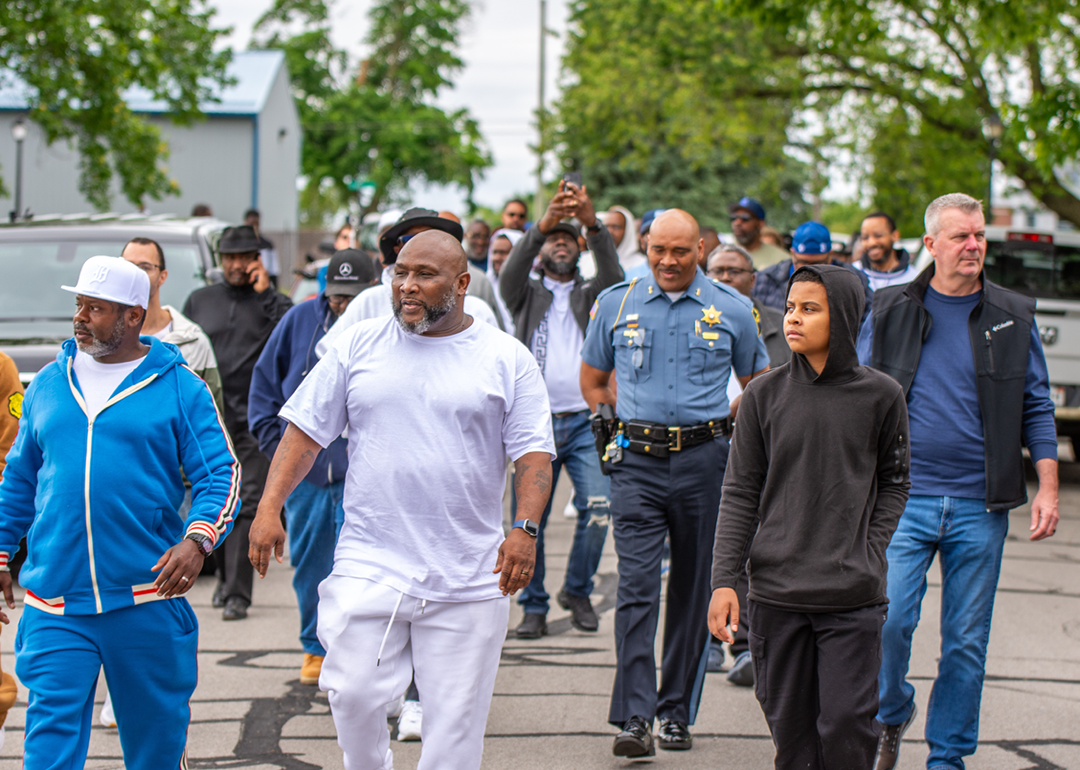
During the administration of the late Mayor Tom Henry in 2016, Fort Wayne partnered with Cities United, a national nonprofit that helps municipalities reduce gun violence. That collaboration led to the launch of the Ten Point Coalition, an initiative of local activists and outreach teams that regularly walked the city’s most violent neighborhoods to engage with residents. But after Henry died in 2024, his successor, Mayor Sharon Tucker, paused both programs, . “The new mayor thought it was too big of a risk and a liability for the city, and she halted the program,” said Joe Jordan, the CEO of the Boys & Girls Clubs of Fort Wayne. Tucker’s office declined to comment on why the programs were paused, but of concern about the city’s youth violence.
Despite the rising toll, the police consistently solve a high number of cases, averaging an 89% homicide clearance rate over the last five years. Detective Sergeant Chris Felton, who runs the Gang and Violence unit in Fort Wayne, credits the success to a coordinated task force approach. When a homicide occurs, multiple units respond immediately, sometimes bringing in 20 to 40 officers to gather evidence, review surveillance video, pull phone records, and serve search warrants. “We get the information and we start pursuing it right away until we’ve done literally everything we can do,” Felton said.
While that strategy is proving effective, community leaders argue that it’s not enough to succeed only after the damage is done. “I think there’s a strong sense of trauma and hopelessness that a lot of our community members are feeling right now. People are on edge,” said Jordan, who co-chaired Fort Wayne United. “We have to focus on more preventive measures as opposed to reactionary measures.”
Felton acknowledges the department’s limitations. “We only have 10 detectives on our gang unit… In a perfect world, we’d have 30,” he said. “We don’t have the manpower, and a lot of places our size just don’t have the manpower to staff that.” Parker, the activist working with young people, believes this is where community organizations must step in — if they have the resources and can sustain them. “People say there’s no way to stop violence…but I know we can stop these kids from shooting each other,” Parker said. “We just have to do the work.”
A group of activists has since relaunched Fort Wayne United, but it no longer has formal ties to the city. Meanwhile, Parker is working on a proposal to bring a structured violence intervention model to Fort Wayne. He’s in conversations with national groups and hopes to present a comprehensive plan to city officials.
“We have people here that are willing to do this work,” Parker said. “They just need some support.”
was produced by and reviewed and distributed by Â鶹ԭ´´.