How Americans feel about 30 major issues
If you feel you can't get through a single news cycle without hearing about the polarization of the country, resist the urge to blow it off as fake news. , the 21st century has driven a massive partisan wedge between red and blue America. From homosexuality to corporate profits, to environmental regulations to poverty, there are widening gaps in the attitudes, values, and opinions between Democrats and Republicans on some of the biggest issues. While factors like age, gender, and ethnicity are occasionally better indicators, political affiliation is significantly more likely than before to shape modern world views鈥攁t least since 1994 when Pew first conducted the surveys.
for the population as a whole. A smaller percentage of Americans worry about the economy, for example, than they did just a few years back, while a greater percentage worry about addiction. Several years of positive economic growth and record-low unemployment in the wake of the Great Recession undoubtedly contributes to that change in opinion.
Using polling data from sources like Pew Research, Gallup, and the Kaiser Family Foundation, 麻豆原创 examined America's opinions on 25 of the biggest issues facing the country today. 麻豆原创 focuses on what drives those opinions, how those opinions have changed, and how those opinions play out in real-life policies and events. Since so many issues are split by political identity, it's important to note that any reference to "Democrats" and "Republicans" could also include respondents who are independent but "lean" toward one party or the other.
You may also like:
The Space Program
, both Elon Musk's SpaceX and Jeff Bezos' Blue Origin have serious plans to put private citizens in space as early as this year鈥攁nd the space startup sector is booming. , however, 72% of Americans think it's vital for America to remain a leader in space, and most think NASA鈥攏ot private companies鈥攕hould lead the way.
Environmental regulations
Like so many other key issues, are steered by party affiliation. A majority of Americans do share the opinion that the federal government is not doing enough to protect the environment, but there's a strong partisan divide on whether stricter regulations are worth the cost. Republicans think they are not, and that opinion is reflected in President Trump's during his presidency.
Global warming
In the most recent Pew Research poll, 56% of , and 44% believe that dealing with global climate change should be a priority. There is a significant gap, however, based on political affiliation鈥攁nd that gap becomes a canyon when the question includes whether human activity is to blame. Only a quarter of Republicans believe that global warming is real and is also caused by humans, with older Republicans and ardent Trump supporters being skeptical.
Business regulations
When it comes to the most recent polling data on , the country is closely split, with 39% of Americans saying there is too much government regulation on business, a quarter of people saying there is too little, and a third saying that there is the right amount of regulation. Seemingly aware of this sentiment, President Trump campaigned on rolling back regulations, and he has kept his promise. As early as February 2018, that Trump might have killed more regulations than any president in history.
The Affordable Care Act
Few of President Barack Obama's policies were more controversial than the Affordable Care Act, commonly called Obamacare. Some of that controversy, however, is apparently starting to subside. The most recent shows that, while favorability ratings for the 2010 healthcare law dipped slightly, 46% of people surveyed still believe that it is good for the country.
The border wall
Eighty-two percent of Republicans , but an even greater percentage of Democrats鈥攁 full 93%鈥攁re against it. All in all, Pew data shows that 58% of respondents don't think the physical border with Mexico should be significantly expanded or bolstered. The president over funding for the wall, but then walked back that statement.
Legal status for children brought to U.S. illegally
Another major issue in America's immigration debate is the fate of immigrants who were brought to America as children. , America's collective opinion on the issue is clear. A full 73% of respondents think they should be granted legal status, including 54% of Republicans and 89% Democrats.
The global economy
Almost 2 in 3 Americans believe that is a positive thing because it opens up new markets and provides an opportunity for growth. Less than 1 in 3 worries that the dynamic stifles wages and exports jobs. While none of this news is particularly stunning, America's position as a player in the global economy represents one of the few cases where Democrats and Republicans are about evenly paired in their opinions.
[Pictured: President Trump and French President Emmanuel Macron at the G7 Summit in Biarritz, France, in 2019]
America's role in world affairs
only 35% of Americans said the U.S. should actively participate in issues facing other countries while 60% said the country is better off focusing on its own problems at home. Now, more Americans are invested in foreign policy, but . While improving relationships with America鈥檚 allies is a top priority for 70% of Democrats (compared to 44% for Republicans), maintaining America鈥檚 military superiority over other nations is a top priority for 70% of Republicans (compared to 34% of Democrats).
[Pictured: Protesters in Hong Kong hold up signs that say "President Trump, please liberate Hong Kong."]
Privacy vs. security
on the trade-off between privacy and security in the digital age. Republicans, women, and older Americans are more likely to sacrifice privacy for the sake of security against threats like terrorism鈥攂ut not by much.
[Pictured: US Acting Secretary of Homeland Security Kevin McAleenan]
Islam and violence
From immigration laws and foreign policy, to religious tolerance and perceived political correctness, few issues have carried more weight in the post-9/11 world than the threat of radical Islamic terrorism鈥攂ut is Islam any more likely to incite violence than other religions? On that issue, Americans are nearly split, but within that split lies a massive partisan divide: 鈥檚 most recent polling, 49% of America thinks Islam does not encourage violence while 43% believe it does. The former category included about 2 in 3 Democrats, and roughly the same percentage of Republicans side with the latter.
Gun regulations
Few issues are more divisive than guns, and , there is far more conflict than agreement on most key topics. Gun owners and the unarmed, however, do see almost eye to eye on a few core issues with gun regulations. Similar percentages of both groups think the mentally ill, people on no-fly lists, and people on watch lists should be banned from owning guns. They also agree that background checks should be mandatory at gun shows and in private sales.
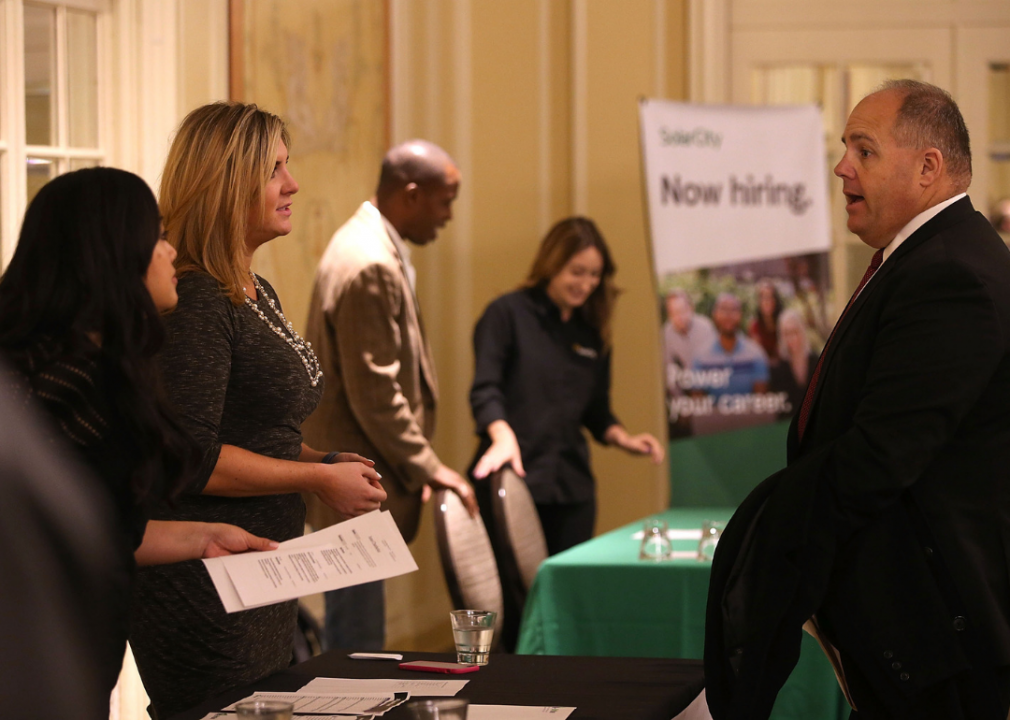
Employment
has offered President Trump a steady stream of good news, with the jobless rate dropping and employment expansion accelerating across a range of sectors. That reality is reflected in polling data: , 60% of Americans say there are 鈥減lenty of jobs鈥� available in their community, the most positive outlook in decades.
Income
While the job market might be hot, the same cannot be said for the paychecks of many of those jobs. In fact, 鈥攚ages after inflation is factored in鈥攈ave remained virtually unchanged for decades, a fact not lost on the masses. that even while a majority of poll respondents are more optimistic about jobs than they've been in a generation, about half don't think wages are keeping up with the cost of living.
President Trump's economic policies
According to CNN, President Trump is right when he says the economy is doing well and that he deserves some credit for that fact. The country seems to agree on the first part of that sentiment, but for attributing economic gains to Trump's policies, it depends on who you ask. that 79%of Republicans associate a strong economy with Trump's policies and 87% of Democrats do not.
Race relations
2018 that 56% of Americans feel that President Donald Trump's election has strained race relations, compared to 15% who think race relations have improved in the Trump era. From to , it's difficult to imagine that most Americans wouldn't concede that racial tension is, indeed, palpable. Only one Republican in five, however, thinks that Trump is to blame, compared to a full 84% of Democrats.
[Pictured: New York City Council members kneeling with a Colin Kaepernick jersey in response to President Donald Trump's condemnation of NFL players taking the knee.]
New tax law
Those most likely to believe that both their families and the country will benefit from the are the ones with annual family incomes over $75,000, and of that group, far more Republicans (68%) than Democrats (21%) believe the legislation is fair. Lower earners are even less likely to have a positive view of the law.
Belief in God
Two undeniable trends in American culture are that and secularism is on the rise, but . Just 56%, however, believe in the God described in the Bible while 33% believe in some other "higher power" or "spiritual force," and 10% of Americans now think humanity is all alone.
News on social media
Most Americans, about 2 of 3, 鈥攂ut that doesn't mean they believe everything they see in their news feeds. In fact, modern media consumers are skeptical, with 57% expecting to receive inaccurate information. Facebook is still the king of the hill, delivering news to 43% of the poll's respondents, with YouTube, Twitter, and Instagram trailing as distant runners up.
News media as a watchdog
Democrats and Republicans are more divided on than they are on virtually any other issue. By a margin of 44 percentage points, Democrats are far more likely to see the media as a watchdog whose spotlight keeps political leaders honest while Republicans are far more likely to believe that the media are politically biased purveyors of inaccurate information. The media are favorite boogeymen for Republicans, but President Trump raised the rhetorical stakes this summer when he called the media the
Genetic engineering of animals
The question of "playing God" with nature has divided Americans on issues from stem cells to vaccines, but when it comes to genetic engineering of animals, it all depends on the reason. Anything that benefits human health, like manipulating mosquitoes to prevent the spread of disease, is widely accepted as appropriate. However, people are far more likely to frown upon seemingly frivolous endeavors, like engineering aquarium fish to glow. In Washington, for the emerging lab-grown meat industry.
Internet's impact on society
One of the most rapidly changing trends has to do with About 9 respondents in 10 report feeling that the internet is good for them as individuals, which mirrors poll results from 2014. Just 70%, however, believe that the online age has been good for society as a whole. Significantly more Americans now think the internet has been a mixed bag for people in general.
Digital and mobile devices
When Apple recently released the iOS 12 update, one of the new features was , which helps users figure out which apps gobble up most of their time. Teens are more likely than their parents to report 鈥�54% admit to excessive use, but their parents have some work to do, too. About 36% of parents admit to spending too much time staring into their screens鈥攖hat's more than 1 in 3.
American greatness
As divided as the country may be on so many issues, Americans are fairly unified in their . All but 15% believe that America is the greatest or one of the greatest countries in the world, with older Americans and Republicans reporting more patriotic fervor.
The secret to America's success
Finally, there's the question of . The answers from liberals and conservatives are probably the least surprising on the entire list鈥攖hat's because they represent the dictionary definition of what it means to be liberal or conservative. Democrats overwhelmingly think that America's success can be traced to its ability and willingness to change and progress with the times. Republicans are far more likely to credit America's success to its reliance on long-standing principles.