Never married and never happier? How attitudes about marriage are changing among singles in America.
originally appeared on and was produced and distributed in partnership with 麻豆原创 Studio.
Never married and never happier? How attitudes about marriage are changing among singles in America.
More Americans are getting married later in life鈥攊f at all.
That's according to a 2023 report by the , which analyzed Census Bureau data to reveal that a record-high share of Americans over 40 have never been married. One in 4 40-year-olds had never tied the knot as of 2021, up from 1 in 5 in 2010.
Forty-year-olds holding a bachelor's degree or higher were more likely to be married than those without a four-year college degree, the report found, and men were more likely to have never said "I do" than women.
This high marks a decades-long slide in marriage rates, coinciding with evolving social norms and drastic economic shifts. Since the early 1990s, as cohabitation started to become more socially acceptable, ideas about the necessity, importance, and timing of marriage鈥攁t least among some segments of the population鈥攈ave dramatically changed.
In part, experts point to economic factors for the delay and decline in marriage rates. Women's economic gains in the workforce have made them less financially reliant on a wage-earning spouse. The rising costs of raising a child, coupled with declining birth rates, have also driven down marriage rates.
Harder to measure, however, is the impact of shifting attitudes on purpose and fulfillment on marriage. While for a fulfilling life, just over half say that while it's important, it's not essential for both men and women, according to Pew Research. Broader recognition that marriage does not "complete" a person has made it a "nice to have"鈥攆or some鈥攔ather than the ultimate goal.
Bella DePaulo, a social scientist and "leading researcher of singlehood" that her "most authentic life" is while being single: "And single for me in the most single sense possible鈥擨 live alone, I don't date, I happily don't date, and that's the life that works best for me," she added.
While some Americans say that society is better off if more people are married, and about 4 in 10 believe marriage brings greater financial security, that's not enough to convince some people to walk down the aisle. Salvador Espinoza, a 44-year-old from New York City, told 麻豆原创 that despite the fact he thinks marriage might "make sense legally" for insurance and taxes purposes, a relationship doesn't need to have a "seal of approval by some other authority."
looked at and to assess how single Americans have reexamined their relationship with marriage.
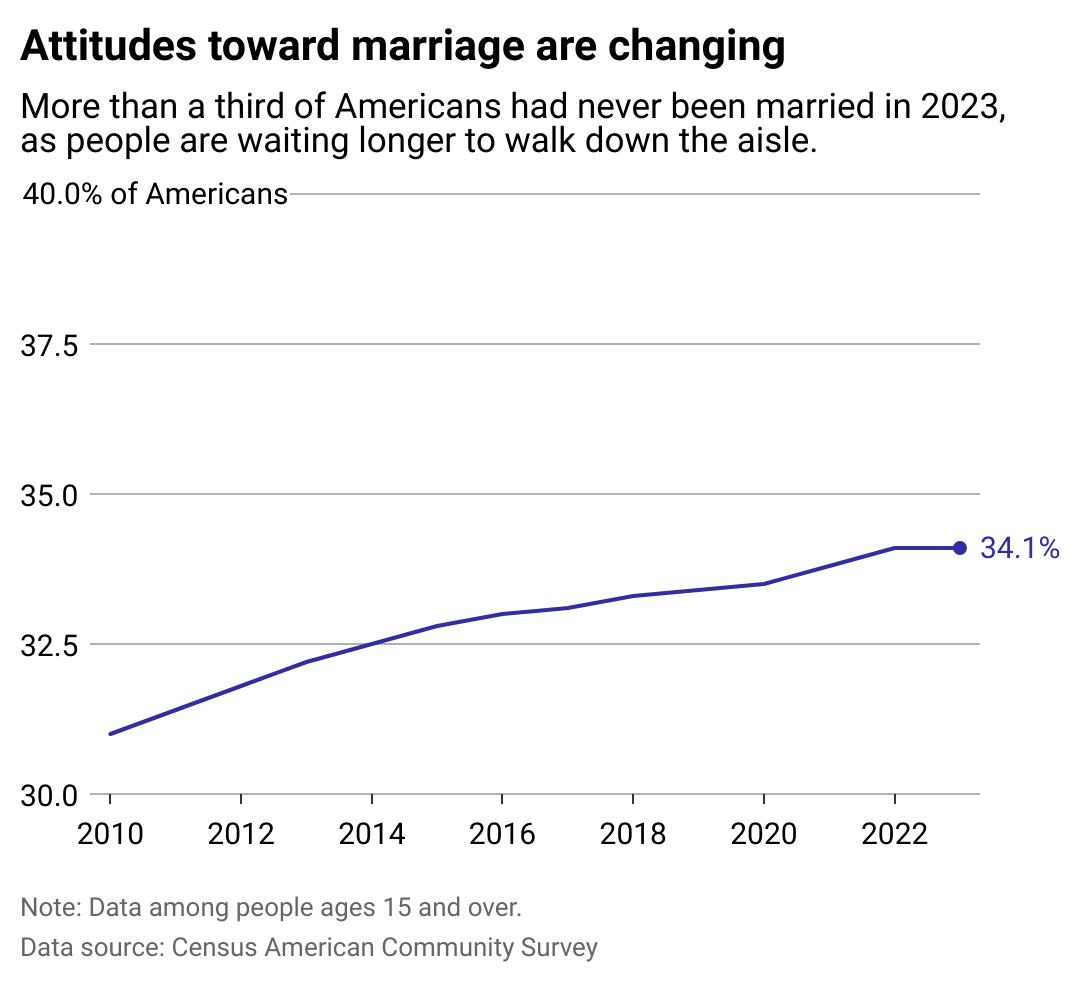
More Americans are delaying marriage
In recent years, the COVID-19 pandemic may have expedited the delay in marriage and engagements. The lowest recorded number of marriages since 1963 occurred in 2020, according to a 2023 report from the.
Overall, single adults aren't looking to rush into marriage, putting it off until when (and if) the time is right. A2022 Pew survey found that approximately are interested in either casual dating or being in a committed relationship, compared to about 3 in 5 adults who weren't looking for any sort of dating relationship.
Gender differences also play out in relationship goals. Roughly 2 in 5 single women say they are strictly looking for a committed relationship compared to just a quarter of men, according to Pew's survey of single Americans. The survey also found that 56% of men and 44% of single women are flexible in their desire to pursue casual dating or a committed relationship.
As views on what it means to have a satisfying life have shifted, looser expectations about when a person "should" get married and diminishing stigma about being single have also pushed back marrying age. In 2023, Americans ranked having a gratifying job or career and close friends higher than marriage and parenthood, according to Pew.
Finally, finances may drive couples together, or apart. Four in 10 adults who live with a partner say that moving in with their significant other However, 53% of Americans believe there isn't much of a difference on whether married or unmarried couples have it easier becoming financially secure.

As more couples cohabitate, marriage rates decline
In the 1990s, more couples began cohabiting, with the practice preceding over half of marriages formed from 1990-1994. From there, it became an increasingly acceptable and even institutionalized step prior to marriage.
Today, half of Americans say couples who live together before getting married are more likely to have successful relationships. Cohabitation is now the norm, with 59% of adults between ages 18 and 44 having at some point in their relationship, according to National Survey of Family Growth data analyzed by Pew. That's compared to 50% of respondents who have ever been married.
As "gray divorces" among adults over 50 rise, cohabitation rates are also changing. The share of divorced adults aged 50 and over is three times higher than it was in 1990, rising from roughly 5% to about 15% in 2022, according to a 2024 report from the National Center for Family & Marriage Research. In 2022, the number of cohabiting adults aged 50 and older was almost quadruple what it was in 2000.
Increasingly, however, cohabitation is not a step on the path to marriage, but a destination in itself. When asked whether they believe being married is needed in order to have a fulfilling life, .
Despite the normalization of cohabitation with no intention of getting married, views on unmarried couples with children are more divided. In 2020, for couples with children to be married, down from 38% who held this view in 2013 and 49% in 2006. Yet views are clearly changing: A majority of people believe that unmarried couples can raise them according to Pew data from 2019.
Crucially, as rates of cohabitation have increased, declining birth rates have pushed down the number of households with children, according to 2023 Census Bureau data.
For Espinoza, having children is on his mind more than before. If he were to enter a long-term relationship with someone who did want to get married, he would be amenable to it, but doesn't "see it as a necessity."
"I think we were growing up in the ages where that was viewed as part of the timeline," Espinoza said. "But I don't think that's quite necessary."
Story editing by Alizah Salario. Additional editing by Elisa Huang. Copy editing by Tim Bruns.