A new study proves that criminalizing homelessness doesn鈥檛 reduce homelessness
A new study proves that criminalizing homelessness doesn鈥檛 reduce homelessness
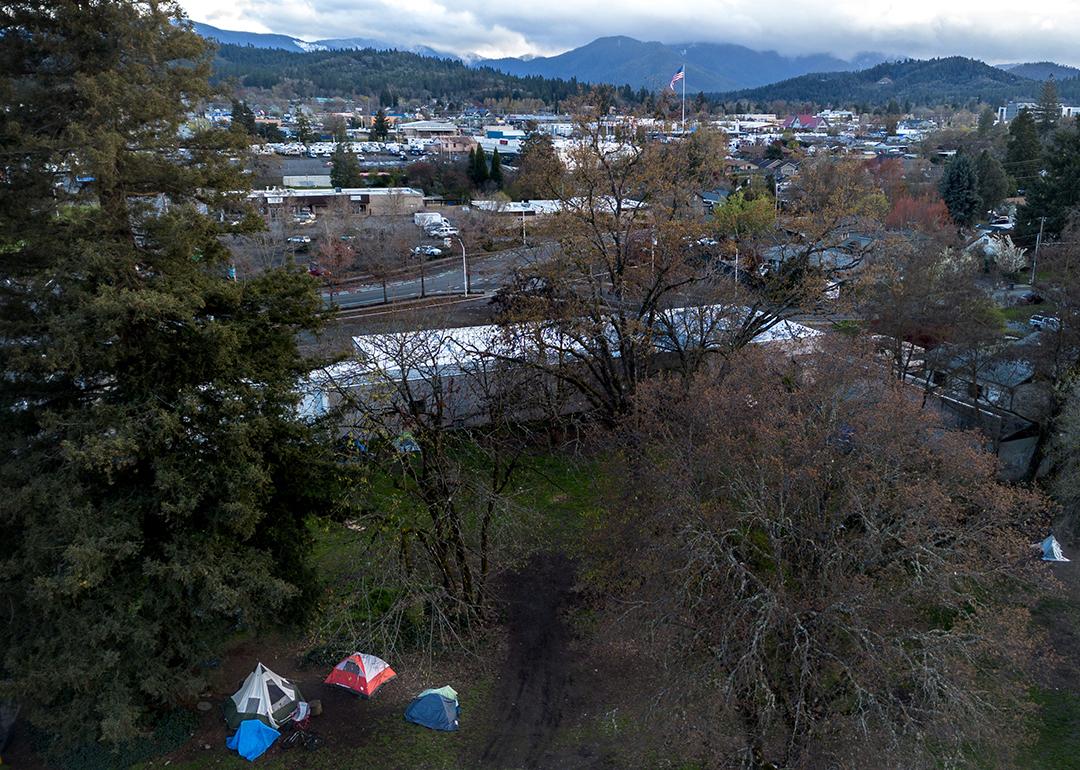
A shows that encampment bans and other policies that criminalize homelessness don鈥檛 keep people from living on the street, reports. The analysis did not find any reduction in homelessness in any of the cities studied as a result of such ordinances.
The study examined the effect of ordinances enacted between 2000 and 2021 across the 100 most populous U.S. cities, using data pulled from Continuums of Care 鈥� local entities that administer federal homelessness funding from the Department of Housing and Urban Development.
The study, , looked beyond camping bans and included laws criminalizing public drunkenness, urination, or other actions that are criminalized when conducted in public but not behind closed doors.
In some cases, the study found a quick dip in visible homelessness when laws were passed followed by a surge in homelessness that exceeded prior levels.
The authors say it is the first nationwide study examining criminalization laws and their impact on homelessness.
鈥淭he deterrence logic doesn鈥檛 hold,鈥� says co-author Hannah Lebovits, assistant director of the Institute of Urban Studies at the University of Texas at Arlington.
Lebovits says she and her co-author Andrew Sullivan, an assistant professor in the University of Central Florida鈥檚 School of Public Administration, began studying the issue after a series of anti-camping ordinances were passed in 2020 and 2021, when homeless encampments were growing across the country. Lebovits says they wanted to look specifically at the issue of deterrence, the underlying logic behind many camping ordinances.
The report found that there was a 2.2% average increase in unsheltered homelessness in cities that implemented criminalization ordinances compared with cities that did not introduce ordinances, but noted that this number is 鈥渟tatistically insignificant鈥� and not evidence that ordinances are increasing homelessness.
Advocates for unhoused people, including the campaign, have argued that criminalization and homeless encampment sweeps increase rates of homelessness because they can result in arrest records that make it more difficult to secure housing and because belongings, . Lebovits stressed that the report she co-authored did not look at these consequences, which would require a more long-term look at housing and employment.
The authors did look into whether criminalization ordinances could decrease unsheltered homelessness at the local level by pushing unhoused people into neighboring cities and counties without sanctions, but didn鈥檛 find any evidence to support this.
Homeless encampment bans are increasing
Big city mayors across the political spectrum have embraced some level of sanctions and homeless sweeps to address encampments.
This is largely because mayors have direct control over their police force, but less control over the policies that could house people. in 39 states found that 78% of mayors said that police have some influence over their city鈥檚 homeless policies. Meanwhile, 81% of mayors surveyed said they didn鈥檛 have much control over the issue of homelessness, though 73% said that they would be held accountable for it by their constituents. Over 40% of mayors defined success as reducing the number of people who are homeless in their city. Several mayors said their main goal was to move people along temporarily.
Public encampments popped up across the country during the first several months of the COVID-19 pandemic, when the CDC recommended against encampment clearance because congregate shelters could increase the spread of the virus.
Homelessness overall has also grown in the past few years as a result of rising housing costs, although that was briefly slowed by pandemic stimulus funding. found that on a single night in January 2024, 771,480 people were homeless, the highest number since the count began. That includes 274,224 people who were unsheltered.
On June 28, 2024, the Supreme Court issued a ruling in Grants Pass, deciding that cities could sweep homeless encampments and implement other punitive measures even if there was no shelter for homeless people to go to. The decision led to a swell of new anti-camping laws.
, in the year since Grants Pass, 260 laws criminalizing homelessness have been passed in cities across the country, most of them camping bans. And 57 state level laws criminalizing homelessness were introduced in 17 states, although only four were passed.
To stem the tide of criminalization, the National Homelessness Law Center created model legislation called the Gloria Johnson Act 鈥� named for the unhoused plaintiff in the Grants Pass case 鈥� which would make it illegal to cite or arrest someone for sleeping outside when there is nowhere else to go. It would also change zoning laws to allow more RV parking. The bill has been introduced in 11 states but has not been passed yet.
A national version of the bill was introduced in Congress by Representatives Pramila Jayapal and Maxwell Frost. On June 26, elected officials and co-sponsors gathered at a press conference in Washington, D.C. to introduce the bill. 鈥淗omelessness is not a personal failure, it is a policy failure,鈥� Rep. Jayapal at the press conference.
In a press release ahead of the bill鈥檚 introduction, Southern Poverty Law Center CEO Maragaret Huang, CEO said, 鈥淭he arguments driving these anti-camping laws and litigation are rooted in the same justifications once used to legitimize vagrancy laws, which are historically intertwined with economic and racial subordination and rely on the false idea that poverty is synonymous with criminality.鈥�
Laws passed in the last year include an . Violation can lead to a $1,000 fine or six months in jail.
In February of 2025, the city of Fremont, CA passed a camping ban that , a law that could criminalize outreach workers, also with a $1,000 fine or six months in jail.
In May of this year, . The governor posted written by his office that said that the 鈥淪upreme Court鈥檚 decision in Grants Pass v. Johnson clarified that officials can take reasonable actions to clear encampments.鈥� Confusingly, Newsom鈥檚 model ordinance also claims that the main holding of Grants Pass is inhumane without attributing it to the Supreme Court, saying 鈥淣o person should face criminal punishment for sleeping outside when they have nowhere else to go.鈥� The model ordinance does not lay out any specific criminal sanctions or fees for sleeping outdoors.
The Cicero Institute, a conservative think tank started by Palantir founder and billionaire Joe Lonsdale, with its own model ordinance that would also penalize counties with 鈥渉ousing first鈥� approaches.
Lebovits believes these types of laws are driven by the idea that 鈥渢he reason why we see visible homelessness is the cities are permissive.鈥� That means it鈥檚 important, she says, 鈥渢o have a study that shows definitively that is not the case.鈥�
This story was co-published in collaboration with , the only independent, non-academic publication covering the worlds of affordable housing, community development and housing justice.
was produced by a nonprofit newsroom covering solutions for equitable cities, and reviewed and distributed by 麻豆原创.