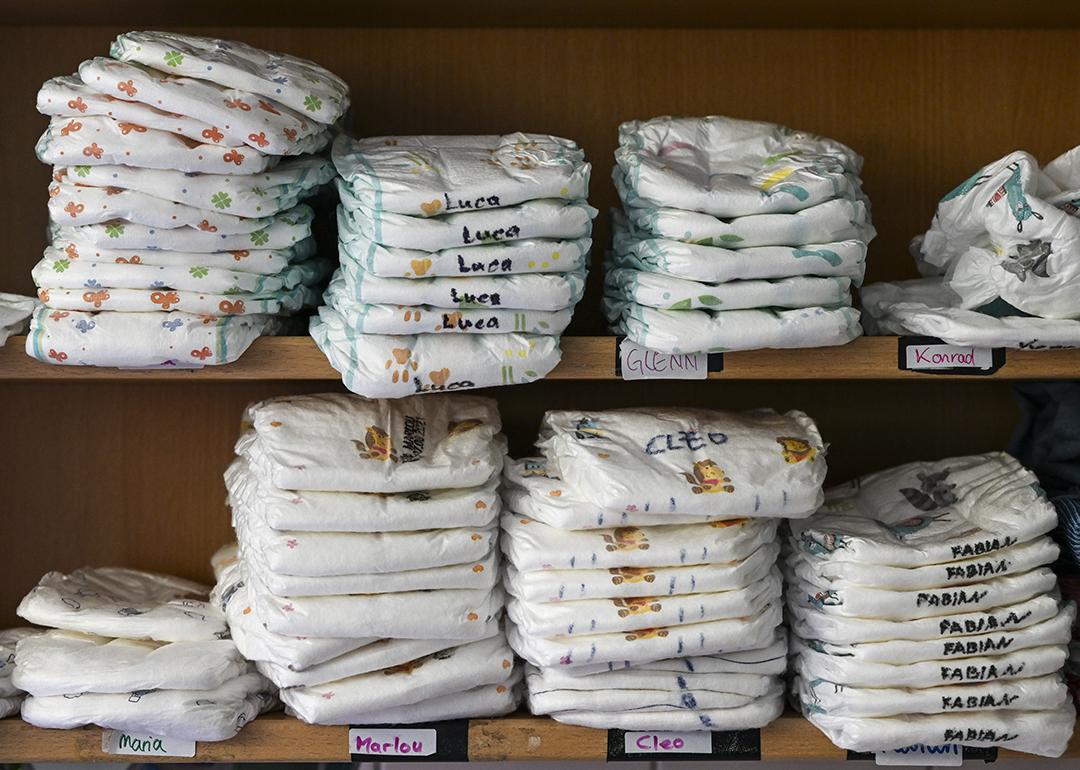
What if diapers were free for the parents who need them most?
What if diapers were free for the parents who need them most?
In America, diapers have long been treated as a luxury good rather than a necessity.
struggle to afford all the diapers they need. A quarter of families miss work as a result, often because they don’t have enough diapers to send with their children to child care.
It’s a largely invisible issue with enormous consequences for the health of parents and children. Studies have found that diaper need is a greater contributor than food insecurity and housing instability. And when parents don’t have enough diapers, they make do with sanitary pads, rags or other materials. Some report having to leave their children in soiled diapers for extended periods, raising the risk for urinary tract infections and diaper rash.
So Amy Kadens, who has worked in the diaper space for nearly 15 years, wondered: What if diapers were free for the parents who need them most? For decades, the United States has not had a good answer. So she came up with her own reports.
Diaper banks started popping up across the nation in 2011, collecting donations and dispersing diapers to families through a . They are one of the few lifelines for parents.
Kadens, who co-founded a nonprofit that provides diapers called Share our Spare in 2011, knew that diaper banks often operate with limited staff and resources, and operationally can only address a small percentage of a massive need. Without more government support, they can only get at a slice of the problem.
Federal assistance programs that help low-income families, such as food stamps and the Special Supplemental Nutrition Program for Women, Infants and Children (WIC), have never allowed families to use those funds to purchase diapers.
“Diaper banks are doing heroic work with very little. I didn’t want to reinvent the wheel,” Kadens said. But, “I wanted to continue to sink my teeth into this.”
So Kadens started to work on a solution that could give people the funds to get whatever diapers they needed, without the warehouses to store donations or the teams to get those donations out.
That solution was Diaper Dollars, a $40 e-card that users get in their email every month. The virtual card comes with a barcode they can scan at checkout at most major retailers, including Walmart, CVS and Walgreens, that will cover the cost of diapers. So far, users in Illinois and Ohio can access the program.
The idea, Kadens said, was to make it as simple as possible, while also giving parents the ability to choose what brands they preferred.
“Families have brand loyalty,” Kadens said. “I wanted to keep dignity and choice at the forefront of everything we did.”
The Diaper Dollars team went through months of market research to refine the tech to work well for participants. They didn’t want coupons because there was too much in the system, and gift cards meant users could be limited on where to shop.
Instead, they landed on a system that allowed them to build out a catalog of diapers at 6,200 retail locations in the country. The bar code on the digital card recognizes the diapers when it’s scanned and deducts the price from the total purchase. That catalog of diapers is monitored daily and updated in case brands come out with new box sizes or products. It also works for online purchases.
The system does have some limitations. It’s not valid in Amazon or Target, two retailers that don’t yet accept that form of payment. And it also likely only covers a portion of the need: The average family spends about $100 on diapers a month, but families earning a median income can only afford to cover about $65, according to an . It’s also more expensive — parents are paying retail prices plus sales tax (, including Illinois). By contrast, products at diaper banks are donated or sold to the banks from the manufacturer at deeply discounted rates.
To find participants, Diaper Dollars partners with organizations such as WIC clinics and local hospitals to refer people to the program, which is funded from a mix of philanthropy and financial support from those same partners. Partners establish the eligibility criteria, how long participants can be a part of the program, and whether the stipend will be higher for those with multiple babies.
A pilot program launched in 2023 with 100 people, then in 2024 the Illinois Department of Human Services dedicated $1 million to run its own pilot at a larger scale. Nearly 8,000 people have been served so far, with 10,000 projected by 2026.
Illinois Lt. Gov. Juliana Stratton told The 19th that she had been looking for solutions that could support people in the postpartum period, when is high, . Diaper need, specifically, is linked to and considered a potential risk factor for moderate to high maternal depressive symptoms. According to the Centers for Disease Control and Prevention, in 2023, the maternal mortality rate for Black women was 50.3 deaths per 100,000 live births. For White women it was 14.5 deaths.
So when Illinois launched a birth equity initiative to address the needs of postpartum parents, from a home visiting program to better diaper access, it chose to partner with Diaper Dollars.
“Giving someone a card where they can go to the store of their choice, decide what’s best, that is what’s part of dignity,” Stratton said. “Every woman deserves to bring life into this world safely and with dignity.”
Brendan Kitt, Diaper Dollars’ program director, said the program was able to offer an operational solution to a problem the state wanted to address but didn’t have a mechanism for. The system works similarly to a universal basic income, where people in need are given a cash stipend, but it’s more targeted.
“Both for funders and supporters, it’s always a question when you talk to people about where the money goes,” he said. “The fact that we can limit the transactions to the specific needs that we’re trying to serve, I think, is one of the biggest things that legitimized our operation over just giving basic cash assistance.”
Parents who benefited from Diaper Dollars told the organization in testimonials that they’ve had to turn to using underwear or old T-shirts when they didn’t have the money for diapers, often making decisions between paying for rent or diapers.
After going through the program, parents reported that the funds gave them the wiggle room to buy their children other essentials or to make them better meals.
About 90 percent of those who went through the program reported being able to better afford essentials like food, rent and other bills. Some 95 percent felt less stressed about not having enough diapers.
Joanne Samuel Goldblum, the CEO of the National Diaper Bank Network, which has more than 240 partners nationwide, said a model like Diaper Dollars can address unmet needs, particularly in rural areas where it’s harder for diaper banks to distribute products.
“The need is really so big, and it’s not going to be addressed through just one sort of answer or one type of program,” Samuel Goldblum said. “It’s really important to have ways to reach people in all sorts of different communities.”
The Diaper Dollars program has raised about $2 million so far — 45 percent from the state of Illinois, 35 percent from philanthropic donors and 20 percent from grants from community partners. It is now also running in Ohio and expected to expand to Washington soon.
Kadens’ dream is to take the program to every state. Since Roe v. Wade was overturned and some red states instituted abortion bans, conservative lawmakers have been looking for ways to support postpartum parents.
In Tennessee, for example, where abortion was banned in 2022, the state in 2024 that allowed families enrolled in Tennessee’s Medicaid program to receive up to a month for the first two years of life.
Samuel Goldblum said the National Diaper Bank Network has seen more bipartisan support for addressing diaper needs this year “than we’ve ever seen before.”
It should be that simple, Kadens said: “It doesn’t matter if you’re blue or red. Babies need diapers.”
was produced by and reviewed and distributed by Â鶹ԭ´´.