25 unique sports from around the world
Man's fascination with competitive sports goes back to at least Ancient Sumer, where depictions of wrestling competitions and foot races have been found at sites . Civilization first embraced sport not simply to entertain the idle populace, which it certainly did, but, more importantly, to instill martial prowess and teamwork in the young men who would form the local militia and national military. That's why the oldest recorded sports are wrestling, racing, archery, and other feats of physical and mental fortitude that would fit perfectly on a battlefield.
Much has changed, of course. Women are now as as men are, inviting a whole new group of people to compete and welcoming a female perspective on sports. And with professionally trained armies, there's no longer any need to ready young men and women for military service through organized sports.
Now that sports serve primarily to entertain spectators, the sporting world has evolved and blossomed into a massive universe of interesting games. Never in human history have so many sports been followed, played, and managed by so many people. While physical prowess and mental fortitude still play an important role in sports, competitions also now require skill, specialized training, creativity, and cunning. Unshackled from military requirements, the wide world of sports even incorporates a whole new fundamental element of competition: fun.
To see just a sample of all the wild and wonderful sports out there, You may also like: 25 LGBTQ+ athletes you need to know about
Kabaddi
The national sport of Bangladesh and popular throughout South Asia since the 20th century, kabaddi is a contact team sport played by men and women. Teams attempt to have their offensive player, the 鈥渞aider,鈥� infiltrate the opponent鈥檚 defensive side and tag out as many opponents as possible before returning safely to their side. Over 40 nations belong to the governing body and field teams, including the United States, where men鈥檚 and women鈥檚 national teams compete on the Americas circuit.
Yukigassen
Think snowball fights are a spontaneous recess activity? Think again. Born in , yukigassen combines dodgeball with snowball fighting. Seven-person teams compete with 90 premade snowballs each, trying to eject opposing players by hitting them with snowballs. Once the snowballs are gone, the team with the most players remaining wins.
Sepaktakraw
Do you love volleyball but wish it were harder? Then sepaktakraw is the sport for you. Sepaktakraw is like volleyball鈥� but played with your feet. Originating in Thailand, has grown into a fiercely competitive sport that rivals the popularity of soccer in Malaysia, Thailand, and Indonesia.
Calcio storico
An Italian precursor to American football and rugby, calcio storico (aka, calcio fiorentino) pits 27 bare-chested players per side against each other on a rectangular field with goal nets on both ends. Thought to have begun with the Roman sport of harpastum, allows head-butting, punching, elbowing, and choking. After centuries of declining interest post-Renaissance, calcio made a comeback in the 1930s.
Buzkashi
Central Asia's version of polo, especially , four to five horsemen on each squad try to carry a goat or calf carcass into the opposing team's "Circle of Justice." Sounds easy enough? Beware: Unsanctioned games can last days and brutal head injuries are common.
Picigin
In 1908, in Split, Croatia, frustrated in their search for deep enough water to play their favorite game, came up with this beach game instead. Five players stand in a circle and swat around an unpeeled tennis ball, trying to keep it from touching the water. The biggest risk to athletes? A sunburn.
Senegalese wrestling
Traditional wrestling is popular throughout West Africa, but the Senegalese version is the only one that allows blows to the head, which brings it closer to modern mixed martial arts than old-school grappling. A national sport in Senegal, the sport has in popularity with modern champions becoming national celebrities.
Fierljeppen
Who hasn鈥檛 stood astride a large puddle or middling stream and thought they could jump over it only to fail miserably? Probably could have made it with the help of a pole, huh? With fierljeppen (鈥渇ar leaping鈥�), that鈥檚 exactly what you get: the pole vault combined with your childhood love of jumping over (sometimes into) puddles. Born as a practical way to of Friesland in the Netherlands, competitors pole vault a canal or stream and attempt to climb atop the pole before jumping as far as possible onto the other bank.
Underwater torpedo
This list鈥檚 youngest sport, underwater torpedo was developed by two retired Marine . Two teams of five play at the bottom of a deep pool in a form of underwater football. Players try to move a 10-inch 鈥渢orpedo鈥� into nets anchored to the bottom of each team鈥檚 defensive end. Tackling, holding, pulling, and wrestling are all permitted, as long as players and the torpedo remain submerged, but strikes like kicks and punches are not.
Skijoring
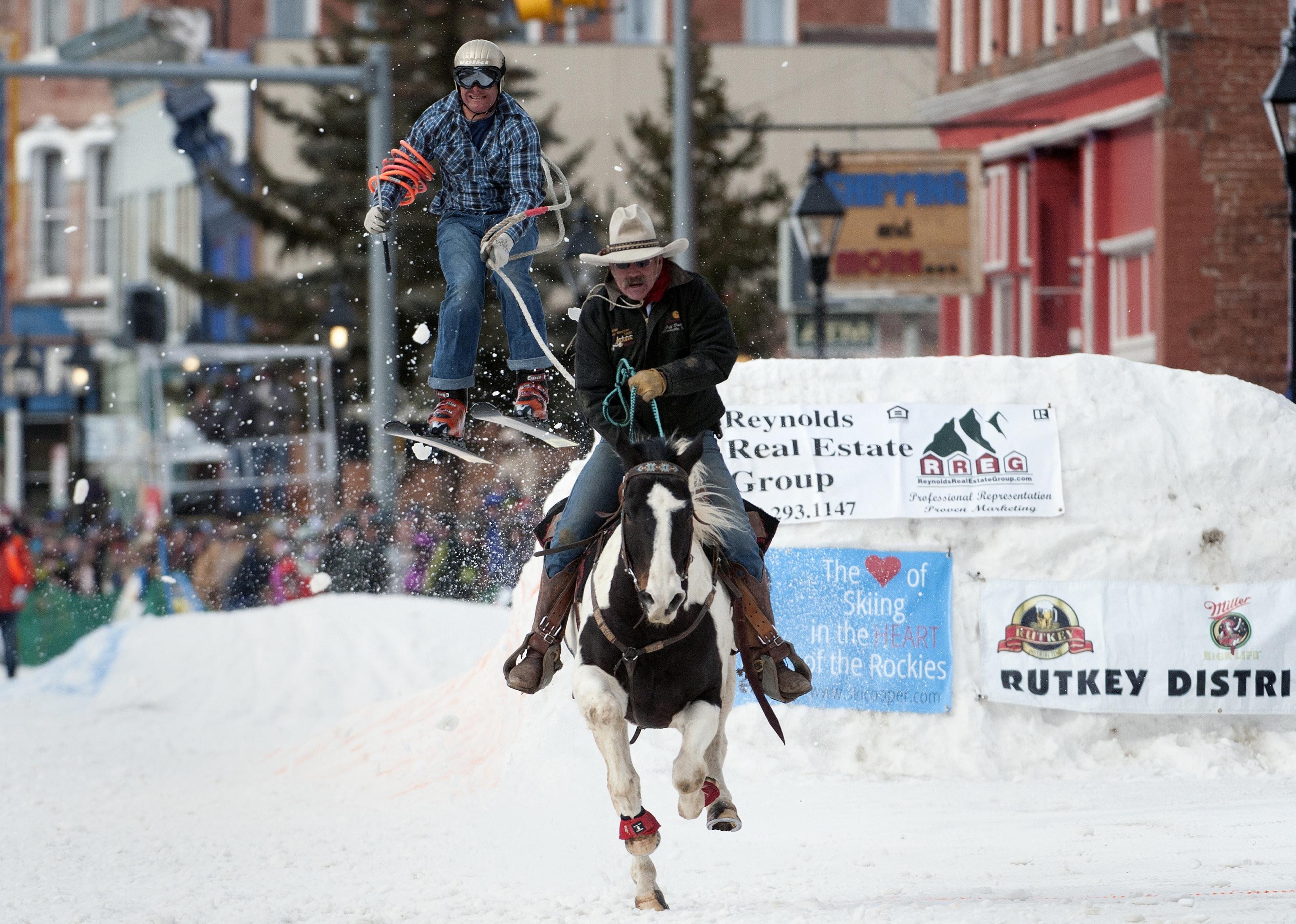
Long before the ghastly snowmobile, getting around Norway required a pair of skis. It likely didn't take long for Norwegians to figure out they could move much faster if their . Thus, skijoring was born. No longer strictly a mode of transportation, skijoring is now a competitive sport where skiers are pulled behind a horse, dog, or motorized vehicle down a snowy course. The fastest time wins. Several mountain communities in America and Canada host equestrian-based competitions with events in Steamboat Springs and Leadville, Colorado, among North America's oldest.
Palla
Considered a forerunner to modern tennis, the Tuscan sport of palla pits two players or teams against each other on a rectangular court similar to a tennis court without a net. Players hit the ball with their hands, serving and returning volleys until it bounces more than once on a side, earning the other player a point. Courtside elements, like parked cars, walls, spectators, even unsuspecting pedestrians, are all .
翱颈苍膬
A Romanian bat-and-ball sport played since at least 1370, oin膬 pits two teams of 11 on a rectangular field. A govern proceedings, but basically, a pitcher throws the ball to his teammate at-bat, who then tries to hit the ball away from the opposing team鈥檚 fielders. The batter can then run the lanes until he鈥檚 thrown out by an opposing player who tries to hit him with the ball.
Shin-kicking
Played in England since the 1600s, shin-kicking is a that is exactly like it sounds. Opponents clench their upper bodies, similar to the plum position in Muay Thai kickboxing and the clinch in Greco-Roman wrestling, then attempt to take their opponent to the ground using nothing but shin kicks. Participants wear hardened boots and stuff their pants with straw.
Basse
A ball-bag game from Norway first appearing after World War I, five to nine players use any part of their body except their hands to keep the ball from , which can be a circle or square. Americans will notice similarities to the playground game four square.
Arnis
The national martial art of the Philippines, arnis (aka "eskrima" and "kali") is a weapons-based fighting style. Adherents use sticks, blades, swords, and even improvised weapons to attack their opponent. The fighting style but since the illiterate poor comprised its main practitioners, a written history of the sport's inception doesn't exist.
Ba game
The Western world鈥檚 precursor to rugby and American football, ba game and pitted two sides of a town against each other. Play takes the form of a moving scrum as the teams methodically use their collective mass to matriculate the ball toward the opponent鈥檚 goal. Back before formalized playing fields were made, games were played right in town with scrums moving through parks, up alleyways, across lawns, and down city streets.
Basque pelota
Basque pelota fathered an expansive diaspora of hard-ball sports, including jai alai and hand-pelota. Using a racket, stick, gloved hand, basket, or club, players carom a small, hard-rubber ball off a wall, known as the 鈥渇rontis.鈥� Pelota games can be played one-on-one or in teams on larger courts. Some exists throughout Latin America and much of Western Europe.
Beikou
A stick-and-ball team sport similar to field hockey, beikou has been played in Inner Mongolia for . Fierce competitors hit a balled-up apricot root with wooden branches toward the opponent鈥檚 goal. When field hockey arrived in China for the 2008 Summer Olympics in Beijing, a third of China鈥檚 national men鈥檚 team hailed from Morin Dawa, Inner Mongolia.
Biribol
Born in 1960s Brazil, biribol is volleyball played in a small motel-sized pool鈥攋ust don鈥檛 call it water volleyball! Why? A few rule variations鈥攍ike players can block a serve but can鈥檛 break the plane of the net when spiking鈥攕et it ever-so-slightly apart. It鈥檚 considered Brazil鈥檚 .
Bossaball
Spain broke the mold with bossaball, a hybrid of volleyball, soccer, and gymnastics played on an inflatable court with a trampoline on each side. Invented by Belgian , bossaball pits two teams of four against each other. Each volley has complicated rules but boils down to this: Players from each side can hit the ball up to five times but only once with their hands or arms; the other four hits must happen with their feet, chest, head, or legs.
Bo-taoshi
edBo-taoshi is like capture the flag with a serious dose of testosterone. Teams of up to 150 players, divided evenly between defense and offense, try to topple the opponent鈥檚 pole, which is defended in a vertical position until it reaches a 30-degree angle relative to the lovround. It鈥檚 primarily played by military cadets and is thought to have first appeared on the sporting scene .
Fives
In this British variation of handball and racquetball revered among the U.K.鈥檚 boarding school elite, players use a gloved hand to swat a rubber ball against a three or four-sided court. Developed at , the sport has seeped into the middle classes and has recently found interest in Britain鈥檚 state school system.
Gilli Danda
A bat-and-ball game that looks a lot like cricket but is native to India and , Gilli Danda played throughout the subcontinent and even has a following in Southeast Asia and the Caribbean. Even-numbered players (sometimes as many as 100) play on two opposing teams, with one person batting while the other team fields. After striking the ball (鈥済illi鈥�), the batter attempts to touch a pre-defined point outside the batter鈥檚 circle.
Hornussen
Developed in Switzerland in the 16th century, hornussen is unlike any other bat-and-ball game, though baseball and cricket fans will try to find parallels. Good luck with that. Two teams of between 16 and 20 players take turns (鈥渘ouss鈥�) at each other. Defenders try to keep the ball from landing in their zones using a 鈥渟chindel,鈥� which looks like an oversized, square pizza peel.
Jokgu
Another fusion sport, jokgu is like volleyball but played with feet, shins, and the head, like soccer. Started as a physical fitness activity by the Republic of Korea Air Force in 1960 but tracing its ., the sport's popularity surged across Korea and even into the United States, where a league formed in 2011.