Athletes who stood up for a cause
Throughout history, athletes have used their celebrity and sometimes put their careers on the line to protest injustice, champion causes, and create awareness for what is going on in the world on a range of issues from race to gender equality to civil rights, to religious freedom to war and peace. As a result, many sports stars have lost their careers, given up millions of dollars, and even risked jail time standing up for what they believed in.
麻豆原创 looked into the world of athlete causes and found some of the most profound protests and risk-taking stances in sports history. Using authoritative sources like The New York Times, ESPN, Sports Illustrated, and others, 麻豆原创 found some of the most- and least-known athletes who stood up for what they believed in.
Athletes who have taken stands for principled causes have been met with praise and derision for their views. But the results of these crusading warriors have helped bring about change to some of society's greatest injustices. This list of sports legends expressed their views often when it was the most inconvenient and most career threatening. Read on to learn more about their stories.
You may also like:
Muhammad Ali and Vietnam
There may be no athlete who risked more in the prime of his career than professional boxer Muhammad Ali in 1967. Ali refused to serve in the Vietnam War because of. 鈥淲hy should they ask me to put on a uniform and go 10,000 miles from home and drop bombs and bullets on brown people in Vietnam after so-called Negro people in Louisville are treated like dogs and denied simple human rights?鈥� Ali said. As a result, Ali was sentenced to five years in prison and fined $10,000. In 1971, he returned to boxing after the U.S. Supreme Court overturned his conviction and public sentiment had started turning against the war.
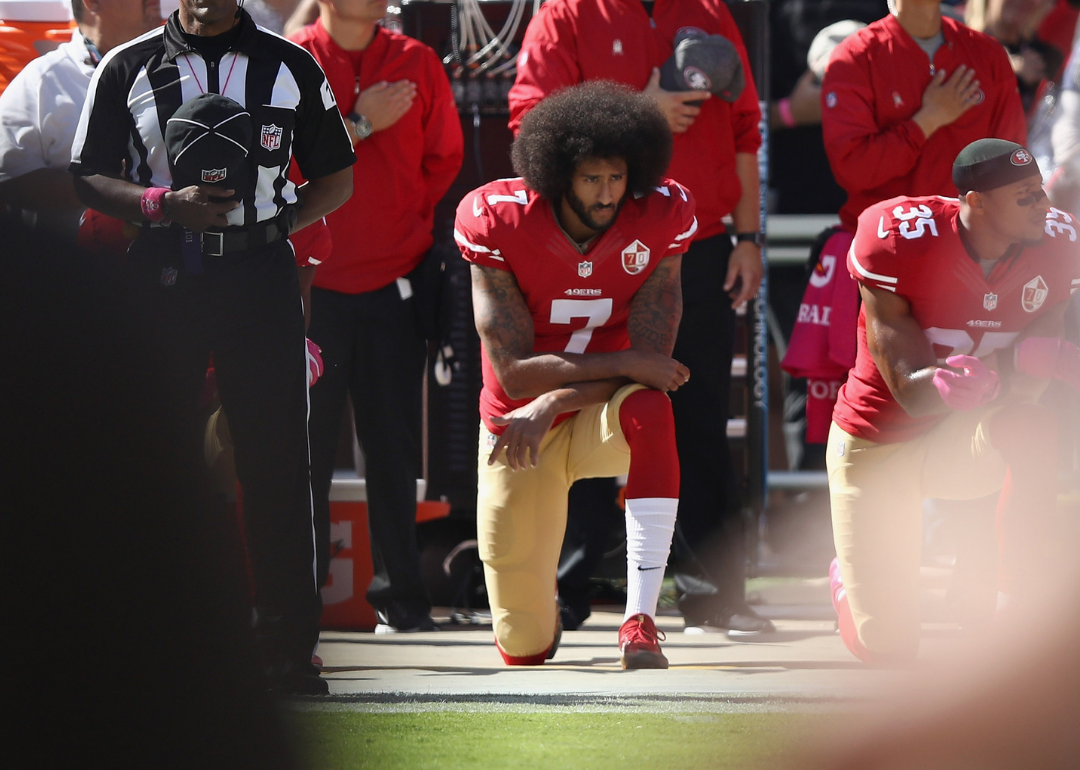
Colin Kaepernick takes a knee
鈥淚 am not going to stand up to show pride in a flag for a country that oppresses black people and people of color,鈥� professional football player Colin Kaepernick said on Aug. 26, 2016. That was the first time the media took notice of Kaepernick's public protest of by not standing for the national anthem. Because of his actions, Kaepernick lost his chance to continue to play in the NFL, but he started a national conversation about the issue.
Lew Alcindor's Olympic boycott
In 1967, Kareem Abdul-Jabbar was still known as Lew Alcindor, a student at the University of California at Los Angeles and one of the best basketball players in the world. Alcindor, along with other prominent African-American athletes because of racial inequality in the United States. Alcindor's protest helped raise awareness for racial equality during the height of the civil rights movement.
Pat Tillman enlists
Pat Tillman was playing safety for the NFL's Arizona Cardinals on Sept. 11, 2001. The terrorists attacks that day inspired Tillman to. He ended up serving in Afghanistan with the Army Rangers, but was on April 22, 2004. Tillman's courage is still hailed today as an act of extreme patriotism.
Branch Rickey integrates baseball
As a player, Branch Rickey is barely a footnote in Major League Baseball's archives. But as a manager, Rickey made history. In 1942, the Brooklyn Dodgers hired Rickey as the team's president and general manager, and three years later he and brought him up to the majors in 1947. Rickey helped Robinson become the first African-American to play in the major leagues, integrating a professional sport for the first time in U.S. history.
Mahmoud Abdul-Rauf refuses to stand
Before Colin Kaepernick's protest, a lesser-known point guard for the Denver Nuggets also refused to stand for the U.S. flag. In 1990, Chris Jackson converted to Islam and changed his name to Mahmoud Abdul-Rauf. His spiritual awakening came with a public consciousness as he viewed the flag. The fallout from his religious stance came quickly鈥擜bdul-Rauf was suspended by the NBA, traded from the team, and eventually left the professional sport entirely.
Tommie Smith and John Carlos raise the fist
Track and field stars Tommie Smith and John Carlos raised their black-gloved fists during the medal ceremony at the 1968 Summer Olympics. The gold and bronze medalists wore black socks with no shoes to, a black glove symbolizing black power, and beads to protest lynchings. For their protest, the two were and kicked out of the Olympic village, but today they're recognized as two of the most famous athletes who championed civil rights.
Venus Williams pay rights
The equal rights movement in tennis was started by legendary player Billie Jean King, but it was Venus Williams who carried the mantel further. Starting in 2005, Williams spearheaded the effort to get Wimbledon to as the men. Not only was she successful in convincing the All England Club to change, but in 2007 she won the celebrated tournament and was paid equally.
Los Suns
In 2010, Arizona passed one of the strictest immigration laws in the country. In response, the Phoenix Suns staged a protest during the NBA playoffs. Steve Kerr, then the Suns' general manager said 鈥渢hat allowing the police to ask people for their papers rings up images of Nazi Germany.鈥� The players on the front, representing their distaste for the new law.
Carlos Delgado's anti-war protest
After 9/11, then-commissioner of Major League Baseball Bud Selig during the seventh-inning stretch. But in 2004, after the invasion of Iraq, Toronto Blue Jays infielder Carlos Delgado decided not to stand up during the song to protest the war. Delgado was.
U.S. Olympic boycott
At the height of the Cold War in 1979, the Soviet Union invaded Afghanistan. In response, then-U.S. President Jimmy Carter decided that the United States would boycott the 1980 Summer Olympic games in Moscow. Other countries, including West Germany, Canada, and Japan followed suit, and only 80 countries participated in the games,.
I can't breathe
African-American Eric Garner was seen on camera in 2014 yelling, 鈥淚 can't breathe鈥� as a police officer put him in a chokehold. He ultimately died. Responding to the death, NBA stars Kobe Bryant, LeBron James, and Derrick Rose wore during pre-game warmups. Their mini-protest contributed to the national dialogue about police brutality.
Chariots of Fire
Immortalized in the 1981 movie 鈥淐hariots of Fire,鈥� British runners Harold Abrahams and Eric Liddell had to overcome prejudice and personal beliefs in deciding when and how to race in the 1924 Olympic games in Paris. Abrahams, who was Jewish, had to combat anti-Semitism when he hired a trainer to coach him in the 100-meter race. But it was Liddell who made the biggest sacrifice鈥攈e dropped out of the race because the. Liddell, a devout Christian, refused to race on the Christian Sabbath, helping pave the way for Abrahams' victory.
The Syracuse Eight
In 1970, nine black players on the Syracuse University football team boycotted practice to demand racial equality in the athletic program. The name 鈥淪yracuse Eight鈥� stems from the fact that media reports did not note that a. The athletes' demands were simple: better medical treatment, access to real academic programs, a merit-based system for playing time, and more diversity among the coaching staff. As a result of their boycott, the players were suspended and their football careers were stymied.
Seattle Storm's Planned Parenthood
Planned Parenthood was in the news frequently in 2016 and 2017. Conservative politicians railed against the organization and its mission. In response to the criticism, the WNBA's Seattle Storm players staged a pre-game rally to show support for the organization and also pledged to give $5 from each ticket sold to Planned Parenthood, .
Hands up, don't shoot
Michael Brown, a black teenager, was shot and killed by police in 2014 while his hands were raised over his head. As a result, the phrase 鈥渉ands up, don't shoot鈥� was adopted as a rallying cry against police brutality. joined the movement, including Jared Cook, Kenny Britt, Tavon Austin who raised their hands over their heads as they ran onto the field to show solidarity with the protest.
The Black 14
Leading up to a football game against the Brigham Young University Cougars in 1969, 14 African-American members of the University of Wyoming team planned to wear black armbands to protest the racism they said they felt the last time the two teams played. Before they had a chance to take to the field, however, the Wyoming coach kicked all 14 players off the team. The fallout drew national attention and around player protests.
Billie Jean King
Tennis legend Billie Jean King's biggest stand came in 1970 when she and eight other women took a giant leap of faith to to protest the pay discrepancy between men and women on the tour at the time. The gamble paid off: The Women's Tennis Association was officially formed in 1973 and remains the governing body for women's tennis to this day.
Sandy Koufax
There was a problem for Sandy Koufax as his Los Angeles Dodgers faced off against the Minnesota Twins in Game 1 of the 1965 World Series. The game fell on Yom Kippur, the holiest day in the Jewish faith, and Koufax, the Dodgers' best pitcher, happened to be Jewish. Instead of pitching, Koufax of the series. The Dodgers beat the Twins in seven games and Koufax was named the MVP of the series.
Protests on the pitch
In a friendly match between AC Milan and Pro Patria in 2013, fans of the Pro Patria squad lobbed racist chants at AC Milan star Kevin-Prince Boateng. Boateng, who is of Ghanaian descent, kicked the soccer ball into the stands and led his entire team off the field mid-match. He later tweeted, "Shame that these things still happen... #StopRacismforever." by the international football community.