US stadiums switch to grass for FIFA World Cup 2026
US stadiums switch to grass for FIFA World Cup 2026
For one month, the grass under the world’s best soccer players has to be pitch-perfect at stadiums across the U.S., Canada, and Mexico.
In the U.S., that has meant hauling grass in dozens of refrigerated tractor trailers, laying pipes, and spreading sand across several existing fields before the new grass is rolled out, stitched together, and then kept green with LED lights in the indoor stadiums.
The story of the World Cup grass started four years ago, with the cooperation of two U.S. universities charged by FIFA with growing the perfect grass.
In this article, explores the grass preparation at each U.S. stadium for soccer’s biggest competition, starting June 11.
Natural Grass vs. Artificial Turf: Why FIFA Insists on Grass
Why are World Cup matches played on natural grass and not artificial turf? FIFA’s has very high test standards for ball rolling, bouncing, and shock absorption. Every stadium needs to deliver consistent playability across the tournament.
Why FIFA insists on grass:
- Player preference: Professional soccer players and their coaches prefer the feel and consistency of natural grass.
- Ball behavior: FIFA closely monitors how the ball rolls and bounces to ensure consistent ball behavior across all venues.
- Injury and performance: Research has shown between playing on artificial turf and playing on real grass.
The Masterminds Behind the Turf: Michigan State and Tennessee
Growing world-class grass for stadiums in very different climates is a serious undertaking that requires academic precision.
Michigan State University’s , under the leadership of Professor John “Trey” Rogers III, provided a source of both educational and research-based information to support the 2026 World Cup.
The University of Tennessee’s is well-known for its testing of field surfaces and for developing recommendations about which type of grass or root zone mixture may be used safely for athletes to play on, as well as how the type of grass and root zone mixture can influence athlete injury prevention, health and biomechanics.
Through their collaboration with each other, MSU and the University of Tennessee have developed turf systems that will allow the soccer ball to bounce, roll, and grip similarly across the 16 total World Cup venues in the U.S., Canada, and Mexico.
They split the fields into two families, covering 88 miles of natural sod:
- Warm‑weather venues use .
- Cooler and indoor venues use a mix of and .
For those cooler, indoor venues, the two groups chose an 84% Kentucky bluegrass and 16% perennial ryegrass combination when growing the turf using plastic sheeting. Through FIFA-funded trials, they determined this combination provided better quality and quicker establishment of sod than did individual Kentucky bluegrass.
Instead of planting grass in native soil and slicing off the roots, MSU and UT had farms grow it on a thin layer of sand with plastic sheeting. When the grass roots reach the plastic, they spread sideways and intertwine, forming a dense mat which can be rolled up like carpet without cutting the roots that can be easily shipped and installed.
The Turf Transformation: A Closer Look at Each U.S. Stadium
MetLife Stadium (New York/New Jersey)
Location: East Rutherford, New Jersey
Capacity: 82,500
World Cup matches: 8
World Cup surface: Bermudagrass, hybrid reinforced fibers
Grass provider: Carolina Green Turf Farm
Opened: 2010
For the World Cup finals, MetLife Stadium swapped out its artificial turf for a Tahoma 31 Bermudagrass field grown at Carolina Green Turf Farm in North Carolina. The existing turf infrastructure stays in place, but it’s now buried under roughly 2 feet of sand plus a full irrigation and vacuum‑ventilation system, with the forming the top layer.
FIFA senior pitch manager David Graham summed up the stakes as crews stitched the rolls together on site: “It’s only justice that the best players on the planet hopefully get the , and we’re trying to achieve that.”
Crews hauled in roughly 20 truckloads of sod that had been grown for about 10 months before installation. They used a “sewing machine-esque device” to stitch hybrid reinforcement fibers through the profile so the pitch can withstand eight matches, including the final.
AT&T Stadium (Dallas Stadium)
Location: Arlington, Texas
Capacity: 94,000 (World Cup configuration)
World Cup matches: 9
World Cup surface: Kentucky bluegrass and perennial ryegrass mixture with hybrid reinforced fibers
Grass provider: Green Valley Sod
Opened: 2009
“Jerry World” replaced its Hellas Matrix Turf artificial grass with Helix Soft Top turf to install a natural-grass playing surface. The crews removed the existing turf and left the concrete subbase, on top of which they installed an entirely new irrigation system along with a new ventilation system.
Following this installation, about 10 inches of sand was placed atop the subbase to provide a root zone to create a FIFA‑spec root zone roughly 2 feet above the stadium floor. On top of the root zone is a Kentucky bluegrass sod grown in Colorado, rolled into large pieces and transported to AT&T Stadium.
A second, backup field was also planted in case there were issues with the primary field, due to it hosting the most matches of any World Cup venue: nine games.
Mercedes‑Benz Stadium (Atlanta Stadium)
Location: Atlanta, Georgia
Capacity: 75,000
World Cup matches: 8
World Cup surface: Kentucky bluegrass, hybrid reinforced fibers
Grass provider: Green Valley Sod
Opened: 2017
Atlanta’s domed Mercedes‑Benz Stadium had one of the toughest turf swaps in the tournament. For the World Cup, crews tore out the existing turf and artificial surface starting in late January, then built a Permavoid-based system from scratch, topped with a Kentucky bluegrass/perennial ryegrass hybrid grass grown in Colorado.
According to , this pitch was one of the most difficult World Cup pitches to maintain due to limited direct sunlight. The grass requires the use of a combination of LED grow lights, an extensive irrigation system, and a shallow root zone to provide consistent safety for players and good playing conditions.
NRG Stadium (Houston Stadium)
Location: Houston, Texas
Capacity: 72,000
World Cup matches: 7
World Cup surface: Kentucky bluegrass and perennial ryegrass mixture with hybrid reinforced fibers
Grass provider: Green Valley Sod
Opened: 2002
Under NRG Stadium’s turf is a concrete floor with channels for fake grass systems. The UT team chose a shallow system using Permavoid. These are strong plastic cells that store water and help the field drain.
Crews put the Permavoid right on the concrete. They covered it with a plastic woven sheeting to keep sand out of the cells, then added a deep-sand base and hybrid Kentucky bluegrass and perennial ryegrass.
The grass had been grown in the Denver area for the past 18 months, then shipped from Denver to Houston in massive refrigerated rolls before being stitched together into a continuous surface.
The stadium’s large roof severely limits how much sunlight reaches the grass. Crews brought large LED grow lights from Europe to assist in maintaining the health of the grass during the seven World Cup matches that will be hosted there.
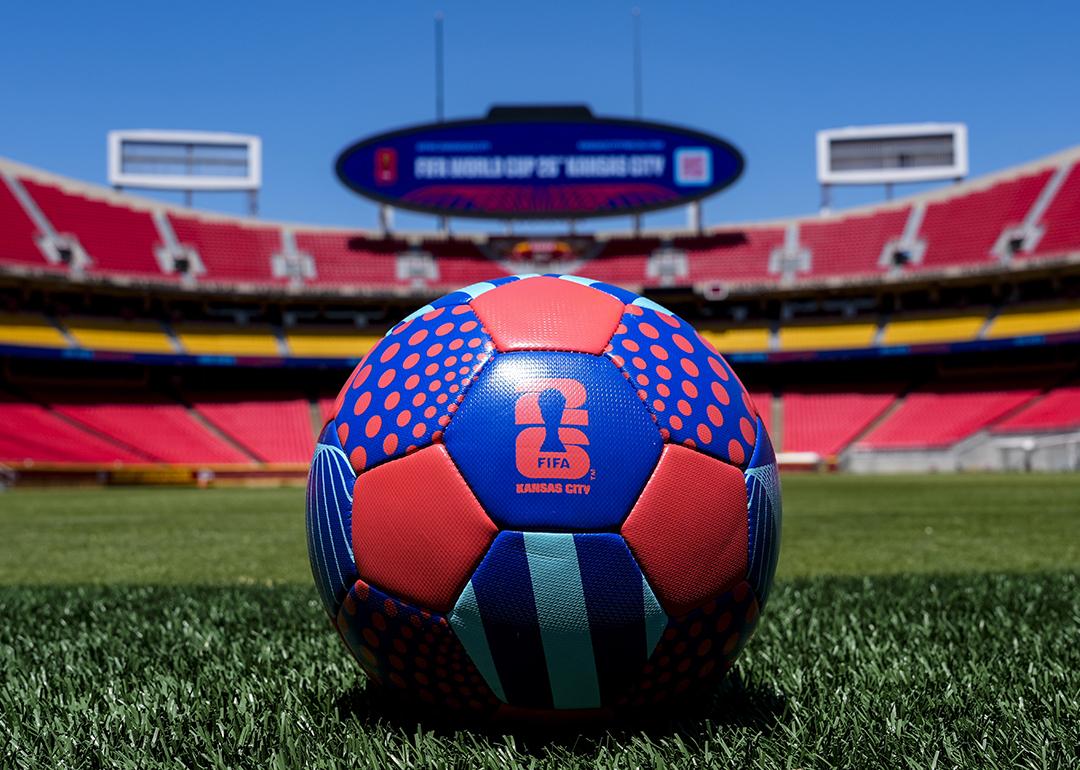
Arrowhead Stadium (Kansas City Stadium)
Location: Kansas City, Missouri
Capacity: 73,000
World Cup matches: 6
World Cup surface: Bermudagrass, hybrid reinforced fibers
Grass provider: Carolina Green
Opened: 1972
Arrowhead already uses natural grass. However, the field was still rebuilt to meet FIFA rules. For the tournament, grass provider Carolina Green from North Carolina provided Bermudagrass mixed with hybrid fibers. This is built on a stronger base of about 12 inches of sand over a gravel and pipe network with vacuum drainage, giving the surface a stable platform for the six matches.
To make the field the right size (115 by 74 yards), the Chiefs have removed seats and extended the playing surface into the corners, trading a small amount of capacity for a fully FIFA‑compliant pitch.
SoFi Stadium (Los Angeles Stadium)
Location: Inglewood, California
Capacity: 70,000
World Cup matches: 8
World Cup surface: Kentucky bluegrass and perennial ryegrass mixture with hybrid reinforced fibers
Grass provider: Desert Green Sod
Opened: 2020
To make natural grass work under SoFi Stadium’s translucent roof, FIFA and the UT/MSU team chose a Permavoid system stacked on top of the NFL turf, then covered with geotextile fabric, sand, and a hybrid Kentucky bluegrass/perennial ryegrass carpet reinforced with synthetic fibers.
SoFi tested a similar hybrid grass for a event and found that it “weathered the strain of four games in as many days.” This showed FIFA that the grass can survive eight World Cup matches. With corners changed to meet FIFA’s field shape, the stadium perfectly shows how UT’s shallow system works inside a roofed stadium.
Hard Rock Stadium (Miami Stadium)
Location: Miami Gardens, Florida
Capacity: 65,000
World Cup matches: 7
World Cup surface: Bermudagrass, hybrid reinforced fibers
Grass provider: Miami Dolphins’ own private sod farm in Loxahatchee Groves, Florida
Opened: 1987
Miami is one of the few World Cup venues that didn’t need to convert from turf to grass because it already uses Bermudagrass grown at a private sod farm in Loxahatchee Groves, roughly an hour north of the stadium.
The grass was specifically grown for the World Cup by FIFA and transported to Hard Rock Stadium and converted to a temporary warm-season grass surface for the seven World Cup matches. However, the staff had to rely on grow lights as well as carefully manage water usage to ensure the color and density of the grass would remain uniform throughout the entire tournament.
Gillette Stadium (Boston Stadium)
Location: Foxborough, Massachusetts
Capacity: 65,000
World Cup matches: 7
World Cup surface: 365SS Kentucky bluegrass with hybrid reinforced fibers
Grass provider: Tuckahoe Turf Farms
Opened: 2002
For its World Cup matches, Gillette Stadium returned to real grass for the first time in almost 20 years. Gillette Stadium tore up the existing FieldTurf and gravel, rebuilt the new base with sand and other porous materials, and then installed a hybrid‑reinforced 365SS Kentucky bluegrass sod supplied by Tuckahoe Turf Farms in New Jersey.
The hybrid grass is about 95% natural and 5% synthetic fiber. The roots wrap the fibers together to provide stability to the surface.
Grass provider Tuckahoe CFO Allen Carter shared the backstory.
“We have been working with FIFA and the stadiums on this project for about four years now,” he explained. “The sod itself is about a year old.” Carter added that the sod was grown “on plastic on top of special pods that had computer‑controlled irrigation systems,” so they could dial in nutrients, water, and FIFA‑spec from day one.
At Gillette, superintendent Ryan Bjorn said “the ,” and that “we’re really just focused on making sure that this field is as strong as it can be.”
Lincoln Financial Field (Philadelphia Stadium)
Location: Philadelphia, Pennsylvania
Capacity: 69,000
World Cup matches: 6
World Cup surface: Kentucky bluegrass with hybrid reinforced fibers
Grass provider: Tuckahoe Turf Farms
Opened: 2003
“The Linc” had been home to real grass, but it was renovated prior to hosting the 2025 Club World Cup, which opened up potential for a complete FIFA-recognized hybrid system for the 2026 World Cup.
For the Club World Cup, crews took out seats to widen the field to 115 by 74 yards. They installed a HERO Hybrid grass from Tuckahoe Turf Farms, a Kentucky bluegrass mix reinforced with synthetic fibers, grown on plastic for about a year before installation.
“We have grown the sod on plastic on top of special pods that had computer-controlled irrigation systems, then controlled the amount of nutrients, water, applied the FIFA spec topdressing throughout its growth period, and of course kept it mowed at the requested height,” Carter said.
“The hybrid-infused system should help with the wear of the pitch,” he noted, as the stadium prepares to host six games in a short amount of time.
Lumen Field (Seattle Stadium)
Location: Seattle, Washington
Capacity: 69,000
World Cup matches: 6
World Cup surface: Kentucky bluegrass and perennial ryegrass mixture with hybrid reinforced fibers
Grass provider: Moses Lake, Washington farm
Opened: 2002
In Seattle, the artificial grass hides under a layered natural‑grass system. For the 2026 World Cup, crews built the grass field right on top of the existing FieldTurf: 6 inches of sand and other base materials went down first, then a hybrid Kentucky bluegrass/perennial ryegrass sod from a Moses Lake, Washington, farm was rolled out on top.
FIFA turf expert Trey Rogers explained the logic to the .
“As long as we have 6 inches of sand over the top of the artificial turf, the player will not feel anything but a natural turf reaction,” Rogers said.
The new field will host a minimum of six World Cup events and then Seattle Sounders FC and Seattle Reign FC events before the grass is removed.
With long June days and cooler temperatures, Seattle may be able to rely more on natural sunlight than the domed U.S. venues. However, the shallow profile system still requires irrigation, drainage, and close monitoring to ensure the grass is World Cup-ready.
Levi’s Stadium (San Francisco Bay Area Stadium)
Location: Santa Clara, California
Capacity: 71,000
World Cup matches: 6
World Cup surface: Bermudagrass, hybrid reinforced fibers
Grass provider: West Coast Turf
Opened: 2014
Levi’s Stadium already uses high‑performance natural grass, and for 2026, the stadium is using Bermudagrass reinforced with stitched synthetic fibers supplied by West Coast Turf.
The fibers are stitched lightly so the grass can be removed easily after the tournament. But while they’re in place, the fibers tie the roots together into a strong mat. With a traditional root base and a strong warm-weather grass, Levi’s Stadium can easily hold up to six matches.
Back in Your Own Backyard
The grass beneath the World Cup soccer players will get a lot of attention in the coming weeks, but at home, there’s no need for laying pipes and inches of sand and then a new layer of specially formulated grass.
Just take care of your grass. when needed, heeding any local watering restrictions. Block weeds or pluck them out when they spring up. Rake or blow leaves. as necessary. And mow your grass regularly or hire a local lawn care pro to do it for you.
You can leave the running around on the grass to the soccer stars, and instead, simply enjoy the luxury and health benefits of .
was produced by and reviewed and distributed by Â鶹ԭ´´.