Canada’s biggest nickel mine could store carbon in its waste rock, if all goes to plan
Canada’s biggest nickel mine could store carbon in its waste rock, if all goes to plan
In 2006, scientists descended upon a remote open-pit mine in Australia to study air that turns into rock.
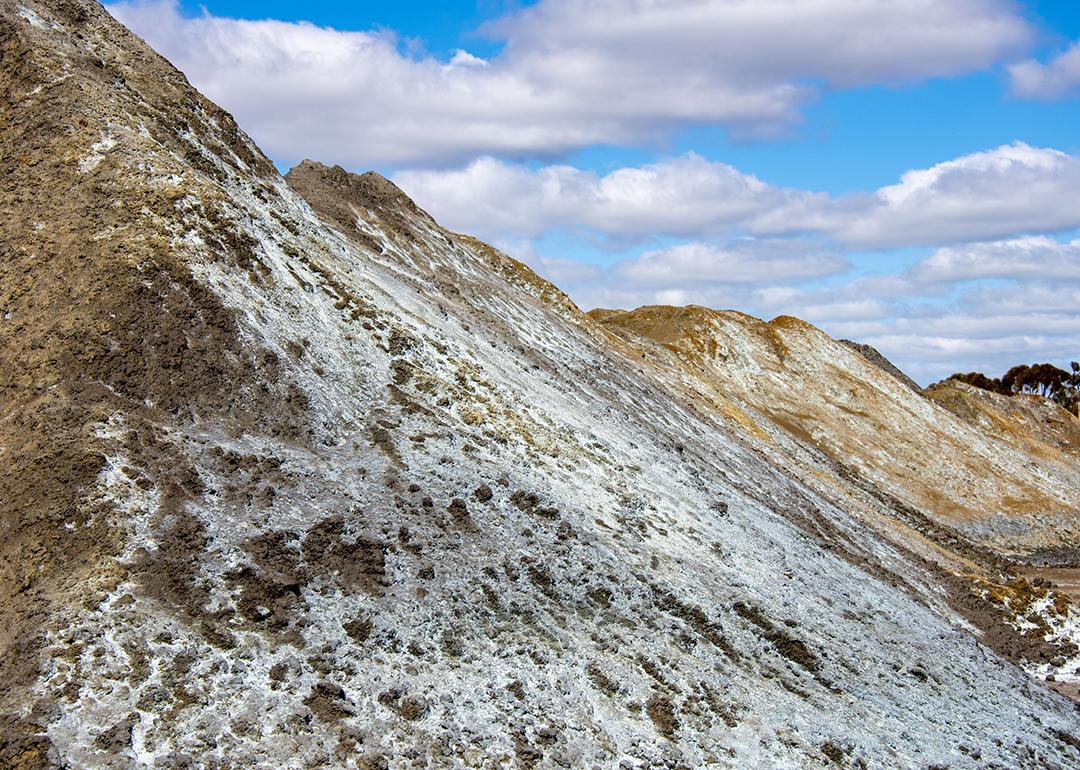
Like many mines, after churning through rock to get at a mineral, the Mount Keith nickel mine was left with piles of waste rock, which it held in huge, exposed reservoirs called tailings. This waste rock, however, was reacting with carbon dioxide in the air to form new minerals. It was effectively pulling the carbon out of the air and embedding it within the rocks, a kind of natural version of .
The scientists wanted to investigate exactly how much, and how quickly, this natural phenomenon was leading to carbon being captured and mineralized at the mine. Pinpointing this, they figured, would provide insight into how mines with similar tailings could offset their greenhouse gas emissions.
They took more than 800 samples of the mine waste to test and study and discovered something intriguing: The majority of the carbon was being pulled out of the air at Mount Keith by one mineral. Brucite is a waxy, pearly crystal that’s often a dull yellow or blue. It is highly reactive with carbon dioxide, and leveraging that reactivity could boost carbon storage at the mine many times over, the researchers .
“As we studied the site and became more aware of the presence of brucite, I think then we understood that, ‘Oh yeah, brucite was really doing a lot of the work,’ ” said Ian Power, one of the scientists who travelled to Australia to study the mine, and now the and an assistant professor at Trent University.
Brucite is now a key part of the carbon storage aspirations of a . Critical minerals, including copper, nickel and lithium, are essential components in renewable energy systems such as solar panels, wind turbines and batteries. They’re also used in a wide variety of other products, from phones to laptops to weapons. In this article, explores the plans for the Timmins venture, and how brucite plays a role in the mine’s approach to carbon capture and storage.
The proponent of the Timmins mine, Canada Nickel Company Inc., says its Crawford Nickel-Cobalt Sulphide Project will be “Canada’s largest nickel mine.” The project, expected to last 41 years, involves an open pit and stockpile areas, two ore processing plants, a new rail line and relocating a portion of a provincial highway and existing power line.
The project’s greenhouse gas emissions over its lifetime are for the Impact Assessment Agency of Canada. Before enacting any net-zero plans, the mine was expected to emit roughly 15,200 kilotonnes of carbon dioxide equivalent, or about as much as 3.5 million gas-powered cars driven over a year, according to the U.S. Environmental Protection Agency’s (Natural Resources Canada’s was not functioning at the time of publication).
The company expects to lower those emissions considerably by, for example, electrifying parts of its operation. All told, its net-zero plans could reduce emissions to 154 kilotonnes per year by the year 2030, it said.
But Crawford Nickel will also be capable of storing more than a megatonne of carbon dioxide per year, amounting to over the life of the project, the company said — and it will be relying on brucite in its tailings to do the heavy lifting.
The company expects to after it secures its remaining federal and provincial permits. It says it has moved its carbon storage technology along to the point where it’s filing for patents.
Beyond its own operations, it plans to source carbon from industrial emitters in the region, although the details of how this will work are still unclear. Questions also remain about whether the technology will work as advertised and the mine’s overall environmental impact.
The little mineral that could
Taking advantage of brucite — as well as other minerals that aren’t quite as efficient — to store carbon is a different technique for “carbon capture and storage” than the one that gets the lion’s share of attention.
The technique the fossil fuel industry has used for years involves taking a stream of carbon dioxide gas and injecting it deep underground into porous rock formations. Traditionally this has been used to and extract more oil, but more recently, and in smaller amounts, it has been used to store that carbon underground.
The problem with mineralization, as Canada Nickel plans to use, has been that the natural process of carbon turning into a solid can take thousands of years under normal conditions.
Artificially speeding it up has been a scientific pursuit for years , where Power worked with other trailblazers in the field. A , for example, showed how carbon storage could be accelerated at a nickel deposit northwest of Prince George, B.C., by bubbling carbon dioxide and other gases through a powdered mixture containing brucite.
Sourcing the rock from mine tailings is part of the appeal, Power said, because the rock has already been pulverized from ore processing. That exposes much more surface area to carbon dioxide for chemical reactions. Bubbling the gas through brucite also helps the process.
“We were kind of at the forefront of the field, and then [there was] a lot of research, field studies, experiments,” Power said. “And then people at this stage now are thinking, ‘Okay, how can we get to commercialization?’”
Canada’s environmental regulations and subsidies for green technology development from government and other private sources could be prodding companies to take carbon storage more seriously, he said.
One of the leaders of the field is Greg Dipple, who worked at the University of British Columbia on carbon mineralization before retiring and co-founding Vancouver-based company Arca, which calls itself an “industrial mineralization company.”
Dipple told The Narwhal he was familiar with Canada Nickel but had not had a chance to work with it yet. Arca’s technology involves capturing carbon dioxide from the atmosphere, he said, rather than from direct sources like Canada Nickel is planning.
“To meet the world’s climate targets, no one company or pathway can do it alone,” Dipple said. “We look forward to Canada Nickel’s success in their carbon removal plans.”
How Canada Nickel plans to store carbon at its Crawford mine
The sites studied by Power, Dipple and others involve magnesium-rich rock, often home to nickel and chromium, and where brucite is also often found. The Crawford mine has this type of rock, and is targeting nickel, chromium, cobalt and other mineral deposits for extraction.
To make use of the carbon-hungry mineral, and expedite its reaction with carbon dioxide, the company plans to run its tailings through a series of tanks as a final step at its ore-processing plant, said Pierre-Philippe Dupont, vice-president of sustainability at Canada Nickel, in an emailed response to questions from The Narwhal.
Inside the tanks, the carbon dioxide will be “bubbled and stirred into the tailings for several hours,” Dupont said. By using “high strength” carbon dioxide streams and controlling for “certain conditions,” he said, the company expects to “fully utilize the brucite in the tailings” to store more carbon.
It will be the first time the technology is being realized at the scale of a full commercial mine.
In its Impact Assessment Agency submission, the company described its mineralization process as being “at the research stage.”
Asked by The Narwhal to describe its readiness today, the company pointed to several announcements it has made since 2023 showing the technology advancing through testing and pilot projects, to filing for a patent.
“While [the technology] has not yet been implemented at full commercial production scale, these disclosures show that the technology has progressed … and is being actively advanced toward commercialization as part of broader carbon management efforts,” Dupont said by email.
Capturing public funds for carbon capture
Both Prime Minister Mark Carney and Ontario Premier Doug Ford have a lot riding on the mine’s success.
It’s the first project in Canada to get to both the federal Major Projects Office and the “One Project, One Process” list. Both the federal office and the provincial process are meant to make project approvals happen faster and smoother.
In press releases, both governments touted the Crawford Nickel project as “” and both linked its production to “batteries and green steel.” Both also cited research showing its projected emissions would be “ the global average.” Both governments have also made millions of dollars available for the project to happen. For example, federal dollars have funded its as well as its plans.
In a January 2026 , the company acknowledged it’s drawing on between US$100 and US$300 million of government funding, including support from federal and provincial critical minerals funds. It also has through the Crown corporation Export Development Canada.
It’s also banking on US$600 million it expects to receive from two Canadian federal tax credits, one for and the other for .
“While Crawford could move forward without government support, our project economics includes eligibility for existing federal and provincial programs, including investment tax credits, as well as other forms of government support available to strategically significant critical minerals projects,” Canada Nickel CEO Mark Selby told The Narwhal in an emailed response to questions.
Bringing additional carbon to Crawford Nickel mine could involve a pipeline, or rail
As part of its carbon capture plans, Canada Nickel wants to become a “low-carbon or potentially zero-carbon industrial cluster.”
The company has proposed a scheme where the emissions of potential future nickel processing and stainless steel facilities in the region would be transported to the Crawford mine for carbon mineralization.
Its subsidiary, NetZero Metals, is “advancing plans” for those facilities, Selby told The Narwhal. But he acknowledged there are no detailed plans yet for how it would transport the emissions.
The company has had “discussions” with “potential suppliers” of emissions, which have considered both the idea of constructing a carbon dioxide pipeline in the Timmins region as well as using rail transport, Selby said.
Whether a pipeline or rail, or another solution is pursued, there would need to be “further engineering work, regulatory frameworks and project approvals” first, Selby said.
Meanwhile, the company’s priority is to reduce its own expected emissions first by electrifying operations and sourcing green energy.
Building a mine creates emissions, through wetland and forest destruction
The mine’s footprint, too, could itself create carbon emissions. Northern Ontario is home to the boreal forest and a vast peatland, which is a net absorber of carbon dioxide and also acts like a filter for clean water, keeping flooding and drought in check and supporting wildlife and biodiversity.
Peatlands are under threat in Canada from industrial uses like forestry, mining and agriculture — all of which can disturb the sequestered carbon, releasing it into the atmosphere. The Wildlife Conservation Society Canada has warned , including Crawford.
The company’s Impact Assessment Agency of Canada submission calculated the total forgone carbon sequestration over the project’s life was estimated at roughly seven million tonnes of carbon dioxide equivalent.
At the same time, the proposed mine is situated in an area that’s already partially disturbed and near roads — unlike the proposed mining developments in the so-called farther north, which would involve pushing deep into undisturbed peatland to build new mining sites, and building new roads to access them.
“It’s not in the Hudson Bay Lowlands, for example, where there are billions of tons of carbon stored in peatlands,” Adam Kirkwood, a research associate for forests, peatlands and climate change at Wildlife Conservation Society Canada, said in an interview.
“My perspective is, it’s still in the boreal forest, where we do have quite a few peatlands as well.”
Kirkwood said the area around Timmins is a “mosaic” of forests, lakes and wetlands that may turn into peatlands in the future. He said there was an opportunity for the company to try to minimize its impact so peatland, which takes thousands of years to form, is left undisturbed.
Canada Nickel says the mine’s footprint was assessed federally and, where there are areas that overlap with wetlands and peatland, “these features have been identified and assessed as part of the environmental effects evaluation.”
“Where impacts are unavoidable, we have proposed mitigation, monitoring and compensation measures consistent with regulatory requirements and the commitments made through the Impact Assessment process,” Dupont said.
was produced by and reviewed and distributed by Â鶹ԭ´´.