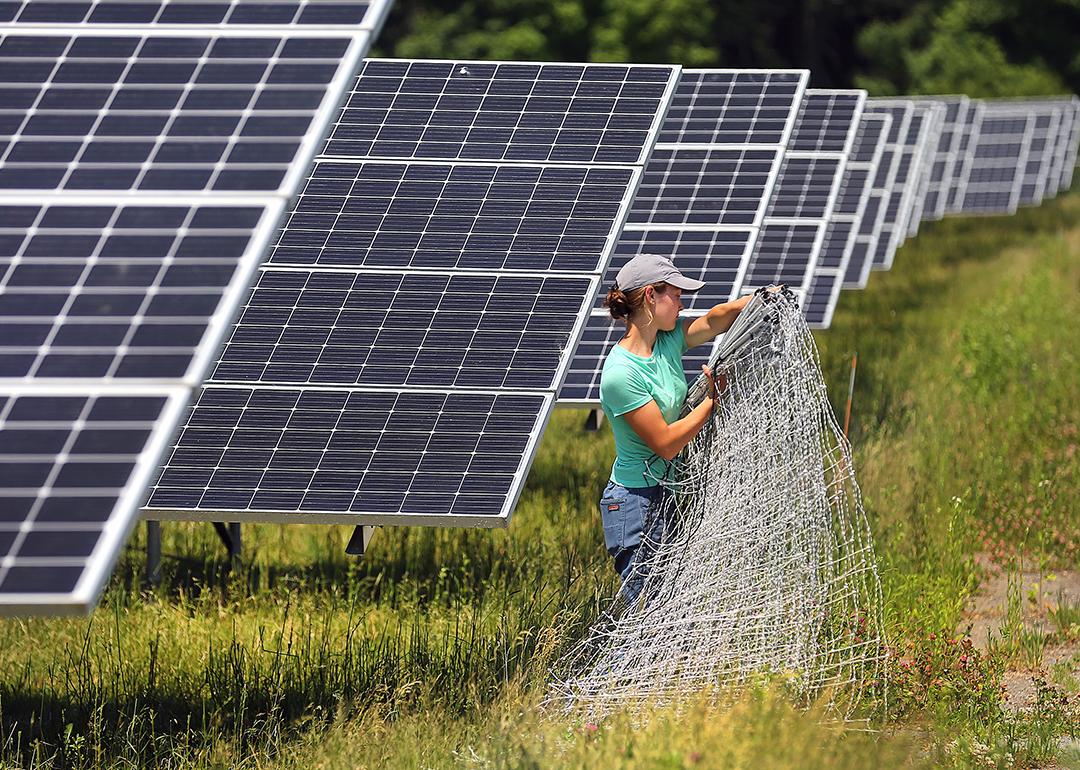
The state of solar: Despite partisan rhetoric, the industry is still booming
The state of solar: Despite partisan rhetoric, the industry is still booming
The future looked dire for renewable energy in the United States last spring. Republicans in Congress started gutting the Inflation Reduction Act, forcing its generous tax credits for wind and solar into an early retirement. The Interior Department then aimed at restricting clean energy on federal land. Some feared those regulations would curb wind and solar development on private land, too.
Although these restrictions do seem to have hindered the wind industry, . But a year later, solar continues to boom. MAGA influencers are promoting it, there’s hope for legislation that would speed up approvals for new projects, and the industry has continued to expand over the last year as energy requirements from data centers demand fast, cheap power. The Trump administration has even signed off on some big solar projects: In February, that it would allow several solar projects that had been blocked by the new Interior regulations to move forward.
“I feel like there has been so much written that’s like, ‘The Trump administration is delaying this stuff. It’s holding it all up in red tape. Nothing’s getting built,’” said Hannah Hess, director of the Rhodium Group’s Clean Investment Monitor team, told “When we look at the data, that’s not true.” Combined, solar and battery storage (which banks excess energy for use when the sun’s not shining) of power generation brought online in 2025 and are expected to continue to before the Inflation Reduction Act tax credits expire at the end of 2027.
Support for solar among rank-and-file conservatives has , caught up in partisan culture wars, but it could gain more traction in the party if it’s paired with affordability concerns. Some 69% of Republicans say they are supportive of solar, provided it lowers electricity costs, from the research organizations GoodPower and . The Solar Energy Industries Association, the industry’s primary lobbying group, has emphasized that its industry aligns with President Donald Trump’s “energy dominance” agenda and lowers energy costs for families and businesses. “Conservative voters are drawing a clear distinction between rhetoric and practical solutions that lower costs,” read from the association in February.
Even prominent conservative figures seem to be softening toward solar. Katie Miller, a former Trump administration official and the wife of Stephen Miller, the White House’s deputy chief of staff for policy, has gone so far as to herald solar as the “energy of the future.” In February, she to X: “Giant fusion reactor up there in the sky — we must rapidly expand solar to compete with China.” That same month, Energy Secretary Chris Wright, who had been , started saying it could be beneficial. “Is there a commercial role for solar power that can add to the grid affordable, reliable energy?” he said. “Certainly there is.”
Data center developers have begun looking to solar as a complement to oil and gas, rather than a competitor. The incoming demand “feels crazy,” said Jim DesJardins, executive director of the Renewable Energy Industries Association of New Mexico. “It’s scary, almost. Five years ago, we were talking about an increase in load from EVs and building electrification — we’re not talking about that anymore. It’s all data centers and how are you going to power them.” This year marked the first time, said DesJardins, that the New Mexico Oil and Gas Association reached out to sponsor the renewable energy association’s annual conference.
Solar is, by far, the cheapest and fastest way to bring energy online, especially as — internal combustion engines that convert fuel into a steady, reliable energy — in the U.S. creates yearslong delays to build new power plants that run on natural gas. The technology is crucial for data centers that need to run 24 hours a day, seven days a week. “The backlog alone [for turbines] is five to nine years,” said Mike Hall, CEO of Anza Renewables, an energy intelligence and procurement platform based in California. “Then you’ve got to permit it. Then you’ve got to be near a gas pipeline for fuel, and then you’ve got the climate and the carbon issues.” A found that half of data center deals were expected to be delayed due to power constraints and local opposition, and developers are beginning to realize that waiting in line for a gas turbine could spell doom for their operation.
There are still some obstacles ahead for solar power, however. “We’ve definitely seen examples from our developer customers where the Department of Interior rules are creating challenges for their projects on federal land, but we haven’t seen that it’s really slowed down development on private land,” said Hall. “The bottlenecks are typically still local permitting and interconnection with utilities — those are still major challenges, and we haven’t seen a lot of improvement in either area yet.”
Shortly before Congress adjourned for its winter recess in December, the House passed the Standardizing Permitting and Expediting Economic Development Act, also known as the SPEED ACT, a bipartisan bill that would streamline the permitting process for energy, infrastructure, and transportation projects by overhauling the National Environmental Policy Act, or NEPA. Signed by President Nixon in 1970, NEPA requires federal agencies to consider how proposed infrastructure projects or drilling permits would affect the environment before approving them. Permitting reform is the rare, bipartisan issue that has sparked real enthusiasm on both sides of the aisle.
After a scuffle over the Trump administration’s decisions to shut down offshore wind projects, which judges ruled invalid, Democratic senators Martin Heinrich and Sheldon Whitehouse are to the negotiating table to hammer out a deal. “Right now, we’re leaving electrons on the table thanks to Trump’s deliberate attacks on clean energy — forcing Americans to pay higher electricity bills,” Heinrich’s office told Grist. “To lower costs, this administration needs to stop stalling and slow walking clean energy projects and take the politics out of permitting reform.”
The war in Iran, which has caused oil prices to skyrocket, may serve to boost interest in solar power even more — especially as a way to combat rising electricity costs and promote energy independence. “Energy poverty has always been a problem in the U.S., and it’s gotten significantly worse in recent years,” said Brad Townsend, vice president of policy and outreach at the Center for Climate and Energy Solutions, an environmental policy nonprofit. He pointed to a study from the nonprofit RMI, formerly the Rocky Mountain Institute, 1 in 3 households were struggling to pay their utility bills. “I think folks in the administration are increasingly becoming aware of the fact that we can’t turn away renewable energy.”
In terms of the geopolitical reasons to support solar, “no one has fought a war over the sun,” DesJardins told Grist. “Not yet, anyways.”
was produced by and reviewed and distributed by Â鶹ԭ´´.