Your doctor is probably using AI and you might not even know it
Would you trust AI with your healthcare?
Millions of Americans already do—and they may not even realize it.
In exam rooms across the country, doctors are now using artificial intelligence to transcribe appointments, summarize patient data, and surface clinical insights.
The result? More time looking patients in the eye, less time looking at screens. And in many cases, more focused, more personal care.
Interactions like this capture a subtle but profound shift around . By taking care of administrative tasks, AI is making doctor-patient interactions more focused, personal, and human.
At the same time, AI in healthcare is expanding what’s possible at the cutting edge of medicine, analyzing massive datasets to help , uncover overlooked treatments, and reveal new ways to diagnose conditions earlier and more accurately.
These breakthroughs are beginning to shape everyday healthcare, from interpreting complex to and surfacing insights your doctor can act on.
It’s also quietly revolutionizing how medicine is practiced behind the scenes, reports.
AI-Powered Diagnostics and Imaging
AI is assisting healthcare providers in practical and often invisible ways: speeding up diagnoses, sorting through the flood of data modern medicine generates, and flagging risks before they become serious problems.
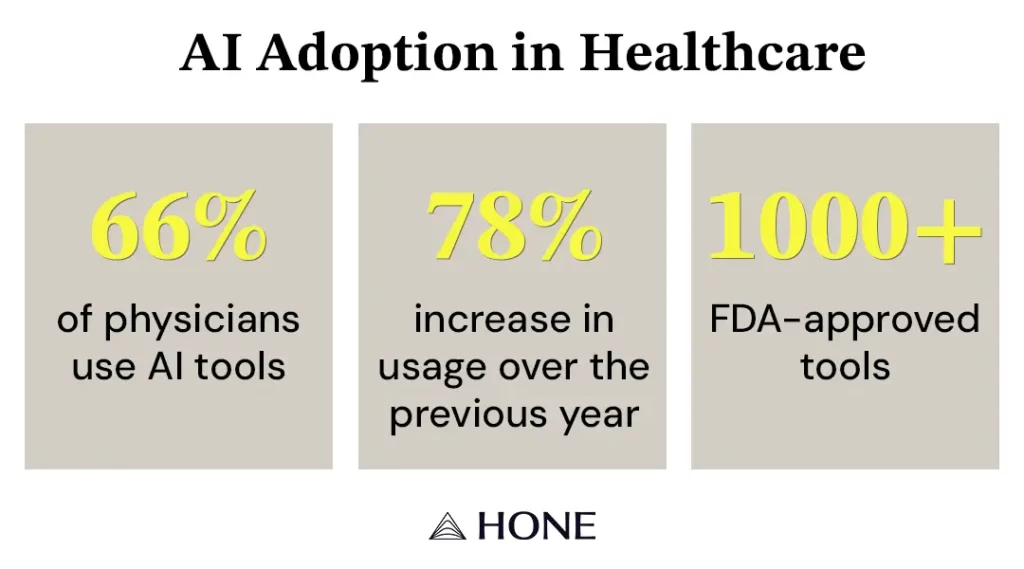
According to a , two-thirds of physicians use AI tools in their practice, a 78% increase from the year before.
“There are now over 1,000 FDA-approved AI tools in healthcare,” says James Zou, Ph.D., a Stanford professor who studies medical AI.
One of them is EchoNet, an AI system Zou helped develop. It analyzes ultrasound videos of the heart and, in , matched the accuracy of experienced technicians in evaluating cardiac function.
Other AI systems are helping radiologists detect brain bleeds or blood clots faster (like Aidoc), flag early signs of cancer (PathAI), and even summarize clinical notes or explain lab results in simple language (like Google's Med-PaLM 2).
These types of diagnostic breakthroughs—faster scans, earlier pattern recognition, more accurate reads —are laying the foundation for individualized medicine, where a person’s care plan is shaped not just by symptoms, but by signals from their .
Today, patients are awash in data. can determine and . (CGMs) identify . Wearable devices keep tabs on your and resting heart rate.
For clinicians, parsing what matters in that tidal wave of information can be daunting. But this is where AI shines. It can analyze data to highlight the most relevant health information for each person, flagging patterns that align with risks so diseases can be caught before they progress.
What This Means for You
Imagine you’re a middle-aged patient with a family history of . You log meals, wear a fitness tracker, and get regular blood work. AI can look for patterns, a spike in , , and markers—when you or . It can then surface those insights to your doctor and suggest a and to lower the markers before things escalate.
And that’s just the beginning.
“Soon enough, AI could look at 20,000 biomarkers and, based on millions of cases, recommend personalized interventions,” says Valter Longo, Ph.D., professor of gerontology and biological sciences at USC. “It could recommend healthy actions based on , , and other factors.”
“AI can turn the overwhelming flood of and into actionable, personalized insights,” says Zou.
AI Is Powerful, But Not Perfect.
Of course, AI has limits. It can’t build trust, show empathy, or understand the full complexity of your life. And it doesn’t always get things right.
ChatGPT—which some people already use to ask medical questions—can offer inaccurate or incomplete answers when faced with complex health issues. That’s why experts agree: AI should , not replace it.
“Right now [AI] is helpful but can be unreliable in certain cases,” says Longo. “It can help me put things together and give me possibilities, but it doesn’t replace human intelligence and decision-making.”
There are risks, too. Despite the promise that AI eliminates bias, it often inherits new ones, especially when trained on flawed data. If a dataset underrepresents women or people of color, for example, the AI may make less accurate recommendations for those groups.
Privacy is another concern. Healthcare data is sensitive, and there’s growing scrutiny over how it’s used by AI and who gets to see it. Groups like the and are pushing for clearer standards and better safeguards.
“Even when trained, AI gets too much wrong,” says Longo, comparing its potential to nuclear power: transformative, but not without risk. Like nuclear energy, AI offers enormous promise, but national leaders need to consider not just what it can do, but what it might do if left unchecked, Longo says, adding, “It has to be regulated carefully.”
was produced by and reviewed and distributed by Â鶹ԭ´´.