Your Google ads playbook won’t work for ChatGPT ads. Here’s what will.
OpenAI announced that ads are coming to ChatGPT, with testing starting in the coming weeks for free and Go-tier users in the U.S. With 800 million weekly active users, this is one of the most significant new ad channels to emerge in years.
But ChatGPT operates differently. Users don’t type keywords and scan results. They explain problems, ask for help, and expect real answers. That mindset shift is why your Google Ads playbook won’t work here. In this article, breaks down what we know so far and how marketers can prepare.
What we know about ChatGPT ads so far
On Jan. 16, 2026, plans to start testing ads in ChatGPT. Here’s what we know:
Who will see ChatGPT ads:
- Free-tier users in the U.S. (adults only)
- ChatGPT Go subscribers in the U.S. ($8/month)
Who won’t see ChatGPT ads:
- Plus, Pro, Business, Enterprise, and Edu accounts
- Users under 18, either self-reported or predicted by OpenAI
Where ChatGPT ads appear:
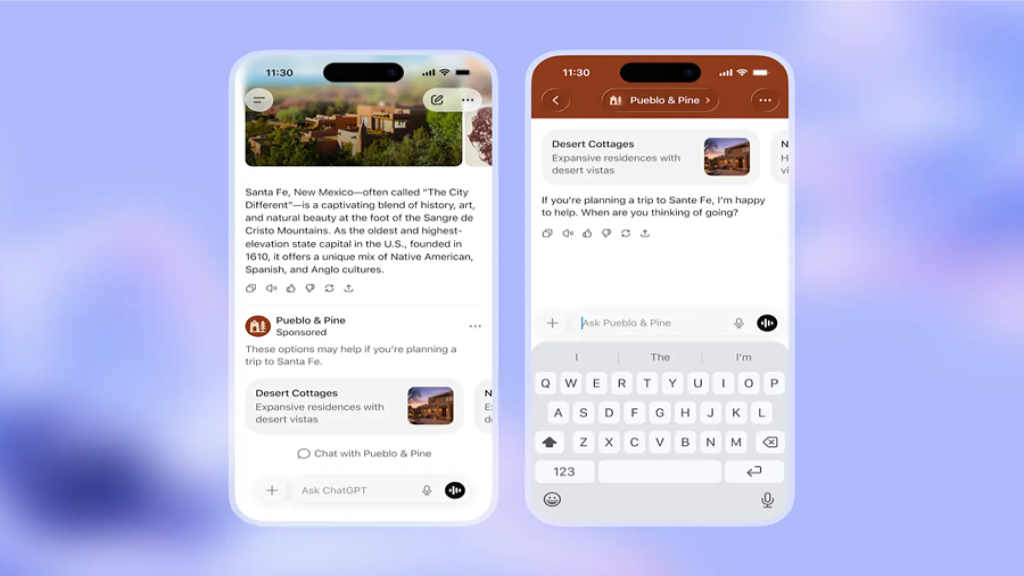
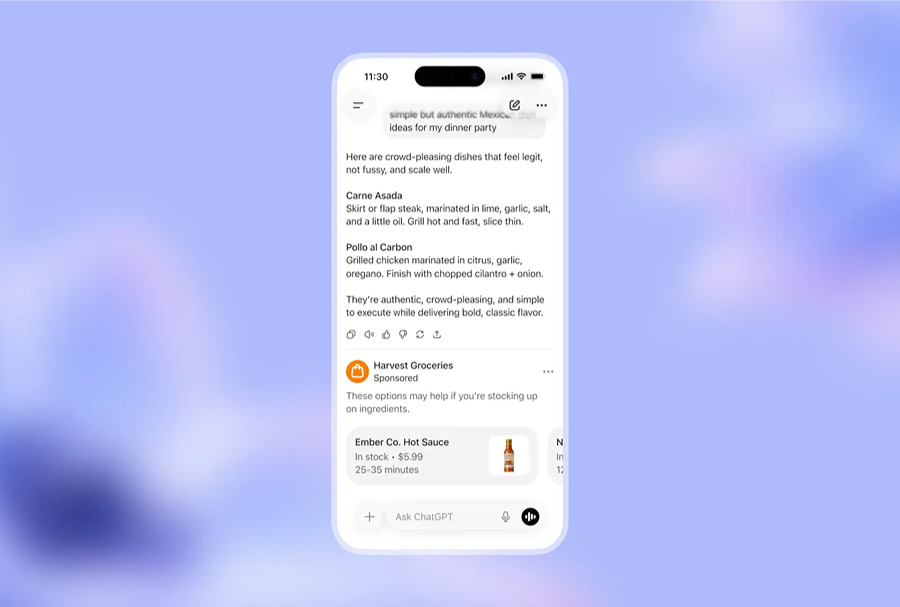
Ads show up at the bottom of ChatGPT’s responses, clearly labeled as “Sponsored” and separated from the AI’s answer. They’re contextual, meaning they’re triggered by what you’re discussing in the conversation.
What’s off-limits:
OpenAI won’t show ads near sensitive topics like health, mental health, or politics.
What you can control:
You can dismiss any ads in ChatGPT, see why you’re being shown it, turn off personalization, and clear your ad data at any time.
What OpenAI says about ad influence:
Ads do not influence ChatGPT’s responses. Answers are based on what’s most helpful to you.
OpenAI’s 5 ad principles
OpenAI is framing this rollout carefully. Before ads even go live, they published five principles guiding how advertising will work in ChatGPT:
- Mission alignment: OpenAI says advertising supports their mission to make AI accessible to everyone, including those who can’t or won’t pay for a subscription.
- Answer independence: Ads won’t influence ChatGPT’s responses. The AI optimizes for helpfulness, and AI ads are always separate and clearly labeled.
- Conversation privacy: OpenAI won’t share your conversations with advertisers and says they’ll never sell your data.
- Choice and control: You can turn off ad personalization, clear your ad data anytime, and there will always be an ad-free paid tier.
- Long-term value: OpenAI says they won’t optimize for time spent in ChatGPT. User trust and experience come before revenue.
Whether these principles hold up once ad revenue starts flowing is another question. But for now, OpenAI is drawing a clear line: AI ads stay separate from answers. For marketers exploring ChatGPT advertising, that distinction matters.
Why your Google Ads strategy won’t work here
Here’s where most marketers will get it wrong.
Google Ads is built around keyword intent. Someone types “CRM for manufacturing,” and you bid on that phrase. You know what they’re searching for, and you serve an ad that matches.
ChatGPT works differently. Users have conversations, not searches. They say things like, “My sales team keeps losing deals because follow-ups fall through the cracks. What should I do?”
That’s a problem, not a keyword. And that shift changes everything about how ads need to work.
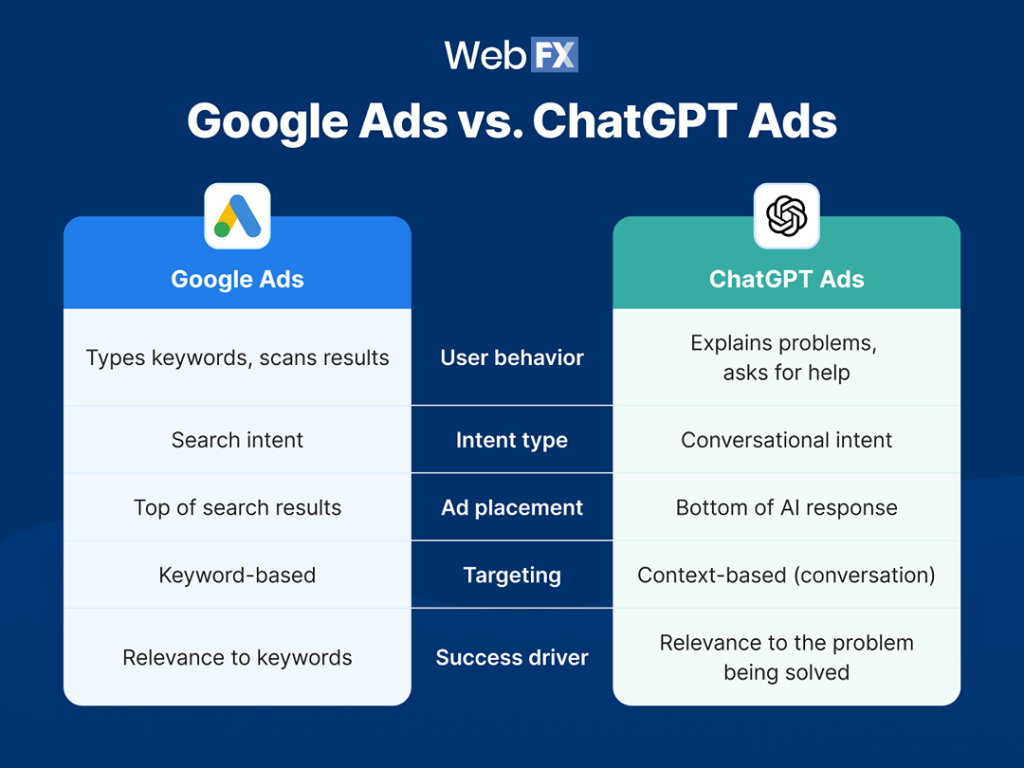
On Google, your ad competes for a click. On ChatGPT, your ad appears after the AI has already tried to help. The user is in problem-solving mode, so an ad that feels like an interruption will get ignored. And an ad that feels like an extension of the solution might actually land.
In the grand scheme of things, ChatGPT and Google behave in a contrary fashion. The brands that figure out conversational AI ads first will have a serious head start.
The C.H.A.T. framework for ChatGPT ads
So if Google tactics won’t work, what will?
The C.H.A.T. framework offers a way for marketers to think about advertising on conversational AI platforms.
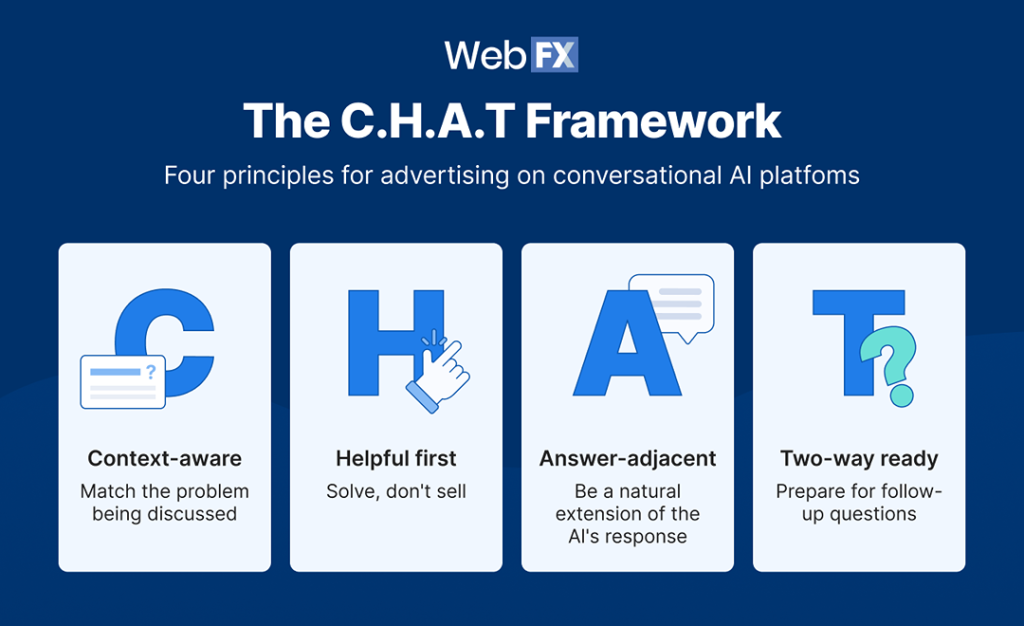
C = Context-aware
Match the problem being discussed. Your ad should feel relevant to the specific pain point the user just asked about. A generic product pitch won’t cut it. If someone is asking ChatGPT how to fix their email deliverability issues, an ad for “email marketing software” may lack relevance. An ad that speaks directly to deliverability problems feels like it belongs.
H = Helpful first
Solve, don’t sell. Lead with value, not features. The user is in problem-solving mode, and the AI just tried to help them. Your ad needs to extend that helpfulness, not interrupt it. Think less “buy now” and more “here’s how we can help with that.”
A = Answer-adjacent
Be a natural extension of the AI’s response. If your ad feels like an interruption, you’ve already lost. The most effective ChatGPT ads will feel like a logical next step after the answer, not a detour from it.
T = Two-way ready
OpenAI said users will soon be able to ask follow-up questions directly within the ad unit. If that rolls out, brands with static landing pages will be at a disadvantage. Prepare conversational responses, not just one-way pitches. Create interactive demos or landing pages built for dialogue.
Early reactions to ChatGPT ads from marketers
ChatGPT ads haven’t launched yet, but PPC professionals are already weighing in. The reactions range from skeptical to cautiously optimistic.
The optimist
Some marketers see this as a major opportunity. A new ad channel with 800 million weekly users doesn’t come around often, and early movers on platforms like Facebook ads and TikTok ads were rewarded for testing before the competition caught on.
The skeptic’s view
Others aren’t convinced. They raised concerns about ChatGPT users being in research mode, not buying mode. According to them, users are mostly asking questions, exploring options, and learning, and that’s a completely different mindset than someone typing “buy running shoes” into Google.
The pragmatic tester
Then there are marketers taking a test-and-measure approach. They’ll experiment, but with guardrails. Limited budget, clear performance benchmarks, and a willingness to stop campaigns if the numbers don’t add up.
Reading between the lines
The jury’s still out. But one theme is clear across all these reactions. Treating ChatGPT advertising like search ads will likely deplete budgets before results show up. Forward-looking marketers are building a new approach from scratch.
What marketers should do now
ChatGPT ads aren’t live yet, but that doesn’t mean you should wait. Here’s how to get ahead before the platform opens up.
Audit your ad creative
Look at your current Google ads and Meta ads. Are they keyword-led or problem-led? If your copy focuses on features and product names, start testing versions that lead with the pain point instead.
Test your brand in ChatGPT
Open ChatGPT and ask it questions about your category. Are you mentioned? How does the AI describe your product or competitors? This gives you a baseline for how your brand shows up in conversational AI before ads even enter the picture.
Build conversational landing pages
Static pages with a form and a headline may be less effective if users expect to ask follow-up questions. Consider adding chatbot flows or FAQ sections that mirror how people ask questions in chat.
Set aside a test budget
When ChatGPT ads open up, the brands that learn fastest will set the pace. Set aside a small portion of your paid media budget for early experimentation. Treat it like you would any new ad channel. Test, measure, iterate.
Track AI referral traffic now
Set up UTM tracking and create a segment in your analytics to track AI traffic coming from ChatGPT, Perplexity, and other AI platforms. You’ll want a baseline before AI ads launch so you can measure incremental lift.
Methodology:
This story was compiled from OpenAI announcements and industry reports.
was produced by and reviewed and distributed by Â鶹ԭ´´.