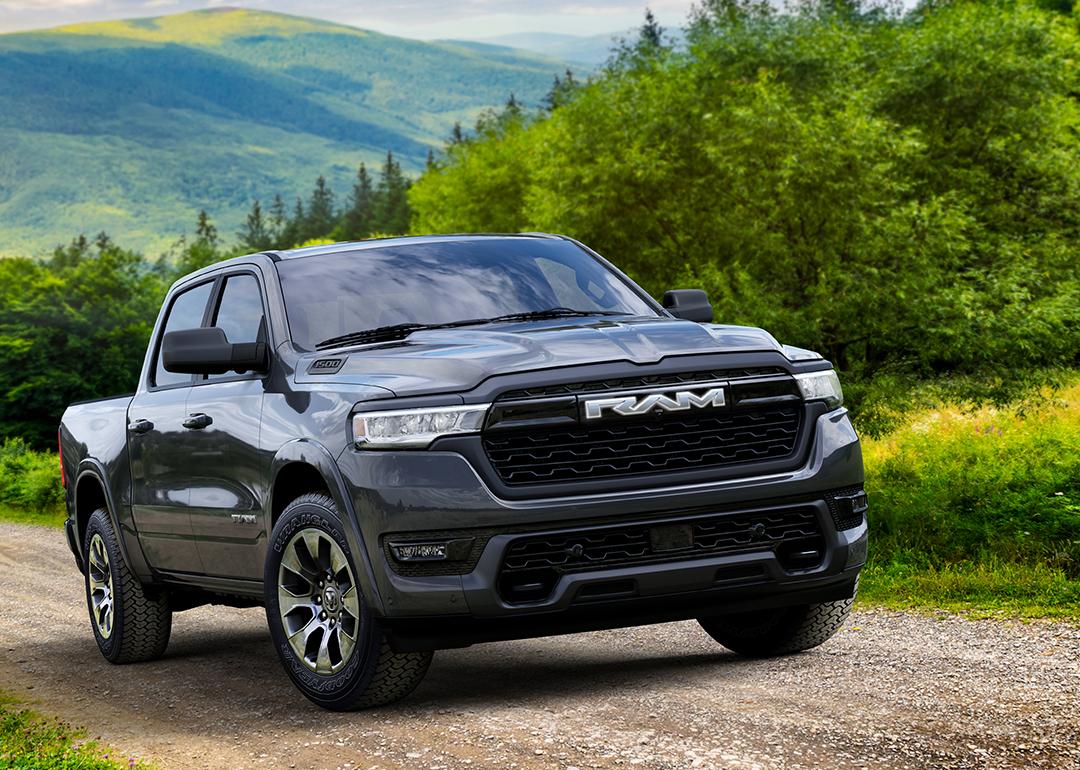
The first plug-in hybrid trucks coming to the US
The first plug-in hybrid trucks coming to the US
Plug-in hybrid (PHEV) trucks are a rare breed 鈥� in fact, none are currently for sale in North America. The (formerly called the "Ramcharger") will be the first plug-in hybrid pickup truck to land stateside , following a delay and Ram's cancellation of pickup. Ford also announced a midsize pickup, but it isn鈥檛 expected to make its way to the United States. With this in mind, focuses on what is actually available at this time.
There are five hybrid trucks available in the U.S.: the , , , and . All of these are traditional hybrids with batteries that can't be charged on their own. Fully electric pickups are also increasing in popularity, with the , and all making the case for gas-free truck driving. There are also electric versions of the and .
But the , which boasts a pair of electric motors, a 92-kWh battery and a 3.5-liter V6 engine, seeks to stand out. The V6 engine doesn't power the truck; it powers the battery. Think of the Rev as an electric truck with a big ol' gasoline generator along for the ride. Ram is calling the Rev the ultimate electric truck, but in truth, it's a plug-in hybrid with a neat party trick. Ram estimates the Rev can travel 690 miles thanks to its combination of fully electric and gasoline-powered range.
What trucks are plug-in hybrids?
The upcoming Ram 1500 Rev is a plug-in hybrid pickup truck. When it goes on sale in 2026, it will be the only plug-in hybrid (PHEV) truck on sale in the United States.
Does the Ford Ranger come as a plug-in hybrid?
Yes, but not in the U.S. The Ford Ranger plug-in hybrid is available overseas, and there are no plans to bring it stateside as of this writing.
Is Toyota coming out with a plug-in hybrid truck?
If it is, don't expect to see one soon. The Toyota Tacoma and Toyota Tundra were both recently redesigned, and neither has a plug-in hybrid option. concept a few years ago, but more information is still forthcoming on that project.
What are the disadvantages of plug-in hybrid trucks?
It's hard to say what specifically could be a disadvantage of a plug-in hybrid (PHEV) truck because one doesn't actually exist for us to test yet. But a potential disadvantage could be its cost. Typically, PHEVs cost more than their regular hybrid or all-gas counterparts. And if you don't regularly plug in your PHEV to charge it, instead relying on the gas engine, you're losing out on the potential savings. Ram claims you won't need to plug in the 1500 Rev because you can rely on the V6 engine to generate electricity for the vehicle. That sounds great, but we suspect that will not be a very efficient way to use the truck.
Why are plug-in hybrids not selling?
More plug-in hybrids were sold in the than in any previous year. But it's true that they sell in far smaller quantities than all-hybrid and all-electric vehicles. This is probably because of a couple of reasons. Plug-in hybrids tend to be more expensive than regular gas vehicles and need to be charged often to maximize their efficiency. If you own a home or live somewhere that you can regularly charge a vehicle, you're more likely to get an all-electric vehicle to truly maximize your fuel savings rather than opt for a PHEV.
was produced by and reviewed and distributed by 麻豆原创.