How EVs can fix the grid and lower your electric bill
How EVs can fix the grid and lower your electric bill
Depending on whom you’re asking, renewable energy and electric vehicles will either destroy the grid or save it. The sun doesn’t always shine and the wind doesn’t always blow, true enough, while a gas-fired power plant can generate electricity any time. That supposed precarity of renewables will get even shakier, critics argue, as Americans ditch conventional vehicles for electric ones, which will draw ever more power from an already strained grid.
Luckily, that’s not a realistic scenario because of what renewables and EVs have in common: giant batteries. Solar and wind farms are plugging into huge banks of them to store energy to use as needed, fixing their intermittency challenge, reports. (Engineers are turning Earth itself into an .) And a growing number of cars with cords feature vehicle-to-grid technology, or V2G, also known as bidirectional charging. They can draw clean power when renewables are humming on the grid, and their owners get paid to send some back to a utility to meet growing demand — creating a vast distributed network that could make the electrical system more reliable, not less. Research has found that globally, would have to opt into such a system to meet the rising need for energy storage.
Until now, we’ve been customers of utilities — with power flowing one way to homes — but more and more we’ll be active participants in the grid, sending extra battery power the other way. That shift is getting a head start in Maryland, where last month the Baltimore Gas and Electric Company partnered with Sunrun, which provides home solar and batteries, and Ford, which makes the electric F-150 Lightning, to activate the nation’s .
“This is the first time there are actual customers who are off-boarding power from their electric vehicles to the grid, and we’re doing it at peak times in the evening,” said Chris Rauscher, vice president of grid services at Sunrun, referring to the periods of greatest need for electricity. “So we’re actually reducing the stress and the demand on the grid — crushing the curve, crushing the peak — which helps lower costs for everyone.”
To understand how this works, think of EVs less like vehicles and more like immense batteries on wheels. In fact, the Lightning’s battery is 10 times bigger than a residential pack, Rauscher said. “There’s more energy capacity deployed today in electric vehicle batteries on the road in the U.S. than in all stationary batteries combined,” Rauscher added. “This is a massive resource.” And it’s only getting more massive: The Natural Resources Defense Council has estimated that if California V2G’ed all of the 14 million EVs it’s expected to have by 2035, it could .
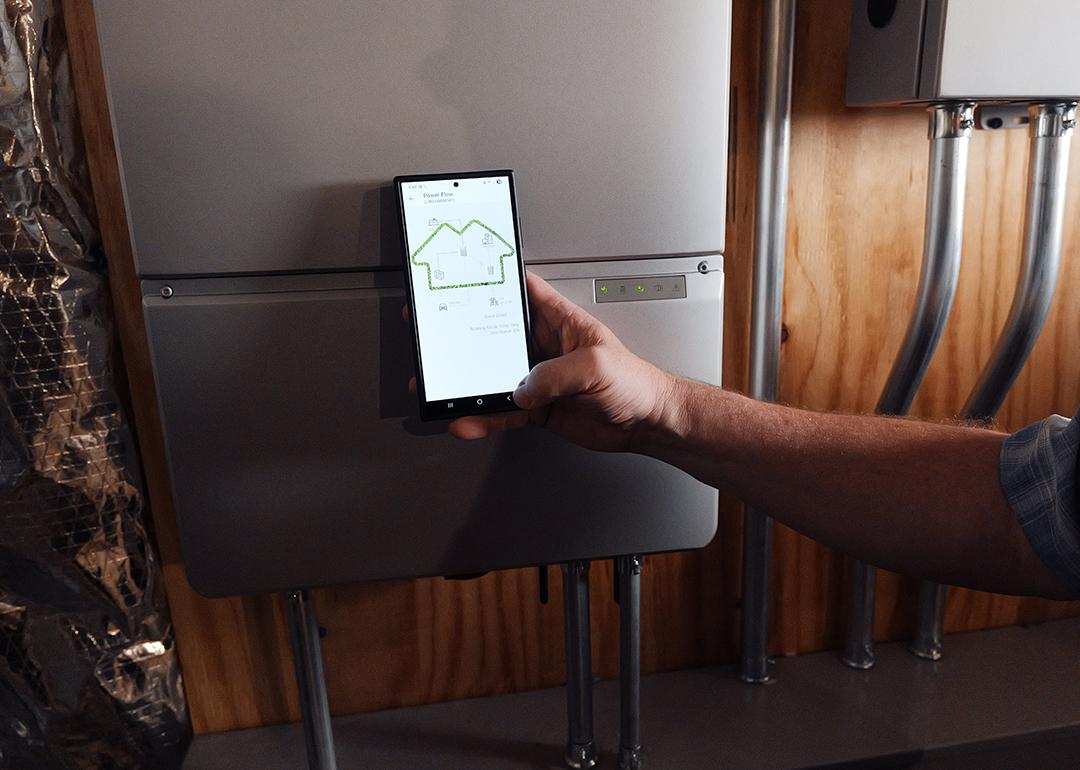
In these early days of the tech, though, only a handful of models sport V2G capabilities, but the number is growing. The hardware and software aren’t wildly complicated. A special charger juices up the vehicle’s battery, then draws from the car to power a house, in the case of vehicle-to-home systems, or sends it back to the utility, in the case of vehicle-to-grid.
Utilities will have to communicate with anyone participating in such a program, for instance, with an app that allows a customer to, say, ask that their vehicle never be discharged below a certain percentage. Each utility will also need to figure out how much to compensate people for their power in order to incentivize them to join in. That might mean paying for the amount of energy provided, the same principle behind net metering, in which residential solar customers are reimbursed for . “We’re still in a bit of an early stage here,” said Divesh Gupta, director of clean energy solutions at Baltimore Gas and Electric Company. “There are a lot of things that need to be worked out, particularly on the customer-experience side.”
That battery power need not go all the way back to the grid, though, to help utilities. For years now, owners have been using their Ford Lightning trucks to . These batteries are mammoth — the extended-range version can go 300-plus miles — and powering a home with one uses just five or six miles of that range per hour.
So say an owner returns home at 6 p.m., when demand on the grid is skyrocketing as everyone else is knocking off work and switching on air conditioners and other energy-hungry appliances. Because consumption is rising, so too is the price of electricity. But a Lightning owner doesn’t have to pay that if they’re using their battery to power their home for five hours until they go to bed, using 25 to 30 miles of range on their battery. “It basically makes the house disappear, effectively, from the grid,” said Ryan O’Gorman, Ford’s business lead for vehicle-to-grid and vehicle-to-home.
Then the owner can charge again when demand, and electricity prices, are lower. If they work from home, for example, they can charge during the day, when lots of solar power is coursing through the grid.
More homes tapping EV batteries also eases demand on the grid, which is especially welcome during a heatwave when everyone’s running their AC units. Those heat waves will only get worse from here — a growing challenge for utilities to provide the power that keeps people cool and safe. At the same time, ever more data centers are devouring ever more power and . That infrastructure also must accommodate other forms of decarbonization, like and induction stoves, that are essential for .
Instead of sitting idly in a garage depreciating, V2G turns an EV into an asset for bolstering the grid and powering the home cheaply. “Cars are parked more than 22 hours a day,” O’Gorman said. “When we look at the advantages of an EV, now that vehicle can provide savings and potentially revenue flows for the customer.” (Interestingly, even back to the grid and generate revenue, thanks to what they gain from regenerative braking: In the Bay Area, the Caltrain system , slashing its estimated annual power cost from $19.5 million to $16.5 million.)
The residential V2G program in Baltimore follows other experiments across the nation with larger vehicles. In Oakland, California, for instance, the utility Pacific Gas & Electric worked with the electric bus provider Zum to deploy vehicles that take kids home in the afternoon, return to the lot, and . Because their batteries are so large, they have ample power left over, sending that extra energy to the grid just as demand is spiking. They charge overnight, take kids to school, and plug in again to charge.
This kind of predictability could make commercial fleets even more powerful for V2G than residential vehicles, experts say. A school bus is on a schedule a utility can rely on — it’s parked and available at certain times of day and making the rounds at others. Plus, in the summer, they would be available almost constantly. Other fleets, like delivery and government vehicles, follow regular timetables as well.
Fleet managers can also procure large numbers of the appropriate chargers, buying into the system en masse, compared to a homeowner shelling out for just one. “In the short term, we see commercial-level V2G applications as more viable due to infrastructure costs, but we expect affordable domestic units to emerge as the market matures and demand grows,” said a spokesperson for Nissan, which has long included bidirectional charging in its electric Leaf.
Utilities are still figuring out how to coordinate this ballet between vehicle, charger, and grid on a citywide scale. But the payoff could be big, because all those EVs are existing infrastructure that could help reduce the need to build dedicated battery plants to store renewable energy. The less a utility has to build, the fewer costs it has to pass on to ratepayers. And with more V2G, a utility that has to import lots of electricity from a neighboring state can now store power locally.
Thus, this technology could reduce energy bills. And for participants, their vehicles now provide transportation and energy storage. “It would seem pretty easy to imagine that that’s going to be cheaper than building just stationary battery storage facilities that do nothing but support the grid in times of need,” said Rudi Halbright, product manager of VGI pilot implementation at Pacific Gas & Electric. “Because you’re not getting that secondary use with those batteries. They’re kind of sitting around a lot of the time.”
People are more complicated than battery banks, though. Folks with busy lives want the convenience of charging their cars whenever they like and might not even realize how much prices fluctuate throughout the day, said David Victor, a professor at the University of California, San Diego, who studies the behavior of EV drivers. Many like the peace of mind of having a fully charged vehicle ready at all times. “I take from that that V2G is going to be really, really hard for fleets outside of professionally managed fleets,” Victor said, “that we know reliably are going to be available at the time that the V2G asset is going to be needed.”
Still, given the number of EVs out there, only a fraction of owners need to participate to make a sizable impact. And residential and commercial V2G can complement each other — and in turn, complement a utility’s larger battery facilities — a widescale diversification of energy storage that could accelerate the adoption of renewables. “I fundamentally believe that bidirectional electric vehicles are going to be something that no one’s ever heard of, until suddenly everyone has it,” Rauscher said. “Once we have enough customers enrolled and deployed out there, some percent of customers not plugging in and performing doesn’t really matter.”
was produced by and reviewed and distributed by Â鶹ԭ´´.