The most dangerous time to drive in every state
In 2023, roughly one-third of all U.S. , with the single deadliest three-hour block from 6 p.m. to 9 p.m. (18% of all deaths). Those hours straddle the evening commute, when roads are crowded, daylight fades, and impairment risks rise. That pattern shows up year after year in federal crash data.
While weather, road design, and vehicle safety technology all play a role, federal crash records show that the time of day is one of the strongest predictors of fatal risk on the road. And that the riskiest hour varies significantly by state.
The following analysis, conducted by , a personal injury law firm based in Nevada, uses data from the National Safety Council and National Highway Traffic Safety Administration鈥檚 Fatality Analysis Reporting System (FARS) to identify when fatal crashes are most likely to occur across the country, and which states see the highest concentration of deadly collisions during night, rush hour, and weekend periods.
Evening hours are the deadliest nationwide
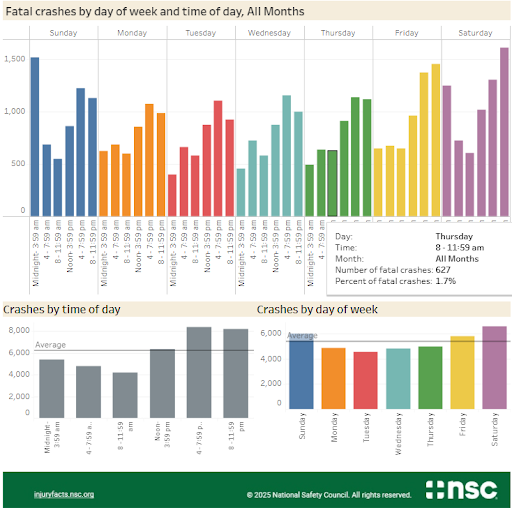
Fatal crashes in the U.S. are most likely to occur in the early evening, with the 4 p.m. to 7:59 p.m. time block recording the highest death totals across every day of the week, data shows. The period coincides with the end of the workday, heavier traffic on major routes, and the start of evening social activity.
Risk remains elevated into the night. Crashes between 8 p.m. and 11:59 p.m. make up the next-highest share of fatalities, even though overall traffic volume drops. Reduced visibility, faster travel speeds on open roads, and a higher proportion of impaired drivers are key factors.
Fridays and Saturdays show the sharpest increases, reflecting the overlap of weekend travel and nighttime recreation.
Per state breakdown of peak crash times
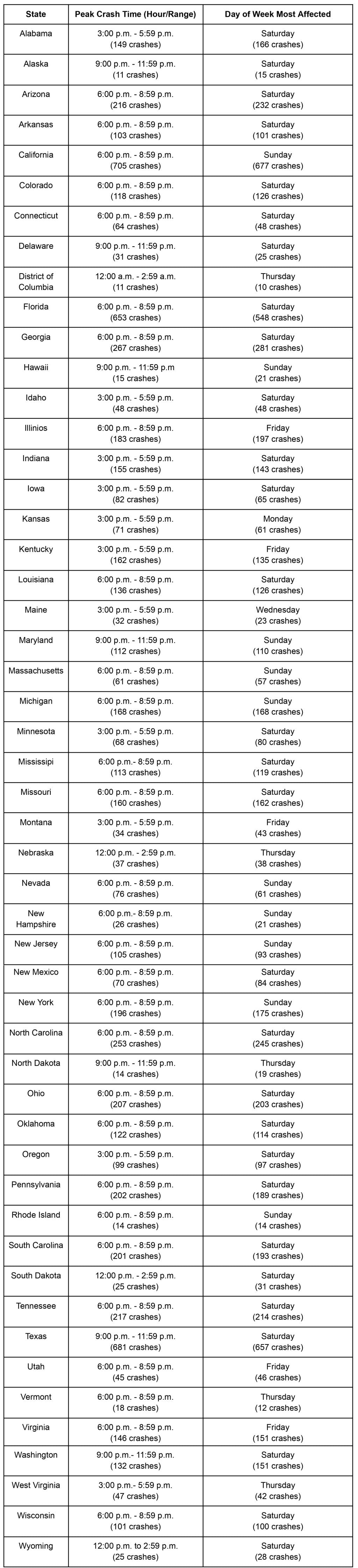
Analysis of the time-of-day crash dataset shows 6 p.m. to 9 p.m. as the deadliest three-hour window, but state-level patterns are not uniform. In some states, the peak shifts earlier into the late-afternoon commute, while others see their highest concentration of fatal crashes after dark.
How the risk shifts within the 3鈥�9 p.m. band
Commuter hazards
Late afternoon remains a high-risk window for drivers as heavy traffic, impatience, and end-of-day fatigue converge.
Teens face a later peak
Among teenagers killed in crashes in 2023, the , just after the national 6 p.m. to 9 p.m. peak.
Crash type matters
In fixed-object crashes (e.g., trees, poles), ., with 12 a.m. to 3 a.m. the single biggest slice (17%).
What changing traffic patterns may mean next
While , transportation officials note that the underlying factors behind those crashes vary widely from state to state, ranging from to population growth in fast-expanding metropolitan areas.
As more states adopt real-time traffic monitoring, expand pedestrian-safety corridors, and adjust daylight-saving timetables, analysts expect the distribution of risk to keep shifting. What hasn鈥檛 changed in more than a decade of federal crash records is the familiar shape of the curve: a steady rise through the late afternoon, a sharp peak after sunset, and millions of Americans still on the road when that risk is at its highest.
was produced by and reviewed and distributed by 麻豆原创.