
Americans are known for being bad at taking time off: Are work vacations the solution?
This story originally appeared on Bounce and was produced and distributed in partnership with 麻豆原创 Studio.
Americans are known for being bad at taking time off: Are work vacations the solution?
Americans have a fraught relationship with work-life balance. And it's not just a trope in films depicting harried New Yorkers and San Franciscans, either.
Before the COVID-19 pandemic, U.S. workers took 17.4 vacation days per year, . That meant workers across the country left 768 million vacation days unused in 2019. A found that nearly 2 in 5 (36%) government workers didn't take a vacation between August 2021 and 2022; just over half (51%) said they fully unplugged from work during time off. Seven percent responded that they continued working while on vacation.
Americans are . Consequently, vacation time to its European counterparts. It seems that the biggest driver behind this difference is cultural attitudes about work and health.
The solution, paradoxically, could be to expand how and how often Americans work. Combining remote work capabilities with vacation time , even if it means further blending work and play. Such remaining available to be contacted and complete tasks while out of the office on break, are growing increasingly popular.
Using research from across the internet, dug into the details behind America's cultural struggles with taking time off from work鈥攁nd whether or not work vacations are the answer.
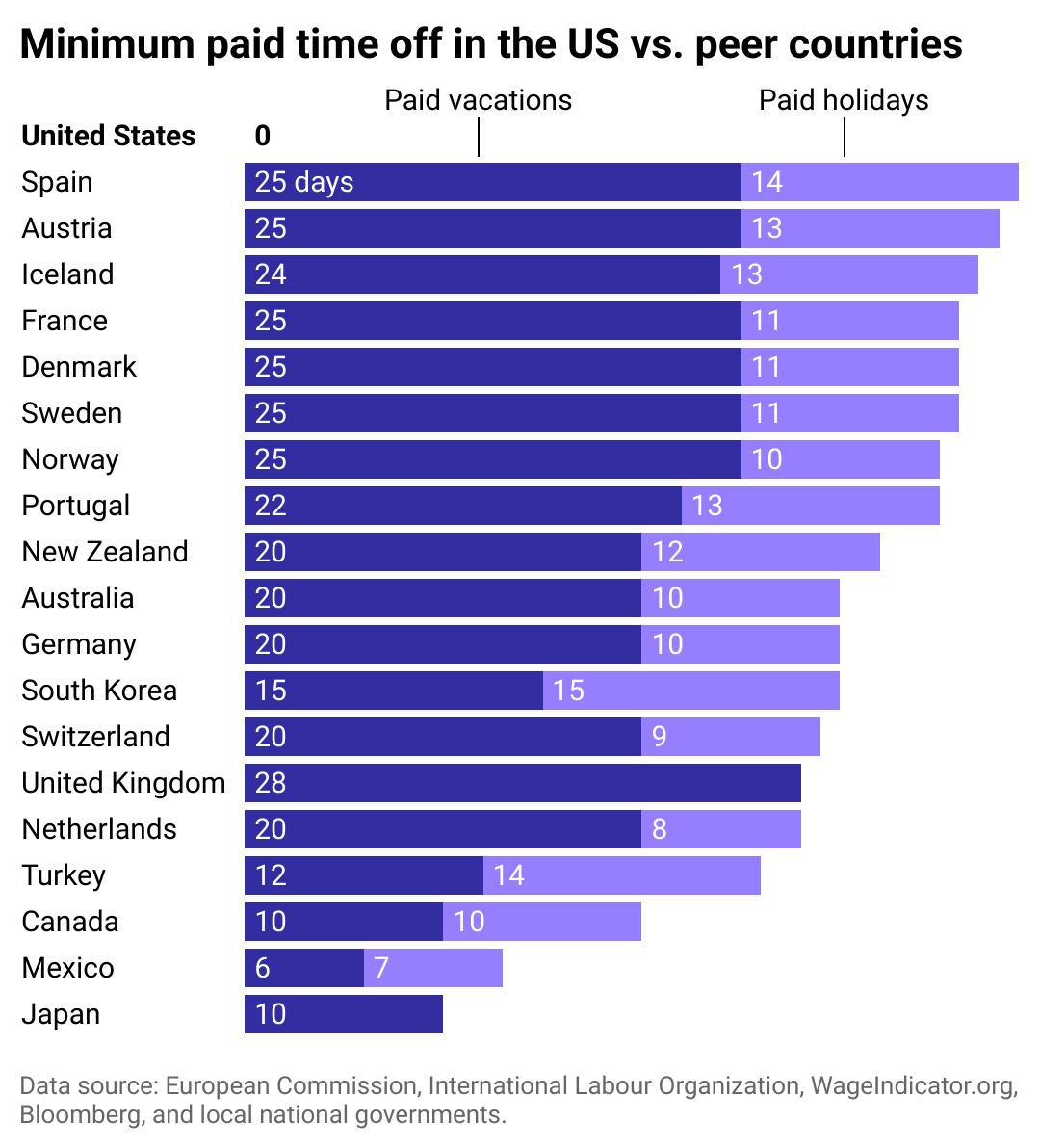
Government-mandated paid time off in the US lags well behind other countries
Compared to other countries, American culture doesn't encourage taking vacation time. As seen above, government-mandated paid vacations and holidays exist in many other countries but are absent in the U.S.; in the EU, the is to thank. The WTD is a European mandate introduced in 1993 that gives workers a right to a minimum of four weeks paid vacation per year, in addition to other laws on working hours the directive mandates.
Many northern European nations, including , , and , ensure extensive holiday pay. Neighbors to the U.S., Canada and Mexico, also grant more guaranteed time off. In fact, the in December 2022 to double the paid time off for workers to 12 days per year. Nordic countries generally mandated for workers, averaging around 35 or more paid days annually.

The pandemic boosted work vacations
The COVID-19 pandemic didn't do Americans any favors regarding work-life balance, making it all too easy to blur the boundaries between work and personal time.
Workers are and not completely signing off during weekends or vacations as remote work technology enables a near-constant communication channel with the office. But the flipside of this means that when planning vacations, many with remote or hybrid schedules are taking advantage of telecommuting on a "workcation," which combines leisure days with remote work.
About 3 in 4 Americans surveyed by said they planned to partake in a workcation last year. Workcations allow more flexibility for some workers who don't have to use as many vacation days鈥攚hile on their trip to Hawaii they could add on a few days and work during daytime hours and not count it as time off. They can also save money by choosing less busy travel days or midday weekday flights since they can work from airports or planes. Similar is the "bleisure" trend, in which companies or individuals elect to bundle together vacation trips with the ability to work from anywhere. These "digital nomads" might choose to work from different cities so that they work during the day but have evenings and weekends to explore a new location. Or maybe they add on a few days to a work trip so that they can relax and explore a city before or after their conference. The key to blending work and leisure though is making sure that work doesn't overtake your vacation time, and that you protect your time for relaxing.

Not taking time off鈥攁nd working on vacation鈥攃an affect health
As the line between work and play blurs, feeling overworked can interfere with someone's ability to , leading to poor sleep, eating habits, and exercising routines. Chronic conditions鈥攊ncluding 鈥攁nd everyday illnesses like the cold or flu are linked with experiencing job stress.
A nine-year study examining the health of those who used their allotted vacation time versus those who didn't found that the former were . Additionally, their ability to perform well when working also takes a hit, according to the Harvard Business Review, which found that those who spend some of their time on the weekends working .
If employers want their workers to be , they might want to consider upping their vacation days.

What can be done about Americans not taking enough vacations?
Understandably, however, it is quite difficult to change the work culture in the U.S. About 1 in 4 workers in the U.S. don't get paid vacation from their employers. But for the rest of Americans who do, workers can start by considering time off less of an indulgence and more of a necessity to ensure good work performance. Taking those vacation days and actually unplugging will pay off .
Additionally, employers can reframe vacation time as a health requirement akin to taking a day for an annual checkup. If planned properly, even a workcation can be .
According to a more Americans took time off to relax and be with family through holiday workcations: The survey found that people were able to add an average of eight days of travel across the 2022 holiday season because of the flexibility to work remotely.
While nearly half of these travelers reported that they would be unplugging during their longest trip, 26% intended to work remotely while still traveling. These workcation travelers were also increasing the average number of holiday trips from 1.8 to 2.6, showing that many planned not only for more journeys away from home but also longer ones.