These 22 conservation-minded presidents preserved the most national park land
was produced by and reviewed and distributed by 麻豆原创 Media.
These 22 conservation-minded presidents preserved the most national park land
Which American presidents did the most to preserve the land we love as national parks and preserves?
With the presidential election around the corner and the U.S. National Park Foundation receiving a record-breaking grant of $100 million, ranked 22 presidents who preserved the most national park land.
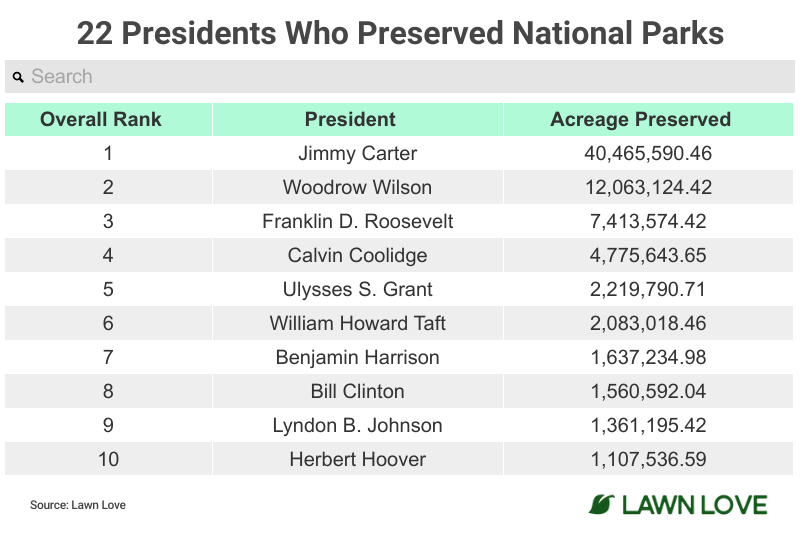
The rankings factored in the acreages of 94 different national parks, national military parks, national preserves, and national trails.
Note: Not all public lands were included in this story. NPS units such as national historic sites, national historic parks, and national monuments were not included, nor were conservation lands managed by the Bureau of Land Management or Forest Service. See the full .
Presidential rankings
Top Five Close Up
No. 1: Jimmy Carter | Protected parkland: 40.5 million acres
- Term in office: 1977-1981
- Vice President: Walter F. Mondale
- Political party: Democrat
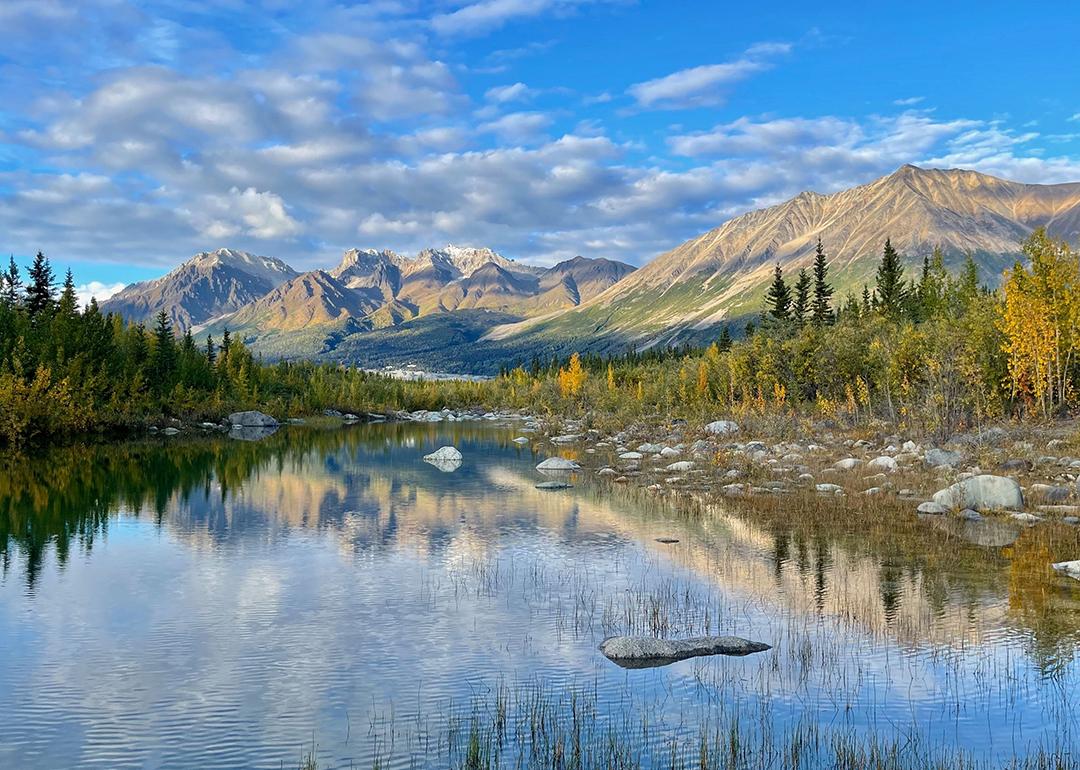
- Highlights: President Jimmy Carter established in Alaska鈥攖he nation's largest national park, spanning over 13 million acres. He preserved other vast expanses of endangered areas in Alaska, including , , and .
Outside of Alaska, Carter protected land in West Virginia鈥�鈥攁nd Washington鈥�.
The analysis did not factor in conserved areas to be managed by the Bureau of Land Management, which would include an additional 100 million acres of land dedicated by the (1980).
Carter was an early proponent of energy conservation and alternative energy sources and supported laws against pollution and for protecting air, water, and natural resources. He installed on the roof of the White House in 1979.
The former president's high school, childhood home, and campaign headquarters can be explored at in Georgia.
No. 2: Woodrow Wilson | Protected parkland: 12 million acres
- Term in office: 1913-1921
- Vice President: Thomas R. Marshall
- Political party: Democrat
- Highlights: The National Park Service was created by President Woodrow Wilson in 1916.
Over the course of his term, Wilson preserved parks from the nation's tallest peak, , to the tropical landscapes of and the .
Wilson is also credited with preserving in Maine, in Colorado, and the .
No. 3: Franklin D. Roosevelt | Protected parkland: 7.4 million acres
- Term in office: 1933-1945
- Vice President: John Nance Garner | Henry Agard Wallace | Harry S. Truman
- Political party: Democrat
- Highlights: Numerous iconic park destinations鈥攆rom in Texas to the South Dakota to the Florida 鈥攚ere preserved by President Franklin D. Roosevelt. Several California sites were protected as well, including Channel Islands, , and .
As president, Roosevelt introduced the which employed 3 million workers for land conservation projects鈥攔emoving and restoring trails and historic sites. The CCC also created numerous state parks.
FDR expanded the NPS to include historic sites like cemeteries and memorials, and transferred the management of many public monuments from the War Department and Army Corps of Engineers to NPS.
Over the course of his lifetime, FDR planted in his hometown of Hyde Park, New York. His home is now a .
No. 4: Calvin Coolidge| Protected parkland: 4.8 million acres
- Term in office: 1923-1929
- Vice President: Charles Gates Dawes
- Political party: Republican
- Highlights: President Calvin Coolidge preserved the glaciers and rainforest of in Alaska.
He also protected iconic Southeastern spots like in Kentucky, in Virginia, and America's most-visited national park, the in North Carolina and Tennessee.
Coolidge also Forest Protection Week and Arbor Day.
His childhood home has been preserved by Vermont as a .
No. 5: Ulysses S. Grant | Protected parkland: 2.2 million acres
- Term in office: 1869-1877
- Vice President: Schuyler Colfax | Henry Wilson
- Political party: Republican
- Highlights: Grant signed the in 1872, designating Yellowstone as the first national park.
However, Grant never visited Yellowstone, and in creating the park forced out and displaced the numerous Indigenous tribes native to the region.
His family estate in Missouri is preserved as a .
Key insights
, America's first national park, was by Ulysses S. Grant (No. 5). Since then, conservation efforts have expanded to managed by the National Park Service, including 63 national parks and 19 national preserves.
, signed by Benjamin Harrison (No. 7), was an early legislative step toward federal conservation efforts. Theodore Roosevelt (No. 13) later signed the into law, introducing federal protections for natural resources and historic sites.
Among the biggest steps for national park conservation over the past two decades was the establishment of in California by Bill Clinton in 1994, protecting over 1.5 million acres of land.
- Two presidents had a close relationship with NPS before Inauguration Day: Herbert Hoover (No. 10) was of the National Parks Conservation Association in 1924, and Gerald Ford (No. 12) was a for one summer in 1936 at Yellowstone.
- Of the nation's 10 biggest national parks, seven are located . The largest park is 鈥攑rotected by Jimmy Carter (No. 1) in 1978鈥攁t around 13 million acres.
Behind the ranking
For each of the 94 national parks, preserves, military parks, and trails included in this ranking, the analysis used data on park size (acreage) and their establishment dates, which were then attributed to the respective presidential administrations.
Notes:
- Not all units managed by the National Park Service were included in this ranking. Battlefields, historical parks and sites, monuments, and memorials were not considered, since many are designated to preserve historic sites like military forts, buildings, and ruins鈥攁nd not to preserve wild lands or natural resources.
- Conservation lands managed by the Bureau of Land Management or Forest Service were not included in this ranking.
Final thoughts
Conservation is a complex topic: the development of national parks hasn't been positive for everyone. Many national parks were created by forcibly displacing the Indigenous stewards who had occupied the land for ages. Several parks in the Jim Crow era were , including Hot Springs, Shenandoah, and the Great Smoky Mountains.
Today, some parks are working to restore cultural ties and partner with Native communities for conservation efforts. There are now more than between Indigenous Tribes and communities and NPS sites, featuring groups like the and cultural programs and projects at parks like , , and .
After a hefty from Congress, the parks will benefit from a record-breaking to the National Park Foundation, dedicated to enhancing wildlife conservation and exploring the parks' Indigenous histories.
Visitation records show that parks are , meanwhile staffing has been steadily decreasing as parks struggle with smaller budgets. With increased instances of on the horizon, it will become even more costly to maintain and repair national parks from storm damage.
Parkland is worth the cost to manage, not only because of the priceless scenery, but because national parks boost local鈥攎any rural鈥攅conomies and provide within park communities.