This story originally appeared on CoPilot and was produced and distributed in partnership with 麻豆原创 Studio.
See how many electric vehicles are registered in Vermont
Few announcements have rocked the automotive industry as hard as the one-two punch of General Motors鈥� to exclusively produce electric-powered vehicles by 2035 and the Ford Motor Company鈥檚 $30 billion investment in electric vehicle development. The latter has thus far resulted in the release of an all-electric F-150 and Mustang, the automaker鈥檚 two top-selling models. Of course, other automakers have taken a dip into the EV pool, among them Chevrolet, Volvo, Porsche, Mazda, and Mercedes Benz, and it would seem that Tesla set a gold standard for the development and marketing of the electric vehicle.
ranked each state (and Washington D.C.) by the number of registered EVs as a percentage of total registered private and commercial vehicles to offer a quick look at where the nation stands on electric vehicle adoption, using data from the and. Ties were broken at the thousandths of a percent level which, for brevity, are not shown. Charging station and charging port data came from an report issued by the BTS. The U.S. Department of Energy also maintains a of all AFS locations nationwide. It should be noted that the stated number of ports per 100 EVs is not necessarily inversely related to the overall quantity of EVs in a given state, but rather the number of highway miles or the number of established 鈥�.鈥�
While Elon Musk鈥檚 multibillion-dollar Tesla 鈥渆xperiment鈥� has without question forced the auto industry to rethink the public鈥檚 appetite for EVs, it鈥檚 the anteing up of the big players that has the potential to permanently change the nation鈥檚 approach to vehicular travel. Just 30 years ago the industry dismissed as though it were an allowance given to an unruly child so they wouldn't ask for something more expensive.
In its , Ford showed a 121.1% increase in total EV sales year over year. Not only does this mark the best-ever EV sales for the company, but it also represents 36% faster growth than the entire segment鈥攎eaning Ford, the nation鈥檚 largest carmaker, has already begun to dominate this sector. The Mustang Mach-E has become second only to Tesla鈥檚 Model Y in total EV sales, and the F-150 continues to be the top-selling truck in America (which it has been for more than 40 years running). Orders for the F-150 Lightning EV have . Ford not only anticipates to be electric by 2030 but has recently in both manufacturing and battery production and recycling. It is more than clear that an irreversible revolution in car manufacturing and ownership is now upon us.
Continue reading to find out the state of electric vehicle adoption in your neck of the woods, or check out the national list .
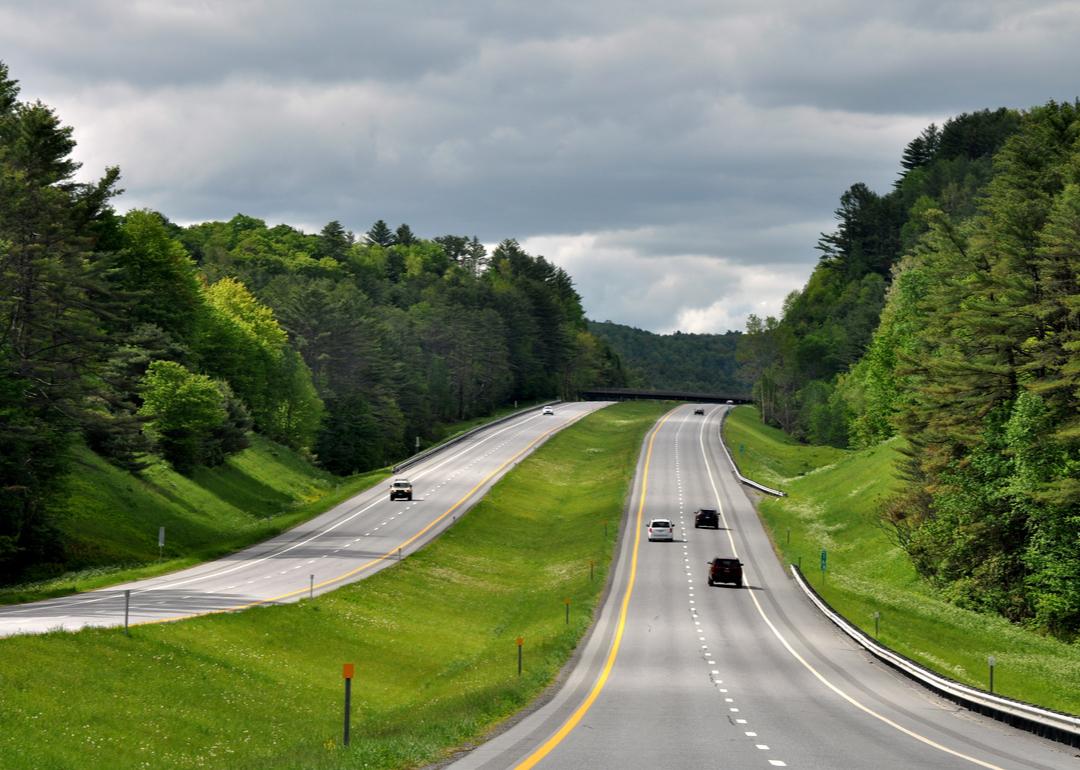
Vermont by the numbers
- Percentage of registered vehicles that are electric: 0.37%
- Total registered electric vehicles: 2,230 (#38 overall)
- Number of statewide charging stations: 328 (#30 overall)
- Number of charging ports per 100 EVs: 39.1 (#6 overall)
On a wider scale, reached 6.6 million in 2021, a more than threefold rise over the previous year. This number is impressive in and of itself but becomes staggering when you consider that in 2012 only about 130,000 EVs were sold across the globe. There are now an estimated 16 million EVs on the road, and if sales trends pan out as predicted, that number is going to get a whole lot bigger. When it does, naturally the other side of the equation will be a decrease in gas-powered vehicle sales.
The need for a nationwide network of charging stations to allow cross-country travel has emerged alongside the expansion of electric vehicle ownership. At best, the longest range a current EV (the Lucid Air Dream Edition) can go on a single charge is 520 miles鈥攂ut it also comes with a $170,000 price tag. The , one of the most popular EVs on the market, can get 400 miles to a charge, which is no small feat. But without the right kind of charging infrastructure, it still won鈥檛 get you from the Rockies to an East Coast vacation spot, to say nothing of making it across a state as expansive as Texas (where, incidentally, the is the F-150).
In its December 2021 , the Biden-Harris administration outlined its strategy to 鈥減ut [the country] on the path to a convenient and equitable network of 500,000 chargers and make EVs accessible to all Americans for both local and long-distance trips.鈥� This strategy includes a $5 billion investment in the national EV charging network and a further $2.5 billion to be made available through a grant program to ensure states鈥� ability to support rural charging and charging access in disadvantaged communities.
Read on to see which states have the most and least electric vehicles.
States with the most electric vehicles
#1. California: 1.43% of registered vehicles are electric
#2. Hawaii: 0.86% of registered vehicles are electric
#3. Washington, D.C.: 0.74% of registered vehicles are electric
States with the fewest electric vehicles
#1. North Dakota: 0.02% of registered vehicles are electric
#2. South Dakota: 0.03% of registered vehicles are electric
#3. West Virginia: 0.04% of registered vehicles are electric