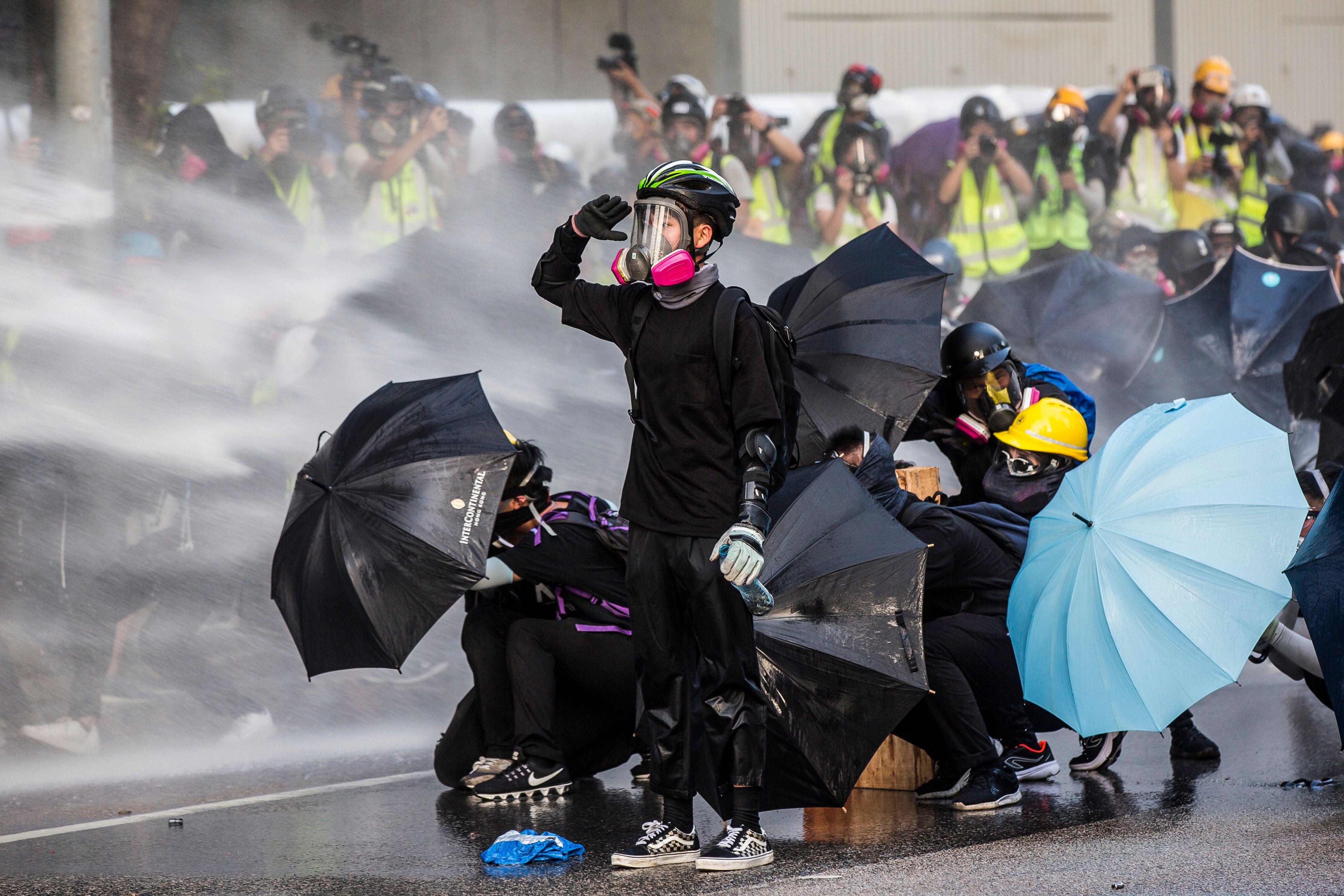
One year in: What to know about Hong Kong's year of protests
One year in: What to know about Hong Kong's year of protests
One murder might not seem like enough to spark an entire democratic movement, but that's exactly what happened in Hong Kong, a province of China with a high degree of autonomy. A couple from the city took a Valentine's Day trip to Taipei in February 2018. Poon Hiu-wing never returned home, but her 19-year-old boyfriend Chan Tong-kai did. He would soon confess to Hong Kong police that he left a suitcase containing her body near a Taipei subway station after strangling her. He also used Poon's ATM card to withdraw more than $3,000 from her bank account in Taipei and Hong Kong.
Hong Kong authorities prosecuted him for money laundering, but they lacked the jurisdiction to charge him with murder. The crime occurred in Taipei, and there was no extradition treaty between Hong Kong and Taiwan. That's when Hong Kong leader Carrie Lam stepped in to fast-track a new bill that would allow the city to send suspected criminals to Taiwan, along with mainland China. Critics slammed the proposed legislation as a threat to the "one country, two systems" arrangement Hong Kong has had with China since 1997. Mass protests against the proposal broke out in March 2019.
While the demonstrations initially just called for a withdrawal of the extradition bill, protesters eventually expanded their calls to "five demands, not one less." They wanted the government to reject a characterization of their demonstrations as riots, provide amnesty to arrested activists, allow for an independent investigation of police brutality, and implement universal suffrage. Only one of their needs—withdrawal of the controversial extradition bill—has been met, and activists are continuing to fight for the other four demands to the present day.
So what's happened during Hong Kong's protests over the last 15 months that have brought the city where it is today? To find out, Â鶹ԭ´´ looked at news reports from domestic and international publications including The New York Times, CNN, the South China Morning Post, Time, BBC, Reuters, and the Associated Press on protests in Hong Kong. The result is a fascinating timeline of important events—ranging from activists singing in unison and a peaceful march of more than 1 million demonstrators in the pouring rain to brawls between lawmakers and the use of hundreds of rounds of tear gas against protesters.
Keep reading to find out what you should know about Hong Kong's year of protests—and what it means for the state of the city's autonomy.
You may also like:
1997: ‘One country, two systems’
Control of Hong Kong on July 1, 1997, after more than 150 years of colonial rule. Under the Sino-British Joint Declaration of 1984, the handover included a “one country, two systems” understanding that would allow Hong Kong to maintain its economic and legal system for the next 50 years.
[Pictured: Signing the draft agreement of the Sino-British Joint Declaration on the Question of Hong Kong.]
2015: The Causeway Bay Books disappearances
Five people associated with Causeway Bay Books, a bookstore in Hong Kong that often sold literature on Chinese politics that wasn’t available on the mainland to Chinese tourists, . It was later discovered that the Chinese government was responsible for at least some of the kidnappings.
[Pictured: Books about Chinese politics are displayed in a bookstore in Causeway Bay district in Hong Kong on Jan. 5, 2016.]
2017: The kidnapping of billionaire Xiao Jianhua
Unidentified captors, believed by many to be Chinese agents, abducted Chinese-born billionaire Xiao Jianhua from the Four Seasons Hotel in Hong Kong on the morning of Jan. 27, 2017. The removal of Xiao, a Canadian citizen who had connections with China’s political elite, from Hong Kong seemed to, according to Michael Forsythe of The New York Times.
[Pictured: A member of staff walks outside the Four Seasons Hotel in Hong Kong on Feb. 1, 2017.]
2018: The murder of Poon Hiu-wing
Chan Tong-kai, a man from Hong Kong, confessed that he had murdered his girlfriend, Poon Hiu-wing, also a Hong Kong resident, in a Taipei hotel room while on vacation in February 2018. Without an extradition pact with Taiwan, Hong Kong could not seek justice for Poon. Hong Kong leader Carrie Lam began pushing for new laws that would give the city authority to send people suspected of crimes to Taiwan and mainland China for trial.
[Pictured: Chan Tong-kai is seen outside Pik Uk Prison in Hong Kong on Oct. 23, 2019.]
February 2019: The Fugitive Offenders and Mutual Legal Assistance in Criminal Matters Legislation proposed
The Hong Kong government proposed the Fugitive Offenders and Mutual Legal Assistance in Criminal Matters Legislation in February 2019 in an effort to create a way for the city to extradite suspected criminals to Taiwan, Macau, and mainland China. The bill was met with widespread criticism at home and abroad.
[Pictured: Secretary for Security John Lee Ka-chiu seen at the LegCo for the first reading of the bill about the proposal.]
March 15, 2019: The first protest against the extradition bill
Pro-democracy group Demosisto held a sit-in at the Hong Kong government headquarters on March 15, 2019, in protest of the recently proposed extradition bill.
[Pictured: Joshua Wong, co-founder of the Demosisto political party protesting on June 21, 2019.]
April 28, 2019: Second protest march
Fifty pro-democracy groups under the umbrella organization Civil Human Rights Front held a protest march through Hong Kong on April 28, 2019. It would be their largest march to date in five years, drawing an estimated, according to Demosisto, via CNN.
[Pictured: Hong Kong Island.]
May 11, 2019: A fight in the Hong Kong legislature
Tensions over China’s role in Hong Kong got physical in the city’s legislature on May 11, 2019, when pro-democracy and pro-Beijing politicians fought to take over the chairperson’s seat for an important legislative committee. Some lawmakers were injured, while others were escorted from the room by security.
[Pictured: Legislators attend a reading of the National Anthem Bill at the Legislative Council (LegCo) in Hong Kong.]
June 6, 2019: Lawyers march in protest
Dressed in black, legal professionals and law students staged a silent protest march to the Central Government Offices from the Court of Final Appeal in Hong Kong on June 6, 2019. The anti-extradition-bill demonstration included around 25% of Hong Kong’s legal professionals.
[Pictured: Legislator Eddie Chu is seen being pulled from his chair inside Hong Kong's Legislative Council (LegCo) on May 11, 2019.]
June 9, 2019: Tensions heightened with largest protest to date
Hong Kong had one of its largest protests ever on June 9, 2019, when flooded the city streets, according to the march’s organizers Civil Human Rights Front. Police clashed with some remaining protesters after midnight, firing pepper spray and striking them with batons near the legislature.
[Pictured: Lawyers march during a protest from the Court of Final Appeal to the Central Government Complex on June 6, 2019 in Hong Kong.]
June 12, 2019: Workers' strike and charge on Legislative Council building
Workers went on strike and tens of thousands of protesters surrounded the Hong Kong government headquarters on June 12, 2019, ahead of an expected debate on the extradition bill. Violence erupted with the police, who used tear gas on the protesters for the first time, and the debate was postponed.
[Pictured: Protesters attend a rally against a controversial extradition law proposal in Hong Kong on June 9, 2019.]
June 12, 2019: 'Five demands, not one less' becomes the new objective
Following the harsh tactics used by police, protesters expanded their goal from cancellation of the extradition bill to include an additional four demands: official retraction of the government’s characterization of demonstrations as “riots,” exoneration of protesters who had been arrested, creation of an independent committee to look into police conduct against protesters, and establishment of universal suffrage for elections for the chief executive and the legislative council.
[Pictured: A woman meditates in front of a line of riot police standing guard with their shields outside the government headquarters in Hong Kong early on June 12, 2019.]
June 14, 2019: Not your children, Carrie Lam (mothers’ protest)
Lam drew the ire of mothers after a TV interview in which she said that if she, as a mother, gave into every demand of her son, he would be spoiled—an analogy for the relationship between the government and its citizens. In response, a group of around 6,000 mothers staged a sit-in in Chater Garden, calling for a retraction of the extradition bill and removal of Lam, on June 14, 2019. More than condemning Lam’s interview, according to Naomi Ng of the South China Morning Post.
[Pictured: Protesters block roads during a rally against a controversial extradition law proposal outside the government headquarters in Hong Kong on June 12, 2019.]
June 15, 2019: A pause in the extradition bill
Lam announced she would put the extradition bill on hold on June 15, 2019. Pro-democracy groups decided they would move forward with the upcoming June 16 protests anyway, calling for a complete withdrawal of the bill.
[Pictured: Chief Executive Carrie Lam holds a press conference in Hong Kong on June 10, 2019.]
June 15, 2019: A pause in the extradition bill
Lam announced she would put the extradition bill on hold on June 15, 2019. Pro-democracy groups decided they would move forward with the upcoming June 16 protests anyway, calling for a complete withdrawal of the bill.
[Pictured: Hong Kong Chief Executive Carrie Lam speaks during a press conference at the government headquarters in Hong Kong on June 15, 2019.]
June 16, 2019: Protest in black
Hong Kong streets were packed with an estimated 2 million protesters dressed in black on June 16, 2019, demanding Lam’s resignation, an apology for police violence against protesters, the release of detained protesters, and official rejection of the characterization of an earlier protest as a “riot.” That evening, Lam issued an apology to Hong Kong residents.
[Pictured: Protesters hold banners and shout slogans as they march on a street on June 16, 2019, in Hong Kong.]
June 21, 2019: A peaceful siege of HK police headquarters
Protesters staged a siege of the Arsenal Street police headquarters that on June 21, 2019. While the demonstration ended peacefully, some police officers required medical attention.
[Pictured: Hundreds of thousands of protesters gather outside police headquarters during anti-extradition bill march in Hong Kong on July 21, 2019.]
July 1, 2019: Break-in at the Legislative Council Building
A small faction of protesters broke away from a peaceful march to smash the windows of the Legislative Council Building and vandalize the property on July 1, 2019. One, “It was the government who taught us that peaceful protest is useless,” according to Jin Wu, K.K. Rebecca Lai, and Alan Yuhas of The New York Times.
[Pictured: Police standing inside the government headquarters look at protesters who tried to smash their way into the building in Hong Kong on July 1, 2019.]
July 21–22, 2019: Yuen Long attack
Wearing masks and white T-shirts, dozens of men used umbrellas and rods to attack a group of protesters in a metro station on their way home to the Yuen Long area of Hong Kong late on July 21, 2019. Local residents were enraged by a slow response from police and according to Jeffie Lam, Danny Mok, and Alvin Lum of the South China Morning Post. At least 45 people were injured.
[Pictured: A set of barricades made by protesters are seen after a protest at Yuen Long MTR station in Hong Kong.]
Aug. 5, 2019: 800 rounds of tear gas fired
Police used around 1,000 rounds of ammunition—including at least 800 rounds of tear gas, along with rubber bullets and sponge-tipped rounds—against protesters on Aug. 5, 2019. during the demonstration, which included a citywide strike that disrupted transportation and businesses, according to Christy Leung and Sum Lok-kei of the South China Morning Post.
[Pictured: Police fire tear gas at protesters in the Admiralty area during a general strike in Hong Kong on Aug. 5, 2019.]
Aug. 13, 2019: Protest at Hong Kong International Airport
Protesters shut down Hong Kong International Airport, one of the world’s busiest transportation hubs, on Aug. 13, 2019. It would mark the fifth day of demonstrations at the airport and would force, according to Jen Kirby of Vox. Some demonstrators also assaulted two men from mainland China.
[Pictured: Protesters rally against a controversial extradition bill at Hong Kong International Airport.]
Aug. 18, 2019: 1.7M march in the rain
In defiance of police, around peacefully marched through Hong Kong on a rainy Sunday in mid-August.
[Pictured: Protesters gather for a rally in Victoria Park in Hong Kong on Aug. 18, 2019.]
Aug. 31, 2019: Escalating violence on anniversary of 2014 voting reforms
Aug. 31, 2019 marked the fifth anniversary of a Chinese plan to curtail direct elections in Hong Kong. Protesters started their, and some engaged in violent clashes with the police, who blasted the protesters with blue dye from water cannons so they could be identified and arrested later on.
[Pictured: Protest posters hang from the wall of a walkway near the Legislative Council Building in Hong Kong.]
Sept. 4, 2019: Carrie Lam announces withdrawal of extradition bill
One of the protesters’ main demands was satisfied on Sept. 4, 2019, when Lam officially withdrew the extradition bill. She acknowledged that people’s grievances with the government extended beyond the bill.
[Pictured: A television replays Hong Kong Chief Executive Carrie Lam announcing the formal withdrawal of the extradition bill inside a restaurant on Sept. 4, 2019, in Hong Kong.]
Sept. 8. 2019: Thousands march to support Hong Kong Human Rights and Democracy Act
Thousands of protesters marched to the U.S. Consulate in Hong Kong to call on Congress to pass the on Sept. 8, 2019. The bill, which was eventually passed on Oct. 15, 2019, would allow the U.S. to place sanctions on authorities in mainland China and Hong Kong who committed human rights violations in Hong Kong, as well as conduct an annual review on trade relations with the city to address potential changes in its political status.
[Pictured: Protesters march from Chater Garden to the U.S. consulate in Hong Kong on Sept. 8, 2019.]
Sept. 11, 2019: Protest paused in remembrance of 9/11 terror attacks in US
Organizers called off official protests in Hong Kong on Sept. 11, 2019, in remembrance of the 9/11 terrorist attacks on the U.S.
[Picture: A man sticks a poster to a walkway pillar near the Legislative Council Building in Hong Kong.]
Sept. 11, 2019: Thousands sing ‘Glory to Hong Kong’
Thousands of demonstrators assembled in Hong Kong shopping malls and sang “Glory to Hong Kong” in unison on Sept. 11, 2019. The song would become the unofficial anthem of the Hong Kong protests.
[Pictured: People gather at a shopping mall in the Shatin area of Hong Kong on Sept. 11, 2019.]
Sept. 29, 2019: Violence during anti-CCP protests
Violence erupted during anti-CCP protests in Hong Kong on Sept. 29, 2019, ahead of China’s National Day. Riot police and water cannons filled with blue liquid, while protesters threw Molotov cocktails at police, according to the Associated Press.
[Pictured: Riot police officers arrest demonstrators outside of the legislative council building in Admiralty, Hong Kong on Sept. 29, 2019.]
Oct. 1, 2019: First live round fired by HK police at a protester
Police shot a teenage protester in Hong Kong with a live round for the first time on Oct. 1, 2019, the day that China commemorated 70 years of its ruling Communist Party. Violent clashes continued throughout the evening.
[Pictured: Riot police aim with a tear gas launcher as they charge outside Tai Koo MTR station on Oct. 3, 2019.]
Oct. 4, 2019: Carrie Lam bans face masks
Lam announced on Oct. 4, 2019, that she would invoke an emergency law from the colonial era to ban face masks in Hong Kong, which would help authorities more easily identify protesters. Mask-clad demonstrators marched through the streets in protest of the ban.
[Pictured: Lam takes part in a press conference in Hong Kong on Oct. 4, 2019.]
Oct. 14, 2019: Rally for the Human Rights and Democracy Act
rallied in Hong Kong to encourage the U.S. to pass the Hong Kong Human Rights and Democracy Act on Oct. 14, 2019. Police sent organizers a letter saying they didn’t object to the rally, making it the first approved demonstration since Hong Kong invoked emergency law.
[Pictured: Demonstrators shine their cellphones and wave U.S. national flags during a rally in support of the Hong Kong Human Rights and Democracy Act on Oct. 14, 2019.]
Oct. 28, 2019: Tuen Mun protest
at a police base, protesters gathered in Tuen Mun and shined laser pointers at on-duty officers on Oct. 28, 2019, according to Danny Mok of the South China Morning Post. Protests at the police station continued until after midnight.
[Pictured: A piece of blank white paper is seen on a riot police officer during an anti-government protest in Tuen Mun district in Hong Kong, China, Oct. 28, 2019.]
Nov. 5, 2019: Guy Fawkes invoked to protest mask ban
On the one-month anniversary of the deployment of the mask ban, gathered on short notice in Tsim Sha Tsui on Nov. 5, 2019. Police fired a water cannon and tear gas at the crowds.
[Pictured: Protestors in Guy Fawkes masks march on Nov. 5, 2019, in Hong Kong.]
Nov. 8, 2019: Chow Tsz-lok dies, tensions rise
Chow Tsz-lok, a 22-year-old student, plunged from a parking garage near a police clash with protesters on Nov. 4, 2019. Police were accused of intentionally blocking paramedics from reaching him. Four days later he died, and thousands of mourners participated in protests and remembrance events.
[Pictured: Protesters light candles during the memorial ceremony for Chow Tsz-lok on Nov. 9, 2019.]
Nov. 11–15, 2019: City-wide strikes halt Hong Kong
Protestors continued to respond to the death of Chow Tsz-lok by staging a citywide strike and disrupting transportation from Nov. 11 to Nov. 15, 2019. On Nov. 12, Lam called the demonstrators the
[Pictured: A vandalized train carriage at the University MTR train station in Hong Kong on Nov. 14, 2019.]
Nov.17–29, 2019: The Siege of PolyU
Protesters turned Hong Kong Polytechnic University into their base in mid-November 2019. The next two weeks would be filled with violent clashes with the police, who trapped demonstrators inside the university and attempted to drive an armored vehicle onto the property.
[Pictured: Damaged and vandalized facilities inside the Polytechnic University campus on Nov. 28, 2019.]
Dec. 8, 2019: Mass protest
in a huge march from Victoria Park to Hong Kong’s Central Business District on Dec. 8, 2019, according to organizers from the Civil Human Rights Front.
[Pictured: Hundreds of thousands of people marched through Hong Kong on Dec. 8, 2019.]
Dec. 19, 2019: Members of Spark Alliance arrested
Hong Kong police arrested four members of the Spark Alliance, an organization providing bail money and financial assistance to protesters, on Dec. 20, 2019, for allegedly laundering money. They also that the activists had raised for the protesters, according to Danny Mok, Christy Leung, Clifford Lo, and Alvin Lum of the South China Morning Post.
[Pictured: A pro-democracy protester takes part in a rally to support Spark Alliance in Hong Kong on Dec. 23, 2019.]
Jan. 1, 2020: ‘Stand shoulder to shoulder’ march
Pro-democracy organizers kicked off 2020 with a mass march of around 1 million people on New Year’s Day in an effort to pressure Lam to accept their demands. The Civil Human Rights Front ended the march around 6:15 p.m. after some violent clashes occurred in Wan Chai.
[Pictured: Protest against the government for New Year's Day, in Hong Kong on Jan. 1, 2020.]
Jan. 19, 2020: Rally at Chater Garden
Around 150,000 protesters gathered at Chater Garden to call for electoral reform and show resistance to the Chinese Communist Party on Jan. 19, 2020, according to organizers. Police attempted to disperse the crowd by firing tear gas near the park.
[Pictured: Rally at Charter Garden in Hong Kong on Jan. 19, 2020.]
Feb. 29, 2020: More than 100 arrested at Mong Kok
Despite the outbreak of the coronavirus, Hong Kong experienced violent anti-government protests on Feb. 29, 2020. Police for allegedly participating in unauthorized assemblies, carrying weapons, committing arson, and attacking officers, according to Christy Leung, Kimmy Chung, and Phila Siu of the South China Morning Post.
[Pictured: Anti-government protest in Hong Kong on Feb. 29, 2020.]
March 1–31, 2020: Protest anniversaries marked amid COVID-19
Amid the COVID-19 pandemic, protests continued throughout the month of March. On March 22, thousands of pro-democracy protesters gathered in various neighborhoods around the city to, according to Vivian Wang, Austin Ramzy, and Tiffany May of The New York Times. Police responded by firing tear gas, water cannons, and pepper spray at demonstrators.
[Pictured: Pro-democracy protesters hold a banner in Hong Kong.]
April 18, 2020: 15 former Democrats arrested
Hong Kong police apprehended 15 former lawmakers and pro-democracy activists on April 18, 2020, on suspicion of participating in authorized assemblies in mid-2019.
[Pictured: A pro-democracy football fan holds up a Demands 5 Not One Less jersey during a human chain event in Hong Kong.]
April 26, 2020: ‘Sing with you’ at Cityplaza
Around 300 activists dressed in black staged a singing protest at Cityplaza mall on April 26, 2020. It was the since public meetings were banned in Hong Kong in late March in an effort to stop the spread of coronavirus infections, according to Reuters.
[Pictured: Police wear face masks inside a shopping mall during a "Sing with you rally" on April 26, 2020 in Hong Kong.]
May 10, 2020: 230 arrested in largest protest in recent months
May 10 brought some of the largest protests in months to Hong Kong. Police arrested around 230 people on suspicion of weapon possession and unlawful assembly.
[Pictured: Police officers patrol the Tsim Sha Tsui waterfront in Hong Kong on May 10, 2020.]
May 18, 2020: Starry Lee reelected
Skirmishes broke out between lawmakers in Hong Kong’s parliament on May 18 as they fought over who would control the chair of a key committee that had been at a standstill for several months. Pro-Beijing lawmaker Starry Lee was eventually reelected chairwoman.
[Pictured: Hong Kong pro-democracy lawmakers holding up placards are blocked by security as they protest during a House Committee meeting, chaired by Starry Lee.]
May 19, 2020: Popular news satire ‘Headliner’ suspended
Hong Kong’s public broadcaster suspended “Headliner,” a satirical TV news show, on May 20 due to its portrayal of the police. Rights groups, lawyers, and journalists criticized the decision as a violation of press freedom.
[Pictured: Various messages of support for Hong Kong are displayed in the window of a restaurant in Taiwan.]
May 24, 2020: Thousands protest Chinese national security legislation
Thousands of protesters gathered in busy neighborhoods around Hong Kong to sing, chant, and block roads on May 24, 2020. It was the first major protest since China revealed a new national security proposal that would potentially.
[Pictured: Hong Kong Police raise the blue flag warning protesters in the Causeway Bay district in Hong Kong on May 24, 2020.]
May 27, 2020: Mike Pompeo certifies Hong Kong not autonomous from China
Secretary of State Mike Pompeo announced on May 27 that his department no longer regarded Hong Kong as having autonomy under Chinese rule. The move could end any favorable treatment to Hong Kong from the U.S.
[Pictured: U.S. Secretary of State Mike Pompeo listens during a Cabinet meeting in the East Room of the White House on May 19, 2020.]
May 28, 2020: The National Security Law passed in the National People's Congress
China passed the National Security Law with a near consensus of votes on May 28. Pro-democracy activists say the new legislation is a to Hong Kong’s autonomy and freedom, according to Lily Kuo of The Guardian.
[Pictured: Chinese President Xi Jinping, center, and Premier Li Keqiang, center right, and other members of the government applaud after a passing vote on a new draft security bill for Hong Kong on May 28, 2020, in Beijing.]
June 29, 2020: Security legislation passed, mainland law enforcement permitted in Hong Kong
On June 29, the Chinese government enacted national security legislation to be implemented in Hong Kong. The law and prosecute cases within the territory, all without being held accountable to Hong Kong's laws. This is the latest move by China to further erode Hong Kong's autonomy under the established ‘one country, two systems.’
[Pictured: A woman walks past a government-sponsored advertisement promoting the new national security law on June 30, 2020 in Hong Kong, China.]
You may also like: