A centuries-old Appalachian hymn singing tradition is still soothing souls
±õ³Ù’s in country and bluegrass music. You can hear it in the singing of Patty Loveless, Keith Whitley and Ricky Skaggs.
The way these Appalachian-born singers bend and glide and flip over their melodies—it can stir your soul and break your heart at the same time. You can trace this style of singing back to bluegrass legends like Ralph Stanley. But the roots of this sound go even deeper, back to the Primitive and Old Regular Baptist churches where folks like Stanley were raised.
The acapella music tradition of these churches provided the soundtrack to singer Ginny Hawker’s childhood, reports. She grew up near Chincoteague, Virginia where her father worked construction. But every opportunity the family got, they’d take the ferry across the Chesapeake Bay and head to Danville, Virginia where Hawker’s grandfather, James, still lived.
“Even though we weren’t living near my grandfather, we spent every minute that we could get free over there with him,” Hawker said.
And when they visited grandpa, they went to grandpa’s church: Old Mill Primitive Baptist. It was far different than the Methodist congregation Hawker attended back home. For one thing, the services were much less formal.
“There is no choir, there is no leader, there is no printed order … of what’s going to be done,” she said.
In her Methodist church, people sang from a shape note hymnal with the four-part harmonies all spelled out. The choir was accompanied by a piano and organ. At her grandpa’s church, there were no instruments. There were no harmonies. All the hymns were sung in unison—everybody on the same note.
“Sometimes the women would sing an octave higher, up there. And if some guy had a really low, really bass voice, he might sing down there. All in unison but in three octaves,” Hawker said.
And often the hymns were sung in a call-and-response style where the “caller” would “line out” a phrase before the rest of the congregation repeated it back.
“It wasn’t like a performance. This was a prayer,” Hawker said.
±õ³Ù’s an old tradition found throughout Appalachia and the South, brought to this part of the world from the British Isles. But as can be the case with the things we grow up around, Hawker said she took this musical tradition for granted.
That changed in 1986 when Hawker came to Elkins, West Virginia for the . She took a class taught by the legendary West Virginia bluegrass singer-songwriter Hazel Dickens.
“I took a songwriting class, like I would ever write songs. But I just wanted to be around her,” Hawker said.
Hawker knew Dickens had also grown up in the Primitive Baptist tradition and one day, she screwed up the courage to make a request. She asked Dickens to sing the hymn “A Few More Years to Roll.”
“She said, ‘Not hardly anybody asks me to sing that one in class. Did you grow up Primitive Baptist?’ So the word was out,” Hawker said.
At the end of the week, Hawker attended a gospel sing Augusta was hosting at a city park. Dickens was there too, and the organizers invited her onstage to sit with other instructors.
“Hazel said, ‘I’ll come up and sit if Ginny can come up and sit with me. I said, ‘Hazel, I haven’t sung in a microphone since I was 18,” Hawker remembered.
But Dickens put Hawker beside her onstage, held onto the back of her chair and spoke into her ear: “Sing your grandfather’s song and put them in his church.”
“I could feel her knuckles in my back, holding onto my chair,” Hawker said.
Hawker was so nervous that she has no memory of what song she sang that day. But nervous as she was, this proved to be a pivot point in Hawker’s life. The next year she was back at Augusta—this time as an instructor. That led to appearances at other folk festivals around the country, where Hawker both performed and taught Primitive Baptist singing.
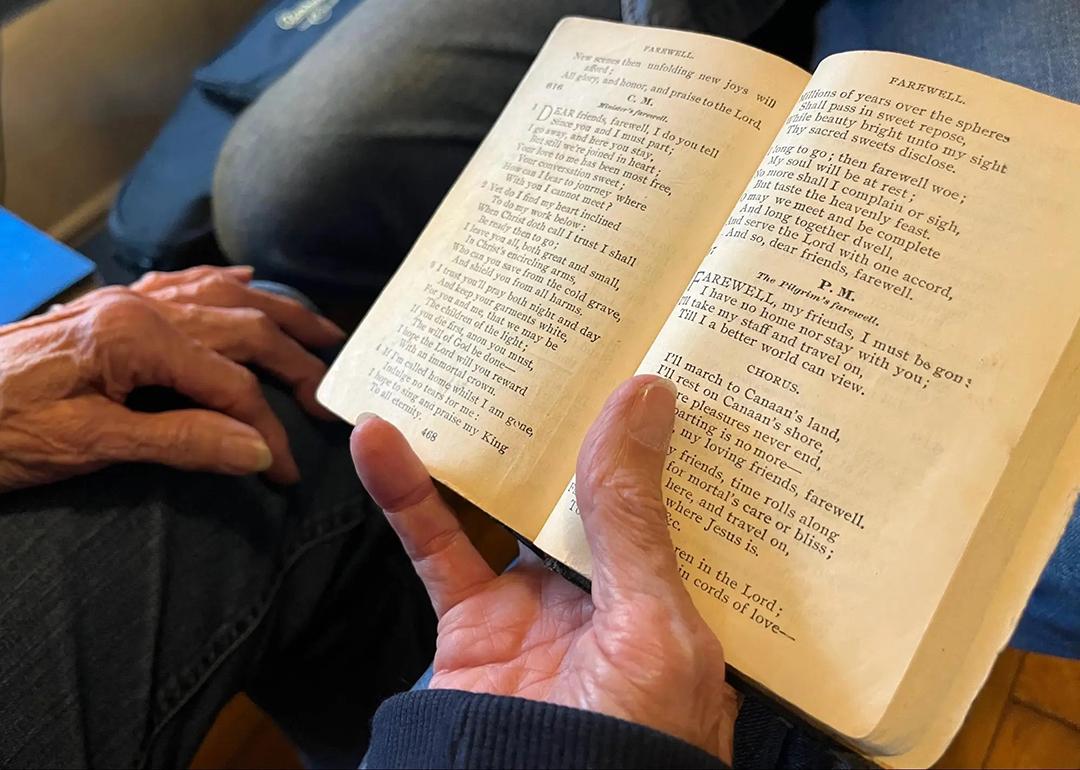
Everywhere she went, Hawker carried along her most prized possession, a little black book: “Lloyd’s Primitive Baptist Hymns.”
Not long after she started spreading the gospel of Primitive Baptist singing, she went to visit her aunt Annie Maud Puckett in a nursing home. Puckett had also grown up in the Primitive Baptist church.
“She said, ‘I heard you’re singing those old hymns,’ and I said, ‘Yes, when I am in a place where people are listening,” Hawker said.
Though Hawker wasn’t always singing the Primitive Baptist songs in religious spaces, she was careful to only bring them out when they’d get the reverence they deserved from the audience.
“She said, ‘Well, go over there on the dresser and take that little black book. That’s for you,” Hawker said.
Hawker left that day with Puckett’s copy of “Lloyd’s Primitive Baptist Hymns.” And that battered old hymnbook still carries the mark of her aunt’s time working in tobacco fields.
“All my aunts and uncles worked in tobacco: handling leaves, pulling tobacco out of the fields and everything. The thumbprints with tobacco on them are pretty obvious,” she said.
It was this worn-out, tobacco-stained hymnal that accompanied Hawker to West Virginia University a few years ago. Music professor Travis Stimeling invited her to speak—and sing—at a class.
“We see this short lady walk in, her hair all done up. She just sits there really quietly and all of a sudden she starts singing and you can feel the wall of sound,” said Mary Linscheid, who was in attendance that day. “It was like, whoa, she’s a powerhouse. I wanna be like her.”
Linscheid had grown up around music. Her parents are both classical musicians, and her dad was also a big fan of southern gospel and bluegrass music. Linscheid herself had grown up playing classical violin before getting into old-time music. But she’d never heard anything like Hawker.
“There’s just something about the sound of that singing that reaches deeper than words. That just grabs you,” Linscheid said.
After Hawker’s visit, Linscheid reached out to Stimeling and asked if Hawker would teach her to sing in the Primitive Baptist style. It was perfect timing for Hawker’s part.
This was 2021 and, though the COVID-19 vaccine had been released, people still were not gathering.
“Nobody wanted to get anybody my age sick,” Hawker said. “It was so nice every Thursday to see [Mary’s] face. It saved my life that winter. I’ve loved her ever since. She’s my rock.”
Their first lesson was “Amazing Grace”—a classic old hymn, sung by lots of churches but none like the Primitive Baptists.
“Mary was the first and only student I’ve ever had that could really hear that, the first time,” Hawker said.
What Linscheid heard was something she didn’t find in the classical music she grew up playing.
“There’s a lot of faking it in classical music. Move your body in this way to fake emotion while you’re playing,” she said.
±õ³Ù’s even something that was lacking in the Baptist church where her family attended and Linscheid played in the worship band.
“They had a fair amount of traditional hymns they would do, and that was mixed in with the modern praise and worship music. And I always hated that,” Linscheid said.
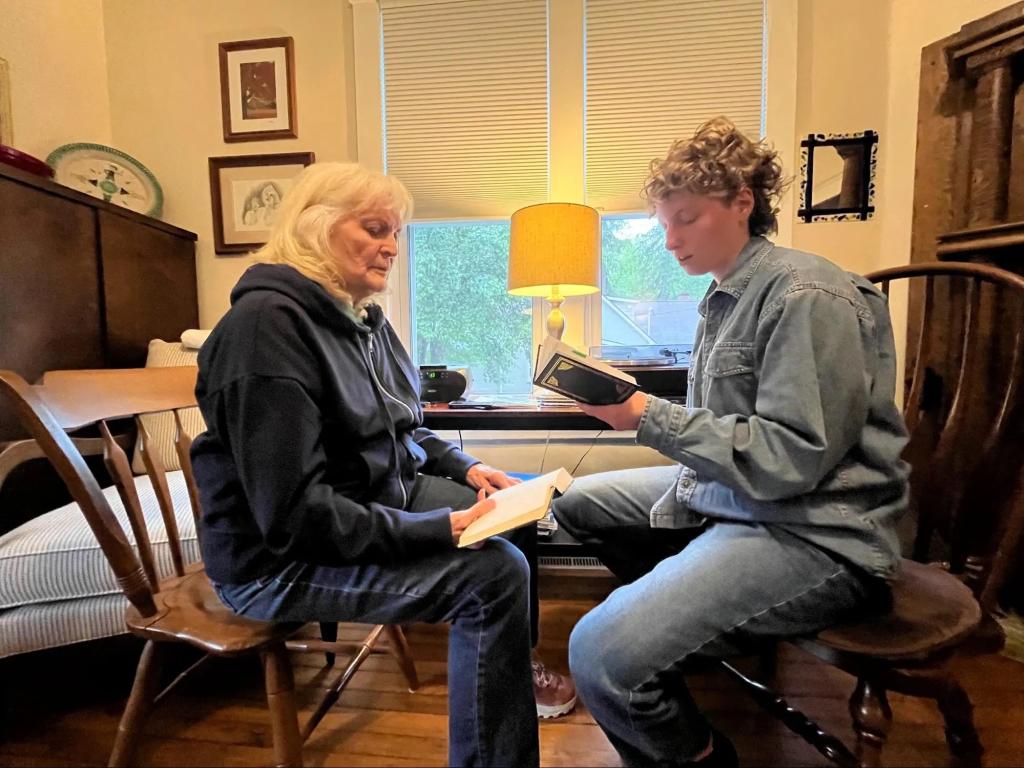
Those other styles might have been more polished. But for Linscheid, they couldn’t beat Primitive Baptist singing in conviction.
“Ginny always says, ‘Good singing is better than pretty singing any day.’ So it was a huge, mind-opening experience,” Linscheid said. “You can hear it soothing their own soul, so it’s kind of contagious in that way.”
Over the years, the influence of more popular musical styles has crept into many congregations, changing the sound Hawker remembers from childhood.
“Even if you went back to my grandpa’s church, where my cousins still go, there’s liable to be somebody in there singing harmony. Because they hear it on the radio,” Hawker said.
In 2024, Hawker and Linscheid became part of the —a program that provides a stipend and other support to tradition-bearers and the apprentices who want to learn their craft. As part of that, Hawker wants to take Linscheid to the places where this music is still being sung the way it was when Hawker was growing up. And because every singer needs a songbook, Hawker has also gifted Linscheid a brand new copy of “Lloyd’s Primitive Baptist Hymns.”
“But hers is all new. I wish I could put some tobacco stains in it,” Hawker said.
There may be no tobacco stains, but the soul of Primitive Baptist singing was never on paper anyway.
The melodies come from whoever taught you the song. And the stories—of Hawker’s grandfather, and her dad, her Aunt Annie, now of her and Linscheid—live in the space between those long, lilting notes.
was produced by and reviewed and distributed by Â鶹ԭ´´.