Influential artists of the 20th century
In December 2019, the journal Nature found in Indonesia dating back 44,000 years. Spanning nearly 15 feet, the image depicts human-like figures hunting local species of pig and buffalo. More than twice as old as the oldest previously discovered cave art, the images represent the world's oldest-known figurative artwork, which clearly depicts figures or objects found in the natural world. Since it shows a complete scenario of humans interacting with animals, it's more than art, in a way—it's the oldest surviving story in the world.
Long after the early humans who adorned those caves were gone, people across nearly every region of the world, every civilization, and every religion continued to channel experiences into art. Names like Leonardo da Vinci, Vincent van Gogh, Michelangelo, and Rembrandt endure through the ages for the art they left behind. The work they and others created—like the "Mona Lisa," "The Starry Night," "The Last Supper," the ceiling of the Sistine Chapel, "Salvator Mundi," and "David"—are among the most treasured objects on Earth.
No one has to travel back tens of thousands of years or even a few centuries, however, to find inspiration from history's most influential and important artists. Artists who lived and worked in the 20th century produced some of the most significant pieces of art the world has ever known—and many of those artists are still walking among us today.
Using information from museums, collectors, news reports, and other sources, Â鶹ԭ´´ compiled a list of some of the most influential artists of the 20th century. Some were born and worked in the 1800s, but carried over into the century that just passed. Others continued their work into the new millennium. All, however, created art for at least part of their working lives in the 1900s.
Pablo Picasso
Few names in the history of art ring louder than Pablo Picasso, who was born in Spain in 1881 but spent most of his career living and working in France. Although he’s known as the godfather of the Cubist movement, Picasso left behind more than 20,000 works of art that spanned an incredible range of styles and types, including sculptures, drawings, ceramics, and, most famously, paintings. Among his most famous works are “Guernica,” “The Weeping Woman,” and “Don Quixote.”
Andy Warhol
Andy Warhol will always be remembered as the most influential figure in the pop art movement. Although his early art in the 1950s was important and prolific, the 1960s was the decade of Warhol, when he created his most famous works exploring the relationship between media, marketing, and popular culture. Among his most masterpieces were “Coca-Cola [2],” “Campbell’s Soup Cans,” and celebrity portraits of Marilyn Monroe, Elvis Presley, and Elizabeth Taylor.
Banksy
Active since the 1990s, Banksy is an anonymous street artist, activist, filmmaker, and occasional vandal whose identity is still unconfirmed. He began as a freehand graffiti artist and has amassed a cult following to become an iconic figure on the fringes of the mainstream art world. His impromptu and unsanctioned public artwork, which often skews political, is frequently sold after the walls he paints are taken apart and carted away.
Christo and Jeanne-Claude
Born on the same day in 1935, married couple Christo and Jeanne-Claude created massive environmental art on scales so large that their projects were considered controversial simply for their scope. “The Gates,” for example, spread more than 7,500 saffron fabric-adorned structures across New York City’s sprawling Central Park in 2005. “The London Mastaba” was a plateaued pyramid made from more than 7,500 oil barrels floating on the Serpentine lake in England.
Cindy Sherman
Born in 1954, Cindy Sherman's entire artistic portfolio consists of photographic self-portraits. Although she has depicted herself in many contexts and situations, much of her work is an extended critique of gender and female identity. Her seminal work is "Untitled Film Stills," a series of black-and-white photos taken between 1977–1980. Sherman remains active today.
Jackson Pollock
One of the most important figures in the abstract impressionist movement, Jackson Pollock, like Pablo Picasso, is a household name even among people not particularly well versed in modern art. Born in 1912, Pollock pioneered the drip technique, sometimes called “action painting,” which involves splashing paint from above onto a large horizontal canvas on the floor. The result was lineless artworks, exemplified by his 1948 work “No. 5.”
Georgia O’Keeffe
Born in 1887, Georgia O’Keeffe died in 1986, but during her near-century of life, she cemented her legacy as one of the most important artists in history. One of the founding figures of American Modernism, O’Keefe is most famous for her paintings of New Mexican landscapes, flowers, and urban scenes involving New York City skyscrapers.
Jeff Koons
Jeff Koons is still working today, but he rose to fame in the art world in the 1980s with sculptures and inflatables that followed in the footsteps of Andy Warhol. Koons’ work has a pop aesthetic that deals with popular culture and the media. In 2013, his piece “Balloon Dog,” sold for $58.4 million, breaking the record for a work by a living artist. He lost the title briefly, then won it back again in 2019 when his sculpture
Marcel Duchamp
French American painter and sculptor was born in 1887. He was active in the first decades of the 20th century before renouncing art and dedicating his life almost solely to playing chess. His work earned him a place among the likes of Henri Matisse and Pablo Picasso—the trio is credited with revolutionizing plastic art in both painting and sculpting in the early 20th century.
Anish Kapoor
British Indian artist Anish Kapoor's most celebrated work consists of large-scale public sculptures. His work has adorned public space in New York City's Rockefeller Center, and Kensington Gardens and Olympic Park in London. "Cloud Gate," known informally as "The Bean," is his most famous creation, located in Chicago's Millennium Park.
Piet Mondrian
Dutch painter Piet Mondrian was born in 1873 and went on to become one of the most important and influential artists of the 20th century. One of the founding fathers of abstract art, Mondrian cofounded the De Stijl art group and movement with Theo van Doesburg. The group included Georges Vantongerloo and Bart van der Leck and became the genesis for the non-representational Neoplasticism movement.
Damien Hirst
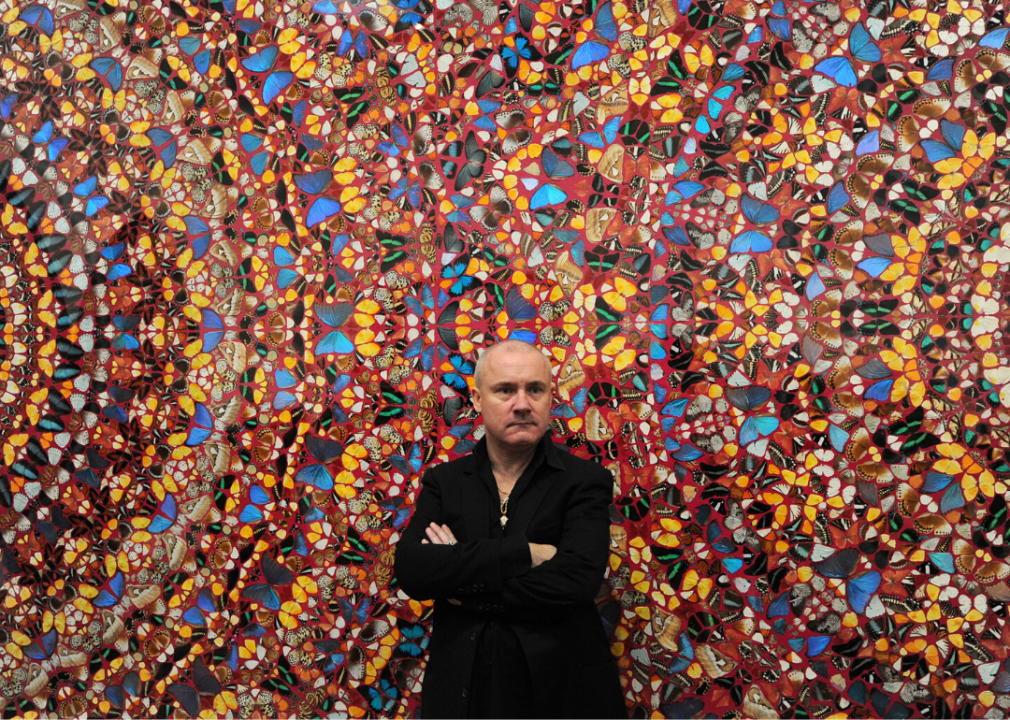
British contemporary artist Damien Hirst was one of the so-called “Young British Artists” who dominated the 1990s art scene in the U.K. and continues to work today. In 2008 he did something no living artist had ever done before when he auctioned off an entire show at a Sotheby’s. Called ” the event broke a single-artist auction record when it fetched a combined $201 million.
Louise Bourgeois
Born in Paris in 1911, Louise Bourgeois lived to the age of 89. She was one of the most famous artists of the 20th century mostly for her large-scale sculptures and installation art, but she was also an influential printmaker and painter. Her sculpture “Maman” is located outside the Guggenheim Museum in Bilbao, Spain, and takes the shape of an enormous spider, a recurring theme in her work.
Roy Lichtenstein
Roy Lichtenstein joined Andy Warhol as one of the most famous and important pop art innovators in the second half of the 20th century. Influenced by advertising and the comic book style, Lichtenstein’s paintings were often satirical in tone. His most famous works are “Look Mickey,” “Drowning Girl,” and “Whaam!”
Frida Kahlo
Born in Mexico City in 1907, Frida Kahlo never lived to see her 50th birthday, but during her short life, she created a treasure of self-portraits that made her autobiographical paintings among the most important works of the century. Her paintings were deeply cultural, and often examined the history and civilization of Mexico, including frequent artistic statements about gender, colonialism, and indigenous heritage.
Salvador Dali
Like Picasso, Rembrandt, and Monet, someone only needs to mention Salvador Dali’s surname to conjure images of the Spanish Surrealist’s most important works. In the 1920s, the eccentric Dali worked with artists like Miró, René Magritte, and Picasso. His 1931 masterpiece “The Persistence of Memory” is probably the most famous Surrealist painting in the world.
Claude Monet
Claude Oscar Monet was born in 1840 and completed many of his most important works in the 19th century, but thanks to his longevity—he lived to be 86—the art world got to enjoy his contributions through the 1920s. He will forever be remembered as the founder of the Impressionist movement and, like Dali and Picasso, his legacy is so significant that his last name alone will suffice. In the 1890s he began painting the same natural scenes—most notably water lilies—multiple times to account for changes in sunlight, work that would take him into the 20th century and consume the rest of his working life.
Pierre-Auguste Renoir
Another giant of Impressionism was Pierre-Auguste Renoir, who, like Monet, was born in the early 1840s but lived and worked into the 20th century through World War I. Some of his most important works were done in the early 1900s, including his later self-portraits and several of his famous nudes, despite the fact that by that point he had developed severe rheumatoid arthritis.
Annie Leibovitz
Annie Leibovitz photographed John Lennon on the day he was murdered. Most famous for her celebrity portraits, which were often done in intimate and vulnerable settings and poses, Leibovitz pioneered new techniques in lighting and staging. She has worked for both Vanity Fair and Rolling Stone, where she became the first woman to be named chief photographer.
Anna Hyatt Huntington
Born in 1876, Anna Hyatt Huntington lived to the age of 97, and her career spanned much of the 20th century. Her legacy honors her contributions as a patron of the arts almost as much for her work as an artist. She's best known for her animal sculptures—although her most famous works, "Joan of Arc" and "Diana of the Chase" depict humans—and is known for using her inherited fortune to establish America's first outdoor sculpture garden, Brookgreen Gardens in South Carolina.
Alberto Giacometti
Swiss sculptor Alberto Giacometti was born into the world of art—his father was a Post-Impressionist painter. His sculptures, among the most important and lauded of the 20th century, were influenced by several movements, most notably Cubism and Surrealism. For a period between the late 1930s and early 1940s, his sculptures were tiny—never more than 3 inches tall—to portray the actual distance between the artist and his work.
Grant Wood
Grant Wood’s masterpiece “American Gothic” is arguably the most iconic and instantly recognizable painting of the 20th century—it has spawned countless parodies, advertisements, and Halloween costumes since Wood first unveiled it in 1930. Most of his work portrays American life in the rural Midwest. Wood was born in Iowa and died there, and his childhood home is a designated historic landmark.
Mark Rothko
Mark Rothko was a Latvian American painter who didn’t personally identify with any movement but is widely associated with Abstract Expressionism. He studied under and was deeply influenced by painter Arshile Gorky at the Parsons School of Design in New York. Rothko is best known for his work featuring colored zones topped with floating spaces of color.
Ansel Adams
Born in San Francisco in 1902, Ansel Adams was an environmentalist and landscape photographer known for his sweeping black-and-white pictures of the American West. His photography was both a product of and a tool for his environmental activism. He’s also known for his intricate understanding of film, cameras, and photography, and is responsible for innovative techniques involving tonal range, exposure, developing negatives, and printing photographs.
Robert Rauschenberg
Milton Ernest "Robert" Rauschenberg's work spanned six decades and several mediums, including performance, photography, print, painting, and sculpting. Between 1954-1964, he developed his defining work "Combines," which mixed artmaking materials and styles with common, everyday items like pillows, baseball stitching, and newspaper.
Jasper Johns
The work of Jasper Johns influenced virtually every major artistic movement in the United States from the 1950s through the current day. Johns, who is currently approaching 90 years old, laid the foundation for the pop art movement and was among the first to incorporate commercial items into his art—he’s most closely associated with his works that incorporate targets and American flags. His pieces routinely fetch millions, tens of millions, and occasionally nine figures at auction.
Bob Ross
An entire generation of American children grew up learning that in painting, “there are no mistakes, there are only happy accidents.” In terms of bringing art to the masses, it’s difficult to imagine that any single artist was more influential than Bob Ross and his “The Joy of Painting” public television show, which aired from 1983 to 1994. An Air Force veteran, Ross was known for utilizing the wet-on-wet technique, which allowed him to finish entire landscape paintings in less than a half-hour for his viewing audience—but he’ll always be remembered by the millions who watched him for his soft voice, giant hair, and “happy little trees.”
Frank Lloyd Wright
Born in 1867, designed more than 1,000 structures, 532 of which were completed. He’s widely considered to be the greatest architect in American history. He pioneered the Prairie School architectural movement and designed everything from skyscrapers and churches to houses and hotels. His masterpiece is "Fallingwater" in rural southeastern Pennsylvania.
David Hockney
One of the most important British artists of the 20th century, David Hockney’s role in Great Britain’s pop art movent of the 1960s is comparable to Andy Warhol in the United States. Not just a painter, but also a printmaker, stage designer, draftsman, and photographer, Hockney’s experiments included art made with fax machines and iPad programs. It was Hockney who briefly dethroned Jeff Koons for the most expensive work by a living artist when in 2018, Hockney’s “Portrait of an Artist (Pool with Two Figures)” at Christie’s.