The culture illusion at work: When leaders overestimate morale and workers pay the price
When it comes to company culture, the view is better from the top. Many leaders say their teams are engaged and motivated, but workers tell a different story, filled with frustration, fading trust and poor communication.
The difference in how executives and workers see culture reflects broader gaps in how they view professional growth, belonging and the future, according to a from .
The culture confidence gap
Executives may spend their days focused on strategy, but many are not spending enough time talking to employees. While leaders believe engagement and communication are strong, workers report lower satisfaction and weaker connection after years of workplace change.
The difference is clear in how both groups rate overall satisfaction. More than a third of global executives (36%) say their satisfaction at work has improved in the last year. In contrast, only 25% of workers report improvements.
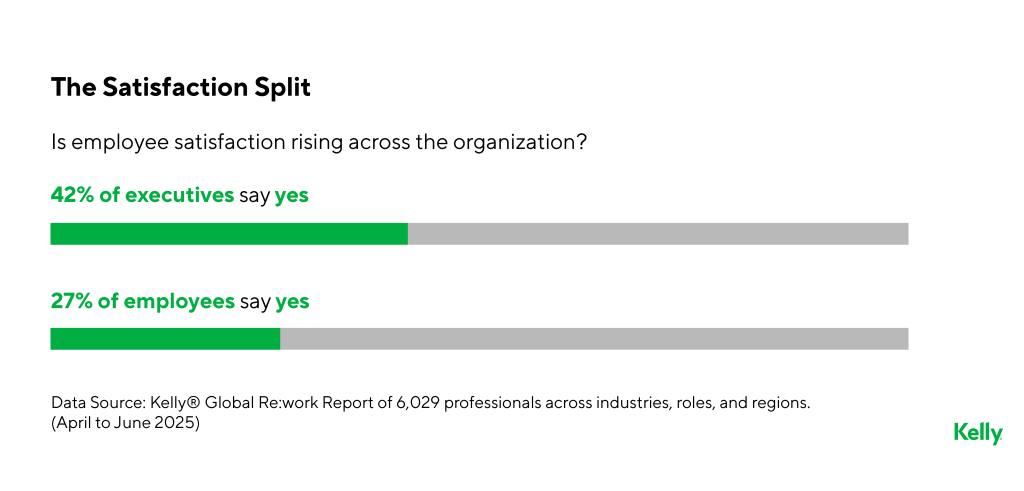
The gap grows when leaders speak for their teams. Forty-two percent of global executives say employee satisfaction is rising across their organization, but only 27% of workers say the same.
The divide is even wider in science, technology, engineering and mathematics (STEM) fields, where leaders and workers report sharply different experiences.
Seventy percent of executives at STEM companies say employee satisfaction is up compared to 55% of workers. Fewer than 1 in 10 executives report a decline, while nearly twice as many workers say morale has fallen.
Experts say perception gaps often stem from how information flows inside organizations. Executives tend to rely on filtered reporting, engagement dashboards and leadership feedback loops that smooth over early warning signs. Hybrid and remote work environments can widen that distance, limiting informal touchpoints where leaders once picked up on morale shifts in real time. Over time, leadership teams risk operating inside an echo chamber, hearing more from peers than from employees navigating daily pressures.
Lack of development and satisfaction harms retention
That culture gap could lead to bigger problems down the road. When leaders assume satisfaction is rising, they overlook early signs of disengagement, and that blind spot erodes trust.
Employees are more likely to trust leadership when training leads to visible career advancement, not just promises. Yet many workers say those opportunities are not happening fast enough, a disconnect that makes talent more likely to leave.
Declining morale also weakens workers' loyalty toward their employers. Many executives believe their teams will stay put, but workers tell a different story. While 40% of global executives say loyalty has improved, only 30% of global workers agree, and more than a quarter (27%) say it鈥檚 getting worse.
Trust goes both ways. Leaders who invest in development expect those new skills to benefit the organization. But according to the report, many workers say they would use those new skills to find a new job if there is no clear path to advancement.
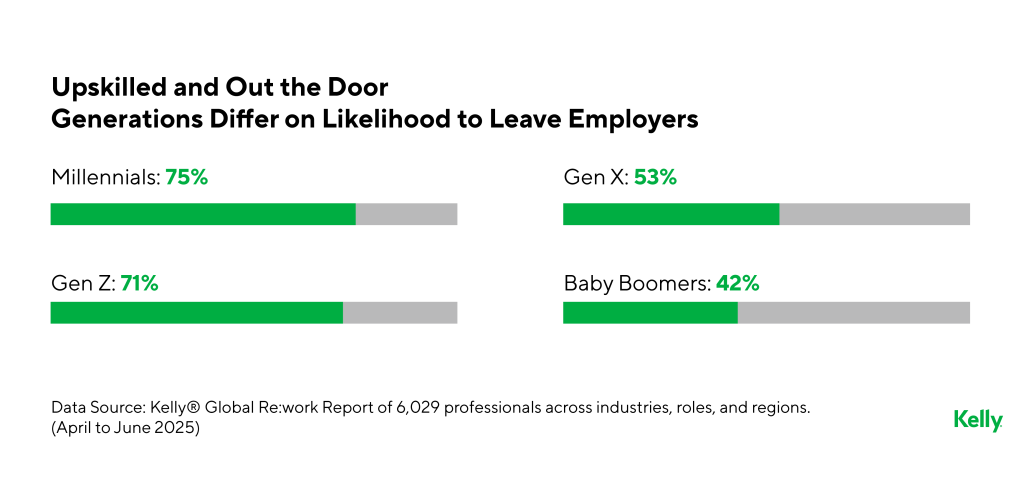
Millennials (75%) and Gen Zers (71%) are the most likely to quit after gaining new skills if they see no clear path forward, followed by 53% of Gen Xers and 42% of Boomers. Together, those four generations make up 85% of the global workforce, a reminder that training without opportunities for growth is not the same as retention.
Workplace culture gaps quickly turn into business risk, especially in knowledge-heavy and fast-moving sectors. When employees feel disconnected or see no path forward, they leave. Each departure drains institutional knowledge, stalls projects and increases pressure on remaining teams. The disruption is greatest in regulated or highly technical roles where replacements take longer to train. Organizations that misread morale often do not recognize the damage until retention drops and rebuilding becomes far more costly.
Belonging could be the missing link
Many leaders believe they have met diversity and inclusion goals, but employees feel unheard. When company leaders fail to act on cultural promises, trust erodes.
Perception gaps extend into whether employees believe inclusion efforts are real. More than half of global workers (57%) say they want their employer to support diversity, equity and inclusion (DEI) efforts. Most executives say those efforts are still happening, but 20% say they have removed DEI language from marketing materials. That may, in part, explain the different views on which initiatives exist. For example, 82% of STEM executives say their organization has programs to recruit, develop and retain women, but only 59% of STEM workers say these programs exist.
Culture fades without communication
The picture of a company鈥檚 future is painted by its leaders, but not everyone sees the same image.
The report shows another gap emerging around confidence in what lies ahead. Nearly 8 in 10 executives (78%) say the business outlook looks strong, while many employees remain uncertain. While leaders focus on growth, workers brace for setbacks. In industries undergoing rapid transformation, that disconnect can make change initiatives harder to implement and weaken alignment across teams.
The divide is sharpest in STEM fields, where workers are far more likely than executives to expect conditions to worsen over the coming years (14% compared to 7%).
Communication bridges optimism and trust. Executives often see disruption as an opportunity, while workers see risk. When leaders are transparent about strategy and change, employees can better connect their roles to the company鈥檚 goals and share that same confidence in the future.
Trust is not given; it must be earned.
The report suggests organizations must move beyond annual culture surveys and adopt continuous listening strategies. Pulse checks tied to retention risk, internal mobility tracking and manager-level engagement data can help leaders identify disconnects earlier. Companies seeing stronger alignment are prioritizing three actions: increasing direct communication between leadership and frontline teams, linking development programs to measurable career pathways, and auditing whether inclusion initiatives are visible and understood across all levels of the workforce.
Organizations that treat culture as a measurable business driver rather than a branding exercise are twice as likely to report they are prepared for the future. Closing perception gaps early protects retention, strengthens trust and develops future leaders before disengagement becomes irreversible.
Methodology
Kelly commissioned Atomik Research to conduct an online survey of professionals across the globe. The sample included 2,011 executives and 2,009 workers. The margin of error is plus or minus two percentage points for each audience at a 95% confidence level.
Fieldwork was conducted between April 25 and May 16, 2025. Atomik Research, part of 4media group, is a creative market research agency.
was produced by and reviewed and distributed by 麻豆原创.