How smart brands are delivering Netflix-level personalization with AI
Remember the last time you got an email that started with ‘Hey {First_Name}’ and immediately felt like deleting it? That visceral reaction isn't just about poor execution — it signals a fundamental shift in buyer expectations.
that 78% of customers expect more personalization in business interactions than ever before. Yet only 47% of business leaders say their customer service experiences are highly personalized.
You can no longer rely on old-school personalization tactics like adding basic customer details to a holiday card or making a generic comment like “I love what your company is doing” in your outreach.
Buyers want to feel like their favorite brand understands their underlying needs and motivations. And they’re doing business with those who prioritize deep connection.
The Next Chapter of Personalization
These expectations have raised the bar. You know that “How did they know?” moment when you’re browsing Netflix and the algorithm picks your next binge-watch for you — and actually gets it right?
That’s the new personalization standard that buyers are holding your brand to.
Reaching that level of resonance isn’t possible with old marketing tactics. The good news is that we’re in the age of AI, where traditional marketing strategies have evolved and opportunities for hyper-personalization are endless.
This is where playbooks like ’s framework come in. Businesses need the right tools to adapt to a world where you have access to unlimited information and endless distribution channels — and AI to make sense of it all.
The Loop is the four-stage playbook that helps businesses evolve with customer habits. Here are the stages:
1. Express who you are: Define your taste, tone, and point of view.
2. Tailor your approach: Use AI to make your interactions personal.
3. Amplify your reach: Diversify your content across channels for humans and bots.
4. Evolve in real-time: Iterate quickly and effectively.
Each of these stages is important, but today, the focus is on Tailor.
When you combine AI efficiency with human authenticity, you can deliver customer experiences that feel one-on-one at scale. And knowing how to tailor your messaging effectively is how you get there. Here’s the breakdown.
Tailoring a Custom-Fit Message
Tailoring is about making your content feel personal, not just personalized.
As a brand, you want to leverage your unified customer data — everything from call records to website behavior — to create genuine relevance. That means developing solutions that resonate with both prospects and existing customers.
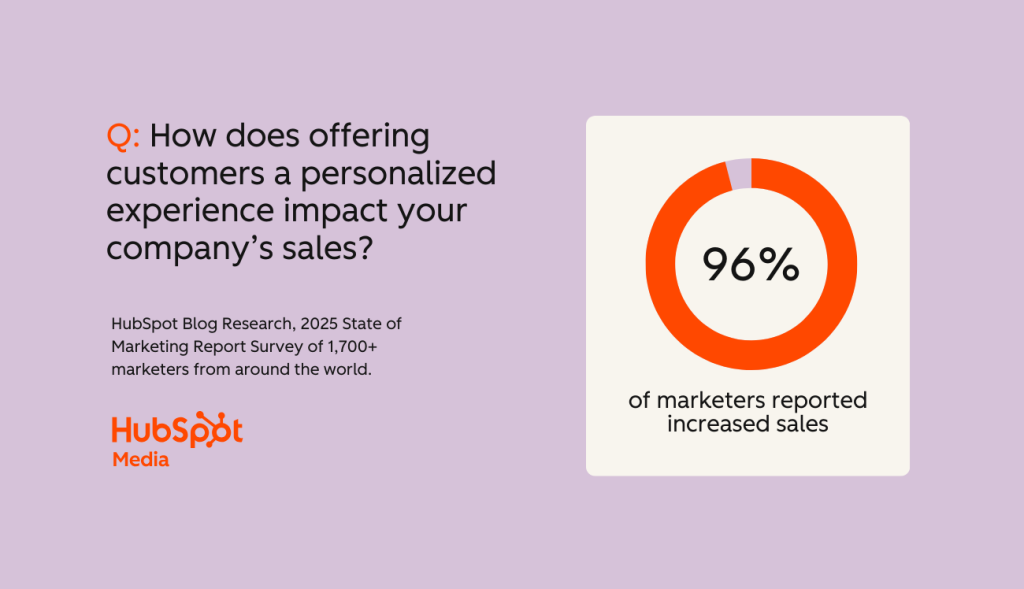
, a whopping 96% of marketers reported that personalized experiences have increased sales.
And that’s a big reason why brands like Netflix, Spotify, and Amazon are at the top. They use data about your past behavior to predict your future preferences — whether that’s a TV show, a playlist, or a product recommendation. The more you know about your target customer, the easier it is to meet (and exceed) their expectations.
Delivering that kind of one-to-one relevance starts with the data you use to power your strategy. Here’s what that looks like in practice.
Gathering the Data That Matters
Most businesses are sitting on goldmines of customer data. Customer interactions live in help desk portals, intent signals hide in analytics, and behavior patterns are scattered across platforms.
The tricky part isn’t gathering the data — it’s making sense of it all. If you can’t connect the dots, all of that good data goes unused.
Take this example: You’re doing cold outreach to the VP of Product at a fintech startup. Sure, it’s nice to know basic information like their industry and company size. But what if you also knew that the company just secured another round of funding and is preparing to expand into the SMB market?
That's the difference between surface-level tracking and enriched intelligence. It’s knowing exactly where each buyer is in their journey and using that context to guide your marketing strategy.
The key to nailing this is using the right tools to bring those scattered signals together. Many of these tools are powered by AI to help you layer context — like firmographics, industry movements, and company news — into your existing contact records.
You can then pull data across your entire tech stack — your CRM, marketing automation, website analytics, even your sales team's conversation notes — and compile these touchpoints into a single source of truth.
Once your data is unified, the next step is turning those insights into customer profiles you can actually act on.
Moving from Insights to Customer Profiles
With data at the foundation, you can turn your rich, contextual insights into real target audience segments. That means going beyond traditional demographics like “Marketing Manager, 25-35, SaaS.”
Today‘s top marketing campaigns are built around intent and timing instead of job titles and company sizes. Brands are zeroing in on hyperspecific audiences like "Companies showing expansion signals who’ve engaged with competitive content in the past 30 days."
Instead of using the static audience approach, use AI tools like ChatGPT to identify dynamic targets based on real-time behavioral patterns and intent signals.
Here’s one approach: Choose a broad intent category (e.g., “actively evaluating solutions”) and layer in context clues (e.g., pricing page visits, competitor research, email engagement patterns, or subtle signals like increased website time-on-page).
Your prompt will look something like this:
“Find contacts who have shown signs of active solution evaluation in the past 30 days. Include behaviors like pricing page visits, demo requests, or content downloads focused on product ROI.”
The beauty of intent-based segmentation is that your messages land when people are ready to hear them, not when your campaign calendar says it's time to send them.
Finding the Intersection Where Personalization Meets Connection
True personalization is about meeting your customers where they are with messages that make them stop and think, “Wait, how did they know that?”
Sprinkling “Hey {First_Name}” personalization into an email is so old playbook. If you truly understand your customers, you can connect your solution to their specific challenges and make your marketing feel more like advice from a trusted colleague.
This approach works across all channels. Take landing pages and CTAs as examples. Rather than using one-size-fits-all messaging, try creating variations that speak to different use cases.
For email campaigns, you can reference recent company announcements, popular industry trends, or seasonal factors relevant to their business in your copy.
Instead of “Save time with our productivity app,” think “Finally, a way to get through your inbox before your morning coffee gets cold.”
If you get stuck, AI can help kickstart your writing process. But the best results come when you pair AI’s speed with your own judgment and make sure the message still sounds human, relevant, and on-brand.
Leaving Room for the Human Touch
If you’re doing business during the AI era, you’re already at an advantage. From data analysis to content creation, AI is helping teams operate leaner and deliver faster results. And that’s exactly what leadership wants to see: fast results.
The catch? AI tools are incredibly powerful, but they’re not infallible. The most brilliant personalization campaigns may fall flat if AI makes assumptions that aren’t quite right or lacks human judgment about timing and context.
rely on it for writing, according to 2025 HubSpot research. And the top challenges they face boil down to inaccurate information and biased outputs.
That’s why it’s so important to build human quality checks into your process.
The most successful teams treat AI as a superpower that amplifies human creativity and strategic thinking — not as a replacement for it. They build systematic review processes that catch issues before prospects ever see them.
If you’re using AI to generate copy, use the right prompts and designate someone on your team to review the content before it enters the final stages of production.
- Does the brand voice feel consistent across all the variations?
- Does the personalization feel natural and helpful?
- Are the facts about both the customer and your product accurate?
- Do the CTAs make sense for where this person is in their buying process?
Even with systematic reviews in place, the reality is that some campaigns will still miss the mark. The difference is catching those misses early and learning from them rather than letting your LLM of choice run unchecked.
Creating Personalization at Scale
When you combine rich data, smart segmentation, AI-powered content generation, and thoughtful human oversight, something remarkable happens. Prospects don't just engage with your content — they build a relationship with your brand.
And at a time when buyers are increasingly skeptical of generic outreach, that human connection is what separates prospects who delete your emails from customers who are enthusiastic about engaging.
was produced by and reviewed and distributed by Â鶹ԭ´´.