
The invisible workplace problem stealing hours
Tools shape everything about an employee’s workday: how they communicate, track information, move between tasks, and experience their workflow. And while organizations invest heavily in software to boost efficiency, productivity depends just as much on how those tools fit together. A streamlined system can speed up work and keep teams aligned; a fragmented one does the opposite. Many employees feel stuck in tech stacks that create more friction than clarity because of overlapping apps, duplicated platforms, and scattered systems that turn simple tasks into multistep searches and constant switching.
’s survey of more than 500 U.S. operations leaders reveals just how widespread this problem has become. Tool sprawl isn’t a niche issue or the result of unusual complexity; it’s the default operating environment for most organizations today. The following report explores how tool overload affects the modern workday: how it slows workflows, scatters information, and drains time through constant switching.
Key Findings
- More than half of organizations (52%) say they’re using too many tools, and only 1 in 4 operate on a consolidated system.
- Teams rely on multiple apps across every core function, with communication especially overloaded as half of organizations use three or more tools just to stay in touch.
- Frustration grows with tool count, and employees in organizations using six or more tools are significantly more likely to say their tech stack is overwhelming.
- Tool switching has become a major time sink: 72% of organizations estimate losing at least 5% of weekly hours to navigating between platforms.
- Most employees (82%) say tool overload harms efficiency, and more than 40% of organizations have already cut or eliminated tools to reduce complexity.
How Do Workplaces End Up With So Many Tools? The Slow Creep of ‘One More App’
For most companies, a scattered tech stack didn’t happen by design; it accumulated one problem, one department, and one “quick fix” at a time. A chat tool here, a scheduling app there, a project board for one team, a spreadsheet for another. Over time, those decisions add up.
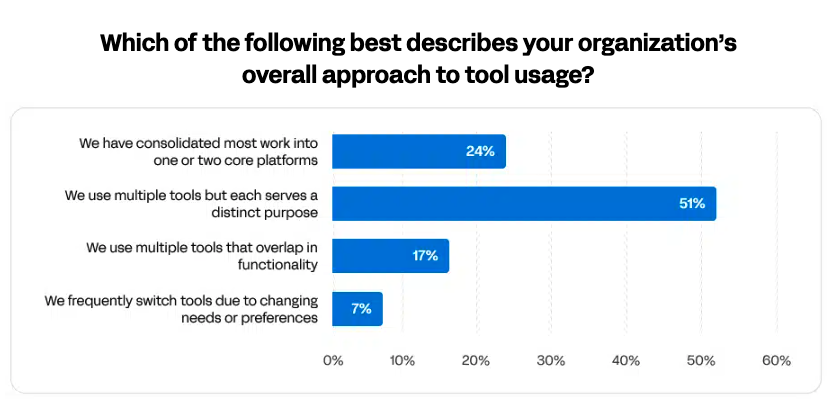
The survey shows just how deeply this pattern is embedded: 51% of companies use multiple tools that each serve a “distinct purpose.” In theory, that sounds reasonable. In practice, it often means switching between apps that perform overlapping tasks, fragmenting work rather than streamlining it.
Only 24% have consolidated most work into one or two core platforms, signaling that true integration is still the exception, not the norm.
Which of the following best describes your organization’s overall approach to tool usage?
The Society for Human Resource Management has , noting that years of ad-hoc software purchases have created a kind of “technology debt” — layers of overlapping platforms that slow teams down and become harder to manage over time.
So tool sprawl is common, but consolidation isn’t. Consolidation requires deliberate effort, and most organizations simply haven’t had the time or bandwidth to make that shift yet.
The Overloaded Tech Stack Behind Everyday Work
Once you look into the actual usage of tools, the sheer scale of tool sprawl becomes even clearer. Across core functions — communication, scheduling, project management, document sharing — most teams aren’t using a single platform. They’re using several.
In fact, two tools per function is the most common pattern, and for many organizations, usage climbs even higher. Communication and collaboration stand out as the most crowded category, with half of teams using three or more tools just to stay in touch. That means employees bounce between email, chat apps, video calls, and other platforms all day long.
Scheduling and time tracking is the only category where a sizable share (33%) use a single tool; however, even here, nearly half rely on two or more.
Approximately how many different tools or platforms does your organization currently use for each of the following?
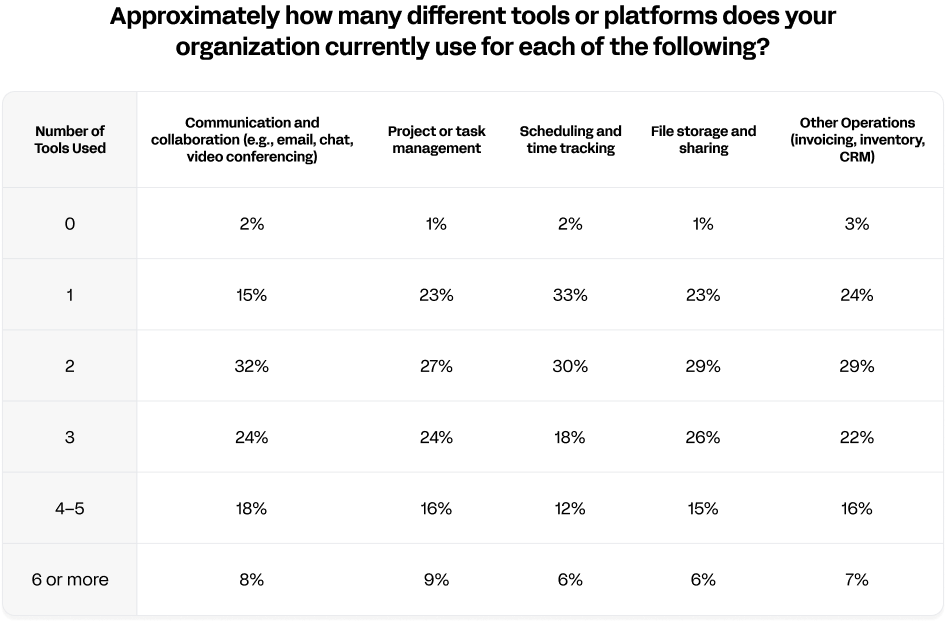
The takeaway is hard to miss: Even small teams are running workflows through multiple apps in every category. It’s not a niche problem or the result of unusual complexity; it’s the default setup for most organizations.
Are Employees Feeling the Weight of Too Many Tools? More Than Half Say Yes
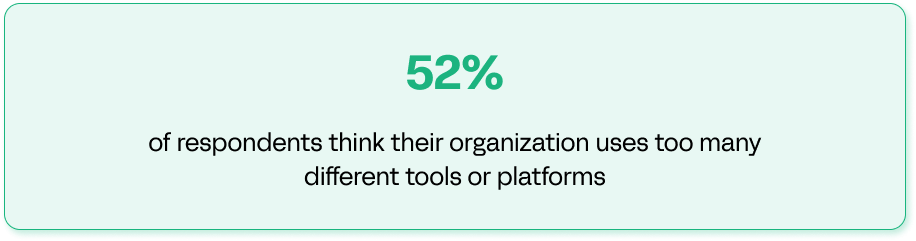
Ask employees whether their organization relies on too many platforms, and more than half (52%) respond that it does. That’s a strong signal that the frustration of juggling tools isn’t just theoretical; it shows up in daily work.
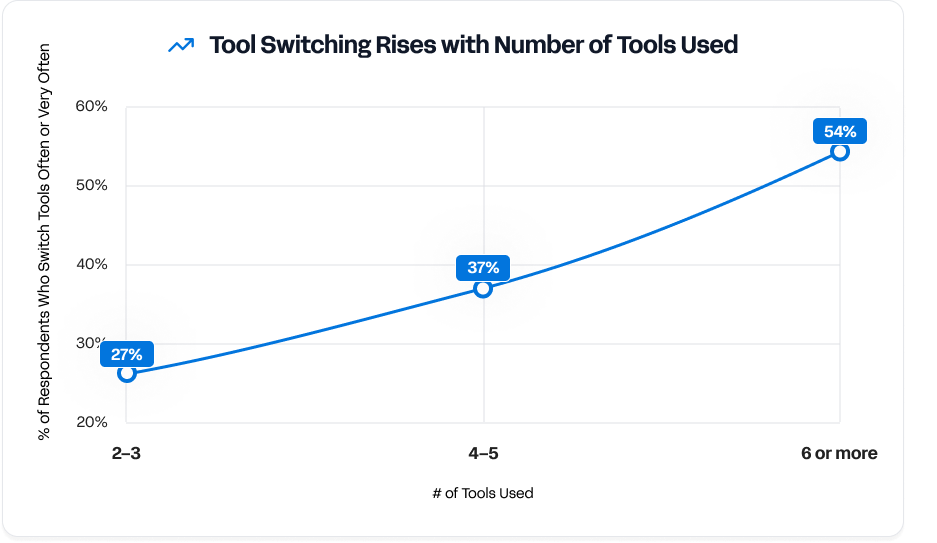
And the more tools in the stack, the louder that frustration becomes:
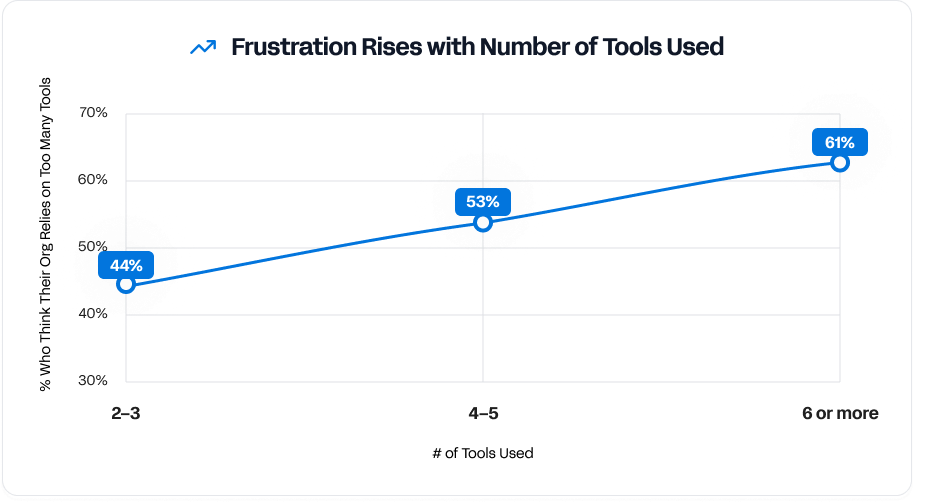
This upward curve is telling. As tool stacks grow, so does the complexity and frustration.
The Organizational Strain Created by Too Many Tools
By the time a tech stack grows bloated, the effects aren’t subtle; they’re woven into the entire workday. The data shows that tool overload doesn’t just complicate workflows; it disrupts how people work, how teams communicate, and how quickly organizations can move.
The most common issues point to a single root cause: fragmentation. Fifty-two percent cite increased workflow complexity, and another 52% report data scattered across multiple systems. When information and tasks are divided across too many places, teams spend more time searching, double-checking, and recreating work that should have been easy to find.
These findings align with , which finds that employees now lose the equivalent of 1.5 days every week simply navigating tools and reconstructing scattered information. It’s not just extra clicks — it’s a structural drain that pulls time away from actual work.
A bloated stack doesn’t just slow people down; it multiplies costs. Nearly half of respondents (49%) say their tools duplicate each other, meaning organizations are often paying for and managing multiple versions of the same functionality. For 48%, too many tools translate directly into higher software costs.
And the human impact is impossible to ignore:
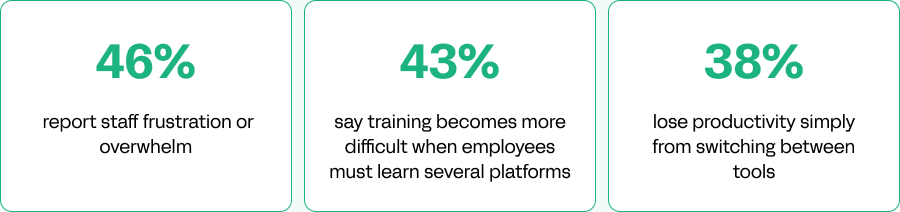
The bottom line: The problem isn’t the tools themselves but the fragmentation they create. As systems multiply, the work slows, the frustration builds, and the hidden costs compound across every part of the organization.
What Happens When Tools Multiply? Switching Takes Over the Workday
If fragmentation is the underlying issue, tool switching is where teams actually feel the cost. And for most employees, switching between tools isn’t an occasional nuisance; it’s the rhythm of the workday.
Tool switching is routine:
- 43% say it happens sometimes
- 31% say it happens often
- 7% say it happens very often
Only 19% rarely or never switch tools, meaning true end-to-end workflows in a single system are increasingly rare.
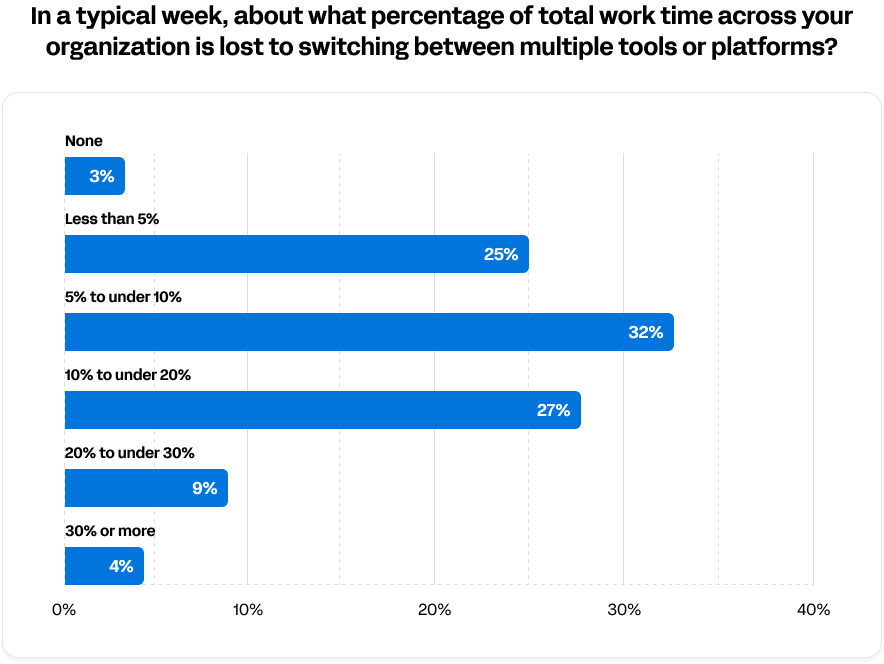
That constant switching adds up fast. Seventy-two percent of organizations estimate that at least 5% of their weekly work hours disappear just from moving between platforms, meaning that teams spend more time navigating systems than completing work.
In a typical week, about what percentage of total work time across your organization is lost to switching between multiple tools or platforms?
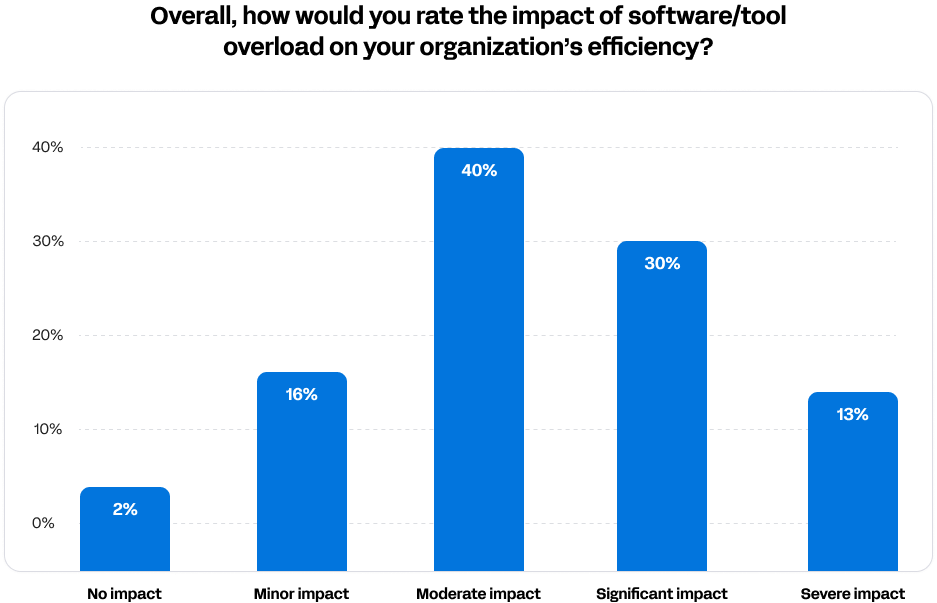
And teams are fully aware of the impact. Overall, 82% say tool overload has at least a moderate effect on efficiency, with 30% calling the impact significant and another 13% describing it as severe.
Overall, how would you rate the impact of software/tool overload on your organization’s efficiency?
A found that nearly half of executives (48%) say the rapid proliferation of digital tools is actively hurting productivity rather than helping it. And 41% of business executives in a agree that their productivity will be hampered in the long run as a result of excessive technology use.
The bottom line: As tools multiply, the switching becomes more frequent, the time loss grows, and the cumulative drag on efficiency becomes impossible to ignore. At a certain point, teams aren’t just working through their tools; they’re working around them.
The Big Takeaway: Tool Sprawl Isn’t a Tech Problem, It’s a Time Problem
Most organizations didn’t set out to create a scattered tool stack. It happened gradually: one new app for chat, another for scheduling, another for project management, another for file sharing.
But today, the costs are clear:
- Employees lose hours switching between tools
- Data lives in too many places
- Teams struggle to stay aligned
- Processes grow more complex rather than more efficient
- Frustration quietly rises
And for small teams especially, every lost hour matters.
That’s why it’s no surprise that nearly half of organizations (43%) in our survey have already cut or eliminated tools in the past year, signaling real pressure to rein in costs and reduce unnecessary complexity.
The future isn’t about eliminating tools; it’s about using fewer, better-integrated ones.
Consolidation won’t fix every workflow issue, but it does reduce noise, simplify training, shrink costs, and give employees back the mental bandwidth they need to focus.
In a landscape where time is the most valuable resource small businesses have, simplifying the tool stack may be one of the easiest wins available.
In the end, the real opportunity isn’t more software — it’s smarter, simpler workflows.
Methodology
This survey was conducted with 534 U.S.-based adults aged 18 or over who are currently employed full-time or part-time as a small business owner, operations manager or leader, or another management professional with operations responsibilities. All respondents had been with their current organization for at least three months; were actively involved in operations management, people management, and oversight or use of work tools or software; and worked at organizations that use at least two tools or software platforms to manage day-to-day work. The survey was fielded online from Aug. 19 to Sept. 3, 2025. Results reflect descriptive statistics with no weighting applied.
was produced by and reviewed and distributed by Â鶹ԭ´´.