Quiz: Can you guess which company owns these brands?
Quiz: Can you guess which company owns these brands?
Here's an experiment: Type "merger" into a Google News search. Yes, like teenagers at summer camp, businesses seem to seek new partners all the time. Just recently, began negotiations to combine their assets, as did . Happy with your T-Mobile cellular service, but worried what a will mean for the market? Switching to another provider could just mean more questions, as merger rumors frequently circulate around most big-name companies.
With so much rapid change going on in the business world, Â鶹ԭ´´ decided to create a quiz with 50 popular brands and the companies that own them. Using various sources to find background history, financial data, and other similar brands, we put this information into a quiz format, where the "clue" slide is the popular brand and the "answer" slide is the parent company.
Who would have thought that Converse, one of the originators of basketball shoes, would be scooped up by a former rival? Or that a fast-food giant known for its finger-lickin' good meals traces its origins to a soda company? If that doesn't knock your socks off, just wait until you get to the company that used a popular rapper to build its brand name, and then said rapper boasted when that company was sold for billions.
We won't break out the red markers or hand out detention passes if you don't fare well on this quiz—we have to admit, some of the parent companies of popular household name brands are headscratchers. But if you want to learn a little bit of history, gain an understanding of what goes into company takeovers, and what major players you should be on the lookout for soon (hint: think internet and e-commerce), then click through and see how many of these 50 questions you can ace.
Brand #1: Converse
- Sector: Clothing
Parent company #1: Nike
Before the Nike “swoosh” became synonymous with athletic sneakers, Converse’s star logo was king of the court—Larry Bird and Magic Johnson both wore Converses during their NBA careers. But in 2003, Nike, which had long surpassed Converse in sales and popularity, acquired the former supplier for Johnson and Bird . Nike, which also owned Cole Haan at the time, added some retro chic to its line, particularly with the iconic Converse Chuck Taylor shoe.
Brand #2: Old Navy
- Sector: Clothing
Parent company #2: Gap Inc.
In the early 1990s, Gap explored creating a chain of retail stores offering more affordable merchandise. In 1994, these “Gap Warehouses” were rechristened Old Navy. For the next 25 years, Old Navy served as a stronghold in the Gap chain, so much so that earlier this year, into a publicly listed company.
Brand #3: Zappos
- Sector: Clothing
Parent company #3: Amazon
During Amazon’s ascent to becoming an online retail giant, the company notably purchased Zappos in 2009 for a whopping total estimated at between and . Zappos CEO Tony Hsieh said led to the deal.
Brand #4: Kate Spade
- Sector: Clothing
Parent company #4: Tapestry
In 2017, in a deal valued at $2.4 billion. Tapestry, which also operates Stuart Weitzman, has not had the expected success with Kate Spade, though. in Kate Spade items and discounts by competing brands have been attributed to stagnancy.
Brand #5: Zara
- Sector: Clothing
Parent company #5: Inditex
Zara's origin began in Spain in 1975, under the guidance of Amancio Ortega. In 2001, Ortega hit the market with an initial public offering (IPO) for Inditex, with Zara serving as the flagship store. In 2018, Inditex recorded , which included merchandise from other stores like Pull&Bear and Bershka.
Brand #6: Blue Moon
- Sector: Beer
Parent company #6: Molson Coors Brewing Co.
Blue Moon founder Keith Villa studied brewing in Belgium. He returned to the United States in 1995 to deploy the tricks of the trade learned abroad at a stand at Coors Field in Denver. Baseball fans became enamored of the beer and, backed by Coors, Villa started a microbrewery to sell what became known as Blue Moon.
Brand #7: Guinness
- Sector: Beer
Parent company #7: Diageo
When companies Guinness and Grand Metropolitan merged in 1997, they christened their new venture “Diageo.” According to AdAge, the name is a portmanteau of the Latin word for “day” and the Greek word for “world.” Today, Diageo also owns whiskeys like Johnnie Walker and rums like Captain Morgan.
Brand #8: Samuel Adams
- Sector: Beer
Parent company #8: Boston Beer Co.
In 1984, Jim Koch started the Boston Beer Co. His first product was Samuel Adams Boston Lager, named after the famous Boston colonial. Earlier this year, Boston Beer Co. .
Brand #9: Cadillac
- Sector: Cars
Parent company #9: General Motors
General Motors acquired Cadillac for in 1909. Over the next century, Cadillac remained a pillar of GM’s business, becoming a status symbol and iconic piece of Americana.
Brand #10: Lexus
- Sector: Cars
Parent company #10: Toyota
Toyota launched its first cars under its new Lexus line in 1989—the LS 400 and ES 250 sedans. Over the years, according to Sharon R. King of The New York Times, and maintained Lexus' high-quality aura by not diluting the brand "with low-priced, less luxurious vehicles to attract buyers." Today, Toyota also holds stakes in Mazda and just renewed a partnership with Subaru.
Brand #11: Lincoln Motors
- Sector: Cars
Parent company #11: Ford
For the costly at the time price of , Ford purchased Lincoln in 1922, helping Ford enter the luxury automobile market in a big way. Today, Lincoln remains one of Ford’s high-end staples, with an planned for future release.
Brand #12: Folgers
- Sector: Coffee
Parent company #12: J.M. Smucker Co.
Two breakfast giants joined in 2008, when J.M. Smucker completed a . Smucker, known for its jams, already owned Jif peanut butter and Crisco. As Smucker has grown, the company , where it has encountered less smooth sailing.
Brand #13: Maxwell House
- Sector: Coffee
Parent company #13: Kraft Heinz
Kraft was sold to Philip Morris for almost , creating one of the biggest mergers in American food history. Maxwell House moved under the Kraft umbrella, but the coffee maker soon may be looking for a new home; earlier this year, reports surfaced that from its portfolio.
Brand #14: Dairy Queen
- Sector: Dining
Parent company #14: Berkshire Hathaway
Berkshire Hathaway, owned by mogul Warren Buffett, in 1997. As 2019 draws to a close, Berkshire Hathaway reports more than $128 billion in cash. Geico and Fruit of the Loom are among Berkshire Hathaway’s other numerous holdings.
Brand #15: KFC
- Sector: Dining
Parent company #15: Yum! Brands
In 1986, PepsiCo purchased KFC, after previously buying Pizza Hut and Taco Bell. In 1997, PepsiCo spun off its fast-food restaurants into a publicly traded company, birthing Yum! Brands.
Brand #16: Michelin Guide
- Sector: Dining
Parent company #16: Michelin
The Michelin brothers founded a tire company in 1889. Eleven years later, in an effort to “encourage more road travel” Michelin published its first guide to restaurants, mechanics, and hotels, and provided other helpful information.
Brand #17: Popeyes
- Sector: Dining
Parent company #17: Restaurant Brands International
Restaurants Brands International (RBI), owner of Burger King, got into the chicken business in 2017, . RBI, which also owns Tim Hortons, saw an uptick in popularity this year when created a craze.
Brand #18: DC Comics
- Sector: Entertainment
Parent company #18: WarnerMedia (subsidiary of AT&T)
In 2018, AT&T forked out to acquire Time Warner, the parent company of DC comic books. However, under the WarnerMedia wing, industry watchers about Batman and his colleagues’ future. While comic book films have dominated Hollywood in recent years, remains to be seen.
Brand #19: Marvel
- Sector: Entertainment
Parent company #19: The Walt Disney Company
In 2009, Disney caught the media world’s attention when it bought Marvel for $4 billion. Ten years later, that at the global box office, thanks to moviegoers’ appetites for Iron Man, Spider-Man, and other superheroes.
Brand #20: Safeway
- Sector: Grocery
Parent company #20: Albertsons
in 2014, to the tune of about $9.4 billion. Albertsons, which also operates ACME, Super Saver, and Vons, had to deal with complaints from Safeway bondholders, but last year was able to .
Brand #21: Sam's Club
- Sector: Grocery
Parent company #21: Walmart
Walmart founder Sam Walton opened his first Sam’s Club in 1983. Like Costco, Sam’s Club is a membership warehouse store and has locations around the world. But last year, Walmart .
Brand #22: Whole Foods
- Sector: Grocery
Parent company #22: Amazon
For $13.4 billion, Amazon purchased Whole Foods in 2017. The move likely was intended to make Amazon a major player in the online food shopping market, but in the first year of the partnership.
Brand #23: Ben & Jerry's
- Sector: Ice cream
Parent company #23: Unilever
Unilever made a fortune selling personal care products like Dove soap, but as any kid will tell you, eating a bar of soap isn’t all that appealing. A few scoops of sweet, savory ice cream, that’s another story. In 2001, , a popular but struggling niche dessert brand at the time, and helped increase profits while keeping Ben & Jerry’s at heart.
Brand #24: Häagen-Dazs
- Sector: Ice cream
Parent company #24: Nestlé (product owner, United States), General Mills (brand owner, international)
In 2001, for the rights to Häagen-Dazs in the United States. (General Mills continued to operate Häagen-Dazs outside the United States). The move was made in part so Nestlé could , which bought the rights to Ben & Jerry’s in 2001.
Brand #25: Kool-Aid
- Sector: Juice drinks
Parent company #25: Kraft Heinz
Kool-Aid's history under Kraft Heinz includes more steps than it takes to make Kool-Aid's sugary drinks. First, Edward Perkins invented Kool-Aid (then called Kool-Ade) in 1927. Decades later, Kool-Aid was sold to General Foods. In 1989, General merged with Kraft. Recently, to adapt to a climate that advocates for more healthy drinks for children.
Brand #26: Minute Maid
- Sector: Juice drinks
Parent company #26: The Coca-Cola Co.
In 1960, Coca-Cola acquired Minute Maid, which the company refers to as a “” for the business. Soon Coca-Cola, which had relied on one product, began releasing a bevy of new drinks and expanded to markets like Japan.
Brand #27: Hulu
- Sector: Media
Parent company #27: The Walt Disney Company, Comcast
When Hulu emerged as a leader in the streaming industry, it operated as a joint venture among several major media companies. But in May, Disney became the primary owner of Hulu when Comcast agreed to sell its stake in the streaming platform. The sale will not take place for another five years, but is estimated to be worth .
Parent company #28: Facebook
Facebook began as a way for Harvard students to connect online. By 2012, Facebook bought Instagram for $1 billion. The deal, which came before Facebook’s IPO, was one of the company’s first forays into gobbling up major online companies.
Brand #29: Twitch
- Sector: Media
Parent company #29: Amazon
In 2014, Amazon promised to pay for Twitch, the video game streaming site. This deal showed that Amazon, which now streams content through Amazon Prime Video, was ready to make a splash in the streaming industry, and that live video game broadcasts were more than a fad. Today, Twitch streams events outside of video games, and video game competitions include several international leagues that sell out stadiums and arenas.
Brand #30: YouTube
- Sector: Media
Parent company #30: Alphabet (Google)
When Google snatched up YouTube for $1.65 billion in 2006, some wondered what copyright concerns the internet titan might encounter in the still nascent world of streaming video. At the time, YouTube was Google's biggest purchase, and despite concerns about YouTube's staying power, the acquisition has worked out well. Still, despite YouTube becoming a household name and some YouTube stars making millions of dollars, the company is facing growing questions over content and .
Brand #31: CNN
- Sector: News
Parent company #31: WarnerMedia (subsidiary of AT&T)
CNN, founded in 1980 by Ted Turner, was acquired by Time Warner in 1996. Earlier this year, AT&T, despite federal appeals, , creating WarnerMedia. The new conglomerate media company also holds the rights to stations like TNT and TBS.
Brand #32: USA Today
- Sector: News
Parent company #32: Gannett
Many newspapers are still sorting out ways to survive in the digital age. One outlet that continues to produce in print and online is USA Today, which was first published by Gannett in 1982. Earlier this year, Gannett reached a deal merging with .
Brand #33: Wall Street Journal
- Sector: News
Parent company #33: Fox Corp.
In 2007, Rupert Murdoch’s News Corp. purchased Dow Jones & Company, whose assets included the Wall Street Journal. Earlier this year, when Disney bought 21st Century Fox, Previously, the Wall Street Journal was owned for more than 100 years by the Bancroft family.
Brand #34: Pepto-Bismol
- Sector: Pharmaceuticals
Parent company #34: Procter & Gamble
Pepto-Bismol was formerly owned by Morton-Norwich Products Inc., of Chicago, but in 1982, . The deal also gave Procter & Gamble rights to Chloraseptic, joining household staples like Tide and Downy.
Brand #35: Tylenol
- Sector: Pharmaceuticals
Parent company #35: Johnson & Johnson
Robert McNeil opened a Philadelphia pharmacy in 1879, which grew to become McNeil Laboratories. In 1955, the lab produced Tylenol for children; four years later, Johnson & Johnson purchased McNeil Laboratories, and Tylenol soon became an over-the-counter drug. The drug's main ingredient, acetaminophen, is advertised as a fever reducer and pain reliever.
Brand #36: Nest
- Sector: Smart home
Parent company #36: Alphabet (Google)
Google purchased Nest, a smart appliance company, for in 2014. But a year later, when Alphabet was created as an umbrella company for Google properties, Nest became its own company. However, in early 2018, Nest once again was .
Brand #37: Ring
- Sector: Smart home
Parent company #37: Amazon
Jamie Siminoff thought his Ring Wi-Fi-enabled doorbells would strike it big on the TV show “Shark Tank.” But when the sharks passed on Siminoff’s technology, and purchased Ring for a reported $1 billion.
Brand #38: Cape Cod Potato Chips
- Sector: Snacks
Parent company #38: Snyder's-Lance (subsidiary of Campbell Soup)
Cape Cod Potato Chips was founded in 1980, and has had several owners. The chip company used to be owned by Anheuser-Busch, but then became a part of the Lance company brand in 1999. Lance merged with Snyder’s of Hanover in 2010, and the Snyder’s-Lance corporation was purchased by Campbell Soup in 2017.
Brand #39: Flamin' Hot Cheetos
- Sector: Snacks
Parent company #39: Frito-Lay (subsidiary of PepsiCo)
Charles Elmer Doolin created the Frito chip and the Cheeto, which both fell under the Frito-Lay brand when Frito merged with H.W. Lay & Co. in 1961. However, it was , which made its debut in the early 1990s.
Brand #40: Teddy Grahams
- Sector: Snacks
Parent company #40: Nabisco (subsidiary of Mondelēz International)
In the late 1980s, Nabisco introduced Teddy Grahams, and in their first year on the market. Kraft and Nabisco reached a partnership in 2000, and in 2012, Kraft .
Brand #41: Gatorade
- Sector: Sports drinks
Parent company #41: PepsiCo
By merging with Quaker Oats in 2001, PepsiCo acquired the coveted Gatorade brand in a . Pepsi outbid rival Coca-Cola for Quaker Oats, which also produced Aunt Jemima products and Cap’n Crunch cereal.
Brand #42: Vitamin Water
- Sector: Sports drinks
Parent company #42: The Coca-Cola Co.
Rapper 50 Cent, an early endorser of Vitamin Water, once bragged on the song “” that he helped the sports drink sell to Coca-Cola for billions. The exact amount Coca-Cola paid to acquire Glaceau, Vitamin Water’s parent company, was $4.2 billion. How much 50 Cent earned off the deal is unknown, but he later .
Brand #43: ESPN
- Sector: Sports media
Parent company #43: The Walt Disney Co.
In 1995, , a deal that included the cable sports behemoth ESPN. The marriage took ESPN to new heights, as it has broadcast all four major U.S. sports leagues since Disney entered the fold, as well as a plethora of major golf, tennis, soccer, and college sports events. Earlier this year, Disney made another huge splash when it .
Brand #44: Sports Illustrated
- Sector: Sports media
Parent company #44: Authentic Brands Group
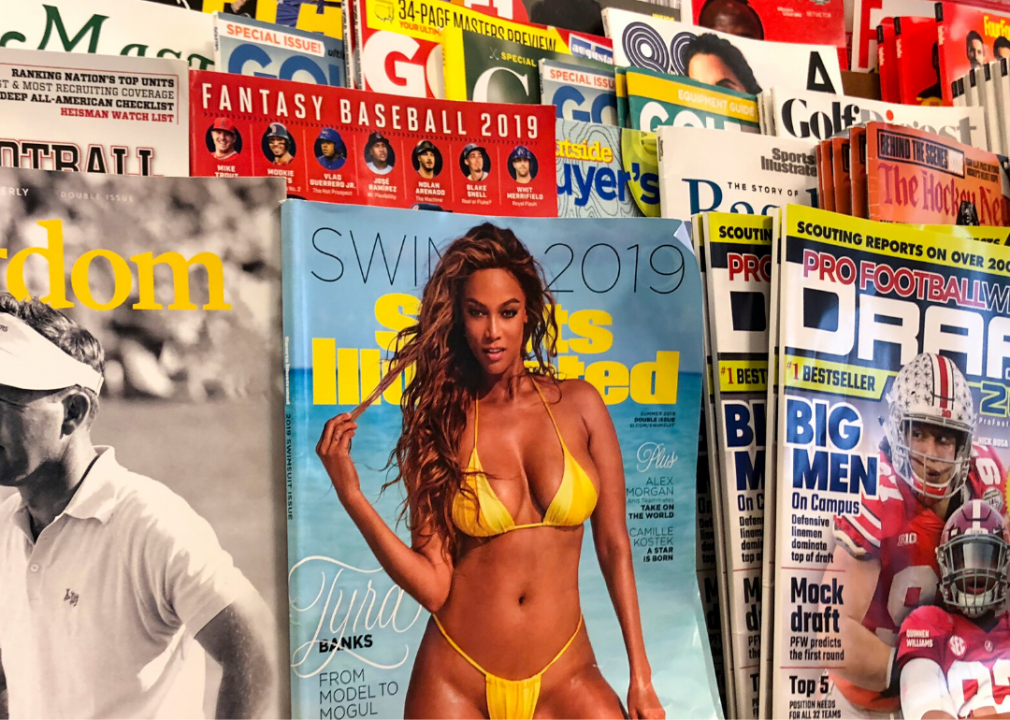
In May 2019, to Authentic Brands Group for $110 million. Authentic Brands managed companies like Nautica, and the licensing and trademark rights for several deceased celebrities, but had not made many notable splashes in the publishing field. Four months after acquiring the heralded sports magazine, Authentic Brands announced at the magazine.
Brand #45: Beats
- Sector: Technology
Parent company #45: Apple
Music producer Dr. Dre is known for his high-profile collaborations, but his duet with Apple may have been the most profitable. Dre, who with Jimmy Iovine made Beats headphones popular, in 2014. Previously, Beats was , a relationship that did not end as positively.
Brand #46: Oculus
- Sector: Technology
Parent company #46: Facebook
Facebook ponied up $2 billion in 2014 to purchase Oculus, a virtual reality company with deep seeds in the gaming world, to everyday life. Despite a slow start, Facebook seems intent on pushing VR, as it , a VR game studio.
Brand #47: Xbox
- Sector: Technology
Parent company #47: Microsoft
After delays, Microsoft released its Xbox gaming system in the fall of 2001. It was Microsoft’s first game console, and subsequent versions like the Xbox 360 and Xbox One have been top sellers in the video game world. As of 2018, , making them a notable force in the industry.
Parent company #48: Unilever
In the summer of 2016, Unilever purchased the direct-to-consumer Dollar Shave Club razor business. Unilever shelled out a reported $1 billion for the company, which was founded in 2012. With various skin-care and hair-styling products in Dollar Shave Club’s line, Unilever said the company brought “a unique male grooming perspective” to a growing market.
Brand #49: Old Spice
- Sector: Toiletries
Parent company #49: Procter & Gamble
When Procter & Gamble purchased Old Spice for $300 million in 1990, a P&G executive told reporters, Fast forward almost 30 years later, and Old Spice commercials are some of the most recognizable on television, injecting a vintage brand with some new wave appeal.
Brand #50: Tom's of Maine
- Sector: Toiletries
Parent company #50: Colgate-Palmolive
Back in 2006, when the natural oral and personal care product market was , Colgate-Palmolive jumped at the chance to acquire a market leader, Tom's of Maine. Already the home of Mennen, Irish Spring, and other household brand names, which was known for its natural toothpastes. its products were not entirely natural.