Why do foreign investors buy American farmland?
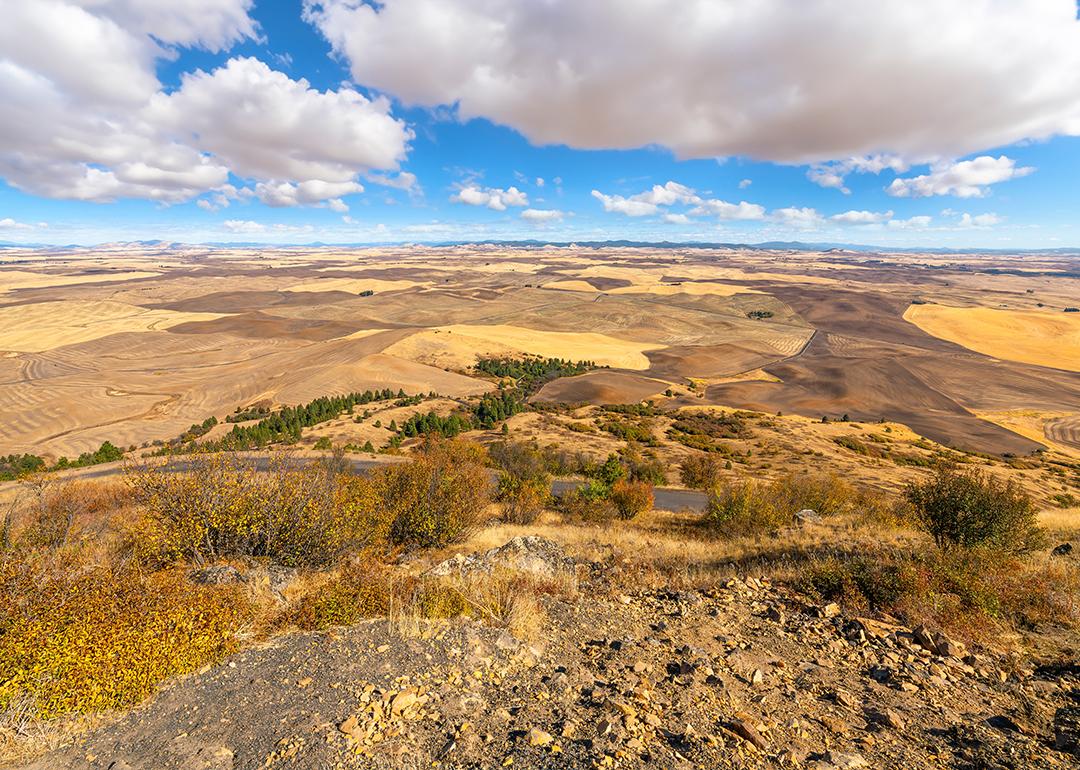
Foreign investors own almost 46 million acres of farm land in the United States, according to data from the 1978 , a federal law meant to track international interest in American land. Foreign-owned farmland had a total estimated value of $82.6 billion in 2023, the last year of available data, the reports.
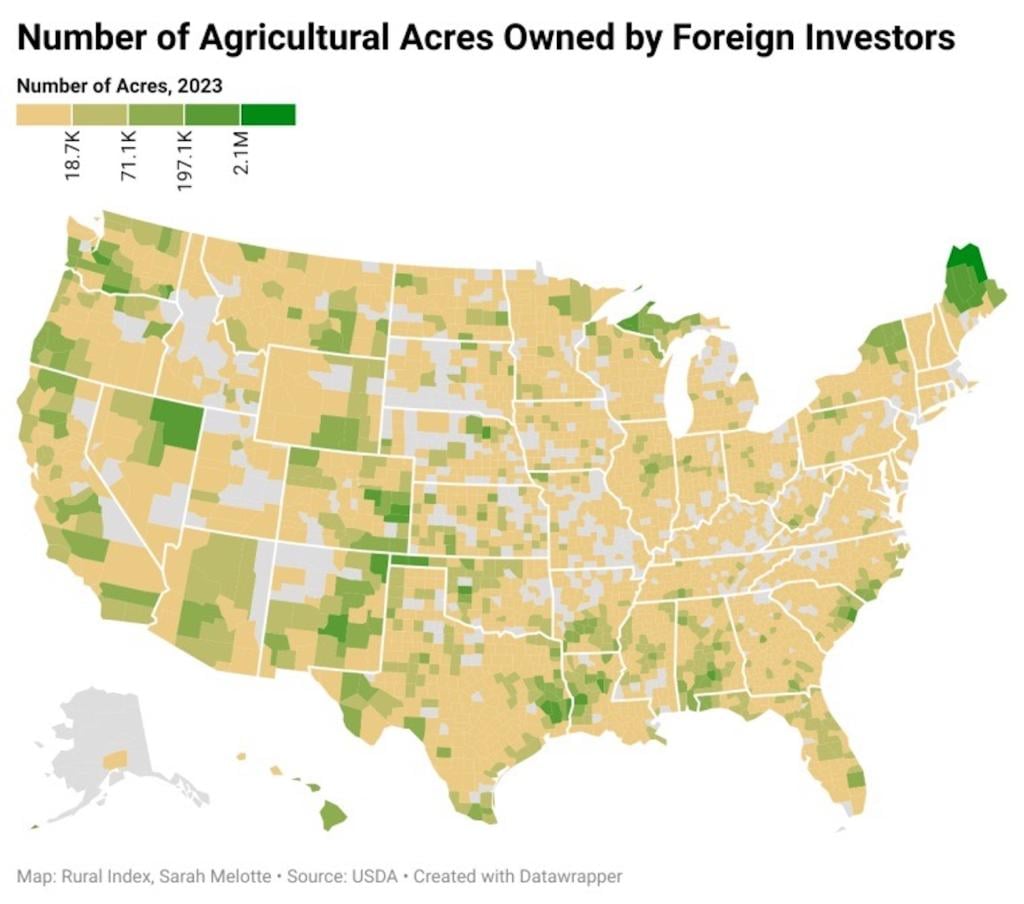
Readers should note that AFIDA data doesn鈥檛 always accurately reflect the current value of a tract of farmland. This can happen for a variety of reasons. Sometimes, USDA employees make manual mistakes while entering data. Other times, the value of the land reflects its original purchase value, which might differ from its current value if it was purchased decades ago. Readers should also note that AFIDA includes both leased and owned land under the umbrella of 鈥渙wnership.鈥�
In 2023, 35 states aimed at limiting foreign ownership of American agricultural land. Much of that legislation was targeted at foreign adversaries, like China and Iran. According to my analysis of AFIDA data, China currently owns 277,000 acres of American farmland.
In Val Verde County, Texas, a of the county鈥檚 total land area. One of Guangxin鈥檚 subsidiaries owns nearly 30,000 acres of Val Verde County alone.
In 2021, Texas Governor Greg Abbott signed the to bar entities from 鈥渉ostile nations鈥� from tapping into the state鈥檚 power grids and other critical infrastructure.
United States Secretary of Agriculture Brooke Rollins wants to take it even further by outright banning of American farmland, according to an interview with far-right site Breitbart News. Although her comments may stem from a legitimate concern about national security, critics say her rhetoric exacerbates anti-Asian stereotypes.
A Chinese-American advocacy nonprofit called said her comments 鈥� about immigrants that would exacerbate rising anti-Asian violence that has negatively affected U.S. citizens and non-citizens alike.鈥�
But is foreign-owned farmland part of a conspiracy to ruin America, or is it just a consequence of global capitalism?
In her 2020 book 鈥溾��, environmental studies professor Madeleine Fairbairn describes investor-owned farmland purchases as 鈥渓and grabs.鈥� She writes that interest in financializing farmland surged in 2008, when investors began seeking real assets that hold long-term value and offer protection against the volatility of the stock market. Farmland, which tends to appreciate steadily and hedge against inflation, became an attractive option. But investors aren鈥檛 necessarily interested in farming the land themselves. They see it as a financial asset, a way to collect rent and capital gains to grow their portfolios.
鈥淚nvestors want land to behave more like a stock or bond and less like an unwieldy expanse of dirt,鈥� wrote Fairbairn.
We live in an economic system that demands constant expansion and ever-new avenues for investment. It鈥檚 often easier to blame whoever seems like the adversary of the moment than to confront the deeper reality: The system rewards those with wealth for treating land as a source of impersonal income.
Fields of Gold
In this edition of the Rural Index, the Daily Yonder explores which foreign entities own American land and where their holdings are located.
Canada is the largest foreign owner of American farmland, holding over 15.3 million acres with a total estimated value of $17 billion.
The Canadian John Hancock Life Insurance Company owns over 745,000 acres as a part of its investment portfolio, with most of that land concentrated in Washington, Oregon, and Maine. About 20% of private farmland is investor-owned in Maine, according to an analysis of USDA data conducted by the .
One of the largest tracts that John Hancock Life Insurance owns is nearly 93,000 acres in Baker County, Oregon, a rural residents that borders Idaho.
Approximately 4.8 million acres of American farmland are owned by foreign energy interests. Invenergy Wind Development, a renewable energy firm, holds 2.3 million acres of farmland with a total estimated value of $9.8 million. Most of Invenergy鈥檚 farmland is in Colorado, where they own half a million acres with an estimated value of $2.1 million.
CORRECTION: A previous version of this article falsely stated that Invenergy was a Canadian company. Invenergy is an American company with Canadian stakeholders, however.
Most of Invenergy鈥檚 Colorado properties are concentrated in the eastern part of the state. In Kiowa County, Colorado, which borders Kansas, Invenergy owns 200,300 acres of land with an estimated value of about $809,800.
Behind Canada, the Netherlands is the second-largest foreign owner of American farmland. that once belonged to an American pulp and paper company International Paper, owns 1.7 million acres in the American South.
Red Mountain Timber owns nearly 250,000 acres in Louisiana alone. In LaSalle Parish, Louisiana, a rural community in the central part of the state, Red Mountain Timber owns 164,100 acres of forest. In nearby Catahoula Parish, Red Mountain Timber owns 53,200 acres of forest.
The Canadian company, Katahdin Forest Management, LLC, is the owner of the largest tract of foreign-owned American farmland. In Piscataquis County, Maine, a, Katahdin Forest Management owns a 171,400-acre tract of forestland worth more than $28 million.
was produced by and reviewed and distributed by 麻豆原创.