25 of the most expensive science experiments in human history
25 of the most expensive science experiments in human history
Technology, medicine, and biological research have advanced at dizzying rates in the last 100 years. Many concepts that today stand as iconic representations of scientific innovations, such as computers and space travel, simply didn't exist at the start of the 20th century. Ushering in such remarkable progress required a lot of work鈥攁nd a lot of funding.
Among the most expensive scientific experiments of all time is the , coming in somewhere between $14.3 billion and $17.6 billion. The nuclear fusion project, funded by 35 collaborating nations, should create the world's largest magnetic fusion device. If it works, the tokamak would prove the usefulness of fusion as a source for carbon-free energy. But the ITER is not alone in the corridors of pricey scientific innovation. 麻豆原创 used a variety of sources to curate a gallery of 25 of the most expensive projects at the forefront of scientific research. From gargantuan lasers to deep-sea observatories, these experiments touch on a variety of disciplines鈥攅ach ambitious in its scope.
Most of these innovations took place in the latter half of the 20th century, with several still in development. Scientific breakthroughs are coming at increasingly faster rates: in May 2019 published an article highlighting the past two decades alone as sparking unprecedented creativity, productivity, and output. Heading into a new decade, there are high hopes for what innovations the 2020s will bring. Past developments and access to innovative technology offer bright prospects for the future of scientific discovery.
Read on to discover some of the most ambitious scientific experiments, both in the past and now starting to come to light.
You may also like:
International Space Station
The is the largest structure humans have ever put into space. The collaboration among 16 countries allows for an array of long-term scientific projects, including researching the effects of microgravity on human bodies, and how (or if) humans may ever explore other solar systems. As of August 2019, from the space station, which orbits Earth 16 times a day. This effort cost around $150 billion, an expense NASA recently began trying to defray by .
Large Hadron Collider
CERN, the European Organization for Nuclear Research, is responsible for the Large Hadron Collider, a particle accelerator hoping to discover the origin of mass, evidence for supersymmetry, the source of antimatter, and many other mysteries. The device is renowned for the 2012 discovery of the , a subatomic particle that gives everything in the universe its mass. The cost for a machine capable of these feats?
Manhattan Project
The U.S. Army Corps of Engineers led the development of the Manhattan Project during World War II at a (around $23 billion in today鈥檚 dollars). With contributions from the U.K. and Canada, the Manhattan Project resulted in the invention of the first nuclear weapons, including the atomic bombs that would be dropped on the Japanese cities of Hiroshima and Nagasaki. As of 2015, the site of the project is now the Manhattan Project National Historical Park.
National Ignition Facility
The largest laser in the world, the National Ignition Facility (NIF) uses lasers to induce nuclear fusion reactions with the goal of nuclear weapons development and research. The U.S. . Besides national security, the facility鈥檚 lasers also help with research toward achieving carbon-free energy.
Juno Spacecraft
Developed by , Juno has was launched Aug. 5, 2011, and has been orbiting Jupiter since July 4, 2016. The spacecraft's mission is to study the planet to discover how Jupiter formed, as well as key facts about its atmosphere and geography. Juno in February 2019 sent back .
You may also like:
Spallation Neutron Source
The (SNS) conducts neutron scattering, which assists scientists in researching the molecular structure and properties of metals, biological samples, polymers, and a slew of other long-puzzling materials that can have ramifications for chemistry, physics, engineering, and biology. The facility took seven years to construct for the U.S. Department of Energy to the tune of about $1.4 billion. The first neutron production occurred on April 28, 2006.
Relativistic Heavy Ion Collider (RHIC)
The Relativistic Heavy Ion Collider is the only operating particle collider in the United States and can produce by colliding thousands of particles each second. Besides researching the spin structure of protons, the collider allows for in the universe, immediately after the Big Bang. The particle collider, which started operating in 2000, is operated by the U.S. Department of Energy and
Curiosity rover
Curiosity is the name bestowed on a that was launched Nov. 26, 2011, and has been exploring Mars since August 2012. The rover was developed to . To that end, Curiosity recently . 鈥淵our friendly neighborhood NASA Mars rover鈥� also .
Mars 2020 rover
Developed out of Curiosity鈥檚 success, NASA鈥檚 2020 Mars Rover is It is intended to study Mars鈥� ancient history, including past geology, and whether life has ever existed on the planet. .
Yucca Mountain Nuclear Waste Repository
The U.S. lacks a long-term site for radioactive waste currently stored at a series of nuclear facilities around the country, a gap some in Congress hope to fix with the Yucca Mountain Nuclear Waste Repository. The ; however, while the project was approved in 2002, there have been waves of opposition from within the federal government and Nevada state government that have put the project on hold. Meanwhile, nuclear power plants continue storing waste in concrete casks. , which in 2008 the U.S. Department of Energy estimated .
You may also like:
International Thermonuclear Experimental Reactor (ITER)
The International Thermonuclear Experimental Reactor website promises 鈥渦nlimited energy,鈥� and , it seems plausible it may deliver. The European Union is footing most of the cost of the reactor which is a . The enormous reactor which will weigh 23,000 tons, aims to produce enough fusion that it can be considered as an alternative for oil and coal.
Advanced Light Source
Funded by the U.S. Department of Energy, to research such things as the electronic structure of matter, atomic and molecular physics, and chemical reaction dynamics. One of the world鈥檚 brightest sources of ultraviolet and soft X-ray light, .
Very Large Array
(VLA) is an interferometer comprising an arrangement of 27 radio telescopes spread in a Y-shape in New Mexico. The project, proposed in 1967 and formally completed in 1981, cost $78.6 million in 1972 dollars (around $477 million today). Astronomers use the VLA to study such things as black holes, gamma-ray bursts, radio galaxies, and more. The facility is a product of the National Science Foundation鈥檚 National Radio Astronomy Observatory. In September 2017 the , an attempt to capture 80% of Earth鈥檚 sky in three scans, thus discovering around 10 million previously unknown objects.
Neptune
, a 500-mile seafloor loop of fiber-optic cable spread across the San Juan de Fuca tectonic plate. It's a joint effort between the National Science Foundation in the United States and Canada鈥檚 University of Victoria. The structure allows for unprecedented ability, including plugging directly into the internet from the ocean floor and .
Earthscope
Funded by the National Science Foundation and requiring $197 million to build, is an observatory that uses geophysical techniques to record data over 3.8 million square miles. Including boreholes into an active fault zone, seismographs, tiltmeters, and magnetotelluric stations, Earthscope provides insight into the deep structure of the North American continent and its earthquakes and volcanoes, .
You may also like:
Alpha Magnetic Spectrometer
Mounted atop the International Space Station, the is a particle physics experiment detector that measures antimatter in cosmic rays, information used to understand the formation of the universe. Built , the particle detector also searches for dark matter and measures cosmic rays. The spectrometer project started in 1994, with several iterations before its completion in 2010. It was brought into orbit in 2011 by space shuttle Endeavor and continues measuring particles today.
Copernicus program
The Copernicus program is a partnership between the European Union, European Space Agency, and EU member states and agencies, intended to to provide a comprehensive, continuous observation and assessment of the planet鈥檚 鈥渉ealth.鈥� Pulling from various ground, sea, and airborne stations, Copernicus offers continual data about the Earth鈥檚 atmosphere, oceans, land, and climate. The goal is to provide the public with information for a variety of initiatives, including emergencies and security. Its estimated cost upon completion in 2020 is $7.4 billion.
Human Genome Project
One of the most ambitious science projects of the second half of the 20th century, the Human Genome Project attempted to identify and sequence all the genes within the human genome. It was the world鈥檚 largest collaborative biological project, including the U.S. Department of Energy, the National Institutes of Health, and several other countries, at a cost of around $5 billion. The idea was to help make advances toward understanding, identifying, and predicting an array of diseases, including cancer. The and made the results available to scientists and researchers.
James Webb Space Telescope
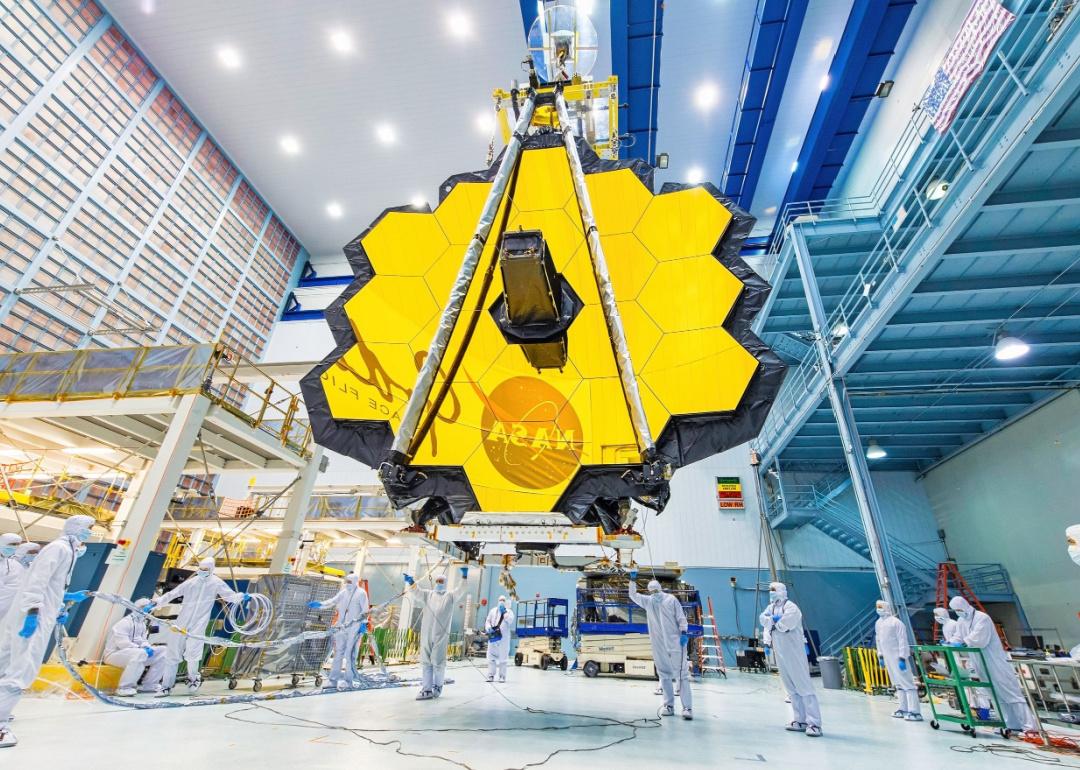
The James Webb Space Telescope is NASA鈥檚 improvement on the Hubble Space Telescope, expected to operate in a much lower frequency range, allowing for observation of objects older and more distant than the Hubble was capable of. Such improved resolution and sensitivity, it is hoped, will , including the formation of galaxies. The and has a planned space launch of March 2021.
MYRRHA
The MYRRHA鈥擬ulti-purpose hYbrid Research Reactor for High-tech Applications鈥攃ouples a nuclear reactor to a proton accelerator for the first time, an innovation that ambitiously for medicine and offers the potential for scientific breakthroughs in fields such as nuclear physics and fundamental interactions. Managed by the Belgian Center for Nuclear Research, the project has a .
You may also like:
Human Cell Atlas
In the same vein as the Human Genome Project, the Human Cell Atlas in the human body. The project is a across the globe who hope that by creating a reference guide to all human cells, we will understand, diagnose, and treat diseases more accurately and rapidly. It is not known exactly how much this project is expected to cost, but the project in 2019 received and $13 million from Helmsley Foundation, suggesting quite a high price tag for the effort.
Global Positioning System
Developed for use by the U.S. Air Force, the Global Positioning System (GPS) became available to the public in the 1980s. With how much we now use it in our daily lives, it is easy to forget how remarkable of a project it was. A satellite-based radio navigation system, GPS provides geolocation and time information anywhere on鈥攐r near鈥攖he planet, anytime. The satellites , and the system costs about $2 million a day to operate.
Advanced LIGO
The Advanced LIGO鈥擫aser Interferometer Gravitational-Wave Observatory鈥攊s a physics observatory than the original LIGO. The brainchild of Caltech and MIT, to develop. As of December 2018, Advanced LIGO had observed 11 gravitational waves; 10 from black hole mergers, and one a collision of two neutron stars,
Watson
Recognizable to the public thanks to a ,鈥� Watson is a computer system developed by IBM capable of answering questions and interacting as a human would. IBM hopes for the legal and medical fields, as well as the government and elsewhere. Though the company has not said how much it has cost to develop Watson, the figure was estimated at according to a CNN report in 2010.
Cancer research
No one organization has been working to find a cure for cancer. But since 1971, the National Cancer Institute alone on research and treatment with . The institute uses , including engineering dual-function viruses, altering diets in mice, and preclinical drug trials.
You may also like: