Most polluted countries in the world
Many of us notice air pollution when it is visible in the form of smog. This is often seen in mountainous areas when weather conditions trap this combination of smoke and sulfur dioxide close to the ground. Around the world, air pollution is and can occur not only outdoors, but in the air we breathe indoors.
The World Health Organization has for what concentration of fine particulate matter (PM) is considered acceptable in the air we breathe, citing evidence that PM can such as respiratory infections, lung cancer, and cardiovascular disease. These guidelines stipulate that PM with a diameter of 2.5 microns (PM2.5) not exceed a 10 micrograms per cubic meter (渭g/m3) annual mean.
麻豆原创 has compiled a ranking of the top 50 (out of 194) nations where people have the highest exposures to these dangerous materials鈥攂oth in rural and urban areas鈥攁ccording to . We've indicated how far above the guidelines PM measures, and also indicated the number of deaths attributed to ambient air pollution in each ranked nation. Finally, we've provided a bit of information about each nation's history, geography, and current political climate; these factors often influence the ways leaders approach the serious threat to daily life and future prosperity that ambient air pollution represents. Continue reading to discover which regions have been impacted the most.
ALSO:
#50. Cabo Verde
- Concentration of fine particulate matter (PM2.5): 32.0 ug/m3 (3.2x above WHO guidelines)
- Urban concentration: 31.6 ug/m3 (3.2x above WHO guidelines, #50 highest)
- Rural concentration: 33.6 ug/m3 (3.4x above WHO guidelines, #50 highest)
- Deaths attributed to ambient air pollution: 41 per 100,000 (#77 highest)
Cabo Verde is an island nation on an archipelago of volcanic origin. Until 2013, it was called by its Anglicized name, . It is situated in the Atlantic Ocean off the northwestern coast of Africa. For this reason, airblown dust from the Sahara Desert causes some of its air pollution. Pollution is also a factor.
#49. Jordan
- Concentration of fine particulate matter (PM2.5): 32.1 ug/m3 (3.2x above WHO guidelines)
- Urban concentration: 31.7 ug/m3 (3.2x above WHO guidelines, #49 highest)
- Rural concentration: 38.0 ug/m3 (3.8x above WHO guidelines, #34 highest)
- Deaths attributed to ambient air pollution: 26 per 100,000 (#133 highest)
In 2014, Jordan's Ministry of Environment started an air quality monitoring system. The purpose was to better , as well as monitor its sources. The stations are located in heavily populated areas with congested roadways and industrial activity, with the goal of being able to regulate these pollution sources once they are identified.
#48. Gambia
- Concentration of fine particulate matter (PM2.5): 32.2 ug/m3 (3.2x above WHO guidelines)
- Urban concentration: 32.3 ug/m3 (3.2x above WHO guidelines, #48 highest)
- Rural concentration: 31.7 ug/m3 (3.2x above WHO guidelines, #52 highest)
- Deaths attributed to ambient air pollution: 37 per 100,000 (#93 highest)
Also known as the Republic of the Gambia, this nation on the west coast of Africa is small in size but has a population of 1.9 million people. in both rural and urban areas is the burning of wood for cooking and energy.
#47. Togo
- Concentration of fine particulate matter (PM2.5): 32.7 ug/m3 (3.3x above WHO guidelines)
- Urban concentration: 31.2 ug/m3 (3.1x above WHO guidelines, #51 highest)
- Rural concentration: 35.1 ug/m3 (3.5x above WHO guidelines, #46 highest)
- Deaths attributed to ambient air pollution: 45 per 100,000 (#60 highest)
Today's Togo , an area of West Africa colonized by the Germans in 1894. That occupation ended during the early days of World War I. The nation was later called French Togoland and finally Togo. Many forms of pollution are a problem in Togo, with the emissions from that burn leaded gasoline as fuel.
#46. Benin
- Concentration of fine particulate matter (PM2.5): 33.1 ug/m3 (3.3x above WHO guidelines)
- Urban concentration: 30.4 ug/m3 (3.0x above WHO guidelines, #56 highest)
- Rural concentration: 41.3 ug/m3 (4.1x above WHO guidelines, #27 highest)
- Deaths attributed to ambient air pollution: 48 per 100,000 (#50 highest)
Benin has shifted away from being governed by . It hopes to move from subsistence agriculture and diversify, in part by developing the tourism business. The population is concentrated in the city of Cotonou, where inefficient make breathing dangerous at times.
#45. Ethiopia
- Concentration of fine particulate matter (PM2.5): 34.4 ug/m3 (3.4x above WHO guidelines)
- Urban concentration: 34.0 ug/m3 (3.4x above WHO guidelines, #45 highest)
- Rural concentration: 34.9 ug/m3 (3.5x above WHO guidelines, #47 highest)
- Deaths attributed to ambient air pollution: 32 per 100,000 (#110 highest)
Once known as Abyssinia, this nation of 90 million on the Horn of Africa has the second-highest population in sub-Saharan Africa. In this region, such as wood, dung, charcoal, and other materials for indoor cooking and other energy needs. The resulting indoor smoke is the primary source of air pollution illness and death.
#44. Myanmar
- Concentration of fine particulate matter (PM2.5): 34.7 ug/m3 (3.5x above WHO guidelines)
- Urban concentration: 34.6 ug/m3 (3.5x above WHO guidelines, #42 highest)
- Rural concentration: 34.8 ug/m3 (3.5x above WHO guidelines, #48 highest)
- Deaths attributed to ambient air pollution: 48 per 100,000 (#50 highest)
Also known as Burma, Myanmar that until recently has made environmental regulation difficult to track; now it's known that the nation has the third-worst air pollution in Southeast Asia. Its sources include indoor burning of biomass fuels as well as .
#43. Iran
- Concentration of fine particulate matter (PM2.5): 35.1 ug/m3 (3.5x above WHO guidelines)
- Urban concentration: 34.4 ug/m3 (3.4x above WHO guidelines, #44 highest)
- Rural concentration: 35.6 ug/m3 (3.6x above WHO guidelines, #41 highest)
- Deaths attributed to ambient air pollution: 34 per 100,000 (#100 highest)
The nation historically known as Persia was one of the great empires of the ancient world. Today it has a population of 79 million and makes its capital in Tehran. That city is greatly affected by airborne contaminants from . The country adopted a clean air law in 2017, allowing it to punish industries and individuals who don't adhere to regulations鈥攚hich is leading to measurable reductions in pollutants such as carbon dioxide and sulfur.
#42. Algeria
- Concentration of fine particulate matter (PM2.5): 35.2 ug/m3 (3.5x above WHO guidelines)
- Urban concentration: 34.5 ug/m3 (3.5x above WHO guidelines, #43 highest)
- Rural concentration: 37.6 ug/m3 (3.8x above WHO guidelines, #37 highest)
- Deaths attributed to ambient air pollution: 35 per 100,000 (#99 highest)
Visitors to cities in the North African nation of Algeria notice visible pollution, but the government in . The worst sources are road traffic in large cities such as Algiers, Oran, and Constantine.
#41. Bhutan
- Concentration of fine particulate matter (PM2.5): 35.3 ug/m3 (3.5x above WHO guidelines)
- Urban concentration: 35.4 ug/m3 (3.5x above WHO guidelines, #41 highest)
- Rural concentration: 35.3 ug/m3 (3.5x above WHO guidelines, #43 highest)
- Deaths attributed to ambient air pollution: 47 per 100,000 (#56 highest)
This landlocked nation is located in the high-elevation Himalayan mountains south of China. One might think the fresh breezes of this mountainous landscape would be pollution-free, but that's not the case. Officials , promotion of electric vehicles, and shifts to improved wood stoves will improve conditions.
#40. Burundi
- Concentration of fine particulate matter (PM2.5): 35.6 ug/m3 (3.6x above WHO guidelines)
- Urban concentration: 35.6 ug/m3 (3.6x above WHO guidelines, #40 highest)
- Rural concentration: 35.2 ug/m3 (3.5x above WHO guidelines, #45 highest)
- Deaths attributed to ambient air pollution: 38 per 100,000 (#89 highest)
Decades of have not improved environmental conditions for the people of this landlocked east-central African nation. The United Nations is assisting the nation with a that aims to help reduce air pollution, a non-motorized development project to improve efficient urban mobility. In addition, they hope citizens will be encouraged to use public transportation.
#39. Tunisia
- Concentration of fine particulate matter (PM2.5): 35.7 ug/m3 (3.6x above WHO guidelines)
- Urban concentration: 35.7 ug/m3 (3.6x above WHO guidelines, #39 highest)
- Rural concentration: 35.5 ug/m3 (3.6x above WHO guidelines, #42 highest)
- Deaths attributed to ambient air pollution: 56 per 100,000 (#32 highest)
This small country in northern Africa shares borders with Algeria and Libya; it also shares a maritime border with Italy, across the Mediterranean Sea. For more than a century , which Tunisians mine, refine, and export to be used in fertilizers, plastics, and paints. The waste goes into the sea and into the air.
#38. Burkina Faso
- Concentration of fine particulate matter (PM2.5): 36.8 ug/m3 (3.7x above WHO guidelines)
- Urban concentration: 36.3 ug/m3 (3.6x above WHO guidelines, #37 highest)
- Rural concentration: 37.2 ug/m3 (3.7x above WHO guidelines, #38 highest)
- Deaths attributed to ambient air pollution: 39 per 100,000 (#82 highest)
The northern part of this nation lies in the and the tropical savanna climate region. Because many people here use wood for cooking and energy, air pollution has increasingly worsened. Officials have introduced a biogas program which will . These are structures that break down organic matter that is frequently burned and convert them into methane, which can then be piped into a stove.
#37. Senegal
- Concentration of fine particulate matter (PM2.5): 37.5 ug/m3 (3.8x above WHO guidelines)
- Urban concentration: 39.7 ug/m3 (4.0x above WHO guidelines, #31 highest)
- Rural concentration: 35.2 ug/m3 (3.5x above WHO guidelines, #44 highest)
- Deaths attributed to ambient air pollution: 34 per 100,000 (#100 highest)
This African nation's air quality problems stem from many of the same sources that affect other African countries: lead gasoline-burning vehicles, wood smoke from burning organic material, and even material from sand storms during the dry season. But unlike other countries in West Africa, it has a , which can warn people to stay indoors or take other measures during pollution peaks.
#36. Democratic Republic of the Congo
- Concentration of fine particulate matter (PM2.5): 37.6 ug/m3 (3.8x above WHO guidelines)
- Urban concentration: 37.4 ug/m3 (3.7x above WHO guidelines, #33 highest)
- Rural concentration: 37.8 ug/m3 (3.8x above WHO guidelines, #36 highest)
- Deaths attributed to ambient air pollution: 40 per 100,000 (#81 highest)
have not helped the people overcome ill health from air pollution in this vast country formerly known as Zaire. Congo's largest city, Kinshasa, is particularly affected by the typical factors of wood smoke, roadways choked by polluting vehicles, and industrialization. One study there caused by man-made heavy metals particulate such as arsenic, cadmium, and lead. These affect the atmosphere, soils, and water, impacting all members of the food chain.
#35. Oman
- Concentration of fine particulate matter (PM2.5): 38.2 ug/m3 (3.8x above WHO guidelines)
- Urban concentration: 36.2 ug/m3 (3.6x above WHO guidelines, #38 highest)
- Rural concentration: 40.0 ug/m3 (4.0x above WHO guidelines, #32 highest)
- Deaths attributed to ambient air pollution: 20 per 100,000 (#159 highest)
Located on the Arabian Peninsula, the Sultanate of Oman has experienced rapid economic development and improved living standards, which has let to more people being concentrated in cities. But whether they are located in urban or rural areas, people are exposed to air pollution from such as cement, chemical, and oil refineries. The government has identified some opportunities for action, such as approving a .
#34. Gabon
- Concentration of fine particulate matter (PM2.5): 38.5 ug/m3 (3.9x above WHO guidelines)
- Urban concentration: 37.8 ug/m3 (3.8x above WHO guidelines, #32 highest)
- Rural concentration: 38.8 ug/m3 (3.9x above WHO guidelines, #33 highest)
- Deaths attributed to ambient air pollution: 34 per 100,000 (#100 highest)
Located in West-Central Africa, Gabon has 13 national parks鈥攊ncluding rainforests and grass savanna spaces鈥攖hat are habitats to animals like gorillas and hippos. Natural resources such as oil and gas make this one of the wealthier nations in Africa but industrialization has harmed its air quality. In response, Gabon is installing in partnership with a French utility company.
#33. Congo
- Concentration of fine particulate matter (PM2.5): 38.7 ug/m3 (3.9x above WHO guidelines)
- Urban concentration: 36.4 ug/m3 (3.6x above WHO guidelines, #36 highest)
- Rural concentration: 41.4 ug/m3 (4.1x above WHO guidelines, #26 highest)
- Deaths attributed to ambient air pollution: 33 per 100,000 (#106 highest)
Republic of the Congo (not to be confused with the Democratic Republic of the Congo) has air pollution sources that are comparable to other countries in Africa that burn wood for heat and energy. , which in turn causes other environmental troubles.
#32. Syrian Arab Republic
- Concentration of fine particulate matter (PM2.5): 39.4 ug/m3 (3.9x above WHO guidelines)
- Urban concentration: 37.4 ug/m3 (3.7x above WHO guidelines, #34 highest)
- Rural concentration: 49.2 ug/m3 (4.9x above WHO guidelines, #15 highest)
- Deaths attributed to ambient air pollution: 43 per 100,000 (#68 highest)
Syria is a country with such as petroleum, phosphates, chrome and manganese ores, asphalt, iron ore, rock salt, marble, and gypsum. It is also in the midst of a years-long civil war, making it difficult for the government to launch environmental clean-up campaigns; one study , including air pollution.
#31. United Arab Emirates
- Concentration of fine particulate matter (PM2.5): 39.4 ug/m3 (3.9x above WHO guidelines)
- Urban concentration: 37.2 ug/m3 (3.7x above WHO guidelines, #35 highest)
- Rural concentration: 40.2 ug/m3 (4.0x above WHO guidelines, #29 highest)
- Deaths attributed to ambient air pollution: 15 per 100,000 (#176 highest)
The UAE is situated on the Arabian Peninsula of in the Middle East. Its largest emirate (or political territory) is Dubai, which has become a . Air quality is compromised by burning, industrialization, traffic density, and natural causes of airborne particles such as dust storms. To address the public health concern, ; these alone won't stop the pollution, but at least can help people protect themselves when conditions are acute.
#30. Tajikistan
- Concentration of fine particulate matter (PM2.5): 40.0 ug/m3 (4.0x above WHO guidelines)
- Urban concentration: 42.8 ug/m3 (4.3x above WHO guidelines, #23 highest)
- Rural concentration: 37.8 ug/m3 (3.8x above WHO guidelines, #35 highest)
- Deaths attributed to ambient air pollution: 50 per 100,000 (#43 highest)
This small, landlocked country in Central Asia (which has seen much in recent decades) has experienced increased energy production, industrialization, and urban development鈥攁nd increased pollution as a result. Tajikistan has noticed , which can be attributed to the and its management strategies.
#29. Djibouti
- Concentration of fine particulate matter (PM2.5): 40.4 ug/m3 (4.0x above WHO guidelines)
- Urban concentration: 41.0 ug/m3 (4.1x above WHO guidelines, #28 highest)
- Rural concentration: 40.1 ug/m3 (4.0x above WHO guidelines, #30 highest)
- Deaths attributed to ambient air pollution: 43 per 100,000 (#68 highest)
This East African nation lies in a strategic location鈥� to the Red Sea and Suez Canal鈥攁nd the United States' largest military base in Africa, , is located there. Water pollution caused by shipping has had a major impact in the nation, and near the capital city, Djibouti City.
#28. Mongolia
- Concentration of fine particulate matter (PM2.5): 40.4 ug/m3 (4.0x above WHO guidelines)
- Urban concentration: 49.5 ug/m3 (5.0x above WHO guidelines, #17 highest)
- Rural concentration: 36.9 ug/m3 (3.7x above WHO guidelines, #39 highest)
- Deaths attributed to ambient air pollution: 49 per 100,000 (#45 highest)
This large, landlocked, and ancient nation lies near Russia and China. Much of its landscape is mountainous with sparse vegetation, limiting its habitability: at 3 million people, it's . Approximately half of the population lives in the capital city of Ulaanbaatar, where air pollution is caused by factors such as industrialization and polluting vehicles. The air is at its , during which particulate matter is less likely to be dispersed by wind.
#27. Rwanda
- Concentration of fine particulate matter (PM2.5): 40.7 ug/m3 (4.1x above WHO guidelines)
- Urban concentration: 40.7 ug/m3 (4.1x above WHO guidelines, #30 highest)
- Rural concentration: 44.0 ug/m3 (4.4x above WHO guidelines, #23 highest)
- Deaths attributed to ambient air pollution: 24 per 100,000 (#142 highest)
This landlocked, hilly nation of 11.5 million has one of the in sub-Saharan Africa. War, political upheaval, and ethnic tensions have made it difficult for Rwanda to tackle its pollution problems, in spite of some . The government is studying the problem and identifying sources of pollution, such as vehicle emissions; it has discovered that on holiday and car-free days.
#26. Mauritania
- Concentration of fine particulate matter (PM2.5): 40.8 ug/m3 (4.1x above WHO guidelines)
- Urban concentration: 41.7 ug/m3 (4.2x above WHO guidelines, #25 highest)
- Rural concentration: 40.0 ug/m3 (4.0x above WHO guidelines, #31 highest)
- Deaths attributed to ambient air pollution: 44 per 100,000 (#65 highest)
Much of this West African nation is covered in the sand of the Sahara Desert. Its largest city is the capital, Nouakchott, with about 3.4 million residents. Sand dust is inevitable, but have made it worse. The drought has also forced people who once lived a nomadic life to move into the cities, where vehicular traffic and industry have increased.
#25. South Sudan
- Concentration of fine particulate matter (PM2.5): 41.1 ug/m3 (4.1x above WHO guidelines)
- Urban concentration: 40.9 ug/m3 (4.1x above WHO guidelines, #29 highest)
- Rural concentration: 41.1 ug/m3 (4.1x above WHO guidelines, #28 highest)
- Deaths attributed to ambient air pollution: 45 per 100,000 (#60 highest)
Civil wars in South Sudan have killed an as of 2018. Coupled with other crises such as Ebola outbreaks, this nation has faced devastation both to people and the environment. In response, the World Health Organization is working with the Ministry of Health on a .
#24. Turkey
- Concentration of fine particulate matter (PM2.5): 42.0 ug/m3 (4.2x above WHO guidelines)
- Urban concentration: 41.2 ug/m3 (4.1x above WHO guidelines, #26 highest)
- Rural concentration: 43.2 ug/m3 (4.3x above WHO guidelines, #24 highest)
- Deaths attributed to ambient air pollution: 46 per 100,000 (#57 highest)
Home to ancient nations and tribes that date back to 10,000 B.C., the Republic of Turkey is today a major tourist destination among European travelers in particular鈥攊n spite of . Public health officials warn that its air pollution can be damaging to .
#23. Eritrea
- Concentration of fine particulate matter (PM2.5): 42.4 ug/m3 (4.2x above WHO guidelines)
- Urban concentration: 41.1 ug/m3 (4.1x above WHO guidelines, #27 highest)
- Rural concentration: 42.9 ug/m3 (4.3x above WHO guidelines, #25 highest)
- Deaths attributed to ambient air pollution: 43 per 100,000 (#68 highest)
This east African nation has a mixed Afro-Asiatic population, with religious and cultural divides as a contributor to decades of . The consequence of these has been environmental damage that has led to drought; combined with widespread use of charcoal for cooking, increased air pollution is one of Eritrea's .
#22. Libya
- Concentration of fine particulate matter (PM2.5): 44.2 ug/m3 (4.4x above WHO guidelines)
- Urban concentration: 41.7 ug/m3 (4.2x above WHO guidelines, #24 highest)
- Rural concentration: 44.9 ug/m3 (4.5x above WHO guidelines, #22 highest)
- Deaths attributed to ambient air pollution: 43 per 100,000 (#68 highest)
More than 90% of this North African country is desert or semi-desert, and well over 90% of the population lives along the Mediterranean coast. The Saharan region of the country is hot, dry, and prone to dust-laden wind storms several times a year. Although politically volatile, Libya dealing with biodiversity, climate change, desertification, and ozone layer protection.
#21. Yemen
- Concentration of fine particulate matter (PM2.5): 45.0 ug/m3 (4.5x above WHO guidelines)
- Urban concentration: 44.3 ug/m3 (4.4x above WHO guidelines, #22 highest)
- Rural concentration: 46.5 ug/m3 (4.6x above WHO guidelines, #20 highest)
- Deaths attributed to ambient air pollution: 55 per 100,000 (#36 highest)
This desert country on the Red Sea supports a population of 26 million, with its capital Sana'a as its largest city. , and its oil production industry contributes to higher pollution around the coastal areas.
#20. Equatorial Guinea
- Concentration of fine particulate matter (PM2.5): 45.9 ug/m3 (4.6x above WHO guidelines)
- Urban concentration: 49.1 ug/m3 (4.9x above WHO guidelines, #18 highest)
- Rural concentration: 45.5 ug/m3 (4.6x above WHO guidelines, #21 highest)
- Deaths attributed to ambient air pollution: 51 per 100,000 (#41 highest)
Five inhabited islands and a section of the African . There is great biodiversity in Equatorial Guinea, but the country is dependent on its oil economy, which is a major source of pollution. describes myriad challenges facing this nation, but also areas of health and wellbeing where improvements have been noted.
#19. Sudan
- Concentration of fine particulate matter (PM2.5): 47.9 ug/m3 (4.8x above WHO guidelines)
- Urban concentration: 46.8 ug/m3 (4.7x above WHO guidelines, #20 highest)
- Rural concentration: 48.3 ug/m3 (4.8x above WHO guidelines, #18 highest)
- Deaths attributed to ambient air pollution: 56 per 100,000 (#32 highest)
The Republic of Sudan until it broke apart into Sudan and South Sudan in 2011. Previous to that, conflict in its western region of Darfur caused environmental and humanitarian crises which are still unresolved. Finding up-to-date detailed reports on current environmental conditions is challenging, but the United Nations has studied conditions in Sudan since the ending of a civil war in 2005鈥� such as environmental degradation, deforestation, and climate change.
#18. Uganda
- Concentration of fine particulate matter (PM2.5): 48.4 ug/m3 (4.8x above WHO guidelines)
- Urban concentration: 48.7 ug/m3 (4.9x above WHO guidelines, #19 highest)
- Rural concentration: 47.1 ug/m3 (4.7x above WHO guidelines, #19 highest)
- Deaths attributed to ambient air pollution: 32 per 100,000 (#110 highest)
Effects of air pollution in Uganda's largest city, Kampala, are primarily caused by vehicle emissions. Across the , mining activities and wood burning for cooking and fuel are also factors. Officials say that encouraging people to walk instead of drive would help solve the problem, but others note because its effects are largely invisible.
#17. Nigeria
- Concentration of fine particulate matter (PM2.5): 48.7 ug/m3 (4.9x above WHO guidelines)
- Urban concentration: 46.3 ug/m3 (4.6x above WHO guidelines, #21 highest)
- Rural concentration: 56.5 ug/m3 (5.7x above WHO guidelines, #8 highest)
- Deaths attributed to ambient air pollution: 76 per 100,000 (#17 highest)
Africa's largest country by population faces continued . Nigeria鈥攚hose largest city, Lagos, is home to 21 million people鈥攈as had the in Africa. Some of the culprits include fumes from generators, vehicle emissions, and crop burning. The nation's is the highest in the world, much of it attributed to pollution.
#16. China
- Concentration of fine particulate matter (PM2.5): 49.2 ug/m3 (4.9x above WHO guidelines)
- Urban concentration: 51.0 ug/m3 (5.1x above WHO guidelines, #15 highest)
- Rural concentration: 35.7 ug/m3 (3.6x above WHO guidelines, #40 highest)
- Deaths attributed to ambient air pollution: 81 per 100,000 (#14 highest)
The , the People's Republic of China contains some 1,367 million people. While its capital is Beijing, its most populated city is Shanghai, with about 23.47 million in the overall metropolitan area. Recent good news is that in 2018, ; smog emissions in Beijing and a surrounding industrial area fell by at least 12% in 2018. A to observe levels of air pollution over China and its changes over time.
#15. Central African Republic
- Concentration of fine particulate matter (PM2.5): 49.5 ug/m3 (5.0x above WHO guidelines)
- Urban concentration: 51.2 ug/m3 (5.1x above WHO guidelines, #14 highest)
- Rural concentration: 49.0 ug/m3 (4.9x above WHO guidelines, #16 highest)
- Deaths attributed to ambient air pollution: 62 per 100,000 (#28 highest)
Like many developing African nations, Central African Republic has gone through . However, this former French colony of five million has recognized how environmental conditions harm the health of its people. In 2013, it joined the , and is now focused on reducing agricultural open-burning and other emission sources.
#14. Chad
- Concentration of fine particulate matter (PM2.5): 53.0 ug/m3 (5.3x above WHO guidelines)
- Urban concentration: 50.8 ug/m3 (5.1x above WHO guidelines, #16 highest)
- Rural concentration: 53.6 ug/m3 (5.4x above WHO guidelines, #11 highest)
- Deaths attributed to ambient air pollution: 83 per 100,000 (#9 highest)
This former French colony in North Central Africa has experienced a . Chad is challenged in part by being part of an area stretching from Senegal to Ethiopia known as the 鈥攊dentified by researchers as a region where the practice of breaking smoke from indoor fires contributes to .
#13. Afghanistan
- Concentration of fine particulate matter (PM2.5): 53.2 ug/m3 (5.3x above WHO guidelines)
- Urban concentration: 59.9 ug/m3 (6.0x above WHO guidelines, #10 highest)
- Rural concentration: 48.7 ug/m3 (4.9x above WHO guidelines, #17 highest)
- Deaths attributed to ambient air pollution: 49 per 100,000 (#45 highest)
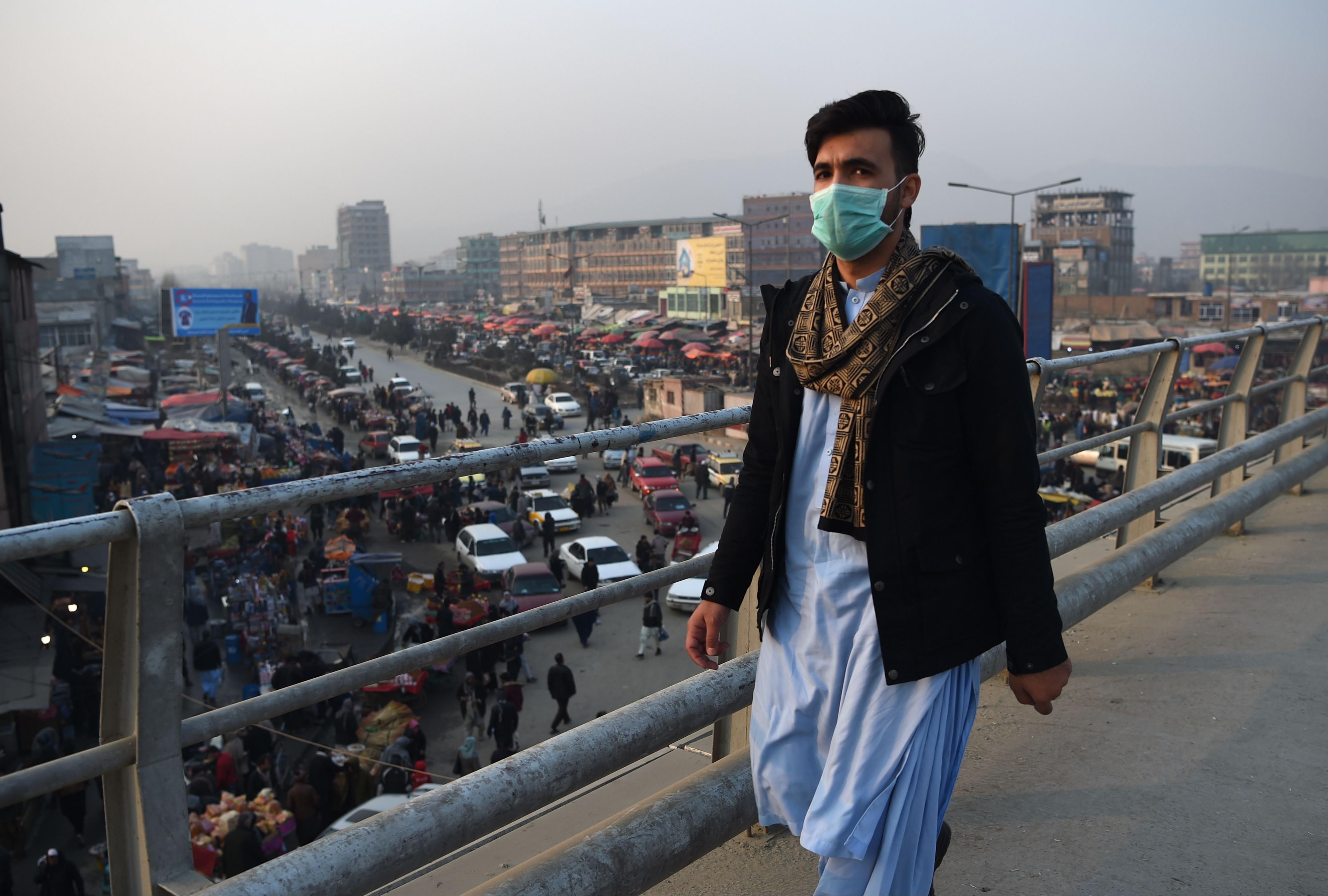
This nation of 26.5 million is touched by three geographical regions: the Middle East, the Indian subcontinent, and Central Asia. Its location has over many decades, with military conflicts being a central fact of life for its people. Residents of the capital city of Kabul face worsening air quality in winter when the use of low-quality fuel with emissions. Officials recommend frequent hand and face washing, as well as gargling and wearing facemasks, to protect the health of Kabul's six million residents.
#12. Pakistan
- Concentration of fine particulate matter (PM2.5): 55.2 ug/m3 (5.5x above WHO guidelines)
- Urban concentration: 56.2 ug/m3 (5.6x above WHO guidelines, #13 highest)
- Rural concentration: 52.0 ug/m3 (5.2x above WHO guidelines, #14 highest)
- Deaths attributed to ambient air pollution: 63 per 100,000 (#26 highest)
Bordering on Afghanistan, Pakistan's population is 188 million, with approximately one million in the capital of Islamabad. The and is composed of desert and mountainous terrain. A resident of Karachi in 2018 for failing to control air pollution; the environmental protection authorities are adding air quality monitors and enforcing emission regulations as a result.
#11. Kuwait
- Concentration of fine particulate matter (PM2.5): 57.2 ug/m3 (5.7x above WHO guidelines)
- Urban concentration: 58.9 ug/m3 (5.9x above WHO guidelines, #11 highest)
- Rural concentration: 52.5 ug/m3 (5.3x above WHO guidelines, #13 highest)
- Deaths attributed to ambient air pollution: 37 per 100,000 (#93 highest)
An oil-rich country on the Arabian Peninsula, Kuwait is a , also known as a constitutional monarchy. It has no rivers or mountains but is flat, sandy, and borders on the Persian Gulf. can be observed thanks to a partnership of the U.S. Department of State and the EPA that has led to the installation of air quality monitors at American embassies around the globe.
#10. Iraq
- Concentration of fine particulate matter (PM2.5): 57.7 ug/m3 (5.8x above WHO guidelines)
- Urban concentration: 60.1 ug/m3 (6.0x above WHO guidelines, #9 highest)
- Rural concentration: 54.8 ug/m3 (5.5x above WHO guidelines, #10 highest)
- Deaths attributed to ambient air pollution: 34 per 100,000 (#100 highest)
Iraq has experienced conflict for several decades鈥攊ncluding the U.S.'s ongoing military presence since its invasion of the country鈥攍eading to harmful environmental degradation. Researchers have determined that rising in Iraq in recent years can be connected to in the environment鈥攖he result of numerous explosions and other wartime ammunition releases.
#9. Bangladesh
- Concentration of fine particulate matter (PM2.5): 58.3 ug/m3 (5.8x above WHO guidelines)
- Urban concentration: 58.6 ug/m3 (5.9x above WHO guidelines, #12 highest)
- Rural concentration: 52.9 ug/m3 (5.3x above WHO guidelines, #12 highest)
- Deaths attributed to ambient air pollution: 51 per 100,000 (#41 highest)
The People's Republic of Bangladesh came into being in 1971. Located in Southern Asia where the Ganges River Delta meets the Bay of Bengal, its make it prone to . Although its land is only about the size of Iowa, Bangladesh's population is around 164 million people鈥攁nd its capital city, Dhaka, has the of any city in the world.
#8. India
- Concentration of fine particulate matter (PM2.5): 65.2 ug/m3 (6.5x above WHO guidelines)
- Urban concentration: 68.0 ug/m3 (6.8x above WHO guidelines, #7 highest)
- Rural concentration: 55.9 ug/m3 (5.6x above WHO guidelines, #9 highest)
- Deaths attributed to ambient air pollution: 82 per 100,000 (#12 highest)
After India gained independence from Britain in 1947, the subcontinent was partitioned into smaller countries鈥攊ncluding neighboring Pakistan, which was later subdivided to form Bangladesh. India remains the second-most-populous nation in the world. Lung cancer is becoming increasingly common in younger non-smokers, to the increasingly polluted air.
#7. Cameroon
- Concentration of fine particulate matter (PM2.5): 65.3 ug/m3 (6.5x above WHO guidelines)
- Urban concentration: 65.4 ug/m3 (6.5x above WHO guidelines, #8 highest)
- Rural concentration: 65.1 ug/m3 (6.5x above WHO guidelines, #7 highest)
- Deaths attributed to ambient air pollution: 62 per 100,000 (#28 highest)
The area of east Africa known as the Republic of Cameroon has been cobbled together from generations of being including Portugal, Spain, Germany, and France. The first study of air quality in was conducted in 2014; researchers concluded that further study needs to be done in order to develop a plan for reducing the problem.
#6. Bahrain
- Concentration of fine particulate matter (PM2.5): 69.0 ug/m3 (6.9x above WHO guidelines)
- Urban concentration: 69.0 ug/m3 (6.9x above WHO guidelines, #6 highest)
- Rural concentration: 70.7 ug/m3 (7.1x above WHO guidelines, #3 highest)
- Deaths attributed to ambient air pollution: 15 per 100,000 (#176 highest)
The Kingdom of Bahrain, which gained independence from Britain in 1971, is an archipelago of that are located off the eastern coast of Saudi Arabia. Its chief industry, oil production, contributes to the country's emissions problem鈥攂ut there is to monitor air quality and take measures to combat harmful effects of pollution.
#5. Niger
- Concentration of fine particulate matter (PM2.5): 70.8 ug/m3 (7.1x above WHO guidelines)
- Urban concentration: 73.0 ug/m3 (7.3x above WHO guidelines, #5 highest)
- Rural concentration: 69.7 ug/m3 (7.0x above WHO guidelines, #4 highest)
- Deaths attributed to ambient air pollution: 69 per 100,000 (#25 highest)
Situated on the southern border of the Sahara desert, the Republic of Niger is dry, drought-prone, and one the . It also has the , with its of 22 million people set to double in 17 years. from burning of both organic materials and garbage, in addition to cook stoves, vehicle exhaust and toxic road dust.
#4. Saudi Arabia
- Concentration of fine particulate matter (PM2.5): 78.4 ug/m3 (7.8x above WHO guidelines)
- Urban concentration: 86.7 ug/m3 (8.7x above WHO guidelines, #3 highest)
- Rural concentration: 75.1 ug/m3 (7.5x above WHO guidelines, #2 highest)
- Deaths attributed to ambient air pollution: 37 per 100,000 (#93 highest)
When oil was discovered there in the 1930s, the Kingdom of Saudi Arabia developed quickly and is now . The capital city, Riyadh, with a population of 4.7 million, has the 鈥攑artly because of blowing desert sand and partly because of the oil industry.
#3. Egypt
- Concentration of fine particulate matter (PM2.5): 79.3 ug/m3 (7.9x above WHO guidelines)
- Urban concentration: 79.6 ug/m3 (8.0x above WHO guidelines, #4 highest)
- Rural concentration: 69.4 ug/m3 (6.9x above WHO guidelines, #5 highest)
- Deaths attributed to ambient air pollution: 70 per 100,000 (#22 highest)
Formally known as the Arab Republic of Egypt, the country is well-known for its , including the pyramids at Giza near the capital city of Cairo. The country's is taking steps to reduce what is known as the ; targets include industrial emissions and vehicle exhaust, as well as farming practices that involve burning off harvested rice fields.
#2. Qatar
- Concentration of fine particulate matter (PM2.5): 90.3 ug/m3 (9.0x above WHO guidelines)
- Urban concentration: 91.7 ug/m3 (9.2x above WHO guidelines, #2 highest)
- Rural concentration: 81.3 ug/m3 (8.1x above WHO guidelines, #1 highest)
- Deaths attributed to ambient air pollution: 13 per 100,000 (#181 highest)
The State of Qatar is an independent emirate on a small peninsula extending north from the larger Arabian Peninsula into the Persian Gulf. Being an and its development of hydrocarbon resources has helped the emirate become economically stable. Officials are studying ways to balance economic growth with of its 2.6 million citizens. The more Qatar becomes important on the world stage, through events such as hosting the , the more its resources will be developed.
#1. Nepal
- Concentration of fine particulate matter (PM2.5): 94.3 ug/m3 (9.4x above WHO guidelines)
- Urban concentration: 99.5 ug/m3 (9.9x above WHO guidelines, #1 highest)
- Rural concentration: 68.3 ug/m3 (6.8x above WHO guidelines, #6 highest)
- Deaths attributed to ambient air pollution: 76 per 100,000 (#17 highest)
Situated in the towering Himalayan mountains, this country is home to 31 million people. Air quality monitors in its capital Kathmandu, home to 1.5 million people, shows that from vehicle exhaust and industry are harming health, particularly in the winter. Farming practices such as brush fires and wood cooking in rural regions are also taking a toll. One of the most alarming effects of Nepal's environmental decline is seen in the changes to .