What happens to leftover hotel soap? How organizations are reducing waste while addressing hygiene inequality
What happens to leftover hotel soap? How organizations are reducing waste while addressing hygiene inequality
A little over 10 years ago, while teaching English in northern Cambodia, Samir Lakhani had a soap epiphany. “I saw a village mom bathing her newborn kiddo, but unfortunately, she was scrubbing him with laundry powder, which can be quite harmful to the skin.” It was all the mother had to use.
According to , 2.3 billion people around the world do not have handwashing facilities with running water and soap available at home. This has consequences. It’s estimated that the simple act of using soap to wash hands, for example, can prevent up to deaths and can reduce the risk of respiratory illnesses by up to in both children and adults.
What Lakhani witnessed in Cambodia changed his life. “Ever since I have wanted to work in soap and to connect people with proper soap,” he says. He came up with a smart but simple idea: rescue used soap from hotel trash bins and deliver it to communities where it could save lives. shares the story of what Lakhani and others are doing to reduce waste and share resources with people around the world whose resources are scarce.
Hotels have stringent hygiene protocols that require toiletries, regardless of whether they’ve been opened or used, to be thrown out at the end of a guest’s stay. The founder of Clean the World, Shawn Seipler, estimated that globally, . Ending up in the landfill, they join a melee of other products emitting harmful greenhouse gases, such as methane, into the atmosphere. Many of the oils used in the manufacture of soap are , but when added to a compacted pile of trash and deprived of air, they do not decay quickly. Some soaps also contain dyes or phosphates that are not naturally decomposable.
In 2014, Lakhani founded , which has since diverted over 14 million pounds of soap from landfills around the world. In its early years, Eco-Soap built a global network of more than 1,000 hotels to intercept this waste. Then came the pandemic, and many of those hotels shut down as people stopped traveling. “We needed to find another source of soap to recycle, and we began to reach out to soap factories,” Lakhani says. “We uncovered a dirty truth.” Annually, about a quarter-billion bars of soap go directly into landfills because of small manufacturing or aesthetic defects that make them unsellable.
Rescuing and recycling the entirety of this soap factory waste stream could prevent the emission of approximately 44 million tons of CO2e and save over 29 million gallons of water per year, according to conducted by Eco-Soap Bank.
Eco-Soap is not alone in its mission to rescue soap and get it to those who need it the most. In Australia, the nonprofit organization collects, sorts, cleans and reprocesses soap from accommodations across Australia and New Zealand into fresh, hygienic soap bars. These soap bars are then redistributed to communities in need throughout the southern continent and the world. Since its inception in 2011, the organization has kept over 380 metric tons of soap out of landfills.
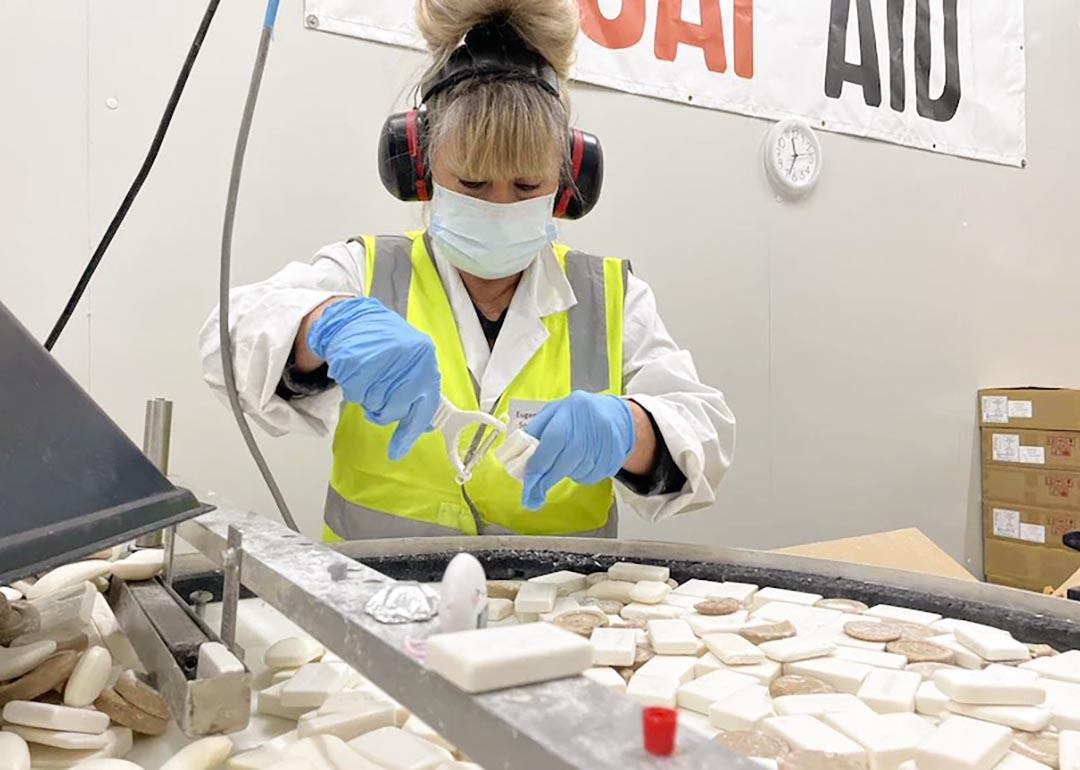
When discarded soap arrives at the organization’s recycling facility in Melbourne, it’s sorted, any packaging is removed, and it’s fed into a hopper that sends it through recycling machines that grind it into small noodle shapes.
“These noodles are heated, blended and reformed into new bars,” explains Laura O’Leary, partnership engagement office.
In Canada, , based in Victoria, British Columbia, also upcycles soap but uses less rigorous methods. “Bacteria doesn’t grow on soap,” notes the organization’s founder, C. Anne McIntyre. The soap bars received by Soap for Hope are hand-scraped by the organization’s battalion of volunteers, who also sort and repurpose other materials like old hotel linens and amalgamate new bottles of shampoos and conditioners from half-used ones rescued from hotels throughout British Columbia and Alberta.
As with Lakhani, it all started when McIntyre had her soap epiphany in 2015.
“I used to do international aid and we were sending soap overseas with disaster kits, and [it] just seemed very obvious that people needed that,” she says. However, the liquid amenities such as shampoo, sometimes received with the donations of soap, could not be sent overseas. McIntrye took it upon herself to take those products to shelters in Victoria. “They were ecstatic to receive it,” she recalls. This joy at receiving a simple bottle of shampoo made her realize that her own community also lacked access to hygiene products. She decided to do something about it. Flash-forward to 2025, and McIntyre has built partnerships with regional hotel chains such as the Fairmont and Marriott, and the nonprofit provides hygiene products to over 500 community service organizations in British Columbia and Alberta.
In 2024, the British Columbia-based hotel brands Hotel Zed and Accent Inns worked with Soap for Hope to divert nearly 6,500 pounds of waste from landfills, according to Peter Dohan, manager of operations at Hotel Zed and Accent Inns.
In Vancouver, , a nonprofit service organization supporting low-income families, receives donations of toiletries from Soap for Hope. According to Caitlin Creaney, food program and participant engagement coordinator, mothers will forgo things such as scented body wash or skin care for themselves to stretch the budget and make sure their children have what they need. This, though, can have dire consequences.
In January 2025, Soap for Hope sponsored Canada’s first . Polling their database of service organizations in British Columbia and Alberta, almost 98% of respondents reported that their clients experienced negative mental health outcomes, including stress, anxiety and depression, due to hygiene inequity. In addition to basic hygiene products like soap, Soap for Hope also offers body washes and skin care products. Many are collected from hotels, and others from community drives in which bins are set up in local malls and the general public is invited to drop off donations of unused or half-used hygiene products. According to McIntyre, receiving body wash, moisturizer or even shaving lotion goes a long way in helping to restore an individual’s sense of dignity, health and self-confidence.
At Soap for Hope, the motto “nothing goes to waste” extends beyond soap to include the plastic containers that once housed body wash, shampoo or conditioner. Containers that can’t be repurposed by Soap for Hope are sent to a recycling depot, which grinds the plastic down into filaments that can be embedded into cement to make it more durable.
Creating hygiene equity in sustainable ways, though, is a challenge. “When Soap Aid was founded in 2011, the concept of the circular economy was still emerging,” says O’Leary. There was, as she points out, little awareness about hygiene waste or the environmental cost of discarded hotel soap. It’s only in recent years that the conversation around sustainability and corporate social responsibility has emerged.
In the beginning, according to O’Leary and Carol Bellew, Soap Aid’s general operations manager, just setting up a recycling plant was a significant achievement. Most commercial soap machinery is designed to work with uniform, factory-grade inputs. Recycling bars that vary in size, brand, texture and condition requires fine-tuning. The machinery was sourced from multiple manufacturers and had to be tested multiple times to make sure it could do the job.
McIntyre also admits that fundraising to keep Soap for Hope solvent is difficult, especially during economic downturns when donations go down but needs go up. But perhaps her biggest challenge has been proving to the skeptics that she could bridge the gap between sustainability and hygiene inequality.
“I can’t tell you how many people told me I was so crazy when we started,” she says. “But it just made such perfect sense to me. Everyone needs soap.”
was produced by and reviewed and distributed by Â鶹ԭ´´.