How access to fresh produce varies across America
How access to fresh produce varies across America
As threatens the global food supply, how countries feed themselves has become increasingly complex in the past century. This is especially true in America where there has been a dramatic decline in the American agricultural labor force, , and an increased reliance on imported goods.
From 1950–1990, America saw a , and between 2007 and 2012 the United States lost more than . Today more than , and about a third of the vegetables in the supermarket are from another country.
This is a time when food insecurity exists simultaneously with an obesity crisis, with only and even less meeting the daily recommended vegetable intake. When you look at the national averages, this shouldn't be the case: There are 2.7 farmers markets per 100,000 residents, 41.8% of school districts participate in farm-to-school programs, and 44.8% of middle and high schools offer salad bars.
On top of that, there are 234 local food policy councils that help make sure state and local food systems are working, and they often work to increase access to nutritious foods like fruits and vegetables. There are also 212 food hubs that actively manage the entire consumer chain of locally and regionally grown food. In short, food hubs make it easier to access locally grown produce.
While the United States is , the problem is many , especially fresh fruits and vegetables. This is concerning because research has shown that poor diet is one of the .
To explore how access to fresh produce varies from state to state, consulted the Centers for Disease Control and Prevention's (CDC) , which includes the most recent statistics available. The report pulls together data from various country-wide government surveys: the numbers of farmers markets per 100,000 residents are up to date as of 2017; the percentages of school districts participating in farm-to-school programs are accurate as of 2014; the percentages of middle and high schools offering salad bars are from 2016; the numbers of local food policy councils are from 2018, and the numbers of food hubs are up to date as of 2017.
Read on to find out more about access to produce in your state.
Alabama
- Farmers markets per 100,000 residents: 2.9 (7.4% above national average)
- Share of school districts participating in farm-to-school programs: 30.8% (26.3% below national average)
- Share of middle and high schools offering salad bars: 41.7% (6.9% below national median)
- Number of local food policy councils: 1
- Number of food hubs: 1
Food deserts—areas with limited access—still pose a big problem for many . Last year, an was introduced in the state and now lets customers buy food from local farmers for pick-up or delivery.
Alaska
- Farmers markets per 100,000 residents: 5.3 (96.3% above national average)
- Share of school districts participating in farm-to-school programs: 76.3% (82.5% above national average)
- Share of middle and high schools offering salad bars: 26.1% (41.7% below national median)
- Number of local food policy councils: 0
- Number of food hubs: 3
For Alaskans eating healthy is challenging. Cold weather and lack of sunlight limits produce that can grow in the region. Harsh winters can make fresh produce deliveries sparse, which is problematic considering . Fresh food is also more expensive; a single orange can sometimes cost $5.
Arizona
- Farmers markets per 100,000 residents: 1.3 (51.9% below national average)
- Share of school districts participating in farm-to-school programs: 25.3% (39.5% below national average)
- Share of middle and high schools offering salad bars: 49.5% (10.5% above national median)
- Number of local food policy councils: 3
- Number of food hubs: 3
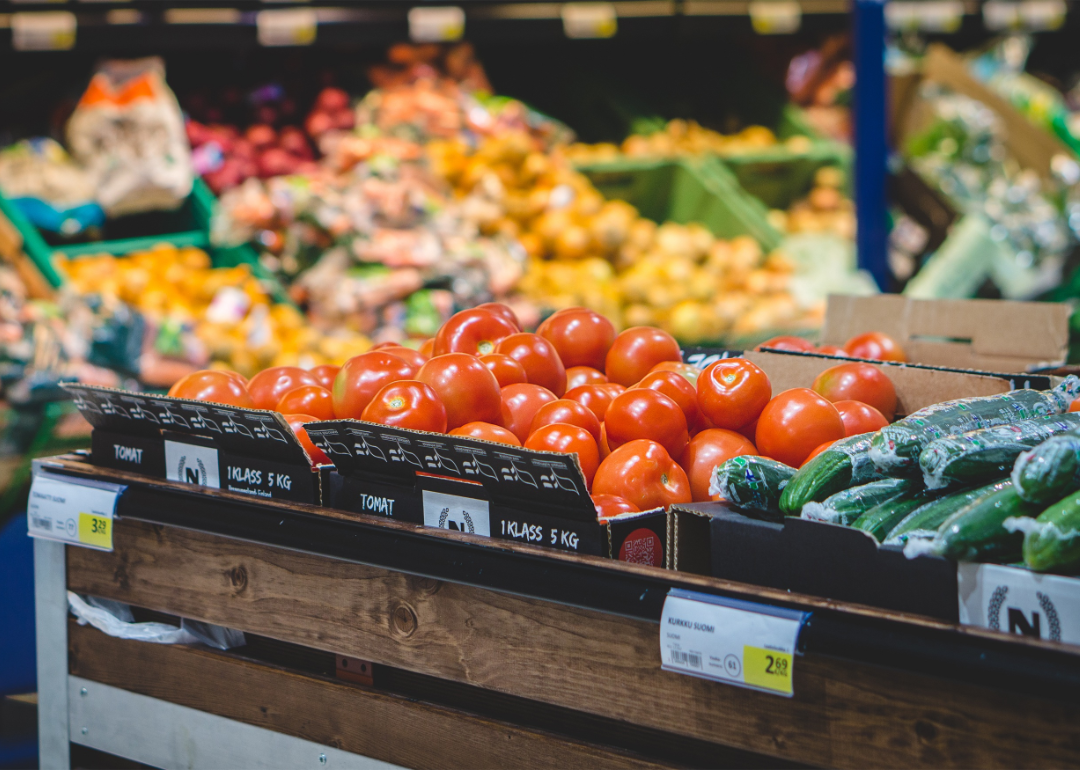
Due to its proximity to the Mexican border and the port of entry city Nogales, fresh produce is one of the major economic drivers in Arizona. the state is the tomato import capital of the United States. And while it may not be thought of as a big accomplishment, tomatoes created more than 33,000 full- and part-time jobs and .
Arkansas
- Farmers markets per 100,000 residents: 3.6 (33.3% above national average)
- Share of school districts participating in farm-to-school programs: 22.3% (46.7% below national average)
- Share of middle and high schools offering salad bars: 40.9% (8.7% below national median)
- Number of local food policy councils: 0
- Number of food hubs: 2
Arkansas has the most food deserts in the United States. Every county has at least . However, there is an increase in efforts such as to help bring fresh produce to people living in food deserts.
California
- Farmers markets per 100,000 residents: 1.9 (29.6% below national average)
- Share of school districts participating in farm-to-school programs: 54.9% (31.3% above national average)
- Share of middle and high schools offering salad bars: 54.8% (22.3% above national median)
- Number of local food policy councils: 29
- Number of food hubs: 14
California is the largest and most diverse agricultural state in America. It produces 13% of the crops in the United States, and is the nation's only producer of walnuts, kiwis, and pomegranates. But according to a study published in a 2018 issue of the journal Agronomy, almost all those . Throughout the past 10 years, the state has seen wildfires, droughts, floods, and storms decimate entire crops. Like many other states, California has .
Charitable organization helps get fresh produce into the hands of low-income people across eight Southern California counties, while also preventing food waste by donating surplus produce that would otherwise go to waste.
Colorado
- Farmers markets per 100,000 residents: 2.8 (3.7% above national average)
- Share of school districts participating in farm-to-school programs: 41.8% (0% below national average)
- Share of middle and high schools offering salad bars: Data not available
- Number of local food policy councils: 16
- Number of food hubs: 3
Colorado’s leading fruit crops are peaches and apples. The climate in Colorado—warm days and cool nights—helps bring out the sweetness in fruit. According to the Colorado government, the state produced .
Connecticut
- Farmers markets per 100,000 residents: 4.3 (59.3% above national average)
- Share of school districts participating in farm-to-school programs: 70.3% (68.2% above national average)
- Share of middle and high schools offering salad bars: 37.1% (17.2% below national median)
- Number of local food policy councils: 5
- Number of food hubs: 2
New Haven has the best school wellness policies, according to , director of the Rudd Center for Food Policy & Obesity and professor of Human Development and Family Sciences at UConn. She analyzed the wellness policies that were implemented in 2006 at each school across Connecticut; she found the policies that support healthy eating were better in schools reporting that more students were below the poverty line. “We thought the wealthier districts would have stronger policies, but we found the opposite,” Schwartz said in an interview with .
Delaware
- Farmers markets per 100,000 residents: 3.8 (40.7% above national average)
- Share of school districts participating in farm-to-school programs: 60% (43.5% above national average)
- Share of middle and high schools offering salad bars: 12.8% (71.4% below national median)
- Number of local food policy councils: 0
- Number of food hubs: 0
in Delaware is a store that specializes in fresh produce only. The store only has three sections: fruit, vegetables and flowers. It’s also known for stocking exotic fruits and vegetables not typically found in the state.
Florida
- Farmers markets per 100,000 residents: 1.2 (55.6% below national average)
- Share of school districts participating in farm-to-school programs: 45% (7.7% above national average)
- Share of middle and high schools offering salad bars: 16.4% (63.4% below national median)
- Number of local food policy councils: 8
- Number of food hubs: 4
Oranges are one of Florida’s most famous crops. After tourism, it’s the state’s second-largest industry. But last year were infected with a bacterium that prevents the fruit from ripening properly. The result has been a devastating knock-on effect on the farming and orange juice industry.
Georgia
- Farmers markets per 100,000 residents: 1.5 (44.4% below national average)
- Share of school districts participating in farm-to-school programs: 61.6% (47.4% above national average)
- Share of middle and high schools offering salad bars: 28.6% (36.2% below national median)
- Number of local food policy councils: 2
- Number of food hubs: 7
Behind California and Florida, . The climate along with the allows for Georgia to produce an abundance of .
Hawaii
- Farmers markets per 100,000 residents: 6.9 (155.6% above national average)
- Share of school districts participating in farm-to-school programs: 47.4% (13.4% above national average)
- Share of middle and high schools offering salad bars: 32.3% (27.9% below national median)
- Number of local food policy councils: 0
- Number of food hubs: 3
Hawaii is the most isolated state, and even though it could probably grow almost any kind of produce it wants, it . In 2012, more than 66% of Hawaii's agricultural sector was export-based—those pineapples and bananas make . But after a big as well as from , Hawaii is . By 2030 Hawaii hopes to double local food production.
Idaho
- Farmers markets per 100,000 residents: 3.7 (37% above national average)
- Share of school districts participating in farm-to-school programs: 44.7% (6.9% above national average)
- Share of middle and high schools offering salad bars: 56.4% (25.9% above national median)
- Number of local food policy councils: 1
- Number of food hubs: 1
Idaho is a state best known for its potato crop. It’s the , with an annual production of 15.5 billion pounds in 2019.
Illinois
- Farmers markets per 100,000 residents: 2.6 (3.7% below national average)
- Share of school districts participating in farm-to-school programs: 24.4% (41.6% below national average)
- Share of middle and high schools offering salad bars: 37.6% (16.1% below national median)
- Number of local food policy councils: 2
- Number of food hubs: 7
People in Illinois are one step closer to being able to use the Supplemental Nutrition Assistance Program (SNAP) online since the that could make it happen. This move would allow people in food deserts, or those who are homebound, to use their SNAP benefits to get local produce shipped to them using retailers like Amazon or Walmart.
Indiana
- Farmers markets per 100,000 residents: 2.9 (7.4% above national average)
- Share of school districts participating in farm-to-school programs: 31.2% (25.4% below national average)
- Share of middle and high schools offering salad bars: 44.8% (0% below national median)
- Number of local food policy councils: 2
- Number of food hubs: 3
In Indianapolis, a take a $2 round-trip Lyft ride to six grocery stores. The initiative helps people stuck in food deserts get fresh produce.
Iowa
- Farmers markets per 100,000 residents: 7.3 (170.4% above national average)
- Share of school districts participating in farm-to-school programs: 29.2% (30.1% below national average)
- Share of middle and high schools offering salad bars: Data not available
- Number of local food policy councils: 5
- Number of food hubs: 5
About is dedicated to farming, with . Its biggest crop is —not to be confused with corn on the cob traditionally served at a barbecue. This corn is hard, dry, and used to feed livestock as well as to make ethanol.
Kansas
- Farmers markets per 100,000 residents: 4 (48.1% above national average)
- Share of school districts participating in farm-to-school programs: 32.6% (22% below national average)
- Share of middle and high schools offering salad bars: 76.6% (71% above national median)
- Number of local food policy councils: 11
- Number of food hubs: 1
While Kansas is known for its wheat production and has been dubbed the breadbasket of America, more than is considered a food desert. In 2017, the Kansas Health Foundation injected $4 million into the Kansas Healthy Food Initiative, which helped create nearly 140 jobs and brought healthy food to more than 63,000 people, the majority of whom were living in low-resource counties.
Kentucky
- Farmers markets per 100,000 residents: 2.9 (7.4% above national average)
- Share of school districts participating in farm-to-school programs: 48.1% (15.1% above national average)
- Share of middle and high schools offering salad bars: 25.6% (42.9% below national median)
- Number of local food policy councils: 2
- Number of food hubs: 2
In 2013, about and 25% ate vegetables less than once a day, according to the CDC. Part of the problem was that many markets didn’t accept federal nutrition assistance benefits. To fix this, the across the state to improve healthier food access in low-income communities. After the initiative, 68% of people surveyed said they now eat more fruits and vegetables.
Louisiana
- Farmers markets per 100,000 residents: 1.7 (37% below national average)
- Share of school districts participating in farm-to-school programs: 33.3% (20.3% below national average)
- Share of middle and high schools offering salad bars: 26.1% (41.7% below national median)
- Number of local food policy councils: 2
- Number of food hubs: 2
In 2019, the Louisiana Agricultural Finance Authority and Hope Enterprise Corp. established Louisiana’s to help grocery stores in underserved communities that were affected by Hurricanes Gustav and Ike. The new program, funded by the U.S. Department of Housing and Urban Development through the State of Louisiana’s Office of Community Development, awarded $800,000 of flexible financing to bolster sales of fresh fruit and vegetables.
Maine
- Farmers markets per 100,000 residents: 7.2 (166.7% above national average)
- Share of school districts participating in farm-to-school programs: 79.4% (90.0% above national average)
- Share of middle and high schools offering salad bars: 82.4% (83.9% above national median)
- Number of local food policy councils: 11
- Number of food hubs: 2
According to the U.S. Department of Agriculture, in the past 10 years, than any other state. More than 16% of Maine households had trouble putting food on the table between 2014 and 2016, which attribute to lower than .
Maryland
- Farmers markets per 100,000 residents: 2.7 (0% below national average)
- Share of school districts participating in farm-to-school programs: 68.3% (63.4% above national average)
- Share of middle and high schools offering salad bars: 27.8% (37.9% below national median)
- Number of local food policy councils: 8
- Number of food hubs: 8
In Maryland, . But this only applies if the fruit or vegetable in question is whole and raw. If any type of processing has been done to it, a license is required, even if it's just chopping it into bite-sized cubes.
Massachusetts
- Farmers markets per 100,000 residents: 4.7 (74.1% above national average)
- Share of school districts participating in farm-to-school programs: 68.4% (63.6% above national average)
- Share of middle and high schools offering salad bars: 39.7% (11.4% below national median)
- Number of local food policy councils: 6
- Number of food hubs: 9
Haymarket is the oldest outdoor market in Boston and one of America’s oldest open air markets. It’s been around , when farmers and merchants would gather to sell their produce to Bostonians. Today more than at some of the lowest prices in New England, according to its website.
Michigan
- Farmers markets per 100,000 residents: 3.4 (25.9% above national average)
- Share of school districts participating in farm-to-school programs: 43.2% (3.3% above national average)
- Share of middle and high schools offering salad bars: 54.1% (20.8% above national median)
- Number of local food policy councils: 15
- Number of food hubs: 10
Traverse City is the cherry capital of America, producing . It’s so famous for cherries there’s a .
Minnesota
- Farmers markets per 100,000 residents: 3.5 (29.6% above national average)
- Share of school districts participating in farm-to-school programs: 50.6% (21.1% above national average)
- Share of middle and high schools offering salad bars: 73.4% (63.8% above national median)
- Number of local food policy councils: 5
- Number of food hubs: 5
Minnesota is the . It’s also a huge , which is used in products like Beyond Meat, a plant-based meat alternative.
Mississippi
- Farmers markets per 100,000 residents: 2.8 (3.7% above national average)
- Share of school districts participating in farm-to-school programs: 50% (19.6% above national average)
- Share of middle and high schools offering salad bars: 15.5% (65.4% below national median)
- Number of local food policy councils: 0
- Number of food hubs: 4
Agriculture is the in Mississippi, but more than one-third of its residents live in areas that have . , for example, turned into a food desert when its only grocery store closed in 2017. Now people need to drive more than 40 miles to get groceries. And that’s not out of the ordinary—in the nation’s poorest state more than have to travel 30 miles or more to reach a grocery store.
Missouri
- Farmers markets per 100,000 residents: 4.2 (55.6% above national average)
- Share of school districts participating in farm-to-school programs: 27.4% (34.4% below national average)
- Share of middle and high schools offering salad bars: 58.2% (29.9% above national median)
- Number of local food policy councils: 3
- Number of food hubs: 3
A program called in St. Louis launched in 2019 with a focus on marketing environmentally responsible farmers. Its efforts have not only helped the community know where to get fresh food in its area, but also increased awareness of locally produced fruit and vegetables.
Montana
- Farmers markets per 100,000 residents: 6.7 (148.1% above national average)
- Share of school districts participating in farm-to-school programs: 40.2% (3.8% below national average)
- Share of middle and high schools offering salad bars: 76.9% (71.7% above national median)
- Number of local food policy councils: 1
- Number of food hubs: 2
The does grocery shopping in a different way. While from Monday to Friday it’s a distribution business selling wholesale produce to restaurants, it recently decided to try its hand at a farmers market-style store on Saturdays at its new Billings location. and then fill it up with all the fresh produce they can fit.
Nebraska
- Farmers markets per 100,000 residents: 5.1 (88.9% above national average)
- Share of school districts participating in farm-to-school programs: 28.9% (30.9% below national average)
- Share of middle and high schools offering salad bars: 85.5% (90.8% above national median)
- Number of local food policy councils: 3
- Number of food hubs: 1
Nebraska is the in the United States: It grows more than 300 million pounds of it every year. But it doesn’t just grow popcorn—Nebraska is the third largest corn producer in the states and grows used for everything from .
Nevada
- Farmers markets per 100,000 residents: 1.3 (51.9% below national average)
- Share of school districts participating in farm-to-school programs: 22.2% (46.9% below national average)
- Share of middle and high schools offering salad bars: 23.3% (48% below national median)
- Number of local food policy councils: 2
- Number of food hubs: 1
Nevada’s geography is mostly mountains and desert. It is the with an average of about 10 inches of rainfall a year, which can make it especially difficult to grow fresh produce. But when there’s a will, there’s a way. in Nevada, producing microgreens and nontraditional crops 365 days a year.
New Hampshire
- Farmers markets per 100,000 residents: 7.1 (163% above national average)
- Share of school districts participating in farm-to-school programs: 76.7% (83.5% above national average)
- Share of middle and high schools offering salad bars: 48.7% (8.7% above national median)
- Number of local food policy councils: 0
- Number of food hubs: 1
Gleaning is a historical term that means to gather leftover produce after the harvest. Food organizations in New Hampshire are to help improve access to fresh fruits and vegetables by donating the gleaned .
New Jersey
- Farmers markets per 100,000 residents: 1.7 (37% below national average)
- Share of school districts participating in farm-to-school programs: 48.3% (15.6% above national average)
- Share of middle and high schools offering salad bars: 27.1% (39.5% below national median)
- Number of local food policy councils: 3
- Number of food hubs: 0
The Garden State produces more than . At the top of the list are apples, bell peppers, cranberries, and blueberries, with the state into the products sold in stores today.
New Mexico
- Farmers markets per 100,000 residents: 3.4 (25.9% above national average)
- Share of school districts participating in farm-to-school programs: 34.5% (17.5% below national average)
- Share of middle and high schools offering salad bars: 43.4% (3.1% below national median)
- Number of local food policy councils: 3
- Number of food hubs: 1
Almost is food insecure. But New Mexico Fresh Foods, a in the capital city of Santa Fe, uses a technique that helps keep food fresher longer and allows it to be shipped to other locations with less spoilage.
New York
- Farmers markets per 100,000 residents: 3.4 (25.9% above national average)
- Share of school districts participating in farm-to-school programs: 60.7% (45.2% above national average)
- Share of middle and high schools offering salad bars: 57.9% (29.2% above national median)
- Number of local food policy councils: 4
- Number of food hubs: 11
in New York City started in 1976 with just a handful of farmers. Today, the market is open year-round and can have up to 140 vendors offering seasonal produce. With nearly 60,000 visitors a day, the place is bustling. Customers might even just .
North Carolina
- Farmers markets per 100,000 residents: 2.5 (7.4% below national average)
- Share of school districts participating in farm-to-school programs: 62.2% (48.8% above national average)
- Share of middle and high schools offering salad bars: 13.3% (70.3% below national median)
- Number of local food policy councils: 22
- Number of food hubs: 12
Since 1971, North Carolina has been the #1 , growing 60% of the nation's sweet potatoes. North Carolina is also known for , .
North Dakota
- Farmers markets per 100,000 residents: 8.6 (218.5% above national average)
- Share of school districts participating in farm-to-school programs: 31.3% (25.1% below national average)
- Share of middle and high schools offering salad bars: 91.2% (103.6% above national median)
- Number of local food policy councils: 1
- Number of food hubs: 0
North Dakota has lost about . A study currently being conducted in the state aims to highlight the main problems with transportation and distribution of produce to rural areas to help fix the grocery store decline.
Ohio
- Farmers markets per 100,000 residents: 2.9 (7.4% above national average)
- Share of school districts participating in farm-to-school programs: 26.6% (36.4% below national average)
- Share of middle and high schools offering salad bars: 31.6% (29.5% below national median)
- Number of local food policy councils: 14
- Number of food hubs: 10
In 2016, failed to meet national standards for obesity prevention, including "regularly providing access to fresh fruits and vegetables." The Ohio Department of Health along with other organizations across the state managed to improve nutrition standards in 80% of Ohio counties. A shining moment of success is that .
Oklahoma
- Farmers markets per 100,000 residents: 1.8 (33.3% below national average)
- Share of school districts participating in farm-to-school programs: 21.3% (49% below national average)
- Share of middle and high schools offering salad bars: 63.6% (42% above national median)
- Number of local food policy councils: 1
- Number of food hubs: 2
Oklahoma has hosted a for the past 70 years that is attended by 20,000 people. About at $1 a slice.
Oregon
- Farmers markets per 100,000 residents: 4.1 (51.9% above national average)
- Share of school districts participating in farm-to-school programs: 54.9% (31.3% above national average)
- Share of middle and high schools offering salad bars: 74.9% (67.2% above national median)
- Number of local food policy councils: 4
- Number of food hubs: 5
The marionberry is Oregon’s pride and joy. It’s a cross between two types of blackberries—Chehalem and Olallie. According to NPR, it was as part of a berry-developing partnership. It’s almost exclusively consumed in the state because the berry is too soft to be shipped.
Pennsylvania
- Farmers markets per 100,000 residents: 2.4 (11.1% below national average)
- Share of school districts participating in farm-to-school programs: 44.2% (5.7% above national average)
- Share of middle and high schools offering salad bars: 39.6% (11.6% below national median)
- Number of local food policy councils: 5
- Number of food hubs: 12
is a historic farmers market in downtown Philadelphia. It’s one of America’s oldest and largest markets, established in 1893, where you can find a wide range of goods, from Amish bread to produce fresh from local farms.
Rhode Island
- Farmers markets per 100,000 residents: 3.4 (25.9% above national average)
- Share of school districts participating in farm-to-school programs: 90.5% (116.5% above national average)
- Share of middle and high schools offering salad bars: 58.8% (31.3% above national median)
- Number of local food policy councils: 0
- Number of food hubs: 2
is Rhode Island’s sustainable food strategy. It wants 50% of the food eaten in New England to be produced there. It aims to achieve the goal by 2060.
South Carolina
- Farmers markets per 100,000 residents: 2.7 (0% below national average)
- Share of school districts participating in farm-to-school programs: 51.6% (23.4% above national average)
- Share of middle and high schools offering salad bars: 24.9% (44.4% below national median)
- Number of local food policy councils: 3
- Number of food hubs: 1
Since 2011, collard greens have been South Carolina's state vegetable. The vegetable has a to thank for its heightened status.
South Dakota
- Farmers markets per 100,000 residents: 4.7 (74.1% above national average)
- Share of school districts participating in farm-to-school programs: 31% (25.8% below national average)
- Share of middle and high schools offering salad bars: 85.3% (90.4% above national median)
- Number of local food policy councils: 0
- Number of food hubs: 2
Dakota Fresh, a South Dakota food hub, expanded in 2019 to to anyone able to pick up their order at a delivery location.
Tennessee
- Farmers markets per 100,000 residents: 1.9 (29.6% below national average)
- Share of school districts participating in farm-to-school programs: 50.9% (21.8% above national average)
- Share of middle and high schools offering salad bars: 32.3% (27.9% below national median)
- Number of local food policy councils: 2
- Number of food hubs: 4
Tomatoes are Tennessee’s state fruit, as well as being its #1 . Tomatoes contributed in 2018.
Texas
- Farmers markets per 100,000 residents: 0.8 (70.4% below national average)
- Share of school districts participating in farm-to-school programs: 28% (33% below national average)
- Share of middle and high schools offering salad bars: 21.9% (51.1% below national median)
- Number of local food policy councils: 6
- Number of food hubs: 7
is a nonprofit organization that works mostly in cities across Texas to deliver fresh fruit and veggies directly to families. However, unlike many food co-ops, Brighter Bites also conducts dietary research with the families on how the added fruit and vegetables .
Utah
- Farmers markets per 100,000 residents: 1.4 (48.1% below national average)
- Share of school districts participating in farm-to-school programs: 34.9% (16.5% below national average)
- Share of middle and high schools offering salad bars: 46.7% (4.2% above national median)
- Number of local food policy councils: 1
- Number of food hubs: 0
is a strip of fresh fruit and vegetable stands along U.S. Highway 89. Dozens of set up stands between July and October each year.
Vermont
- Farmers markets per 100,000 residents: 14.9 (451.9% above national average)
- Share of school districts participating in farm-to-school programs: 82.5% (97.4% above national average)
- Share of middle and high schools offering salad bars: 86.2% (92.4% above national median)
- Number of local food policy councils: 1
- Number of food hubs: 7
While in Vermont—the after all—there are some that grow in Vermont. There's kiwi, quince, and lots of berries—gooseberries, aronia, seaberries, thimbleberries, nannyberries, and elderberries to name just a few.
Virginia
- Farmers markets per 100,000 residents: 3 (11.1% above national average)
- Share of school districts participating in farm-to-school programs: 56.7% (35.6% above national average)
- Share of middle and high schools offering salad bars: 24% (46.4% below national median)
- Number of local food policy councils: 8
- Number of food hubs: 12
Morningside Urban Farm is just one of several farms teaching Roanoke citizens how to grow their own produce. This farm offers to plant whatever their hearts desire. It’s part of the Roanoke Community Garden Association, which now has .
Washington
- Farmers markets per 100,000 residents: 2.3 (14.8% below national average)
- Share of school districts participating in farm-to-school programs: 48.5% (16% above national average)
- Share of middle and high schools offering salad bars: 65.8% (46.9% above national median)
- Number of local food policy councils: 5
- Number of food hubs: 8
The state of Washington leads the United States in apple and pear production. Around in the country come from Washington. The state is also the of pears in the world.
Washington D.C.
- Farmers markets per 100,000 residents: 7.8 (188.9% above national average)
- Share of school districts participating in farm-to-school programs: 76.6% (83.3% above national average)
- Share of middle and high schools offering salad bars: 46.4% (3.6% above national median)
- Number of local food policy councils: 1
- Number of food hubs: 1
In Washington D.C. physicians can write through a program called Produce Rx. The prescriptions can be redeemed for free fruits and vegetables at farmers' markets and grocery stores. The food access program helps at-risk patients manage their diet-related chronic illnesses.
West Virginia
- Farmers markets per 100,000 residents: 5.1 (88.9% above national average)
- Share of school districts participating in farm-to-school programs: 82.5% (97.4% above national average)
- Share of middle and high schools offering salad bars: 82.1% (83.3% above national median)
- Number of local food policy councils: 0
- Number of food hubs: 4
In southern West Virginia, a known as is helping aspiring farmers to create their own farm businesses. It provides training and land so that they can grow local produce and reclaim the food system.
Wisconsin
- Farmers markets per 100,000 residents: 5.3 (96.3% above national average)
- Share of school districts participating in farm-to-school programs: 48.9% (17% above national average)
- Share of middle and high schools offering salad bars: 63.9% (42.6% above national median)
- Number of local food policy councils: 7
- Number of food hubs: 2
Cranberries were first harvested in Wisconsin . Now the state is the #1 producer of the fruit, growing 64% of the nation's supply. Nearly 95% of the supply is used for jams, juices, and other foods.
Wyoming
- Farmers markets per 100,000 residents: 8.3 (207.4% above national average)
- Share of school districts participating in farm-to-school programs: 31.4% (24.9% below national average)
- Share of middle and high schools offering salad bars: 77.5% (73% above national median)
- Number of local food policy councils: 0
- Number of food hubs: 0
The Project helps build greenhouses in communities and at schools. Its mission is to create a place that promotes urban and rural agriculture, as well as healthy eating habits in the community.