50 facts about guns in America
The right to bear arms conferred by the Second Amendment is one of the most debated pieces of legislation in U.S. history; it is repeatedly challenged or upheld in court and also is subject to fierce debate among gun rights organizations, political action committees, and news organizations. Consequently, for better or worse, guns are inextricably tied to America's image, with the U.S. leading the world in . In the first four months of 2024 alone, Americans collectively bought nearly 5.5 million firearms, according to an of FBI data. Another found that at least 494 million guns have been produced and imported for domestic use since 1899, with an estimated 378 million guns still in circulation today.
Each of the 50 states has its own specific rules regarding gun ownership, from Stand Your Ground laws to the right to carry a loaded concealed firearm in public to on the possession of assault weapons. Research has demonstrated that, demographically, where there are there tend to be more firearm deaths per capita. Alabama and Mississippi, states with some of the least restrictive laws in the country, have a seven times that of Massachusetts, where guns are heavily legislated.
Gun ownership is a complex thing. From hunters and sportsmen to recreational shooting range users to individuals who belong to fringe or extremist groups bent on defending what they see as a threat to their liberty, the reasons behind and justifications for gun ownership are myriad. Panic is also a factor, as was the case in 2020, as fears associated with the COVID-19 pandemic drove record-shattering numbers of federal background checks鈥�, more than in any month in the previous 20 years, a figure that was shortly thereafter in December of that year. And while new firearm background checks have since , incidents of gun violence have shown no sign of slowing.
As of Sept. 11, there have been nearly , including the at Georgia's Apalachee High School that left four dead. That the should come as a surprise to no one.
Recent efforts to curb gun violence have resulted in positive strides and unfortunate setbacks. A little more than a month after the horrific school shooting in Uvalde, Texas in 2022, President Joe Biden signed into law the , which aimed to boost "red flag" laws, expand background checks for anyone under the age of 21, and finally close what had come to be known as the "," a discrepancy in previous legislation that had discluded dating partners convicted of domestic abuse from owning a firearm. This progressive piece of legislation was somewhat tinged by just days before the signing of the bill that reversed New York state's ban on the concealed carrying of guns.
The issue of gun ownership remains fraught, with each new act of gun violence the call for tougher restrictions. As this is an issue that affects all Americans, 麻豆原创 gathered information from scientific reports and government and news sites to generate a list of 50 facts related to guns in America.
The first firearm reached the New World in 1492
Firearm evolution dates back to 1364 with what was These gunpowder and wick-fueled arms鈥攑rogenitors of the rifle鈥攚ere . Riflemen in 1776 used flintlock muskets to fire roughly during the American Revolution. Samuel Colt invented the first multi-shot revolver in 1873.
Record climb in background checks during the COVID-19 pandemic
The steep climb in personal history reports required for gun ownership performed by the Federal Bureau of Investigation's National Instant Criminal Background Check System has continued to rise since reaching a historic peak in 2019 of more than 28 million. Despite lockdowns, social distancing, and the closure of businesses and other facilities that might have mitigated the public's hunger for weaponry, the pandemic conversely seemed to for more and more guns. In 2020, 39,695,315 million checks were performed, and the following year, just 818,000 fewer.
Americans purchased more firearms in 2020 and 2021 than at any point in the nation's history
During the spring of 2020, when COVID-19 broke out in the U.S, firearm sales soared, then rose even higher during a summer of racial and social unrest. Many during this time. According to research consultancy firm , 22.8 million guns were purchased in 2020, and in 2021 Americans bought nearly 20 million more.
The Second Amendment is at odds with modern politics
The Constitutional definition regarding "the right to bear arms" , dividing many Americans whose opinions on gun ownership differ. The Atlantic reports that while the "contextual reading is quite enlightening" in the amendment, its initial and sole purpose was to permit U.S. states to create armed militias legally.
Protection cited as a primary reason for ownership
The report "America's Complex Relationship with Guns" details that regardless of demographics, up to 88% of U.S. citizens claim to own firearms . Additional reasons Americans say they own firearms are for hunting, sport shooting, gun collection, and employment purposes.
More Americans want stricter controls
A report by the Pew Research Center in April 2021 found that of all Americans (53%) wanted stricter gun laws than were in effect, while 66% indicated that rules regarding gun sales should be more stringent. Following President Biden's signing the Bipartisan Safer Communities Act into law on June 25, 2022, Pew and found that while public approval of the law is quite high鈥攏early two-thirds of U.S. adults support it鈥攖here is little faith that it will provide a meaningful reduction in gun violence. Moreover, 63% of adults would still like Congress to pass further, tougher laws restricting access to firearms.
Ban of bump stocks upheld by the Supreme Court
is when a semiautomatic weapon recoil causes rapid succession fire. After the mass shootings in Las Vegas and Parkland, Florida, the U.S. the deadly accessory. That ban was challenged in 2022, a challenge that made its way all the way to the Supreme Court鈥攚ell, almost. In October, the court the case, keeping the ban in place.
The leading cause of death for children in the U.S. is guns
Firearm-related deaths were the in 2016, behind injury-related deaths and motor vehicle crashes. Less than a decade later, it has sadly taken the top spot, motor-vehicle crashes.
Only certain states require background checks
Though federal law dictates that all licensed gun dealers perform background checks on purchasers, on brick-and-mortar gun sales or firearms purchased online. However, 21 states and Washington D.C. have beyond federal law. Within this group, 16 states, as well as Washington D.C., mandate checks for all gun sales, regardless of where and how they are purchased.
2016 saw record-breaking gun manufacturing
The Bureau of Alcohol, Tobacco, Firearms, and Explosives (ATF) of 11,497,441 firearms in 2016, besting 2013's previous record of 10,844,792. In the years since, gun manufacturing has slowed, dropping off to just over 7 million in 2019.
Firearm ownership triples the rate of self-murders
that those with self-harm tendencies are more likely to successfully take their lives if a firearm is in residence. More than 12 U.S. case-control studies reveal that more self-murders take place in states with more guns and fewer restrictive firearm regulations, according to the .
Up to 36 states have Stand Your Ground law
Of all U.S. states, 36 have implemented , a law allowing the use of deadly force with a firearm to defend oneself from severe physical harm or possible death. noted in the law often foreshadows that the self-defense law does not result in a criminal penalty if upheld.
3 out of 10 Americans own a gun
Three out of every 10 Americans and 11% of those who do not say someone else in their household does, according to a 2021 Pew Research survey. The study also showed that 66% of gun owners own more than one firearm. Firearm exposure begins in adolescence for almost half of Americans, with up to 48% saying they grew up with a gun in the house. Gallup also conducted a poll that same year鈥攊t found numbers were , with 42% of respondents indicating they were gun owners.
There were nearly 700 mass shootings in 2021
691. That's how many mass shootings in 2021. A mass shooting is as a single event in which gun violence results in four or more people being shot. 2022 is on a course to withstand even more incidents鈥攁s of Oct. 27, there have been 660 mass shootings across the U.S.
The National Rifle Association formed in 1871
Founded by two Union veterans, in order to improve troop marksmanship and "promote and encourage rifle shooting on a scientific basis." The NRA reported that more than 125,000 "certified instructors" train 1 million firearm owners each year on how to properly shoot a rifle.
Bipartisan support against gun owners with mental illness
Both GOP and Democrat lawmakers tend to agree that Americans with documented mental illness should not be allowed to own a gun. Both political parties agree that anyone on a federal no-fly or watchlist should be prohibited from buying or possessing a firearm. This relative bipartisan agreement radiates out to the American populace, as well. Among gun owners and nonowners alike, , between 86% and 91% of U.S. adults believe those with mental illness should be prevented from purchasing guns.
44% of Americans know someone who was shot
to knowing someone who has been accidentally or intentionally shot with a firearm, while 23% admit to using a gun to threaten a family member. Additionally, suburban Americans know fewer people who have been shot compared to citizens in rural regions.
Concealed and open carry
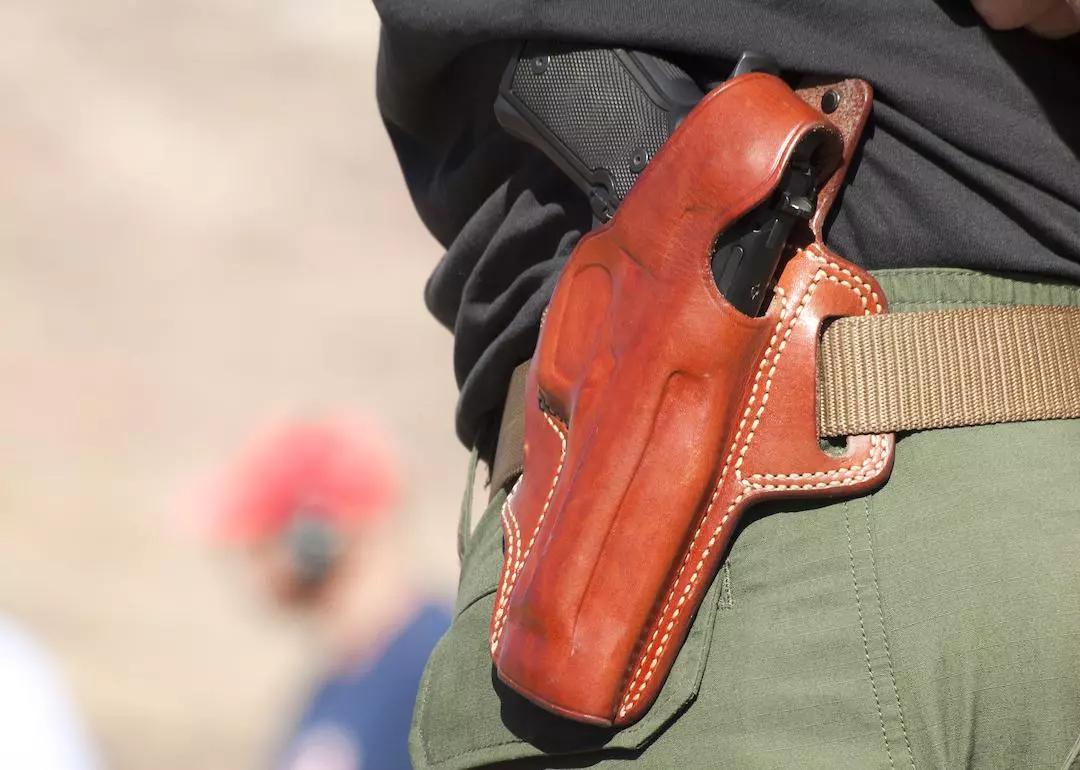
Self-identifying definitions, concealed or open, are the two ways , but this was not always the case. In the last three decades, profound policy changes on the public display of weapons made openly carrying a gun easier. More than 30 states allow open carry without the requirement of a license, while a further 10 require a license. Only four states鈥擟alifornia, Illinois, Florida, New York鈥攁nd Washington D.C. fully prohibit the open carry of a gun in public.
Nonmailable Firearms Act of 1927 banned shipping firearms through USPS
The U.S. Congress , which banned shipping firearms, including pistols, revolvers, and concealable guns, through the U.S. Postal Service. Only military, police officers, and specific law officials were to mail firearms. If found guilty of illegally sending weapons, gun owners could face as much as two years in prison and up to $1,000 in fines.
America has more guns than people
There are with 120.5 firearms per 100 U.S. citizens, according to Vox, making the country more prone to gun violence. As the leading country in gun ownership (with Yemen second), the U.S. owns almost half of all firearms globally, at around 45%.
States with more guns have higher firearm fatalities
Harvard Injury Control Research Center Director David Hemenway states that "a wide array of empirical evidence indicates that more guns in a community leads to more homicide" in America. He adds in his book, that additional research shows firearms in a home cause a greater risk of self-murder and unintentional injury.
Almost 3,000 US mass shootings since Sandy Hook
Since the 2012 Sandy Hook Elementary School shooting in Connecticut, almost have taken place across the country. There have been, as of late October 2022, 660 this year alone.
Higher police officer deaths in gun-friendly states
According to the American Journal of Public Health, is much higher in states with less-restrictive gun regulations. Using the Poisson distribution to breakdown data gathered from the FBI between 1996 and 2019, research proved LEO homicide rates to be three times higher in states with more gun owners; this is, however, an older study, and this ratio may have changed in the past three years or been impacted by COVID-19.
Eleven states allow students to carry concealed guns on campus
While mass shootings, specifically on school grounds, have compelled lawmakers to enforce regional gun restrictions and bans, eleven states . Sixteen states prohibit it, while 23 leave it to the schools themselves to determine whether to allow or forbid concealed carry on school grounds.
Vermont adolescents can own a handgun
In the Green Mountain state, without parental consent. Additionally, there is no age restriction on owning or possessing a rifle or shotgun in Vermont, allowing any child to have that type of firearm without parental consent. There are caveats, however; the sale of firearms to anyone under age 21 within the state is , and the furnishing of a firearm to anyone under the age of 16 is subject to a fine, albeit of $50 max. A further caveat is that shooting instructors can provide a gun to a student under 16 without fear of a fine or other reprisal.
States exempt from federal gun laws
Under nullification laws, some U.S. states feel they do not have to follow federal law regarding the sale of guns manufactured in the region. Since 2010, have all passed federally defiant legislation based on "firearms freedom," allowing them to make guns without national regulations and sell them without an official federal record. In 2021, Missouri federal gun regulations by passing the Second Amendment Preservation Act, but the Justice Department that the act cannot be enforced due to the Constitution's Supremacy Clause.
22 adolescents are shot daily in the US
Around 22 children are shot daily in the U.S. , with an average of three fatalities each dawn-to-dark. Within this figure is a further alarming fact: Eight children and teens are unintentionally shot each day due to , which is a shooting resulting in injury or death that involves an improperly stored or misused gun found in the home.
39% of parents don't think kids know where their gun is stored
Not only do 39% of parents or guardians falsely believe that their children do not know where the firearms in the house are stored, that their children either handled or played with said guns. Presently, .
More than a third of non-owners believe they will own a gun at some point in their lives
While 30% of Americans admit to owning a firearm, and possessing a gun in the future. In a Pew Research Center study, up to 36% of U.S. citizens feel they may need a weapon and followed by a rifle and a shotgun.
More than 320,000 children in US have witnessed mass shootings
A detailed Washington Post report that since the mass shooting at Columbine High School on April 20, 1999, more than 320,000 children have experienced gun violence on school grounds. Those children were spread across 340 schools, meaning gun violence has occurred at an average of about 15 schools each year since 1999.
President George Washington's pistols worth $2 million
The Lafayette-Washington steel-mounted "saddle" pistols during the 1777 encampment at Valley Forge sold located in London and New York. Nearly as expensive, famous french gunsmith Nicolas-Noel Boutet's renowned silver-mounted rifled flintlock pistols also
Domestic violence is a leading cause of adolescent shootings
showed that in the 17 U.S. states tracked in the study, 179 children, at least half younger than 13 years old, became "collateral victims" of domestic violence incidents committed with a gun after a fight broke out in the home from 2003鈥�2013. A 2020 study in the Journal of the American Academy of Psychiatry and the Law revealed that in domestic violence incidents the presence of a firearm increased the risk of multiple or collateral victims by nearly 71%.
States with the most restrictive firearm regulations see fewer deaths by guns
States with stricter gun laws have fewer deaths by firearm, according to . Of the eight states considered to be in gun control legislation, all but two see many fewer gun deaths than the national average; the two outliers are nearer the average, but still below it. Of what are considered to be the when it comes to gun control, only Maine is below the national average.
Gun-Free School Zones Act made it illegal to carry a firearm near schools
The , amended in 1995 to allow for commercial activity, made it illegal to carry a firearm within 1,000 feet of a school. And yet certain states choose to flout this law by making allowances of their own. Seven states with a concealed carry permit鈥攖hough only three do not also require permission from a school authority鈥攁nd many states don't have laws against
Washington D.C. gun ownership was banned from 1975 to 2008
In its 2008 ruling in , the Supreme Court overturned a 32-year handgun ban in the nation's capital. Until 2022, the decision was the most recent regarding the Second Amendment from the top court, which in April 2020 sent back to the lower courts. In June 2022, the Supreme Court New York's law that required a license to conceal-carry a firearm, ruling it unconstitutional.
Demographics of gun ownership
Four out of every 10 adults in America have that there is at least one gun in their home, and men are nearly twice as likely to be gun owners than women. Gun ownership across races varies rather widely, with 36% of white men reporting to own at least one gun, against much lower figures for Black (24%), Hispanic (18%), and Asian men (10%). Most gun owners are over the age of 30 and tend to lean conservative in their political and social beliefs.
National Firearms Act of 1934 was passed in response to gang violence
In response to the notorious extreme including mobster Al Capone and hitman John Dillinger, Congress passed the National Firearms Act of 1934 under President Franklin Roosevelt's administration. The legislation under the "New Deal for Crime" prohibited the use of any firearm with a barrel shorter than 18 inches.
There are more than 2,000 US gun shows a year
The ATF estimates that America hosts about A lack of makes the thousands of firearm displays questionable, with some not requiring background checks or a waiting period in order to purchase.
Montana has the highest percentage of gun ownership
Nearly seven out of every 10 adults in Montana , making the state with the greatest number of gun owners. Wyoming and Alaska run close behind, while Texas leads the way in terms of the , followed by Florida.
Several East Coast states have the lowest percentage of gun ownership and licenses issued
The Northeast region of the United States has some of the on the books, so it may come as little surprise that the states with the lowest number of gun owners and federal licenses issued lie along the Atlantic. While Delaware, Vermont, Rhode Island, and Maine are among the states with the fewest in 2021, New Jersey and Massachusetts show the of gun ownership (followed quite closely by Rhode Island).
58 were killed in largest mass shooting
Fifty-eight concertgoers at the Rt. 91 Harvest Festival in Las Vegas lost their lives during the More than 850 were injured when a single gunman opened fire from the 32nd floor of the Mandalay Bay Casino. Country musician Jason Aldean was performing when the shooting started.
The Federal Firearms Act of 1938 required a license to sell firearms
Under the , all gun dealers, manufacturers, and importers were required to obtain a license to sell firearms. The law also excluded certain groups, like convicted felons, from owning a gun. The replaced the Federal Firearms Act but adopted many of the same rules still in place today.
Seven states and Washington D.C. have assault weapons bans
Seven states and the District of Columbia have while Minnesota and Virginia have regulations in place. California, New Jersey, and Connecticut put before a federal 10-year ban was enacted with the Violent Crime Control and Law Enforcement Act of 1994. Massachusetts, Hawaii, New York, and Maryland have similar laws.
Gun purchases contribute to wildlife conservation efforts
Gun purchasers have contributed billions of dollars to wildlife conservation and hunting safety through the . Through the act, legally sold firearms and ammunition are subject to a minimum 10% tax. In FY2021, a total of $679 billion was to the states via a series of grant programs.
The 1993 Brady Act introduced FBI background checks
The implemented a five-day waiting period before an unlicensed person could purchase a gun so the FBI can perform a background check. The law was named for former , who was shot in the head during an assassination attempt on President Ronald Reagan.
There are loopholes in background checks
Though the Brady Act in 1993 required background checks for the sale of firearms, today occur without one. in certain states are exempt from performing federal background checks, both at gun shows or through online sales. The Bipartisan Background Checks Act would require checks on all sales, passed the House in 2021, but remains, as of October 2022, waylaid under Senate review. Nonetheless, gun legislation has found success very recently. In June 2022, President Joe Biden signed into law the , which in addition to addressing "red flag" laws, greatly expands background checks for those under age 21, and closes the "boyfriend loophole," by which dating partners were excluded in previous legislation from those from owning a firearm were they convicted of domestic abuse.
Alcohol abuse heightens gun violence
A 2017 study by the revealed that an alcohol arrest was a bigger factor in future gun violence than prior violence itself. Another showed that nearly had consumed alcohol before their crimes.
Gun Control Act of 1968 was the first to prohibit gun sales to certain groups
The was the first gun legislation to prohibit the sale of guns to certain groups, including convicted felons, minors, and the mentally unstable. The bill also banned the sale of guns through interstate mail, five years after the assassination using one such gun. Two more assassinations鈥攖hose of Dr. Martin Luther King Jr. and Robert Kennedy鈥攃ame just months before the bill's passage.
A city in Georgia requires that every household must own a gun
The city of Kennesaw, Georgia, has stipulating that "every head of household in the city limits must own a gun." The law was passed in 1982 in response to a . A handful of towns have since passed . Kennesaw's law is, however, a bit misleading in its seeming absoluteness; a closer look at the language of the law makes it clear that gun ownership is required, , "save for those Kennesaw residents who couldn't afford guns, couldn't use guns, couldn't legally own guns, or simply didn't want to have guns."
Remington Arms is the oldest gun manufacturer in the US
Remington Arms was formed in 1816 and serves as the nation's oldest gun manufacturer, while Italy's Beretta dates to 1526. Bankruptcy proceedings in 2020 threatened to break Remington apart, but the company was able to exit bankruptcy just two months after filing. American competitor Smith & Wesson, founded in 1856, is the with Remington a close second.