What have Trump’s troops done for crime in D.C.?
President Donald Trump has claimed that his deployment of National Guard troops and federal agents to Washington D.C., has wiped out crime in the nation’s capital. “We’ve got no crime,” he reporters on October 5.
That’s not true.
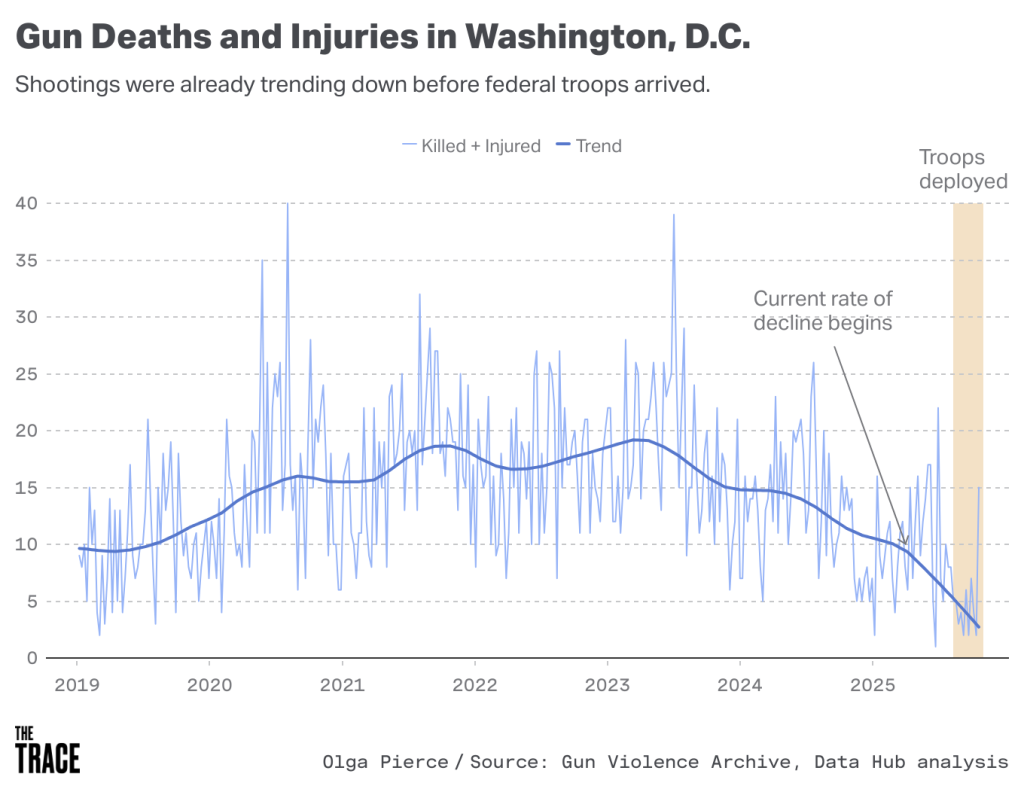
Shootings in the capital are down by two-thirds year-over-year, according to a analysis of the Gun Violence Archive, which collects data on shootings from sources like media and police reports. But a closer look with modeling from The Trace’s Gun Violence Data Hub shows the steep downward trend predates Trump’s deployment by several months. Shootings started plummeting in mid-April, suggesting the military presence is probably not responsible for the decline.
Over the 11 weeks since troops arrived, the Data Hub model estimates fewer than one shooting victim difference citywide, compared with what would have been expected had the deployment never happened. Even if the troops remained through year’s end, the projected difference would still be less than one.
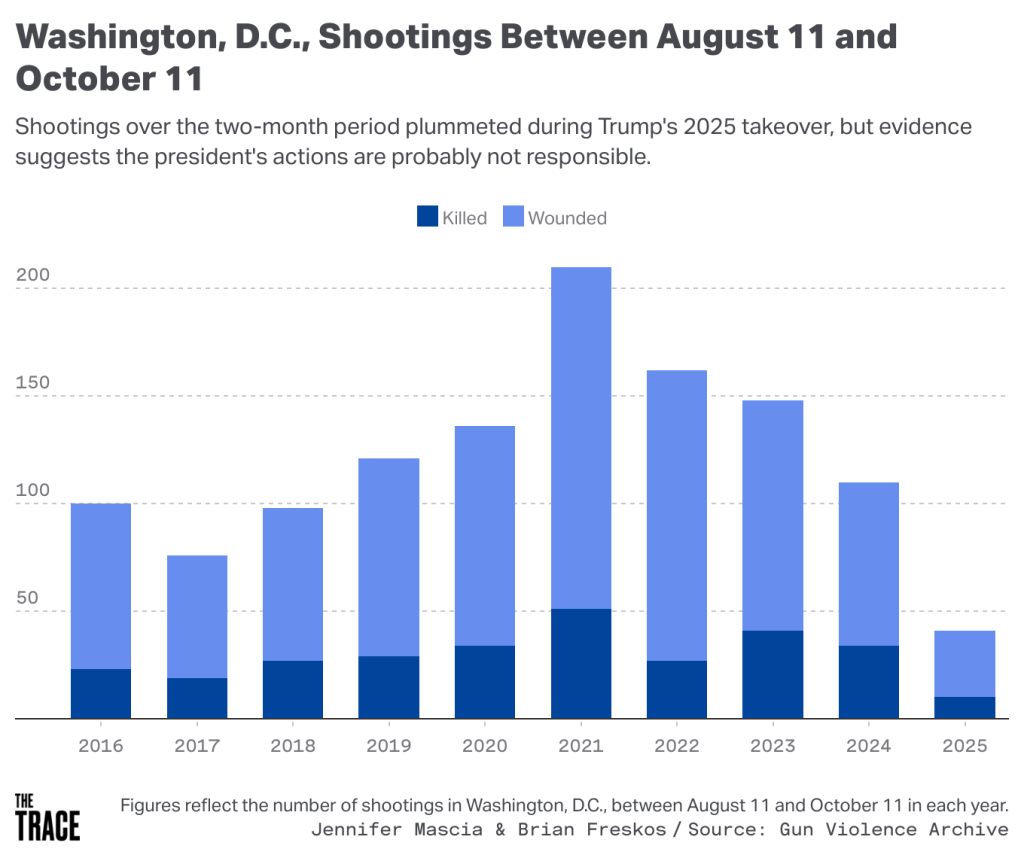
From August 11 to October 11 — the first two months of Trump’s takeover — 41 people were shot in Washington, 10 of them fatally. That’s a 62% drop in the number of shootings over the same period last year, when 110 people were shot, and 34 of them died. It’s the biggest year-over-year reduction for that two-month period on record.
Anecdotally, the presence of troops does seem to have suppressed shootings, at least temporarily, violence interrupters on the ground told us. In recent weeks, federal agents have pulled back from patrolling neighborhoods, and shootings have ramped up again. There were at least six shootings — one of them a mass shooting — .
But that doesn’t mean a semi-permanent federalized police force is a good idea, according to violence interrupters and other experts. “The community said, ‘We want change,’ but not like this,” said Jawanna Hardy, a violence intervention specialist and founder of the capital-based nonprofit Guns Down Friday.
Federal agents had been making quality-of-life arrests for violations like public marijuana smoking up until a couple of weeks ago, Hardy said. But when the agents pulled back, the difference was immediately apparent. “The day they slowed down, I knew it — no one told me.”
A couple of weeks ago, she was holding a Know Your Rights training for young men dealing with police and saw a group of boys rushing to defend someone against an armed robber. No federal agents or officers rushed in to assist. Instead, she and her colleagues mediated and calmed the situation, just like they did before Trump sent in the feds. Local police and federal agents “working together to storm the neighborhoods, that has stopped,” Hardy said.
Crime statistician Jeff Asher, who has closely tracked the nationwide drop in murder in recent years, earlier this month that while “the exact impact of [federal] intervention is a bit difficult to tease out,” September’s of 16 people shot, two of them fatally, marked “the fewest in a month since 2014 and the clearest sign of a possible positive outcome tied to the intervention.”
Thomas Abt, a criminology professor and the founding director of the University of Maryland’s , cautions against drawing conclusions from such a small sample of data — in this case, two months of shooting stats. But generally, he said, it’s not surprising that flooding a jurisdiction with enforcement resources might temporarily suppress crime. “The question is, is it sustainable? It’s hard to tell, but I would say it’s unlikely, given how expensive these crackdowns are, and that they’re drawing resources from other vital public safety functions.”
There are also costs to indiscriminately deploying federal agents and troops into neighborhoods for local crime enforcement, what Abt calls “collateral consequences.” “In the past when people would do these roundups, you would damage and traumatize the community with this dragnet-style approach,” he said. “You might temporarily drive crime down, but you wouldn’t actually catch a lot of hardened criminals with that.”
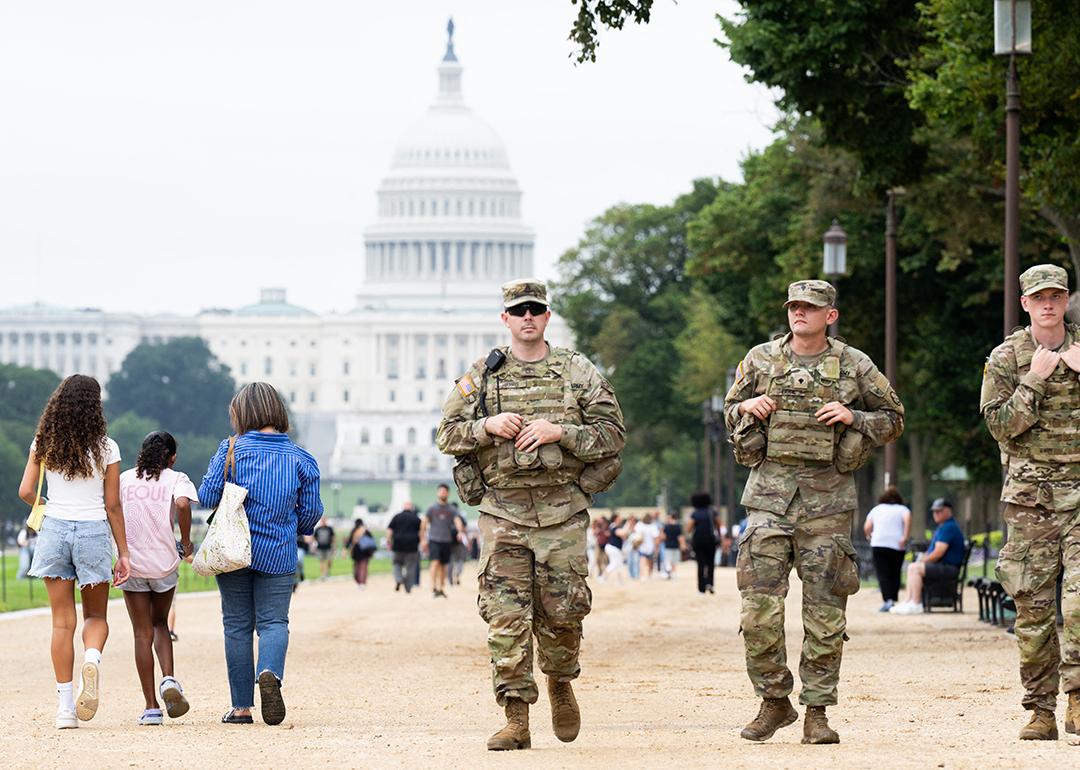
Washington’s attorney general has indicated that the National Guard will be in the city on a long-term basis, possibly until next summer. A long military deployment among a civilian population can take a psychological toll, said Aqeela Sherrills, co-founder of the Community-Based Public Safety Collective, a violence prevention group in Newark, New Jersey. “The presence of troops has a dramatic effect on daily life,” he said. “Residents avoid public spaces. Local businesses end up losing foot traffic. Families may stay home from work and keep children from school out of fear of their kids getting arrested or accosted by law enforcement.”
“Soldiers escalate tension and traumatize communities,” Sherrills added. “Military personnel are not trained to do violence reduction. These interventions aren’t driven by public safety data. They’re being driven by power struggles and political showdowns.”
Hardy, a former Guard member herself, recalls her community being hopeful when the takeover was announced. “We witnessed so many deaths,” she said. “So when they said they were coming to create change, I was excited.”
But the Guard was deployed downtown to the tourist areas, not to the highest-crime neighborhoods, which were instead flooded by federal agents who approached residents about petty violations. “I wish they would have sent the Guardsmen to the neighborhoods,” Hardy said. “It probably would have been a little more holistic. But the way they came into these neighborhoods, it was sad. They over $1 million a day, and as soon as they left, it’s the same.”
Violence interrupters said that funding could be much better spent. “With a fraction of that money,” Sherrills said, “neighbors could run violence interruption programs, healing services, youth mentorship programs that cost pennies on the dollar and create lasting safety.”
Reporting and graphics contributed by Olga Pierce.
was produced by and reviewed and distributed by Â鶹ԭ´´.