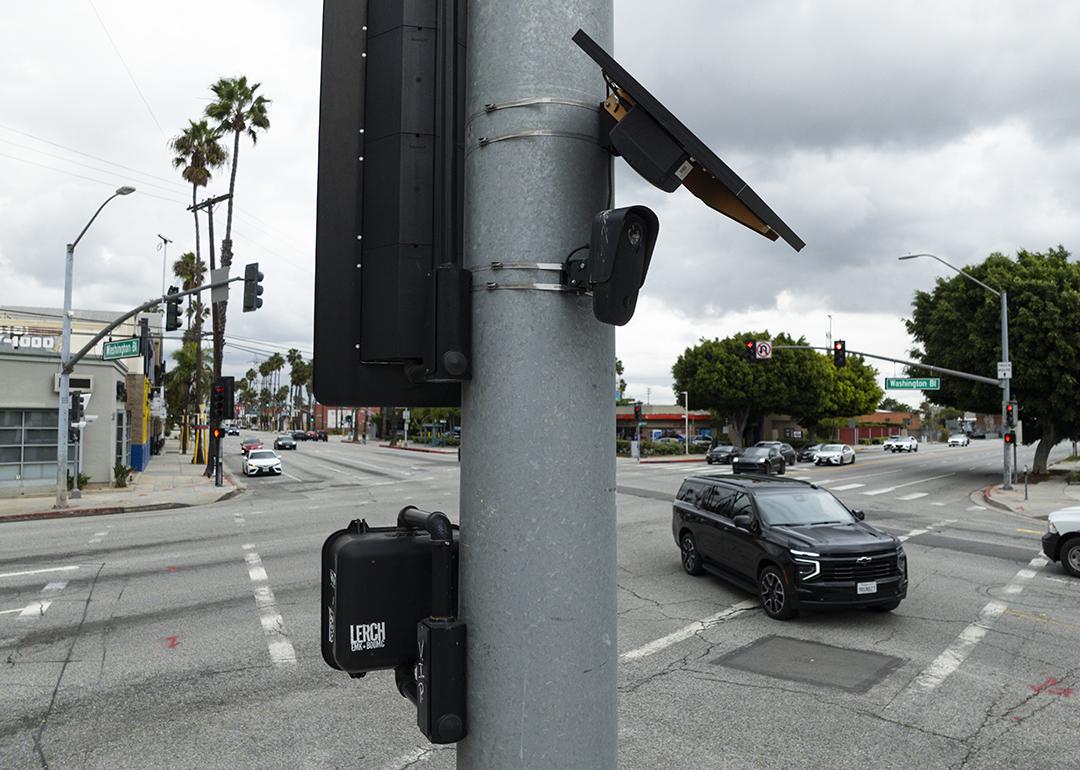
Worried about surveillance, states enact privacy laws and restrict license plate readers
Worried about surveillance, states enact privacy laws and restrict license plate readers
As part of its deportation efforts, the Trump administration has ordered states to hand over personal data from voter rolls, driver’s license records and programs such as Medicaid and food stamps.
At the same time, the administration is trying the bits of personal data held across federal agencies, creating a single trove of information on people who live in the United States.
examines how many left-leaning states and cities are trying to protect their residents’ personal information amid the immigration crackdown. But a growing number of conservative lawmakers also want to curb the use of surveillance technologies, such as automated license plate readers, that can be used to identify and track people.
Conservative-led states such as, and enacted laws last year designed to protect the personal data collected through license plate readers and other means. They joined at least five left-leaning — Illinois, Massachusetts, Minnesota, New York and Washington — that specifically blocked U.S. Immigration and Customs Enforcement from accessing their driver’s license records.
In addition, Democratic-led cities in ,,, , , and last year terminated their contracts with Flock Safety, the of license plate readers in the U.S.
The Trump administration’s goal is to create a “surveillance dragnet across the country,” said William Owen, communications director at the Surveillance Technology Oversight Project, a nonprofit that advocates for stronger privacy laws.
“We’re entering an increasingly dystopian era of high-tech surveillance,” Owen said. Intelligence sharing between various levels of government, he said, has “allowed ICE to sidestep sanctuary laws and co-opt local police databases and surveillance tools, including license plate readers, facial recognition and other technologies.”
A new Montana law bars government entities from accessing electronic communications and related material without a warrant. Republican state Sen. Daniel Emrich, the law’s author, said “the most important thing that our entire justice system is based on is the principle against unlawful search and seizure” — the right enshrined in the Fourth Amendment to the U.S. Constitution.
“It’s tough to find individuals who are constitutionally grounded and understand the necessity of keeping the Fourth Amendment rights intact at all times for all reasons — with minimal or zero exceptions,” Emrich said in an interview.
ICE did not respond to Stateline’s requests for comment.
Automated license plate readers
Recently, cities and states have grown particularly concerned over the use of automated license plate readers (ALPRs), which are high-speed camera and computer systems that capture license plate information on vehicles that drive by. These readers sit on top of police cars and streetlights or can be hidden within construction barrels and utility poles.
Some cameras collect data that gets stored in databases for years, raising among privacy advocates. One from the Brennan Center for Justice, a progressive think tank at New York University, found the data can be susceptible to hacking. Different agencies have varying policies on how long they keep the data, to the International Association of Chiefs of Police, a law enforcement advocacy group.
Supporters of the technology, including many in law enforcement, say the technology is a powerful tool for tracking down criminal suspects.
Flock Safety says it in more than 5,000 communities and is connected to more than 4,800 law enforcement agencies across 49 states. The company claims its cameras conduct more than 20 billion license plate reads a month. It collects the data and gives it to police departments, which use the information to locate people.
Holly Beilin, a spokesperson for Flock Safety, told Stateline that while there are local police agencies that may be working with ICE, the company does not have a contractual relationship with the agency. Beilin also said that many liberal and even sanctuary cities continue to sign contracts with Flock Safety. She noted that the cameras have been used to solve some high-profile crimes, including identifying and leading police to the man who committed the and killed an MIT professor at the end of last year.
“Agencies and cities are very much able to use this technology in a way that complies with their values. So they do not have to share data out of state,” Beilin said.
Pushback over data’s use
But critics, such as the , say that Flock Safety’s cameras are not only “giving even the smallest-town police chief access to an enormously powerful driver-surveillance tool,” but also that the data is being used by ICE. One news outlet, , obtained records of these searches and found many were being carried out by local officers on behalf of ICE.
Last spring, the Denver City Council unanimously voted to terminate its contract with Flock Safety, but Democratic Mayor Mike Johnston unilaterally in October, arguing that the technology was a useful crime-fighting tool.
The ACLU of Colorado has vehemently , saying last August that audit logs from the Denver Police Department show more than 1,400 searches had been conducted for ICE since June 2024.
“The conversation has really gotten bigger because of the federal landscape and the focus, not only on immigrants and the functionality of ICE right now, but also on the side of really trying to reduce and or eliminate protections in regards to access to reproductive care and gender affirming care,” Anaya Robinson, public policy director at the ACLU of Colorado.
“When we erode rights and access for a particular community, it’s just a matter of time before that erosion starts to touch other communities.”
Jimmy Monto, a Democratic city councilor in Syracuse, New York, the charge to eliminate Flock Safety’s contract in his city.
“Syracuse has a very large immigrant population, a very large new American population, refugees that have resettled and been resettled here. So it’s a very sensitive issue,” Monto said, adding that license plate readers allow anyone reviewing the data to determine someone’s immigration status without a warrant.
“When we sign a contract with someone who is collecting data on the citizens who live in a city, we have to be hyper-focused on exactly what they are doing while we’re also giving police departments the tools that they need to also solve homicides, right?” Monto said.
“Certainly, if license plate readers are helpful in that way, I think the scope is right. But we have to make sure that that’s what we’re using it for, and that the companies that we are contracting with are acting in good faith.”
Emrich, the Montana lawmaker, said everyone should be concerned about protecting constitutional privacy rights, regardless of their political views.
“If the government is obtaining data in violation of constitutional rights, they could be violating a whole slew of individuals’ constitutional rights in pursuit of the individuals who may or may not be protected under those same constitutional rights,” he said.
was produced by and reviewed and distributed by Â鶹ԭ´´.