95% of Americans hear therapy words daily. Here are the 9 we misuse most
Have you ever paused mid-conversation and wondered if you’re using a mental health term correctly? Maybe you’ve described feeling “triggered” by something at work, or found yourself questioning whether a situation was really “toxic” or just frustrating.
These moments of uncertainty have become part of a cultural shift where mental health language—what’s now called “therapy speak”—has moved out of therapy offices and into casual conversation.
This isn’t just a personal observation, it’s a measurable phenomenon. set out to understand how mental health terminology has woven itself into daily conversation, and found that a whopping 95% of Americans now encounter therapy speak in their daily lives. But here’s what’s most attention-grabbing: Nearly one in three people (29%) believe these terms have their place but are being overused or misused.
In other words, people might not be as fluent in this new vocabulary as they think.
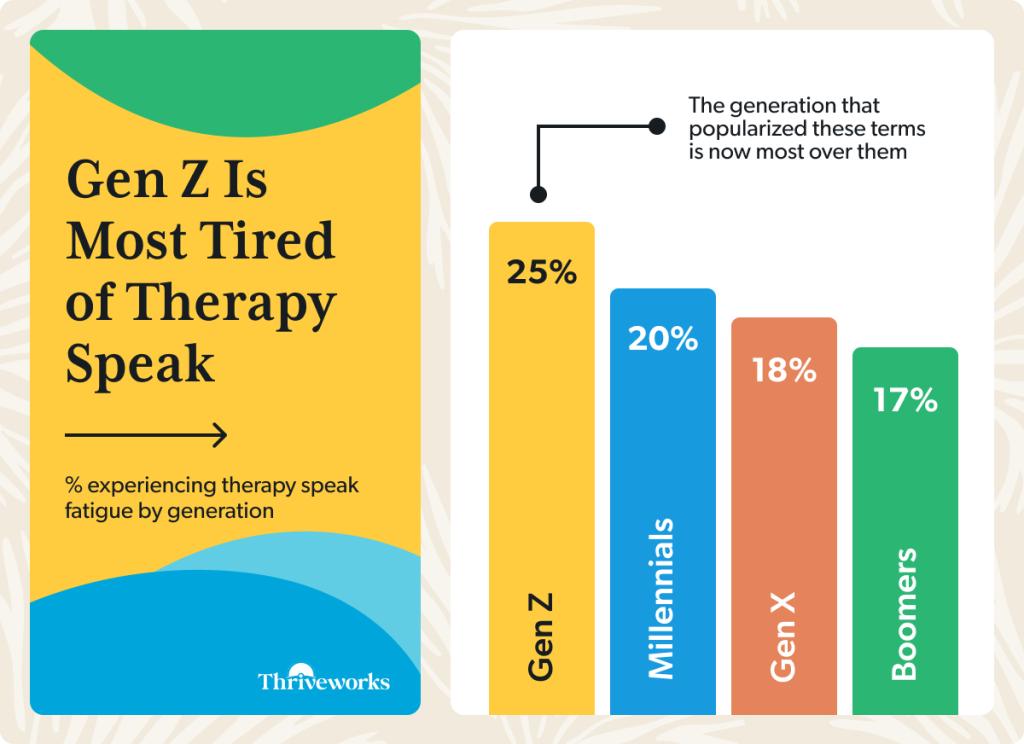
The most telling finding? The generation often credited with bringing therapy language mainstream—Gen Z—is now the most tired of it. While 25% of Gen Z report fatigue with therapy speak, that drops to just 17% among Boomers. It suggests that people might be witnessing the maturation of a movement, where the early adopters are leading a more thoughtful conversation about precision and responsibility in mental health language.
Keep reading to learn more about therapy speak, how it became so widespread, and how to use it more wisely. Plus, more of what this survey revealed.
What Is Therapy Speak?
“Therapy speak is when psychology jargon or terminology used in therapy/by therapists is used in everyday conversation, often by the general population or those not considered experts in the field,” says , a licensed clinical social worker at Thriveworks.
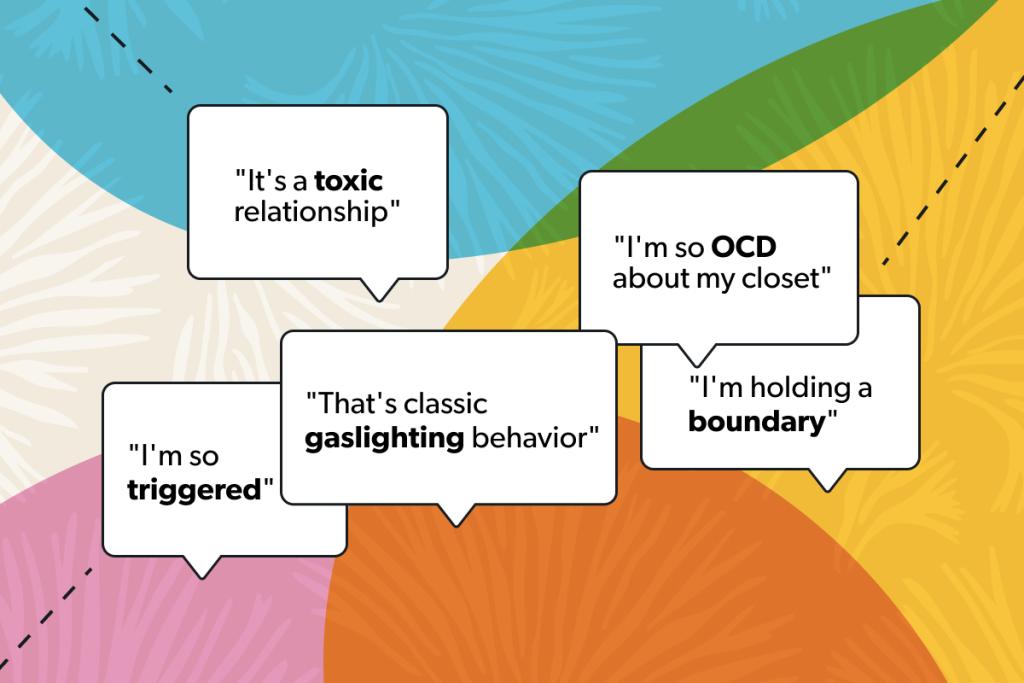
You might hear it when someone says they’re “so OCD” about organization, describes minor stress as “trauma,” or feels “triggered” by everyday frustrations.
This shift toward mental health language in casual conversation isn’t inherently problematic—it shows that mental health awareness is growing. According to our survey, 22% of respondents said therapy speak is a positive trend that increases mental health awareness, and 23% said it helps them better understand people and situations.
“The popularization of therapy speak means that people are talking about therapy out in their regular lives, and I think that’s a real positive,” says Amy Pearlman, MSW, LICSW, senior vice president of clinical strategy at Thriveworks.
However, precision matters when dealing with mental health concepts. “Where it starts to get dangerous is when people start to feel like anyone could be their therapist—and talking about mental health is not therapy,” Pearlman says.
Where We’re Getting It Wrong
While talking more openly about mental health is beneficial, it’s important to recognize when we might be missing the mark with therapy speak. Twenty-nine percent of survey participants believe therapy speak has its place, but it’s being overused or misused.
“This shift in therapy speak entering our everyday language can lead to spreading false information, misuse, oversimplification, or even manipulation of very important, sensitive terms and topics that impact real lives,” Dumler says.
The Most Misunderstood Terms
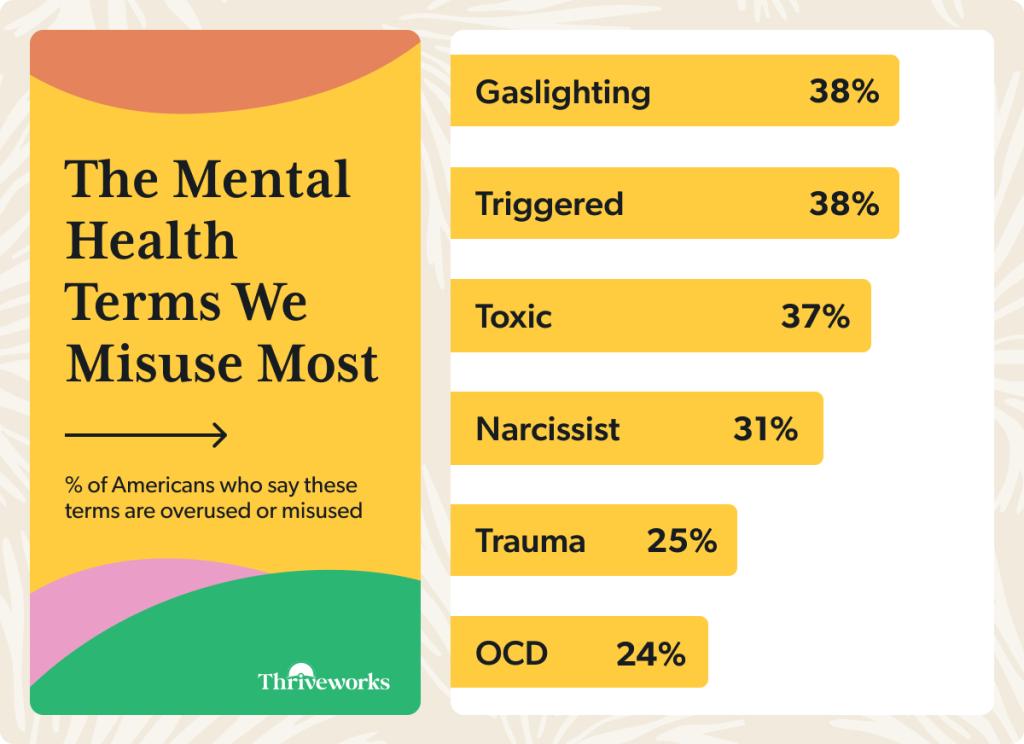
When therapy-related terms are used imprecisely, it can water down their meaning or minimize real mental health struggles. Our survey participants identified the nine terms they feel are most overused or misused:
- Gaslighting (38%)
- Triggered (38%)
- Toxic (37%)
- Narcissist (31%)
- Trauma (25%)
- OCD (24%)
- Self-care (22%)
- Boundaries (22%)
- Codependent (17%)
How We Use Them vs. The Real Definitions
Most people aren’t mental health experts, and while these words have become common in everyday conversation, it doesn’t mean we always understand their clinical meanings. Here’s a breakdown of some of the most commonly misused terms and what they truly mean:
1. Gaslighting
How people use it: “My husband was totally gaslighting me when he said I never told him about my work event.”
What it actually means: “Gaslighting is an intentional form of where an individual systematically feeds false information to confuse, victimize and/or potentially groom the other party to get their way or gain control,” Dumler says. The tactic makes victims question their own reality.
The key difference: Someone forgetting or misremembering a conversation isn’t gaslighting, it’s just human. True gaslighting might look like a partner repeatedly insisting conversations never happened, denying they said hurtful things, or convincing you that your memory of events is wrong to maintain control.
2. Narcissist
How people use it: “She’s such a narcissist. She’s always posting pictures of herself online.”
What it actually means: For someone to be a true narcissist, they must be diagnosed with , Dumler says, which affects only 1-2% of the population. A narcissist requires excessive admiration, lacks for others, has an inflated sense of self, believes they’re special, and exploits others for personal gain.
The key difference: Posting photos frequently might indicate someone enjoys attention, but NPD involves a pervasive pattern that significantly impacts relationships and functioning. A might consistently dismiss others’ feelings, take credit for others’ work, or become enraged when they don’t receive special treatment.
3. Trauma
How people use it: “I have trauma from giving that presentation at work.”
What it actually means: Trauma refers to “an event or experience that involves actual or perceived threat of death or serious injury to self or others,” Dumler says. This event or experience results in feelings of fear, anxiety, horror, or helplessness. It’s much more than just an uncomfortable or unpleasant occurrence.
The key difference: A stressful presentation might be embarrassing or anxiety-provoking, but trauma involves experiences that make you feel genuinely unsafe or helpless. True trauma might include car accidents, violence, or witnessing something horrific.
4. Triggered
How people use it: “I’m triggered by my ex-boyfriend’s Instagram post with his new girlfriend.”
What it actually means: “When someone is triggered, they experience intense and overwhelming emotional—and sometimes physical—distress related to reminders of a prior traumatic experience,” Dumler says. “This initiates their brain/body to go into fight, flight, or freeze mode due to the brain thinking they’re unsafe at the moment.” This is most common for survivors of trauma, especially people who have (PTSD).
The key difference: Feeling upset or jealous about an ex’s new relationship is painful but normal. Being triggered involves your body having an involuntary, intense reaction—like panic, flashbacks, or feeling like you’re in physical danger—because something reminded you of actual trauma.
5. Toxic
How people use it: “My mother-in-law is toxic. She always has opinions about how I parent my kids.”
What it actually means: “Toxic means causing true, consistent harm and damage, often referred to in relationships,” Dumler says. “It’s a more severe level than someone being an unhealthy partner.”
The key difference: Unwanted parenting advice might be annoying or overstepping boundaries, but involves patterns that genuinely damage your wellbeing, like manipulation, constant criticism, or deliberate efforts to undermine your self-worth.
6. OCD
How people use it: “I’m so OCD about my closet. Everything has to be color coordinated and in its place.”
What it actually means: Obsessive-compulsive disorder (OCD) is a mental health condition that significantly impacts daily functioning—very different from preferring things neat and tidy. According to Dumler, OCD is “characterized by unwanted and recurring thoughts, images, or urges that cause distress and shift behavior to reduce the anxiety associated with the obsessions.”
These behaviors, called compulsions, can include physical actions (like excessive hand washing or repeatedly checking something) or mental rituals (like seeking reassurance or silently repeating phrases to feel safe).
The key difference: Liking your closet organized is a preference that makes you feel good. OCD involves distressing, intrusive thoughts that create anxiety, forcing you to perform specific behaviors to feel safe—even when you know the thoughts don’t make logical sense.
How These Terms Spread
We aren’t learning these terms from psychology textbooks, so where are they coming from? Everywhere. And there’s a “telephone game” effect with mental health terms: they become simplified and distorted as they spread through different channels and from person to person.
“Social media gives people a platform to reach many others, and then those people reach even more people—it has a knock-on effect,” says , a board-certified psychiatric mental health nurse practitioner with Thriveworks.
Social media often accelerates the spread of information in an effort to simplify complex topics. But when the average person interprets and shares mental health content, important context can get lost. Someone might see a TikTok about gaslighting in abusive relationships, but when they share the concept with a friend, it becomes “gaslighting is when anyone contradicts you.” The nuance of intentional psychological manipulation gets stripped away.
Another thing that happens: A word gets overused so much that it loses meaning entirely. “If, after a while, everybody is saying, ‘Oh, that’s toxic. This is toxic,’ then everything becomes toxic, Hanselman explains. “The word loses relevance, and it doesn’t mean anything anymore.”
Where We’re Hearing These Terms
According to this survey, here’s where therapy speak appears most often:
- Social media (37%)
- Social settings with friends (29%)
- Family members (28%)
- Strangers in public (22%)
- At work (14%)
- Romantic settings (13%)
Who’s Spreading Them
Survey participants identified these as the biggest contributors to therapy speak misuse:
- The media
- Celebrities/influencers
- Fictional characters in movies/TV
- Co-workers
- Friends
- Siblings
- Spouses
- Parents
The Surprising Generational Shift
While Gen Z didn’t invent therapy speak, they’re often credited with popularizing it. Despite being the generation that brought therapy language mainstream, this survey found that they’re also the most fed up with it.
When it comes to therapy speak fatigue, here’s how the generations stack up:
- 25% of Gen Z are tired of therapy speak
- 20% of Millennials
- 18% of Gen X
- 17% of Boomers
Why might this be the case? “Constant exposure to misused and overused terms can be exhausting and a lot to keep up with,” Dumler says.
The generation is also maturing. Gen Z’s eldest members are now in their late twenties, and with age often comes less tolerance for oversimplified labels. “Teens are more likely to throw labels on things,” Hanselman says. “More fully developed Gen Z adults may be less tolerant of rigid labels.”
This suggests we might be witnessing the evolution of a movement—where the early adopters are now leading a more thoughtful conversation about precision and responsibility in mental health language.
The Real Impact: When Language Matters
Our words matter more than we think. According to the experts, here’s when therapy speak helps versus when it hurts.
When Therapy Speak Helps
When used thoughtfully, therapy speak can create connection, understanding, and empower people to seek the support they need. For example:
1. Breaking Stigma
One in five survey participants says therapy speak has helped destigmatize mental health conditions. “Therapy speak is really helpful in terms of decreasing stigma and validating that many of us do experience all kinds of these concepts,” Pearlman says.
2. Creating Vulnerability
Less stigma means more room for open discussions about mental health. Therapy speak, when used accurately, can help us have a common sense of humanity and shared experiences, Pearlman says. This helps us feel less alone, no matter what we’re going through.
3. Empowering Help-Seeking
Therapy speak and mental health information online may help people understand that they might have a diagnosable condition, and they can get help for it, Hanselman says. For example, accurate descriptions of OCD or trauma online can empower people to understand their symptoms and seek therapy.
When Therapy Speak Hurts
On the flip side, therapy speak can do some damage. Here are some cases when it backfires:
1. Diluting Clinical Terms
Calling minor annoyances “trauma” or labeling someone a “narcissist” for everyday selfish behavior can downplay serious mental health conditions. One in five survey participants says therapy speak has trivialized mental health conditions, and nearly one in four (23%) says it undermines serious issues.
“We can hurt other people by referring to something as traumatic when they have experienced a significant trauma,” Pearlman says. “It really minimizes their experience when we use the word to refer to something that is not particularly significant.”
2. Shutting Down Conversations
Twenty-two percent of survey participants say therapy speak is weaponized in fights or as an excuse for bad behavior. Throwing therapy terms at others, like accusing someone of being a narcissist, can escalate conflicts instead of resolving them.
“Ideally, you shouldn’t just throw a label at someone’s behavior and shut it down,” Hanselman says. “You should talk about it and try to understand where this behavior is coming from to work through the conflict.”
Moving Forward: How We Can Do Better
The goal isn’t to stop using these terms entirely, but to be more intentional with our language. Here are three ways to use therapy speak more thoughtfully.
1. Educate yourself.
Learning more about mental health is always valuable—especially if you plan on using these terms in daily conversation. Pearlman urges you to truly understand what a therapy speak term means before you use it. “Ask yourself: Do I really know what this word means?”
2. Ask clarifying questions.
When other people use therapy speak in conversation, don’t take their words at face value. “Ask follow-up questions when other people use a term to clarify what they meant by it,” Pearlman says. “If someone says something like, ‘OCD,’ or ‘trauma,’ ask, ‘What do you mean by that?'”
This helps ensure you’re on the same page and aren’t reinforcing misinformation.
3. Remember, you’re not a therapist.
You don’t need to try to sound like a mental health professional—being a friend is just as valuable, Pearlman says. Be there for your loved ones without trying to “diagnose” or label them.
The Bottom Line
Therapy speak is powerful. Our words hold more meaning than we know.
Be mindful of the words you choose and how you use them. Mindful language helps us talk about mental health in a way that heals, not harms. Let’s keep the movement going.
*This study was conducted by Researchscape and commissioned by Thriveworks in September 2024 through an online survey of 1,426 US Adults.
was produced by and reviewed and distributed by Â鶹ԭ´´.