Inflammation: The hidden driver of heart disease you need to be testing for
Inflammation: The hidden driver of heart disease you need to be testing for
Most adults know the drill before an annual physical: routine blood work, a few numbers to scan, and hope nothing jumps out. These tests are meant to catch serious illness early. But when it comes to cardiovascular disease—the leading cause of death in the U.S. for both men and women—standard screenings still miss critical risk factors.
The problem starts with how doctors typically test for heart disease. Traditional lipid panels focus on cholesterol—a waxy substance that can build up in arteries—and triglycerides, a type of fat that can raise your risk of heart disease. While lipid panels are important, they don’t fully explain who develops heart disease or why.
Newer findings point to a previously missing factor in heart disease: chronic, low-grade inflammation. This chronic condition plays a direct role in atherosclerotic cardiovascular disease—heart disease caused by plaque buildup that stiffens and narrows your arteries.
Cholesterol provides the building blocks for that plaque, but inflammation is what activates disease, says integrative cardiologist Abid Husain, M.D. “Cholesterol is very much like fuel. It can be inert and stay in the artery and not cause any problems,” he says. “But inflammation is heat. It's fire. It ignites that fuel. Ultimately, the combination can become explosive and turn into a heart attack.” This helps explain why some people develop cardiovascular disease despite having normal lipid levels.
Most people aren’t tested for inflammation unless they already have heart disease or another diagnosed inflammatory condition. Chronic inflammation, also known as ,” rarely causes clear red flags, and when symptoms show up, they often look like everyday issues—, , or metabolic slowdown—rather than heart risk. As a result, some 50% of U.S. adults have moderate or higher inflammatory risk and don’t know it.
The gap in testing is now being addressed. The American College of Cardiology has recommended checking for inflammatory biomarkers as a core part of cardiovascular risk assessment.
are inexpensive, widely available, and can identify risk earlier—when heart disease can still be slowed or prevented. shares what to test, how often, how to interpret results, and what comes next.
What Is Chronic Inflammation—and Why Does It Raise Heart Disease Risk?
Unlike acute inflammation—your body’s short-term response to infection or injury—chronic, low-grade inflammation persists quietly, without pain, fever, or obvious abnormalities on routine labs. It’s a persistent, low-level immune response that damages blood vessels over time.
Even in people taking heart medication, chronic inflammation contributes to what cardiologists call "residual coronary risk"—the heart attack and stroke risk that remains despite treatment.
Chronic inflammation contributes to heart disease through three main pathways:
- Endothelial dysfunction: Inflammation damages the inner lining of blood vessels, making them stiff and less able to regulate blood flow.
- Plaque formation and instability: Inflamed vessel walls are more prone to developing plaques that can rupture and block blood flow, triggering a heart attack or stroke
- Clot formation: Inflammation increases the blood's tendency to clot, raising stroke and heart attack risk
Common causes of chronic inflammation
The most common causes of chronic inflammation include:
- Visceral fat and insulin resistance. —the type stored around your internal organs—releases pro-inflammatory proteins into the bloodstream, contributing to insulin resistance (when your cells don’t respond well to insulin). Insulin resistance and inflammation reinforce one another, creating a vicious cycle that increases cardiometabolic risk.
- Smoking and poor sleep. Smoking damages cells and creates , both of which fuel inflammation. has a similar effect: When you don’t get enough, and blood vessels fail to fully relax, triggering an inflammatory response.
- Chronic stress. can keep the body’s inflammatory response switched on, affecting both the and the rest of the body over time.
- Autoimmune and inflammatory conditions. In these conditions, the immune system keeps reacting as if there’s an injury or infection, even when there isn’t—leading to long-term inflammation.
Red Flags for Inflammation
include biomarkers that—on their own or when viewed as ratios—can signal chronic inflammation that may damage the heart.
Common inflammatory or inflammation-adjacent markers include:
- High-sensitivity C-reactive protein (hsCRP), a marker of inflammation throughout the body
- Lipoprotein(a), an inherited form of cholesterol that promotes inflammation
- Remnant cholesterol, a type of cholesterol that travels through your blood on that can sneak into artery walls and slowly build plaque that leads to heart disease
hs-CRP
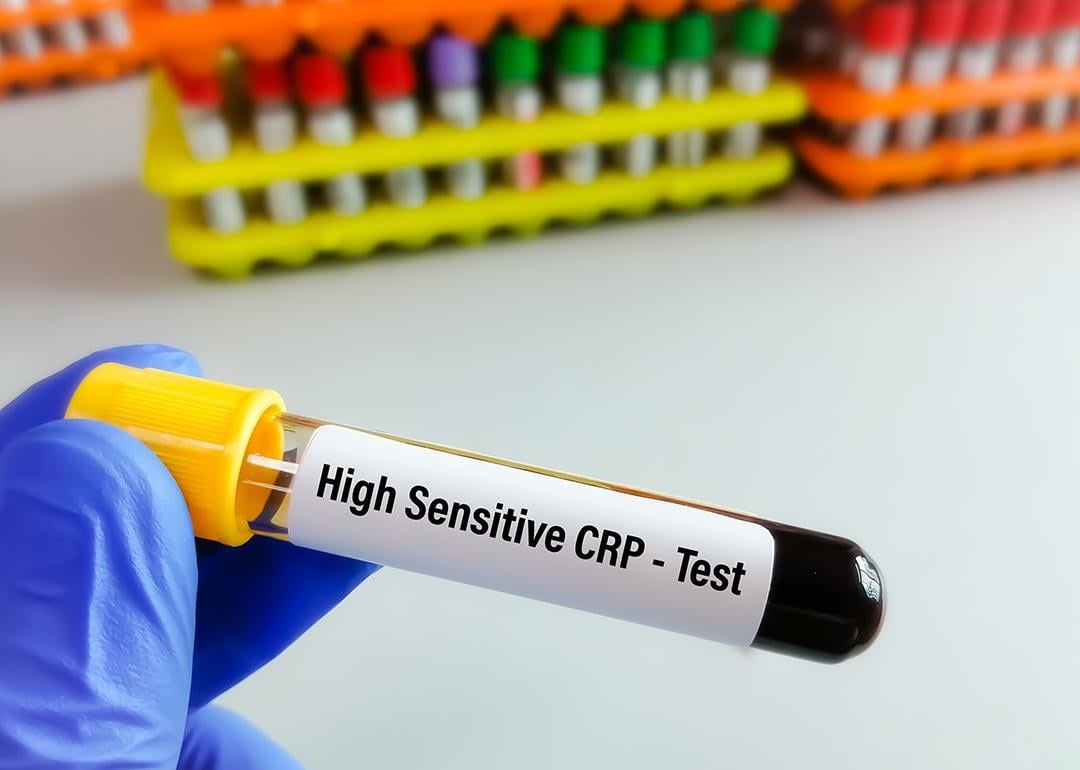
C-reactive protein (CRP) is produced by the liver in response to inflammation. High-sensitivity CRP (hs-CRP) testing detects low-grade, chronic inflammation and is the most validated blood test for identifying cardiovascular-related inflammatory risk before symptoms appear.
The American College of Cardiology now recommends hs-CRP testing for people without known cardiovascular disease and those with existing risk factors. It can flag cardiovascular risk that cholesterol tests miss.
“High-sensitivity testing gives us very specific nuance about chronic inflammation that may be flying under the radar and making plaque progress and worsen,” Husain says.
Here’s how to interpret your results to tell if you may be at risk for heart disease due to inflammation:
- <1.0 mg/L: lower risk
- 1.0–2.0 mg/L: moderate risk
- 2.0–2.9 mg/L: elevated risk
- ≥3.0 mg/L: high risk, especially if it stays elevated over time
For people who already have heart disease, elevated hs-CRP levels are as predictive of future heart attack and stroke as elevated LDL cholesterol levels—even in those taking statins. In its review, the ACC found that people with normal cholesterol but high hsCRP saw fewer major cardiovascular events when treated with statins, proving inflammation matters as much as .
Note that hs-CRP can be elevated during an infection or trauma, so it’s important to delay testing for around two weeks after an acute illness, injury, surgery, or vigorous new exercise regimen.
Lp(a)
Lipoprotein(a), or Lp(a), is a genetically determined form of LDL cholesterol that’s both pro-inflammatory and pro-thrombotic, meaning it promotes inflammation and increases the tendency for blood clot formation. Levels over 50 mg/dL are linked to higher risk of heart attack and stroke.
Most people need to measure Lp(a) only once in a lifetime since it's largely genetic, repeating only if they start a major therapy that specifically targets Lp(a).
Remnant cholesterol
Remnant cholesterol is the cholesterol left over after your body processes triglyceride-rich particles—basically, the cholesterol that lingers in your blood. It’s associated with an heavy in sugar and saturated fats, such as fried foods, , and . Your doctor can estimate remnant cholesterol by subtracting your HDL and LDL from your total cholesterol, or infer it from your triglyceride levels.
There’s no universally accepted cutoff, but a 2021 study found that people with remnant cholesterol levels above 24 mg/dL had a higher risk of having a heart attack or stroke over the following two decades.
White blood cell biomarkers
Additional clues about inflammation can come from a white blood cell differential, which breaks down the various . When there's chronic inflammation, certain patterns emerge in how these cells show up.
These numbers can’t provide a diagnosis on their own—but when interpreted together, they can reveal whether your immune system is under stress.
The main biomarkers associated with white blood cells:
- Neutrophils (absolute and %), the first responders to infection or injury
Normal range: 2,500–7,000 cells per microliter of blood (approximately 40%–70% of white blood cells) - Lymphocytes (absolute and %), immune cells that coordinate long-term defense and immune memory
Normal range: 1,000–4,800 cells per microliter of blood (approximately 20%–40%) - Monocytes (absolute and %), cleanup cells that help control ongoing inflammation
Normal range: 200–800 cells per microliter of blood (approximately 2%–8%) - Basophils (absolute and %), immune cells that release histamine to trigger quick inflammatory reactions
Normal range: 0–100 cells per microliter of blood (approximately 0.5%–1%) - Eosinophils (absolute and %), immune cells that keep inflammation going once it starts
Normal range: 0–500 cells per microliter of blood (approximately 1%–4%) - Red blood cell distribution width (RDW): a measure of uneven red blood cell size linked to chronic inflammation
Normal range: approximately 11%–16%
Clinicians often look at these values together—or in ratio to one another—to better understand immune balance and .
Why Ratios Are Important
Looking at a single number in isolation can be misleading. Biomarker ratios reveal patterns—how different markers interact with each other—and those patterns often tell you more about heart disease risk than any standalone test result.
“There are many markers that can be used to identify cardiovascular risk,” says . Among the most telling for inflammation are biomarker ratios that reflect lipid particle burden, , and immune balance:
LDL-C / ApoB
LDL-C / ApoB tells you whether your LDL cholesterol is packed into fewer large particles or spread across many small, dense ones. Small, dense particles are the troublemakers—they're better at penetrating artery walls and .
Here’s what it tells you: is a protein found on other lipoproteins like LDL. Every particle carries exactly one ApoB molecule, so measuring ApoB tells you how many cholesterol-carrying particles are in circulation.
A lower ratio (below 1.2) means you have more small, dense particles—the kind that raise heart disease risk.
Triglyceride / HDL-C
The triglyceride-to-HDL cholesterol ratio is one of the best markers of insulin resistance (another factor associated with heart disease)—and is closely linked to chronic inflammation.
Target ranges for the triglyceride/HDL-C ratio are:
- >2.0: ideal metabolic health
- 2.0–3.0: moderate insulin resistance
- <3.0: high cardiometabolic risk
Neutrophil / Lymphocyte ratio (NLR)
The neutrophil-to-lymphocyte (NLR) ratio shows the balance between your body’s immediate immune response (neutrophils) and long-term immune regulation (lymphocytes). When neutrophils stay elevated relative to lymphocytes, it signals ongoing .
An elevated NLR is linked with higher risk of heart attack, stroke, and all-cause mortality. Common ranges include:
- <2.0: lower risk
- 2.0–3.0: moderate risk
- >3.0: higher risk
How to Lower Inflammation—and Improve Heart Risk
starts with lifestyle. Consistent physical activity (about 150 minutes per week), maintaining a healthy weight, prioritizing sleep, and eating a are all associated with lower inflammatory markers and reduced cardiovascular risk.
If blood tests show elevated inflammation levels despite lifestyle changes, doctors may consider medications, such as statins, which target both cholesterol and inflammation.
In some cases, targeted , according to Staheli.
- Omega-3 fatty acids (EPA and DHA). Daily doses of 2 to 4 grams are linked to CRP reductions of around 20%-40%.
- . The active compound in turmeric may lower CRP by 25%-50% when taken at 500 to 1,000 mg per day, particularly when bioavailable formulations are used.
- Magnesium. Adding 300 to 400 mg per day is associated with CRP reductions of about 10%-30%. and threonate are the forms least likely to cause digestive upset.
- Vitamin D3. Low vitamin D levels are associated with higher inflammation. Adding (2,000 to 5,000 IU per day), reduced CRP by 15%-40% in people who were deficient.
- Coenzyme Q10. Doses of 100 to 300 mg per day of the ubiquinol form are associated with CRP reductions of approximately 15%. Staheli notes that may be especially helpful for people on statins, which can deplete the body’s CoQ10 levels and contribute to muscle pain and fatigue.
was produced by and reviewed and distributed by Â鶹ԭ´´.