American history from the year you born
A lot has changed in America over the past century. In the early 1900s, cocaine was a , women could not vote, and alcohol was illegal. Agricultural progress and improved medical care in the last 100 years have . Meanwhile, technological advances gave rise to televisions, digital cameras, the internet, and finally smartphones these services into one handheld device. Cultural milestones have taken longer to progress. Sexual harassment ; while public services (including schools) were racially segregated until well into the second half of the 20th century.
Each passing year brings scientific breakthroughs, landmark achievements, and major cultural shifts. Â鶹ԭ´´ took a look at news archives and historical accounts to compile a comprehensive list of historic American events from the last 100 years. Click through to see which groundbreaking moments occurred the same year you were born.
RELATED:
1919: Prohibition begins
Congress marked the start of Prohibition on Jan. 16, 1919, by to make the manufacture, transportation, and sale of alcohol illegal. While the law’s intent was to reduce illegal activity, it ironically led to more organized crime—including the rise of notorious . This year also marked the end of World War I, with the signing of by Allied forces and Germany.
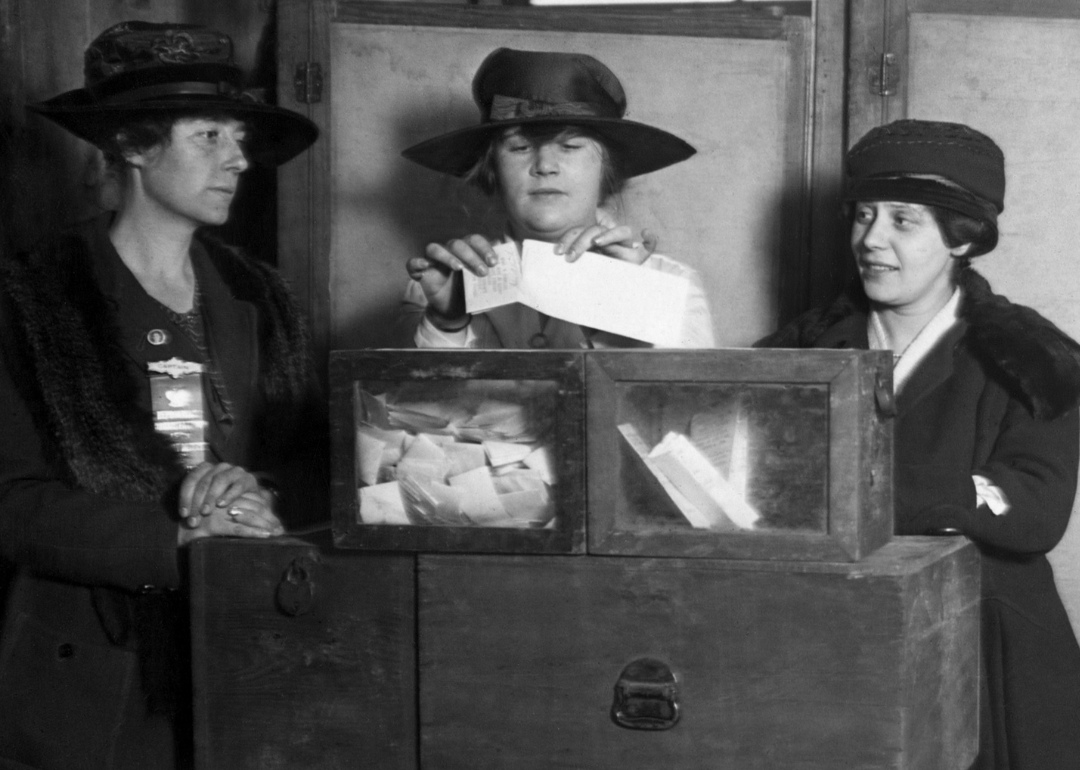
1920: Women gain access to vote
Congress on Aug. 18, 1920, in order to extend the right to vote to “adult women.” However, the amendment did not to black women, who experienced barriers in Southern states. Voter discrimination based on race was not prohibited until the .
1921: Emergency Quota Law
The recession of 1919 and contributed to anti-immigration hysteria. On May 19, 1921, Congress signed , also known as the Immigration Act of 1921. The law sought to limit the number of immigrants who could enter the United States. Quotas were also imposed on arrivals born outside the Western Hemisphere.
1922: Lincoln Memorial dedicated
Chief Justice William Howard Taft on May 30, 1922. The occasion marked the conclusion of a project begun 11 years earlier: During Taft’s service as President of the United States, he signed a bill to create a memorial for Abraham Lincoln.
1923: President Warren G. Harding dies
President Warren G. Harding died on Aug. 2, 1923, following a period of various illnesses. Harding was reported at the time to have died from "," but many historians now believe the cause was . Vice President Calvin Coolidge as president the next day.
1924: J. Edgar Hoover leads FBI
In 1924, J. Edgar Hoover began his as director of the Bureau of Investigation ("Federal" was ). Hoover was 29 at the time.
1925: Female governors elected
became the governor of Wyoming on Jan. 5, 1925. She was the first woman elected to the position in the United States. Twelve days later, became the first female governor of Texas.
1926: NBC founded
On Nov. 15, 1926, the (NBC) launched on radio. NBC was a result of the combined efforts of the Radio Corporation of America (RCA), American Telephone and Telegraph (AT&T), and the Westinghouse Electric Corporation. NBC is the oldest broadcasting network in the United States.
1927: Charles Lindbergh flies across Atlantic
In May of 1927, Charles Lindbergh to cross the Atlantic Ocean. Lindbergh, born and raised modestly in the Midwest, immediately became an American celebrity and one of the most well-known figures of the early 20th century.
1928: Mickey Mouse in the movies
"Steamboat Willie" was not only the first Mickey Mouse film, but it was also the first time animation . The film, which opened on Nov. 18, 1928, launched the Disney empire.
1929: The Great Depression
The , led to . The crash became known as Black Tuesday. The billions of dollars lost in the hysteria caused economic hardships that lasted for a decade.
1930: Smoot-Hawley Tariff
In an effort to protect American farmers and manufacturers, President Herbert Hoover on June 17, 1930. Increasing 900 import tariffs by almost 50%, economists at the time , which isolated the United States from international trade.
1931: Empire State Building
President Herbert Hoover officially turned the lights on at the in New York On May 1, 1931, from Washington D.C. The building took one year to build and was the tallest in the world at the time.
1932: Amelia Earhart flies solo
Amelia Earhart followed the flight path of Charles Lindbergh to to make a solo trip across the Atlantic Ocean. Three years later, Earhart disappeared while attempting to fly around the world.
1933: New Deal
As the Great Depression raged on, President Franklin D. Roosevelt , stabilizing banks and forever changing the relationship between the government and its citizens. The New Deal included the and the creation of the (FDIC). Congress also ratified in 1933, repealing Prohibition.
1934: Dust Bowl
The Southern Plains experienced during the 1930s. In 1934, around 35 million acres were rendered unusable for farming. The huge swaths of dust killed livestock and people as the toll from the Great Depression worsened.
1935: Social Security Act
To further spur economic recovery during the Great Depression, President Franklin D. Roosevelt signed . The federal program was designed to provide a financial safety net, particularly for the elderly. The government became required to pay benefits based on a worker’s lifetime earnings to retirees older than 65.
1936: Flint Sit-Down Strike
Often considered in American history, the Flint Sit-Down Strike transformed the Michigan-based United Automobile Workers (UAW) into one major union. Until was passed in 1935, strikes were illegal.
1937: Hindenburg disaster
The over central New Jersey on May 6, 1937, killing 36 people. This disaster marked the beginning of the end for airships. Later that month, a new era began in engineering when in San Francisco.
1938: Minimum wage established
The Fair Labor Standards Act (FLSA) was passed in 1938, for American workers (25 cents at the time). The fare has been raised 22 times since then. The FLSA also created new federal protections, including requirements for overtime pay and restrictions on child labor.
1939: Political corruption curbed
Congress in an effort to eradicate corrupt political practices in national elections. The act limited contributions from individuals to political campaigns and restricted the campaigning activities of government employees.
1940: Bugs Bunny becomes a star
The precursor to the now-famous Bugs Bunny character popped up in a 1938 cartoon, but the rascally rabbit millions would come to love made in 1940. proved that he is still a “hare” above the rest, as Bugs Bunny was named the most popular cartoon character among Americans.
1941: Attack on Pearl Harbor
Japanese fighter planes bombed the on Dec. 7, 1941. More than 2,400 Americans died. President Franklin D. Roosevelt the next day formally urged Congress for a declaration of war on Japan.
1942: Japanese internment camps
Two months after the attack on Pearl Harbor, President Franklin D. Roosevelt established , a government policy forcing anyone of Japanese descent—even American citizens—to live in isolated camps. The U.S. Supreme Court didn't a 1944 decision upholding the order until 2018.
1943: Detroit race riots
Race riots proliferated throughout major American cities at various times in the last century, but were the longest and deadliest. Thirty-four citizens were killed, most of whom were black. The conflict was sparked by aggression among the city's white population toward an increasing black labor force.
1944: D-Day
The began on June 6, 1944. Approved by U.S. General Dwight D. Eisenhower, more than 156,000 Allied troops successfully stormed the French beachside to begin the arduous journey of liberating Europe from the throes of Nazi Germany.
1945: Battle of Iwo Jima
American forces toward the end of World War II. Thousands of Americans died, but the Japanese also incurred great losses; historians estimate more than 20,000 Japanese soldiers were killed during the battle. The Allied victory paved the way for the on Sept. 2, 1945.
1946: Atomic Energy Act
The established the United States Atomic Energy Commission (AEC), an agency designed to oversee the peaceful creation and use of nuclear energy. The AEC regulated nuclear power until the creation of in 1974.
1947: Jackie Robinson enters the MLB
Jackie Robinson in 1947 made his debut with the Brooklyn Dodgers, becoming the in Major League Baseball. This year also saw the (CIA) and President Harry Truman signed , a vital piece of legislation that shaped American diplomacy during the Cold War. While the government’s focus turned toward confronting communism, some Americans began directing their attention to outer space, as the in Roswell, N.M., captivated the nation’s imagination.
1948: U.S. Army desegregated
President Harry Truman issued Executive Order 9981 on July 26, 1948, officially desegregating the United States military. While most branches accepted the order, the U.S. Army . Army Secretary Kenneth Royall at the time stated the army "was not an instrument for social evolution."
1949: NATO established
The United States, Canada, and several western nations joined forces to (NATO) in 1949. Communist nations then . These alliances lasted throughout the Cold War.
1950: McCarthyism
Wisconsin Sen. Joseph McCarthy in 1950 . McCarthy went on to search for similar breaches in the C.I.A. As McCarthy’s campaign intensified, journalist Edward R. Murrow undermined the senator’s efforts with profound television editorials. On a lighter note, .
1951: Presidential term limits established
Presidents weren’t limited to two terms until the , even though every president but Franklin D. Roosevelt, who died during his fourth term, served two terms or less. Barack Obama if he was allowed to run in 2016.
1952: McCarran-Walter Act
The McCarran-Walter Act, of immigrants with ", made the immigration process much more difficult. The law was vetoed by President Harry Truman, but Congress overrode the veto.
1953: DNA structure is discovered
University of Cambridge scientists James D. Watson and Francis H.C. Crick were credited with the discovery of , the twisted ladder carrying human genes. scientific understanding of genetics.
1954: Schools are desegregated
The Supreme Court unanimously decided in that racial segregation—the separate-but-equal policy—was unconstitutional in public schools. The landmark decision propelled civil rights legislation.
1955: Civil rights movement takes off
In August of 1955, a black teenager named . The men responsible were acquitted by an all-white jury, although decades later witnesses recanted their statements against Till. On Dec. 1, 1955, was arrested for not giving up her seat to a white man, which launched a boycott of the Montgomery bus system.
Also in 1955: Jonas Salk's , Disneyland , and actor James Dean .
1956: Interstate Highway System
Creating an efficient roadway system became a national, federally funded interest with the Federal-Aid Highway Act, which paved the way for 41,000 miles of roadways. President Dwight D. Eisenhower and lessen traffic jams.
1957: Civil Rights Act passes
The Civil Rights Act of 1957 . Despite opposition from Southern senators, the act led to the creation of the to ensure governmental laws and policies were not in violation of a citizen's right to equal protection, including the right to vote.
1958: NASA forms
Following Russia's launch of Sputnik in 1957, (NASA) was initiated on Oct. 1, 1958. NASA absorbed the 8,000 members of the National Advisory Committee for Aeronautics along with other research laboratories.
1959: The Day the Music Died
On Feb. 3, 1959, musicians Buddy Holly, Ritchie Valens, and J.P. “The Big Bopper” Richardson . Also in music history, Ella Fitzgerald and Frank Sinatra were among
1960: Greensboro sit-in
Four black college students at a Woolworth’s in Greensboro, North Carolina, on Feb. 1, 1960. The event catalyzed the civil rights movement, as similar actions spread throughout colleges and forced Woolworth’s to change their segregation policy. President Dwight D. Eisenhower also signed the , which further strengthened policies designed to prevent voter discrimination based on race.
1961: Bay of Pigs
On April 17, 1961, the United States backed Cuban exiles in an unsuccessful attempt to overthrow Cuban Prime Minister Fidel Castro. The failed led to the 1962 —a 13-day standoff between the U.S. and Soviet Union centered on nuclear-armed Russian missiles in Cuba.
1962: John Glenn orbits Earth
After Katherine Goble () double-checked the computer calculations, and the first to orbit the Earth. In the same year, Marilyn Monroe . She was 36 years old.
1963: Second-wave feminism kicks off
Author Betty Friedan published "The Feminine Mystique," a book that emphasized the drudgery experienced by some suburban housewives. The work is credited with . The Equal Pay Act, which requires that women and men for the same work, went into effect the same year. Despite these advancements, The year was capped by tragedy when was assassinated in Dallas.
1964: Martin Luther King Jr. wins Nobel Peace Prize
Dr. Martin Luther King Jr. became . The Nobel committee recognized King’s non-violent efforts to fight racism in America. The Civil Rights Act of 1964 , ending segregation in public places and banning employment discrimination based on race, color, religion, sex, or national origin.
1965: Malcolm X is assassinated
Unrest surrounding the civil rights movement continued in 1965. Muslim minister and human rights activist , Alabama authorities beat nonviolent protesters , and the in Los Angeles. The Voting Rights Act——was signed the same year.
1966: Miranda rights
The Supreme Court held in Miranda v. Arizona that . Miranda rights .
1967: Interracial marriage legalized
The Supreme Court . The case involved a white man named Richard Loving and his wife, Mildred, a black woman who also was of Native American descent. The couple because they were banned from living in Virginia, where their union was illegal.
1968: Martin Luther King Jr. assassinated
A sniper at a motel in Memphis, Tenn., in 1968. The shooting occurred just three years after Malcolm X was killed.
1969: First man lands on the moon
On July 20, 1969, astronauts Neil Armstrong and Buzz Aldrin made space history when they became the first men . Back on Earth, 1969 saw , the Stonewall riots in New York (), and the premiere of “Sesame Street.”
1970: Jimi Hendrix dies
Guitarist and singer Jimi Hendrix, 27, on Sept. 18, 1970. Five months earlier, around the same time environmental activists organized when 20 million Americans showed their support for a more sustainable world.
1971: Pentagon Papers published
When the New York Times decided to publish some of —a Department of Defense study about U.S. involvement in Vietnam—the paper was forced to defend itself . The Supreme Court ultimately ruled that the paper did not endanger national security and could publish newsworthy parts of the report.
1972: Title IX enacted
Title IX, , prohibited universities and colleges that received federal funding from discriminating on the basis of gender. Patsy Takemoto Mink, the first Asian-American woman and woman of color elected to Congress, co-authored the amendment.
Five men for breaking into the Democratic National Committee Headquarters in the Watergate complex in Washington D.C. Carl Bernstein and Bob Woodward reported in the Washington Post that they believed President Richard Nixon was involved in ordering the act.
1973: Roe V. Wade
In the most important abortion rights case to date, the Supreme Court that the Texas law prohibiting abortion during the first trimester was unconstitutional.
1974: President Richard Nixon resigns
At noon on Aug. 9, 1974, , becoming the first and only president to step down from office. Nixon departed only weeks after the Supreme Court unanimously ruled that the president must of conversations he recorded in the White House.
1975: Microsoft is born
Bill Gates left Harvard University to team up with his childhood friend Paul Allen and start Microsoft in April of 1975. The company and sold microprocessors and software. The business eventually made Gates and Allen among the , who also became well-known for their philanthropy. On Oct. 15, 2018, for many years.
1976: Steve Jobs launches Apple
In 1976, Steve Jobs and Steve Wozniak out of the garage and founded Apple Inc. In 2018, the computer giant—which also developed —became a .
1977: 'Star Wars' hits theaters
“Star Wars,” the film that launched , hit theaters on May 25, 1977. The film written and directed made more than $500 million after its first release. 1977 also saw the , at age 42.
1978: Jonestown massacre
On Nov. 18, 1978, American cult leader Jim Jones instructed his followers at his compound in Guyana. for the death of more than 900 people. Harvey Milk, the first openly gay politician, .
1979: Three Mile Island nuclear meltdown
Just after 4 a.m. on Mar. 28, 1979, signaling the start of the worst nuclear accident in U.S. history. When technicians couldn’t fix the reactor at the Pennsylvania plant, radioactive steam and gas leaked into the atmosphere for days. The event led to an of nuclear power.
1980: Mount St. Helens erupts
On May 18, 1980, an earthquake triggered at Mount St. Helens in Washington state. Flooding and ash destroyed much of the surrounding landscape, killing hordes of wildlife and 57 people.
1981: Iran hostage crisis ended
The Iran hostage crisis with the release of 52 people held at the U.S. Embassy in Tehran, Iran. The hostages were freed minutes after the inauguration of President Ronald Reagan, in Iranian assets on the same day. The president later introduced , otherwise .
1982: 'Thriller' is released
Michael Jackson released his “Thriller” album in November of 1982. It remains the best-selling album . Vincent Price, who provided the famous laugh on the title track, only made $1,000 for his work.
1983: Microsoft Word released
The popular word-processing software Microsoft Word . The also was released on the market. With a price tag of more than $4,000, this PC wasn't cheap—but it was the first accessible home computer.
1984: HIV discovered
Researchers finally figured out the cause of the AIDS virus the human immunodeficiency virus (HIV). While a permanent cure for AIDS remains elusive, the (AZT) in 1987 and the introduction of other drugs have helped patients combat HIV.
1985: Live Aid concert held
Satellites linked musicians performing around the world for . The event that featured Elton John, Tom Petty, Madonna, and other famous artists raised more than $125 million for famine relief in Africa, specifically Ethiopia and Sudan.
1986: Challenger tragedy
The world watched in horror on Jan. 28, 1986, as the live on television shortly after launching from the Kennedy Space Center in Florida. All seven on board died, including a teacher set to be the first civilian in space. NASA for almost three years.
1987: Ronald Reagan: 'Tear down that wall'
On June 12, 1987, President Ronald Reagan addressed Soviet Union leader Mikhail Gorbachev and uttered one of his most famous phrases: “Mr. Gorbachev, tear down this wall.” Reagan separating East and West Germany, which remained in place until 1990.
1988: INF Treaty signed
The world became a little safer in 1988 when the United States and Soviet Union signed the Intermediate-Range Nuclear Forces (INF) Treaty. either country from having ground-launched ballistic and cruise missiles that could travel between 300 and 3,300 miles. Russia the treaty when it deployed a banned cruise missile.
1989: Exxon Valdez oil spill
The Exxon Valdez oil tanker of oil in Alaska’s Prince William Sound on March 24, 1989. The black substance covered more than 1,000 miles of shoreline, decimating the area’s wildlife population. It remained the most devastating man-made environmental disaster in the Gulf of Mexico.
1990: Hubble Telescope sent to space
The Hubble Telescope to explore space. NASA will in the next few years, after of distant galaxies and planets for almost 30 years. Along with the launch of NASA’s space telescope, the and went into effect in 1990.
1991: Operation Desert Storm
After Iraqi leader Saddam Hussein ordered an invasion of neighboring Kuwait, the United States led a 42-day air and ground attack known as . President George H. W. Bush declared a ceasefire on Feb. 28, 1991. Originally viewed as a success, the operation’s effects in 2003, which lasted almost a decade.
1992: Los Angeles riots
Riots after the acquittal of four white police officers on charges of assault and excessive force , a black motorist. Thousands were injured and more than 50 people died rioting. In response to the carnage, King famously stated: “Can we all just get along?”
1993: Don't Ask, Don't Tell
President Bill Clinton in 1993 signed the policy, allowing LGBTQ people to serve in the military as long as they kept their sexual orientation private. Before the policy, openly gay individuals were banned from serving under a long-standing theory of protecting unit cohesion. In 2011, President Barack Obama , guaranteeing gay citizens the right to openly serve in the the U.S. Armed Forces.
The United States signed the North American Free Trade Agreement (NAFTA) with Canada and Mexico. Also in 1993, a bombing at the killed six people and injured more than 1,000.
1994: Violence Against Women Act
The Violence Against Women Act created the first federal law against battering women and to support victims of sexual assault and domestic violence. The law followed the , who during the Supreme Court nomination hearing for Clarence Thomas accused the future justice of sexual harassment.
1995: Oklahoma City bombing
The in Oklahoma City, Okla., killed 168 people and injured more than 500. Timothy McVeigh and Terry Nichols were convicted for carrying out the attack.
1996: Centennial Olympic Park bombing
During the 1996 Summer Olympics, Eric Robert Rudolph detonated a 40-pound bomb at Centennial Olympic Park in Atlanta. More than 100 people were injured and two died, including a cameraman who had a heart attack while filming the area.
1997: Madeleine Albright becomes secretary of state
President Bill Clinton as secretary of state after his 1997 inauguration. Albright, who previously served as a United Nations ambassador, became the first female to hold the position.
1998: Monica Lewinsky scandal
A by Paula Jones led to a hearing where President Bill Clinton concealed with White House intern Monica Lewinsky. After White House employee released tapes of conversations she had with Lewinsky about the affair, Clinton became the subject of an investigation. The House of Representatives voted to impeach Clinton for perjury and obstruction of justice, but of both charges by the Senate.
1999: Columbine High School shooting
Two armed students, Dylan Klebold and Eric Harris, committed a mass shooting in Littleton, Colo. Twelve students and one teacher died in the attack. The shooters later killed themselves in the school library. The event police responded to , although school shootings remain a constant worry in communities across America.
2000: Bush v. Gore
Vice President Al Gore contested Florida’s election results from the 2000 presidential election against George W. Bush, governor of Texas. The saga launched the term into the American lexicon. The case , which ruled in favor of Bush.
2001: 9/11
On the , two hijacked planes were flown into the north and south towers of the World Trade Center in New York, causing them to collapse. Another hijacked plane crashed into the Pentagon, and a fourth crashed into a field near Shanksville, Penn., after passengers attempted to retake control of the plane. Nearly 3,000 people died in the Sept. 11 attacks.
2002: Halle Berry wins Academy Award
For her performance in “Monster’s Ball,” Halle Berry became the first black woman to win an Academy Award for Best Actress. Berry recently criticized in Hollywood, saying her Oscar win was “meant nothing.”
2003: Space Shuttle Columbia explodes
On Feb. 1, 2003, seven astronauts as the spacecraft came apart during its reentry to Earth. This was the first shuttle disaster since the Challenger explosion. NASA halted space shuttle flights for more than two years after the disaster, which measures for future missions.
2004: Facebook launches
Nineteen-year-old Mark Zuckerberg in February 2004. The website started out as a platform used by fellow Harvard students, but the social media giant now has more than 2 billion users, making Zuckerberg one of .
2005: Hurricane Katrina hits Gulf Coast
Hurricane Katrina on Louisiana’s Gulf Coast on Aug. 29, 2005. Levees and floodwalls that were supposed to protect New Orleans proved too weak to hold back massive waters. More than (many from drowning), and the storm caused approximately $100 billion in damages.
2006: Pluto downgraded
After the discovery of another celestial body, to a dwarf planet. A 2018 study .
2007: Apple launches iPhone
The iPhone of technology with its release in 2007. The arrival of the smartphone, now the company’s , came six years after the creation of its portable music player, .
2008: Barack Obama elected
In November of 2008, Barack Obama was elected of the United States, becoming the first black person elected to the office. His victory came as the country was since the Great Depression.
2009: Sonia Sotomayor joins Supreme Court
Sonia Sotomayor in 2009 became the first Hispanic justice appointed to the Supreme Court. As of 2018, there have been 114 justices ; only four of them women. President Barack Obama, who in 2010, is responsible for two.
2010: WikiLeaks
Chelsea Manning, a former Army intelligence analyst, provided the organization WikiLeaks with classified documents and a combat video. WikiLeaks went on to release relating to the ongoing war in Afghanistan. Manning was convicted of violating the Espionage Act in 2013, but President Barack Obama later .
2011: Osama bin Laden killed
On the order of President Barack Obama, U.S. Special Forces killed Osama bin Laden in May of 2011. The mastermind behind 9/11 was found .
2012: Mass shootings in Colorado
In 2012, a series of shootings shook the nation. On July 20, 24-year-old James Holmes in Aurora, Colo., when he opened fire in a movie theater full of patrons watching “The Dark Knight Rises.” On Dec. 14, 20-year-old Adam Lanza killed 28 people—including 20 children—during at Sandy Hook Elementary School in Newtown, Conn.
Trayvon Martin, , was shot by George Zimmerman in Florida the same year. After Zimmerman was found not guilty of murder, based on the , the Black Lives Matter movement .
2013: Boston Marathon bombing
Two bombs of the 2013 Boston Marathon, A 19-year-old Kyrgyzstani-American, Dzhokhar Tsarnaev, was for his . His 26-year-old brother Tamerlan Tsarnaev, also responsible for the attack, died in a shootout with police.
2014: Michael Brown killed
Another unarmed black teenager died when Darren Wilson, a police officer in Ferguson, Missouri, 18-year-old Michael Brown. The incident, which was filmed, . Wilson was .
2015: Same-sex marriage legalized
The Supreme Court held in that all citizens have the right to marry and required all 50 states to recognize same-sex marriages. The White House exterior colors to commemorate the event.
2016: Donald Trump elected
Despte a litany , Donald J. Trump was elected the 45th president of the United States in 2016. He defeated Hillary Clinton, for president on a major party ticket.
2017: #MeToo
Actress Alyssa Milano heard around the world in response to articles in the and that revealed that movie mogul Harvey Weinstein was a serial sexual abuser. (Milano’s tweet stemmed from a 2006 use of the phrase “Me Too” by activist Tarana Burke.) Survivors of sexual assault and violence—and their supporters—tweeted #MeToo almost a half a million times in 24 hours and spawned .
2018: More women run for office
After the election of Donald Trump, and motivated by the growing force of the #MeToo movement, more women than ever . Democrats have in House primaries, shattering the previous record of 120.