Famous border walls throughout history
President Donald Trump's to build a wall on the U.S.-Mexico border and make Mexico pay for it was one of his most controversial propositions and remains among his most polarizing policy goals.
Two years into his term, 52% of Americans and 45% approve of it, and the debate doesn't seem likely to resolve any time soon. The 35-day government shutdown, the longest in U.S. history, was since it became clear that money . Trump has since to fund and build the wall.
The question many are asking is whether a border wall would work. While supporters argue it's a necessary and effective measure to prevent illegal immigration at the southern border, critics believe the , and that the wall itself is unbecoming for a country that prides itself on being founded by immigrants.
But Trump is not the first person to propose building some kind of border barrier. Since around 8000 B.C., people have been building walls to protect themselves and keep others away—with varying levels of success. Since World War II, the world has gone from Â鶹ԭ´´ compiled a list of 30 famous border walls from the Stone Age to the Information Age to see what lessons can be learned from the long history of building walls to keep others out.
Here, find out if the mighty Great Wall of China did its job, which country was named for a famous walled city, and how the European migrant crisis is reshaping that continent's borders.
ALSO:
Wall of Jericho
Jericho, located in the modern-day West Bank, is one of the oldest continuously occupied settlements in the world. The famous stone wall that surrounds the city was ; it’s believed residents of the growing city built it in 8000 B.C. to fortify the area. The walls around the city have been destroyed and rebuilt several times throughout history, such as .
Amorite Wall/Wall of Mardu
The Amorite Wall represents one of the , 155 miles long and 29 feet thick, built in the 21st century B.C. during the . The border stretched along the eastern border of Sumeria in the city of Ur. Because it didn’t extend around all of the kingdom, however, nomadic Amorite invaders were able to simply walk around it. Ur was overtaken in the 20th century B.C., heralding the beginning of the end for Sumeria.
Walls of Troy
This city, made famous by the epic Greek poem "The Iliad,” was long thought to be fictional. In the 19th century, German archeologist Hermann Schliemann began his quest to find the famed walled city. He , in 1870. Archeologists have since discovered that Troy was rebuilt eight times between 2700 B.C. and around 1100 B.C.; the city that was destroyed by letting the Trojan Horse past its thick walls was the sixth.
Great Wall of China
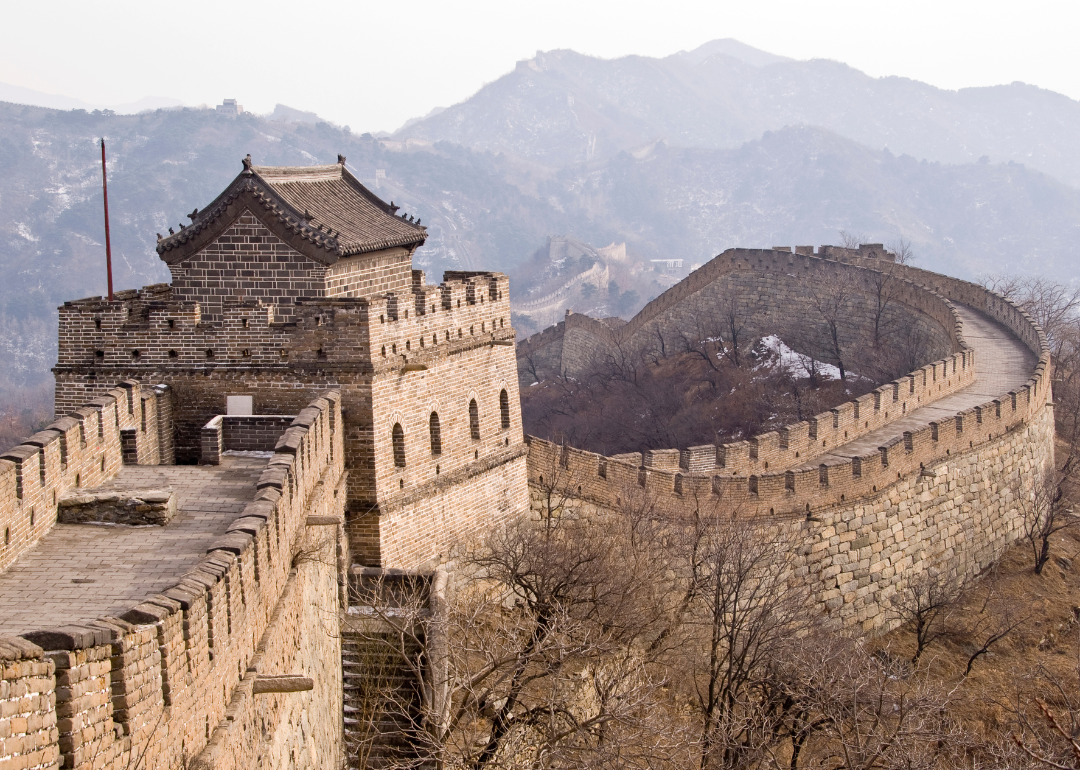
It took more than 1,000 years to build the longest border wall in the world, finally completed in the third century B.C. when several smaller walls were joined together. The emperor hoped to prevent attacks from nomadic tribes, but it was as invaders would just ride around the wall or bribe guards to let them through. Rulers (1368–1644) and created the iconic landmark thousands of tourists visit every day.
Walls of Babylon
King Hammurabi built the first walls in the ancient city of Babylon in 1792 B.C., but they became famous after Nebuchadnezzar II built three walls around the city over 1,000 years later. They were an important defense mechanism, but more importantly, they were impressive and beautiful. The city's entrance, , was long considered one of the Wonders of the Ancient World. Tourists can still visit a replica of the gate, but the war in Iraq
Long Walls of Athens
The Long Walls connected Athens to its port in Piraeus, protecting the city-state from the effects of sieges by making sure they always had a safe connection to the sea. The walls were after the Athenians lost the Peloponnesian War in 403 B.C., but the city quickly rebuilt them once power was reclaimed. A Roman general destroyed them in 86 A.D, though a today.
Hadrian's Wall
In 122 A.D., Roman emperor Hadrian to build this 83-mile long wall on the northwest edge of his empire to separate Roman citizens from the "barbarians.” His successor ordered the construction of a new wall several miles away, but within 20 years, Roman soldiers returned to man Hadrian’s Wall through the end of the Roman empire 300 years later. The wall has since served as a popular tourist attraction and as in the "Game of Thrones” books and TV series.
Romans Walls of Lugo
Romans built the walls of Lugo in the third century to of the city of Lugo from Germanic invaders and other local tribes. These walls, which stand 8 to 12 meters high (one meter is about 3.3 feet) and enclose 4.2 acres, are the best-preserved examples of the Roman empire’s military construction. Lugo is still a thriving city in Galicia, Spain, and the walls are a.
Walls of Constantinople/Theodosian
Constantine the Great first constructed the walls around the new capital of the Roman empire, but it wasn’t until the reign of Theodosius II that they became of the ancient world. Designed to make the city impregnable, the walls withstood 800 years of enemy sieges and earthquakes. They only fell in 1204 when attackers entered through an open door, and large parts remain standing in Istanbul, Turkey.
Great Wall of Gorgan ('Red Snake')
Nicknamed for the red stone used to build it, the Great Wall of Gorgon was built in the fifth century to protect the fertile city of Hyrcania from the White Huns who raided it for its resources. Once ever built, it seems to have been successful at stopping raiders before it was mysteriously abandoned 200 years after it was built. Earth and sand covered it in the centuries since and it was almost forgotten before archeologists discovered it in 1999.
Vatican City walls
After pirates attacked Saint Peter’s Basilica in 824, the surrounding the holy city to protect against future attacks, and they were continually expanded through the 1640s. Though they still stand today, they’re ; anyone can walk into St. Peter’s Square and see the city’s famous landmarks.
Moscow Kremlin walls
Moscow’s founder Prince Yuri Dolgorukiy around the city in 1126. Wood replaced limestone in the 1360s and the walls and towers standing today were built from 1485 to 1495, but all . In 1947, Stalin had the walls painted red in honor of communism, and the Kremlin opened to the public around a decade later before becoming the residence of Russia’s president in 1991.
Walls of Ston
Ston, Croatia, is home to the, built in 1333 to protect the city and its smaller neighbor from the. With 40 defensive towers and a massive hillside fortress, this 22,965-foot-long structure successfully defended the city for 500 years. It was damaged by an earthquake in 1996, but the restoration project that began afterward ensures tourists can continue to enjoy the monument.
Great Zimbabwe's 'Great Enclosure'
Built by the Shona people, the ancient city of Great Zimbabwe has some of the in sub-Saharan Africa. One of three parts of the site remaining, the Great Enclosure is believed to be the and is surrounded by a 35-foot-high wall and slightly smaller conical tower. The city was abandoned in the 1450s. It became an important national symbol and the country itself is named after the city.
Saksaywaman (Sacsayhuaman)
The Killke people on the outskirts of modern-day Cusco, Peru, in 1100, and it was expanded and walled in by the Incas in the 13th century. It's most famous for the mysteries around its construction. Archeologists have spent years so tightly together that a piece of paper couldn't slip between them, and how the walls were built so they lean inward.
Wall Street
In the 17th century, New York City’s Wall Street was a built to separate Dutch settlers from Manhattan’s Native American population and used as a marketplace where . It remained a hub for business after the ramparts were removed in 1699, but the Buttonwood Agreement in 1792 created what would eventually be called the New York Stock Exchange and shifted Wall Street’s reputation toward the hub for finance it is today.
Great Hedge of India
This 1,100-foot-long living border wall was grown and maintained in the 1800s during Britain’s colonial rule of the Indian subcontinent to enforce a hefty salt tax. Thorny hedges were used because to build a wall, which proved a relatively effective way to enforce and collect taxes. A century later, almost of the Great Hedge remains.
Long Wall of Quảng Ngãi
Built in Vietnam in 1819 under the direction of Le Van Duyet, the Long Wall of Quảng Ngãi was built along a pre-existing road to maintain security, collect taxes, and regulate travel and trade between mountain tribes and people living on the plains. rediscovered in 2010, the Vietnamese government began working to turn the wall, the longest monument in Southeast Asia, into an international tourist attraction.
Maginot Line
Following the German invasion of France in World War I, the French government began constructing a barrier of walls and fortresses along its border with Germany. France poured 11 years and $450 million into the 450-mile, but it wasn’t enough to prevent another attack. When the Germans invaded France at the start of World War II, they just went around it.
Warsaw Ghetto wall
In 1940, Nazis occupying the Polish capital began evacuating Jewish people and moving them into a small section of the city by a 13-foot-high wall topped with barbed wire. Conditions in the ghetto were horrific, and either starved to death or were killed in death camps. In 1943, the remaining residents rose up in a failed revolt, which led Germans to destroy the ghetto and the wall. The parts that remain are now a historical monument.
Korean Demilitarized Zone
The 1953 established the Korean Demilitarized Zone (or DMZ) as the dividing line between communist North Korea and democratic South Korea. There is no physical wall, but the line is heavily fortified and manned by armies on both sides. Recent diplomatic talks between North and South Korea have considered an end to the war, and both sides have acted to from the DMZ.
Berlin Wall
After Germany was divided by the Allied powers following World War II, constructed the Berlin Wall in 1961 to keep its citizens from defecting to the democratic state in the west. The well-manned, barbed-wire wall stemmed a potential conflict brewing in the region, but separated families and led to the deaths of hundreds trying to cross. The wall fell on Nov. 9, 1989, the largest section still standing has since become an. Other pieces have been shipped around the world as symbols of peace.
Peace walls
Centuries of tension in Northern Ireland between the Catholics loyal to the Irish state and Protestants loyal to Britain at the end of the 20th century. After riots in Belfast in 1969, the first peace walls were built and were so effective at stopping the violence, they never came down. Peace walls continued to be built even after hostilities ceased in 1994 and have become an important tourist attraction, but Northern Ireland’s Parliament is committed to tearing them down by 2023.
India-Bangladesh wall
Migration from Bangladesh into India’s Assam region turned politically explosive in the 1980s, prompting the Indian government to build an 8-foot-tall barbed-wire fence in hopes it would lower migration and ease tensions. Decades later, of the 2,546-mile border between the countries but .
Cyprus Green Line
The tiny island nation of Cyprus is cut in half north to south by a United Nations-controlled buffer zone. Violence between Greeks and the Turkish had broken out a decade before, but Turkey invaded in 1974 following a coup by residents who supported uniting with Greece, leading to U.N. intervention. The capital, Nicosia, is the only city with a physical wall, and the two sides came back into contact and established checkpoint crossings in 2003.
Western Sahara wall
Building a wall across the Sahara desert might seem like an impossible project, but, or berm, in Western Sahara in 1981, a few years after it invaded and occupied its neighbor. Its goal is to, and starve out their 40-year-long independence movement. The heavily manned wall is the longest minefield in the world, but that hasn’t stopped some independence activists from burrowing underneath.
Melilla border fence
In 1998, Spain around the city and monitors it 24/7 with cameras, watchtowers, and help from the Moroccan government to deter migration from the surrounding region. Melilla is one of two Spanish cities in northern Africa, sharing a border with Morocco, and to reach Europe without a perilous sea crossing. Despite increasing numbers of refugees, Spain has vowed to remove the barbed wire from its fencing in the city after from those trying to climb over it.
West Bank barrier
In 2002, in the West Bank region to prevent violent attacks from Palestinians and regulate the movement of Palestinians into Israel. The International Court of Justice in 2004 that the wall’s construction in occupied territory was illegal. Its existence and effectiveness continue to be at the center of an intense political debate.
Hungary/Serbia border fence
More European countries are in response to Europe’s refugee crisis, and. In 2015 and 2016, the government built a razor-wire fence on its border with Serbia, after it became a main point of crossing for asylum seekers. Since then, the country has improved its technology and taken a hard stance on asylum seekers as part of nationalist Prime Minister.
Calais border barrier
In 2016, Britain and France a 13-foot-high border wall around the Calais refugee and migrant camp to keep nearly 7,000 residents from tunnels or the port that could give them access to Britain. Two months, French police dismantled the camp and burned it to the ground, and it hasn't prevent other migrants from coming to the area and finding a way to get to British soil.