
Functional freeze explained: Why you’re exhausted, disconnected, and still getting things done
You’re crushing work deadlines and leading Zoom meetings with ease, but when it comes time to decide on dinner, you freeze. Or maybe you can easily make it through a jam-packed work trip, but as soon as you have a weekend to yourself, you scroll TikTok or rewatch Schitt’s Creek for the third time instead of completing the art project you’ve put off for months.
If any of the above resonates, you may be experiencing functional freeze, a state where you have a “high-functioning” lifestyle but feel numb or shut down internally. Here, explores what happens during a functional freeze and ways to feel better without adding even more to your to-do list.
What is functional freeze?
Functional freeze is a mental state where a person continues daily activities—such as going to work, answering emails, fitting in a workout, and showing up at social events—yet feels emotionally numb or disconnected. Functional freeze typically occurs as a response to intense or ongoing and .
“It’s not a complete shutdown, but rather a kind of survival mode where a person operates on autopilot,” says , a nutritional psychologist in Pasadena. “They’re doing just enough to function, but emotionally, mentally, or physically, they feel stuck.”
The reason for feeling stuck stems back to how our brain and nervous system operate. When we receive a stressful or dangerous cue from the world around us, our (the fear center of the brain) sends a message to the hypothalamus, which controls the nervous system. Our nervous system then reacts to the cue with what’s known as the fight-or-flight response. This response is ancient, as in it helped our ancestors decide whether to fight or run away from lions in order to survive.
Today, most of us aren’t on the run from lions, but we do navigate situations that cause , like a demanding job or caregiving for an aging family member and kids at the same time. In either scenario, your mind knows it can’t run or fight.
What does it do instead? Enter: functional freeze.
“When your nervous system perceives danger and neither fight nor flight is available or safe, it hits the freeze button,” says , a licensed therapist specializing in anxiety. “Not the ‘play dead’ kind you might picture, but a functional freeze—one that keeps you moving while emotionally shut off.”
Why your brain chooses freeze mode: The neuroscience explained
If experiencing functional freeze, there may be a tiny voice in the back of your head urging you to actually do something. It could tell you to make dinner instead of scrolling TikTok for hours or to advocate for less stress at work instead of taking on another project, but your mind just won’t seem to listen. Instead of acting, it freezes.
The reason your brain chooses freeze mode comes down to : It’s constantly scanning both your environment and your inner world for signs of safety or danger. This means it’s not just your thoughts that matter. Your body is also picking up on physical signals all around you. These “external cues” can include things like a tense tone of voice in a conversation, the sudden slam of a door, a cluttered or chaotic workspace, or even bright, flickering lights. Even if you tell yourself everything is fine, your nervous system might still react to subtle signals, keeping you on edge.
Think of it this way: Changing your thoughts without addressing the physical signals around you is like trying to recharge your laptop with the wrong cord—it just doesn’t work.
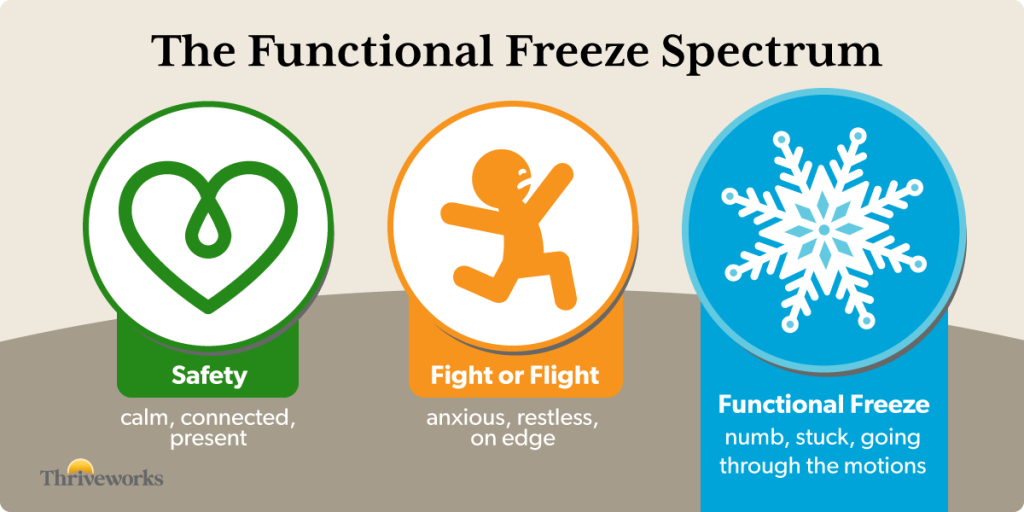
This frustrating freeze mode can be described by a theory from neuroscience: the . Groskopf explains, “Polyvagal Theory explains how our nervous system reacts to safety and threat, and why we respond the way we do, even when we don’t want to.”
The theory offers three main states we move through:
- Safety mode, when all feels well with the body.
- Fight or flight, when we feel like we’re in danger.
- Freeze mode, when we feel overwhelmed or hopeless.
Groskopf adds, “Understanding this helps people stop blaming themselves for ‘shutting down’ and start seeing it as their body’s way of trying to protect them.”
What causes a functional freeze state?
Anyone can experience functional freeze, but certain patterns increase the risk. “People who tend to be high-achieving, , or overly responsible are especially prone to functional freeze,” Tovar says. “These individuals often ignore their own needs and override signs of stress or overwhelm.”
That doesn’t mean all high achievers will experience functional freeze. Usually there’s a direct cause that sets off freeze mode. Common triggers of functional freeze include:
- Specific jobs. “Jobs that involve high stakes, constant urgency, or caregiving roles can also push people into this state,” Tovar says.
- Feeling unsafe being vulnerable. Those who experienced situations in the past where it was unsafe to open up or express themselves are more likely to enter freeze mode, Groskopf explains. If, for example, someone didn’t have a safe space to express their feelings as a child, they may find it more difficult to be vulnerable as an adult.
- Unresolved trauma. refers to a difficult event or multiple events an individual has either suppressed or failed to process. This often results in nervous system dysregulation, which is when our nervous system doesn’t work as intended and has difficulty regulating and responding to emotional and environmental cues. When this happens, there’s a higher potential to go into freeze mode, Tovar says.
- Unhealthy relationships. Relationships that make you feel unsafe or like you can’t express yourself increase the likelihood of functional freeze, says Groskopf, whether this occurs in a romantic, platonic, or workplace relationship.
- Overwhelm from the modern world. “When life becomes too overwhelming, that’s when we go into the functional freeze response state,” explains , a licensed therapist and founder of Optimum Joy Counseling. “It’s so prevalent today because many of us are overwhelmed by modern life and all of its demands and stimulation.”
Signs you might be experiencing a functional freeze
“Unlike the ‘fight or flight’ response, functional freeze doesn’t look dramatic from the outside, which is why it’s often overlooked, even by the person experiencing it,” Tovar says. But that doesn’t mean there aren’t functional freeze symptoms to look out for.
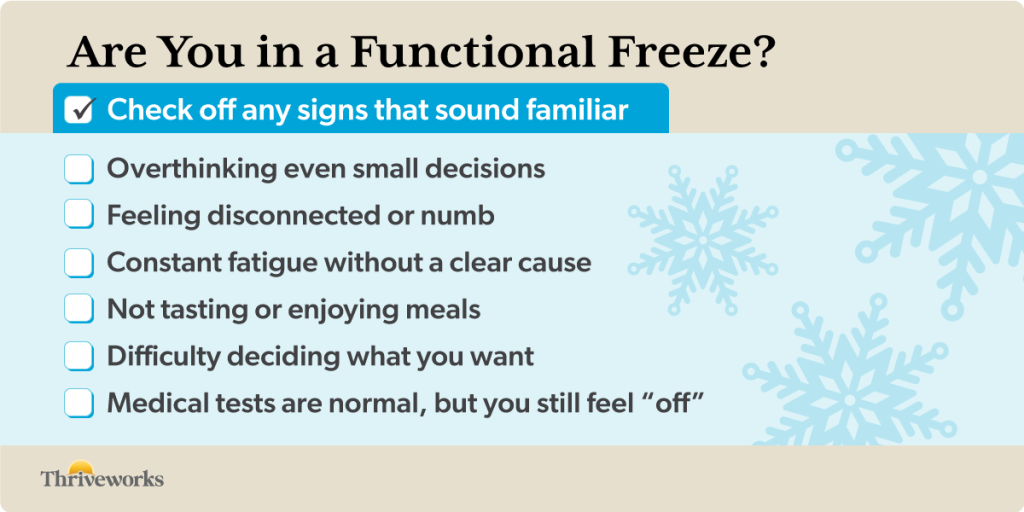
Warning signs of functional freeze include:
- Overthinking everything. Even small decisions like what to wear to the gym or whether to watch a movie or TV show feel like they deserve an entire pros and cons list.
- Feeling disconnected. Your day-to-day feels like you’re just going through the motions or doesn’t bring you joy.
- Experiencing constant fatigue. Each day, you wake up exhausted without any clear cause—and even coffee or eight or more hours of sleep doesn’t seem to shake the fatigue.
- Not tasting meals. Those with functional freeze may remember everyone else raving about the Korean BBQ place the other night, but won’t remember what their meal tasted like. When the nervous system isn’t working properly (as is the case with functional freeze), food may taste more bland because part of the nervous system’s job is to facilitate .
- Difficulty deciding what you want. Deciding what to eat for dinner feels impossible, much less mapping out a plan for your career. Those in functional freeze often feel paralyzed, unable to make a decision and take action.
- Despite these symptoms, medical tests come back normal. Even though you’re exhausted and fatigued, medical tests don’t show anything wrong, and doctors say you’re perfectly healthy.
Why it’s so important to thaw
“Functional freeze is a hardwired protective mechanism in our bodies,” Hoerr says. “So ultimately, thawing is letting your body ‘come up to temp’ slowly so it knows it is safe from overwhelm.”
Once up to temp, it’s easier to feel like you’re truly living, not going through the motions. Thawing lets us take control of our emotional health, relationships, and career goals instead of living on autopilot.
Beyond breathing techniques: 7 ways to get out of a functional freeze
If any of this resonates, your next question is probably how to get out of functional freeze—without taking on a highly impractical wellness routine. The good news: Thawing comes from small steps, not a drastic change.
“You don’t want to try to force yourself to feel everything at once; that would be overwhelming and counterproductive,” Hoerr says. “Instead, we want to do small things to tune into the present moment.” Start here.
1. Move your body gently.
“Repetitive, rhythmic movements such as walking, gentle yoga, or dance can help bring the body out of freeze and into a more regulated state,” Tovar explains. “These types of movement are especially powerful because they don’t overwhelm the nervous system—they meet it where it is and gradually create a sense of internal safety.”
2. Draw for 20 minutes.
A published in the Frontiers in Psychology journal suggests that when we draw or create something by hand, such as pottery or a bracelet, our body and mind build resilience and are better able to respond to stressors, not freeze. This could be as simple as buying an adult coloring book and setting a timer for 20 minutes.
3. Eat more fiber.
“From a nutritional standpoint, fiber is often overlooked but critically important for thawing. It feeds the beneficial bacteria in our gut, which produce short-chain fatty acids and neurotransmitters like serotonin that and emotional regulation,” Tovar explains.
Women should aim for of fiber per day. For men, aim closer to 30 grams per day. Some include:
- Artichokes: 9.6 grams per cup
- Raspberries: 8 grams per cup
- Lentils: 7.8 grams per 1/2 cup
- Oats: 5.8 grams per cup
- Chia seeds: 4.1 grams per tablespoon
- Spinach: 4.3 grams per cup
4. Cut back on screen time, even by just a few minutes.
“Disconnecting from screens helps with functional freezing because it allows a person’s brain to actively register more stimulus from the outside world,” says Hoerr, adding that more time away from screens lets us feel more present.
For those of us who find it hard to log off, Hoerr recommends starting with small adjustments:
- Call someone instead of texting.
- Set time limits on your most used apps.
- Pick up a physical book over your phone before bed.
- Set reminders to take five-minute screen breaks throughout the day.
5. Hum along to your favorite song.
The next time you’re listening to music, try humming along. Humming calms the nervous system, making space for you to thaw. In fact, published in the Cureus journal found that daily humming for 15 minutes or longer was more effective than exercise or sleep for lowering certain stress indicators.
6. Take the cold plunge.
Despite the irony, an ice bath or running an ice roller over your face may help you “thaw.” A published in Scientific Reports found that applying a cold substance to the face, such as an ice cube or ice roller, for five to 35 seconds lowered and calmed the nervous system.
7. Give yourself permission to want something.
When in functional freeze, we focus on what we need, not what we want. “Giving ourselves permission to want something can be a signal to our body that we are thawing out,” Groskopf says.
She adds that wanting something small, like an iced coffee from your favorite cafe, or something big, such as quitting an unfulfilling job, will work. And this tip doesn’t mean you have to act right now. Thawing happens when we allow ourselves to feel the desire. “It’s not about doing more, but feeling more,” Groskopf adds.
When to seek professional help
“People should seek professional help for functional freezing when it starts to impact their ability to take care of themselves or function in their daily lives,” Hoerr says. If there are large chunks of time where you cannot remember what happened or you regularly feel like you’re going through the motions, can help you thaw and tune back into life.
Since functional freeze isn’t an official medical condition, there’s no specific training or therapy style to treat it. The most important thing is to find a provider you feel comfortable with, which may take some trial and error.
was produced by and reviewed and distributed by Â鶹ԭ´´.