History of African Americans in the US military
History of African Americans in the US military
People of color have been integral to American military might from the time of America's inception. Even as settlers of the New World fought for freedom from British rule while enslaving others, many of those enslaved people—African Americans who were at that time legally kept as property by colonists—assisted with war efforts to ensure a more stable future for the forming United States.
Some Black soldiers during the Revolutionary War joined up with the British, who sought more manpower against the colonies and offered the promise of freedom to enslaved men who joined their ranks. Others enlisted on behalf of the colonies, albeit only when Gen. George Washington realized he didn't have enough white soldiers to fight and acquiesced to allow African American men to join up. Over time, slavery fell out of favor with many property owners, particularly throughout the northern states. During the Civil War, around 200,000 people of color served in the U.S. military, either in the Army, Navy, or non-combat positions (including manual tasks like cooking, cleaning, and otherwise supporting the white soldiers).
Other enslaved men fought alongside their Confederate masters, though how many did so willingly. In every military action in U.S. history, then, our military has benefited greatly from the assistance and leadership of Black Americans. Yet even with the integral benefit of Black members of the military, American defense remained segregated through World War I, World War II, and the Korean War. Black Americans became pilots, nurses, Marines, and West Point graduates. It wasn't until President Harry S. Truman issued an executive order in 1948 that the armed services were forced to integrate; even then, some units refused to do so for several more years.
Even though retired Gen. Colin Powell became a four-star general and the first Black chairman of the Joint Chiefs of Staff back in the '90s, Black officers remain underrepresented and Black members of the armed services continue to face racial discrimination. One 2017 report showed that black troops more often than their white counterparts. A year later, the Coast Guard faced accusations of a racially hostile environment.
Using data from the Pew Research Center, news reports, historical archives, and information from government sites, Â鶹ԭ´´ compiled a list of 50 key moments in the history of African-Americans in the U.S. Armed Forces. Click through to learn about various hardships, breakthroughs, and significant accomplishments of black soldiers in the military.
You may also like:
1775: Enslaved people fight for the British
In 1775, the British governor of Virginia, Lord Dunmore, said he would grant Black enslaved people their freedom if they could escape from their masters to fight for “His Majesty's Troops”—although that didn't mean slaves could fight alongside white soldiers. Most of the enslaved women and men performed tasks during the Revolutionary War like cooking, cleaning, and procuring supplies for the British troops. Nevertheless, the decree still had a pronounced psychological impact on Black troop members who could .
1777: Washington's Continental Army accepts Black soldiers
Gen. George Washington in 1775 said no Black person could fight in the Continental Army. Many whites didn't want to fight next to Black soldiers, but Washington—who enslaved peopled himself—also wanted to assuage the concerns of slave owners who worried enslaved people with weapons might rebel. A year later, after Washington couldn't fill the ranks with white men, he said free Blacks with military experience could enlist. Some enslaved Black soldiers fought in place of their enslavers. By 1777, all Black men were allowed to fight.
1778: 1st Rhode Island Regiment allows slaves to enlist
The harsh winter of 1778 followed the September capture of Philadelphia by the British. By January, the colonists' military encampment at Valley Forge in Pennsylvania had a recruiting problem. The Rhode Island Assembly, therefore, in 1778 allowing “every able-bodied negro, mulatto, or Indian man slave in this state to enlist.” After a few months, 100 black soldiers signed up in exchange for their freedom. The law was eventually repealed, but 140 black men who had been promised freedom within the 1st Rhode Island Regiment.
1779: Southern states refuse to give up their slaves
As the Revolutionary War continued, Congress pressed the colonies for more men to aid the war effort. Maryland gave up some of their slaves, but even though South Carolina and Georgia were offered $1,000 for each slave, they wanted to keep their unpaid labor so badly that they took the side of King George III.
1804: Slavery abolished in the North, but remains in the South
About 5,000 Black combat soldiers fought in the Revolutionary War, and many others served the war effort. Six years before the war's conclusion, in 1777, in Vermont's Constitution. The rest of the northern colonies followed suit by 1804, but things were distinctly different in the South. Most black soldiers—even those who in exchange for fighting—remained enslaved for many years or until their death.
Militia Act of 1792
The Militia Act of 1792, passed by Congress, gave federal marshals the authority to use state militias. Even though Black soldiers fought in the Revolutionary War, only citizens were now allowed to enlist.
Black soldiers fight in the War of 1812
Black soldiers the new U.S. colonies during the War of 1812. Those who joined the British were once again promised freedom. During the Battle of New Orleans, there were two regiments of Free Men of Color that fought with Andrew Jackson. Black soldiers also comprised about 15% of the U.S. Navy at the time.
1813: Black sailors find freedom on the seas
About 4,000 refugee slaves who fought on behalf of Britain as Colonial Marines were freed following the War of 1812. The British offered some members of the Colonial Marines land in Trinidad; some of their descendants are still there today.
1862: Congress authorizes recruitment of Black soldiers
The Second Confiscation and Militia Act in 1862 for black men to enlist in the Union army, stating that a “person of African descent [of any rank] . . . shall receive $10 per month . . . $3 of which monthly pay may be in clothing.” Meanwhile, white soldiers earned $13 a month with no clothing allowance deducted. Two years later, Congress made it so Black soldiers received equal pay.
Black soldiers fight for Union Army during the Civil War
About 179,000 Black men , making up 10% of the manpower. Another 19,000 served in the Union navy. About 40,000 Black soldiers didn't live to see the conclusion of the war in 1865, mostly dying from infection or disease.
Black soldiers also fight for the Confederacy
No one knows how many black men—free or slaves—fought alongside Confederate soldiers during the Civil War. Some at least a few thousand, even though they were technically prohibited from enlisting. Around 100,000 probably did manual labor that tangentially helped the Confederacy. Civil rights activist Frederick Douglass later said: “Among rebels were Black troops, no doubt pressed into service by their tyrant masters.”
1863: Robert Smalls steals a Confederate ship
In 1863, a young slave named Robert Smalls being separated from his family. After the start of the Civil War, he stole a Confederate ship and delivered it to the Union Army, receiving his freedom at the same time.
1866: Buffalo Soldiers form
Starting in 1866, Buffalo Soldiers were an all-Black regiment assigned to the Western frontier to fight against Native Americans, although they also served in places like Cuba, Mexico, and the Philippines. In 1992, President George W. Bush made July 28 “Buffalo Soldiers Day,” racial discrimination meant “they often received the worst food and equipment, and labored without the respect and recognition that were their due.”
1866: Cathay Williams becomes first Black female soldier
Women weren't allowed to serve in the military in the 1800s, but Cathay Williams did it anyway. She used the male name "William Cathay" to enlist for three years starting in 1866. Williams joined the 38th U.S. Infantry Regiment after passing a general physical (they didn't examine her whole body). She was after getting sick, but later joined the Buffalo Soldiers— the only woman ever documented to do so.
1877: First Black West Point graduate
Henry O. Flipper, who was born into slavery, was the first Black cadet to attend and graduate from the United States Military Academy at West Point. Flipper didn't receive much comradery from his white classmates, but he became the first black commissioned officer in the U.S. Army when he graduated. He went on to lead the Buffalo Soldiers. Flipper in 1881 for stealing, a crime he likely did not commit. President Bill Clinton officially pardoned him in 1999, although he was exonerated a couple of decades prior.
1898: Buffalo Soldiers help US win Spanish-American War
The Buffalo Soldiers fought alongside then-Col. Theodore Roosevelt at the battle of San Juan Hill in Cuba during the Spanish-American War in 1898. Future-President Roosevelt by saying “no one can tell whether it was the Rough Riders or the men of the ninth who came forward with the greater courage to offer their lives in the service of their country."
President Theodore Roosevelt insults Buffalo Soldiers
After their service in Cuba, and after much praise for the Buffalo Soldiers, President Roosevelt around the turn of the century , "Negro troops were shirkers in their duties and would only go as far as they were led by white officers." Presley Holliday, a trooper in the all-Black 10th Cavalry Regiment, disagreed with Roosevelt, saying the comments were “uncalled for and uncharitable.” His comments demonstrated that in spite of great strides toward racial equality and the overwhelming service of Black soldiers, American culture still had a long way to go.
1900: Sgt. William Carney gets Medal of Honor
Army Sgt. William H. Carney, who was born into slavery, in 1863. He was awarded the Medal of Honor in 1900, the first Black soldier to receive the recognition.
Black soldiers fight in WWI
Black soldiers applied in droves to fight in World War I, though most didn't see combat and were assigned to manual labor positions. The process was rife with discrimination; including Black men being asked to tear off a part of their application so that the all-white board would know the race of the applicant. At the time, the Army of the military: Blacks were not allowed to serve in the Marines, and were given limited roles in the Navy and Coast Guard.
Black soldiers train as officers in WWI with inequal treatment
During World War I, more than 1,300 Black soldiers , which were both segregated and integrated. Many of the white officers treated their Black counterparts poorly, refusing to salute them and not letting them into the same officer's clubs. Black officers also often went without proper clothing.
1917: France gets help from Harlem Hellfighters
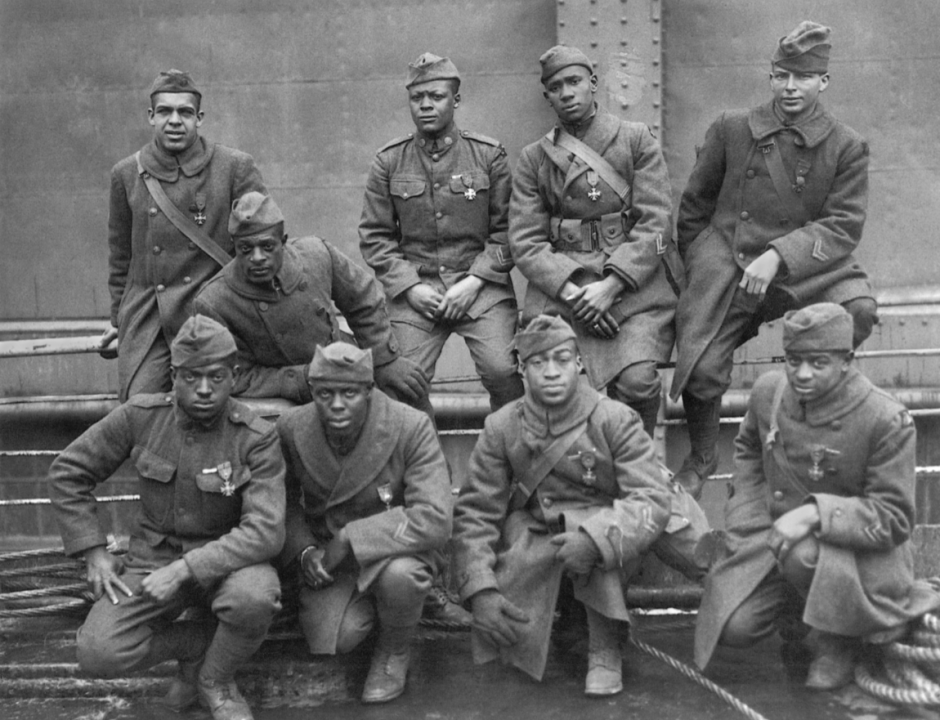
The 369th Infantry Regiment, known as the Harlem Hellfighters, were relieved of U.S. service duties—like cleaning toilets—and to fight in World War I; U.S. Gen. John Pershing needed to provide European allies with reinforcement, but he didn't want to risk the lives of his white soldiers. Historical records say the Harlem Hellfighters spent more time on the front lines than any other American soldiers during the First World War. In 2015, President Barack Obama awarded Pvt. Henry Johnson, who spoke out against racism at the time, the Medal of Honor.
Dr. Louis Tompkins Wright serves in Army Medical Corps
Dr. Louis Tompkins Wright, whose parents were former slaves, graduated from Harvard University School of Medicine in 1917. In France during World War I, Wright in the Army, with the smallpox vaccine. When he returned to the U.S., he became the first black physician at Harlem Hospital.
1918: Cpl. Freddie Stowers leads company in battle
Cpl. Freddie Stowers died in 1918. He led his company into a successful battle against Germany, but he died during the attack. In 1991, President George H.W. Bush posthumously awarded Stowers the Medal of Honor.
1941: Tuskegee Airmen form
In the 1920s, officials in the military Black servicemen were intelligent enough to fly an airplane, although they had already done so: Eugene Bullard, the first Black military pilot, flew for France during World War I. In 1941, as the U.S. entered World War II, the U.S. War Department created a division of Black pilots to train at Tuskegee University in Alabama. More than 30 Tuskegee Airmen made up the 99th Fighter Squadron.
1941: First Black chief nurse in the Army
Maj. Della H. Raney, who retired in 1978, was the first Black chief nurse in the Army Nurse Corps during World War II. At the time, black nurses to tend to Black servicemen. Raney served as chief nurse over the Black nurses at the Tuskegee Army Airfield in Alabama. Because of segregation quotas, just 479 of the 50,000 nurses at the end of the war were Black.
1942: Double Victory campaign
The Pittsburgh Courier—the most Black newspaper at the time—launched the “Double V” campaign (V for victory) in 1942. The paper wanted to make a point about defeating fascism during World War II as well as racism in America, which some say inspired Nazi practices. The New York Amsterdam News was “taking a leaf from United States Jim Crow practices.”
1941: First Black tank battalion unit
In 1941, the Army —the 78th Tank Battalion, later 758th—that trained at Fort Knox, Kentucky. It was the first of three battalions that made up the 5th Tank Group, which consisted of enlisted Black men but led by white officers. When the soldiers returned from fighting in World War II, they still faced discrimination in the U.S.
1942: First Black Marine
Howard P. Perry became the first Black Marine, from 1942 to 1944. While he was training, he and other Black recruits couldn't enter the main camp unless a white escort was with them. By 1947, the Marines became more inclusive, stating “that all men be thoroughly indoctrinated on the principle of the equality of rights and privileges of all marines, and that they should be made to understand that it is their duty to set an example in conduct and deportment, and assist the incoming negro marines.”
1945: First Black all-female unit deployed to WWII
First Lady Eleanor Roosevelt and civil rights activist Mary McLeod Bethune the creation of the Women's Army Corps (WAC), which President Franklin D. Roosevelt signed into law in 1943. It full military benefits. The 6888th Central Postal Directory Battalion—whose job was to go through mail in the European Theater of Operations—in 1945 was the only all-Black female unit deployed in WWII.
Military remains segregated after World War II
Around 1 million Black soldiers served during World War II, but the U.S. military remained segregated. When Black veterans came home, many found it difficult to get housing or jobs. In 1946, the Pittsburgh Courier changed to a single “V” in their campaign, recognizing the need to continue fighting racism in the United States.
1948: The military is desegregated
President Harry S. Truman signed an executive order in 1948 ending segregation in the military and in the federal workforce. Executive Order 9981 said, “There shall be equality of treatment and opportunity for all persons in the armed services without regard to race, color, religion or national origin.” Truman's support of civil rights was an abrupt change from his early thoughts on the black community, as evidenced by many of his letters to friends and family that used racist language. He later changed his ways, “I am not asking for social equality, because no such thing exists, but I am asking for equality of opportunity for all human beings and, as long as I stay here, I am going to continue that fight.”
Some units remain segregated until 1954
Although President Truman issued the order to integrate the Army, many units were still segregated until 1954. Kenneth Claiborne Royall, who was secretary of the Army in 1947, was because it took him a year after the order to desegregate units. It wasn't until 1954 that the last Black unit was dissolved.
1948: First Black pilot in the US Navy
After the Tuskegee Airmen become pilots in the Army, Jesse Brown became the first Black man to pilot an airplane for the U.S. Navy. Brown became interested in flying when . Although many balked at the idea of a Black pilot, Brown attended Ohio University, a predominately white school, because of its Navy program.
POWs in Korean War targeted because of race
Segregation remained during the Korean War. Many of those in the 503rd Battalion, an all-Black unit, spent years in POW camps where they were—the Chinese thought Black soldiers would be susceptible to Communist propaganda because of racial discrimination in the U.S.
Vietnam War sees lower racial tension among US servicemen
Black and white soldiers were no longer segregated in the Vietnam War. While race riots raged in the U.S., many among the troops who fought alongside each other, at least at the beginning of the war. Black soldiers reported being put on more menial tasks than their white counterparts and a Department of Defense report showed they were punished disproportionately: Blacks made up 11% of the total troops, but 58% of the military prisoners at Long Binh Jail.
1965: Black soldiers drafted and killed at higher rate in Vietnam
Black men comprised 11% of the civilian population, but 16.3% of those drafted and 23% of all troops in Vietnam were black. In 1965, about 25% of soldiers who died fighting were black. When Martin Luther King Jr. was assassinated, racial tension heightened among Vietnam soldiers and racial discrimination remained a problem in the military for years.
1967: Lawrence Joel receives Medal of Honor
President Lyndon B. Johnson in 1967 , a Korean War veteran, the Medal of Honor for his service in Vietnam. Johnson was the first medic and first living Black American to receive the award since the Spanish-American War.
1968: James Anderson gets Medal of Honor
A 20-year-old James Anderson served as a Marine in Vietnam. He jumped on a grenade to save his fellow platoon members. In 1968, he the Medal of Honor, the first Black Marine to receive the recognition. In 1983, the Navy named a ship after him.
1979: Hazel Johnson becomes first female general
In 1955, Hazel Johnson (later Brown) enlisted in the Army as a military nurse. In 1979, Johnson promoted to brigadier general and the first black chief of the Army Nurse Corps. The rank came four decades after the first black man, Army Brig. Gen. Benjamin O. Davis Sr., served as a military general.
1980: First Black woman graduates from US Naval Academy
In 1976, a year after Congress passed legislation allowing women to attend military academies, Janie Mines enrolled in the United States Naval Academy. Mines , and the only one who was Black, accepted as a midshipman in the inaugural class. She graduated in 1980.
1989: First Black chairman of Joint Chiefs of Staff
In 1987, Ronald Reagan as National Security Advisor. Powell was then promoted to four-star general, becoming the first Black person to receive the rank. In 1989, under President George H.W. Bush, Powell became the youngest and first Black person to become chairman of the Joint Chiefs of Staff, the Department of Defense's highest military position. Powell retired in 1993 after more than three decades of military service.
1998: First Black woman becomes flag rank in the US Navy
In 1998, Rear. Adm. Lillian Fishburne became the first black woman in the U.S. Navy In 2014, Michelle Howard promoted to four-star admiral and the first Black woman to command a U.S. Navy ship.
2005: Coast Guard appoints first Black female pilot
Jamaican native Jeanine McIntosh (now Menze) first Black female pilot in 2005. Menze later mentored La'Shanda Holmes, who became the Coast Guard's first Black woman to pilot a helicopter in 2010.
2008: Congress forms Military Leadership Diversity Commission
Congress formed the Military Leadership Diversity Commission to increase diversity among officers. Only were Black in 2008, even though they made up about 17% of the military. That rate when assessed in 2015.
President Barack Obama becomes first Black commander-in-chief of US Armed Forces
In becoming the first Black president in 2009, Barack Obama also became the first Black commander-in-chief of the U.S. Armed Forces. Under his tenure, Obama ended the combat missions in Iraq and Afghanistan begun by President George W. Bush. Combat casualties declined during the Obama presidency, partially for airstrikes. In 2011, Obama directed the raid that led to the killing of al-Qaeda leader Osama Bin Laden in Pakistan.
Black women make up a third of women in today's military
Black women comprise 30% of all females in the military, a rate that is twice as high as their representation in the general population. In contrast, Black men make up 17% of men in the military. Black women might because of the repercussions of the 2008 financial crisis coupled with changes to the welfare system and a rise in women-led households.
2017: Military leaders condemn racism in Charlottesville attack
In 2017, President Donald Trump said there were bad people on “both sides” after the deadly attack on a crowd protesting a white supremacist rally in Charlottesville, Va. Shortly after, five U.S. Joint Chiefs—high-ranking military leaders who usually stay out of politics— as intolerant, hateful, and extremist.
Black members of the armed services are more likely to face disciplinary action
A recent study found that Black service members in all four branches of the armed services were —including general punishment or a court-martial—than white troops. Some of the most disparate treatment came from the Marines: Blacks were 2.61 times more likely than whites to be convicted for a general court-martial and 32% more likely to get a guilty verdict in “non-judicial punishment.”
2018: President Donald Trump addresses past racism in the military
President Donald Trump honored Black veterans for Black History Month in 2018. He referenced the desegregation of the military in the ‘50s, but his comments fell short of addressing Black Americans’ ongoing trials with racial discrimination. There is still a lack of diversity in high-level positions, and Blacks in the military continue to face a higher rate of disciplinary action.
2018: Racial discrimination at the US Coast Guard Academy
Black cadets raised concerns in 2018 about racial discrimination at the U.S. Coast Guard Academy, an institution that is mostly white. Complaints included the use of racial slurs, unfair discipline practices, and inappropriate jokes. The academy's diversity officer said they are because “even just one person who doesn't feel fully welcomed and supported here is too many.”