Photos of resilient cities that recovered from war
Wars have decimated many of the world's most famous cities challenging survivors and governments with the task of reconstruction time and time again. In particular after World War II parts of Europe and Asia had been reduced to rubble and had displaced millions of people from their homes. In Germany an estimated 70% of all housing was destroyed while in the Soviet Union—1,700 towns and 70,000 villages were wiped out. Europe lost the majority of its ports and as well.
Cities were faced with the question of whether they should be left in ruins as a monument to the war or rebuilt as if the war never happened. Some saw the opportunity to build entirely new cities. While reconstruction efforts in cities around the world have moved quickly thanks to the inspiring resilience of locals the process is slow—and for some never completely finished. For example visitors to Dresden, Germany will find even though the war ended more than 70 years ago.
Â鶹ԭ´´ has compiled a list of 15 cities that have undergone remarkable and awe-inspiring recoveries from violence. Read on to see how these war-torn places around the world were able to rebuild.
ALSO:
Richmond (1865)
During the Civil War in the United States, Richmond was the capital of the so-called Confederate States of America. In 1865 the city was evacuated and orders were given to destroy stockpiles of supplies; , causing fires worsened by strong winds.
Richmond (1865)
Mobs seized control of the city when the Confederate army withdrew and riots ensued—, but the residential areas were left untouched. The Union army proceeded to put out the fires within the city and a week later Robert E. Lee surrendered the Confederate army to Union Gen. Ulysses S. Grant.
Richmond (2003)
In 1870 Virginia adopted the “Underwood Constitution” to reform the tax system create public schools and recognize the 14th and 15th amendments to the U.S. Constitution—which ensure equality for emancipated slaves. However, the state continued to pass further legislation to .
Richmond (2012)
Richmond—along with the rest of Virginia—came under military control after the war ended and took several years to rebuild physically and economically. Former slaves were transported from the countryside to the city and proved to be adept both in the workforce and in the democratic process—so much so that between 1871 and 1898.
Tokyo (1945)
After the attack almost 1 million people were left homeless. Dry and windy conditions aided the spread of fires and consequently almost 16 square miles of Tokyo were completely destroyed. The Japanese refer to the day of the bombing as the
Tokyo (1945)
On March 9, 1945, U.S. warplanes dropped 2,000 tons of bombs on Tokyo for 48 hours, killing between 80,000 and 130,000 Japanese citizens—the worst firestorm in history. Japanese fire brigades were understaffed and poorly prepared for the attack. The bombing , which consisted of wooden-frame buildings that were quickly set ablaze.
Tokyo (2010)
After the war ended, the United States occupied Japan and implemented sweeping economic political and social reforms. The Japanese adopted parts of American culture and eventually found its . Instead of rebuilding old structures, the city replaced its ruins with modern buildings.
Tokyo (2013)
The Japanese government provided the infrastructure to rebuild Tokyo, but its citizens were the ones ultimately tasked with building the city back up. As a result construction was undertaken neighborhood by neighborhood, making the city a mix of large unplanned settlements. Even today Tokyo has been .
Hiroshima (1945)
The United States dropped the world’s first atomic bomb on Hiroshima in Japan during World War II, sparking the country’s surrender and in the process of the city’s population. Tens of thousands of people later died from radiation exposure.
Hiroshima (2016)
In 1949 national politicians passed the , which established Hiroshima as a peace memorial city and opened previously closed funding to reconstruction efforts. Now aside from the few standing relics from the A-bomb era, the city resembles a typical one featuring offices, chain stores, and nightlife.
Hiroshima (2016)
For years the U.S. suppressed evidence of the catastrophic effects the atomic bomb had on both Hiroshima and Nagasaki. Today the city has rebuilt but also retained evidence of the bomb, maintaining bombed buildings and trees as a living memorial. Hiroshima offers clinics for survivors of the attack and adds names to a registry of the dead kept in the Peace Memorial Park.
Hiroshima (2017)
Hiroshima along with Nagasaki—where the U.S. dropped another atomic bomb days later—suffered almost complete destruction. Everything within a mile radius of the blast was wiped out, leaving only reinforced concrete frames standing. After the bomb was dropped, all around the city causing even more devastation.
St. Quentin (1918)
The German occupation of St. Quentin, France left three-quarters of the city in ruins. The city center sustained the most damage— in the city’s basilica as an observation post for artillery. It eventually caught fire and in the brutal winter that followed the building collapsed in on itself.
St. Quentin (1918)
Many of the 55,000 people that lived in St. Quentin fled the city during the war either immediately after the Germans took over in 1914 or during a large-scale evacuation in 1917 when the . People returned to the town after the war only to find it in ruins.
St. Quentin (2011)
It took St. Quentin until the 1930s to return to its pre-war condition and already the world was experiencing rumbles of World War II. This time the city was prepared, to prevent even more damage.
St. Quentin (2012)
Reconstruction in St. Quentin began with the transportation system including roads, canals, and railways—achieved through The city decided to take an Art Deco approach to reconstruction, incorporating mosaics wrought iron and bow windows.
Sarajevo (1992)
Bosnian Serbs backed by Serbia sieged the city of Sarajevo with rocket mortar and sniper attacks mainly targeting Muslims, but killing many people from different ethnic and religious groups. Croat and Serb forces also in the country, leading more than 70 men to be convicted of war crimes by the United Nations.
Sarajevo (1996)
The 1992 siege of Sarajevo the capital of Bosnia and Herzegovina marked the start of the Bosnian War and was the . Over the period of the war, approximately 100,000 Bosnians were killed and about half of the population fled. The conflict was a result of several republics of the former Yugoslavia proclaiming independence and was made worse by ethnic conflict.
Sarajevo (2011)
When the war ended, Bosnia and Herzegovina transitioned to a democracy and was tasked with rebuilding its capital city—almost 1,500 historic buildings had been destroyed during the siege. Bosnians reportedly rebuilt their homes after every shelling and the
Sarajevo (2013)
The National Library in Sarajevo—along with many important books—was destroyed in 1992 and finally reopened in 2014. Vedran Smajlovic, a cellist who became famous for playing in the ruins of the library,
Madrid (1937)
Labor unions and leftist parties encouraged people to defend their city, which raised morale and encouraged external reinforcements from the Soviet Union. During the siege, Madrid was and combat took place at different places in the city including Casa de Campo and Ciudad Universitaria.
Madrid (1938)
The first bombing raids in Madrid during the Spanish Civil War took place on Aug. 28, 1936 and began a siege that lasted three years. The government that had been in place before the military uprising vacated the capital and moved to Valencia. By the time the war ended, military dictator Francisco Franco claimed that in Madrid.
Madrid (2014)
The Palace of Moncloa, the residence of the Spanish prime minister, was destroyed during the siege but rebuilt a decade later. Other war damage was repaired and detailed reconstruction plans were developed but weren’t unilaterally implemented. Instead, the city of Madrid spread outward; during the 1980s and 1990s, were built.
Madrid (2017)
During the 1990s the city dedicated major efforts toward expanding, building the National Music Auditorium, a new railway station, the Queen Sofia Museum, and Almudena Cathedral. Today the city is once again the capital of Spain. Its status as the center of Spanish government and finance has contributed to its notoriety as well as .
Ypres (1919)
The first battle of Ypres came to foreshadow how fighting on the Western Front would play out for the rest of the war. By the end of the war, the city was reduced to ruins and rubble and the town's once-famous Cloth Hall was destroyed. The battles also marked the on the Western Front.
Ypres (1921)
Due to its geographic location and , the Belgian city of Ypres was a focal point of World War I and suffered from some of its most violent and bitter struggles. The first battle of Ypres in 1914 resulted in about 230,000 deaths while the second battle in 1915 resulted in about 135,000. The third battle in 1917 resulted in almost 500,000 casualties.
Ypres (2008)
Originally should be left in ruins as a monument to the hundreds of thousands of soldiers killed in the city’s major battles. Ultimately Ypres was as it did before the war, but also includes memorials to remember the lives lost during its numerous battles.
Ypres (2009)
On a daily basis a small group of buglers at a monument in Ypres sound “The Last Post” and lead a moment of silence to remember the fallen soldiers.
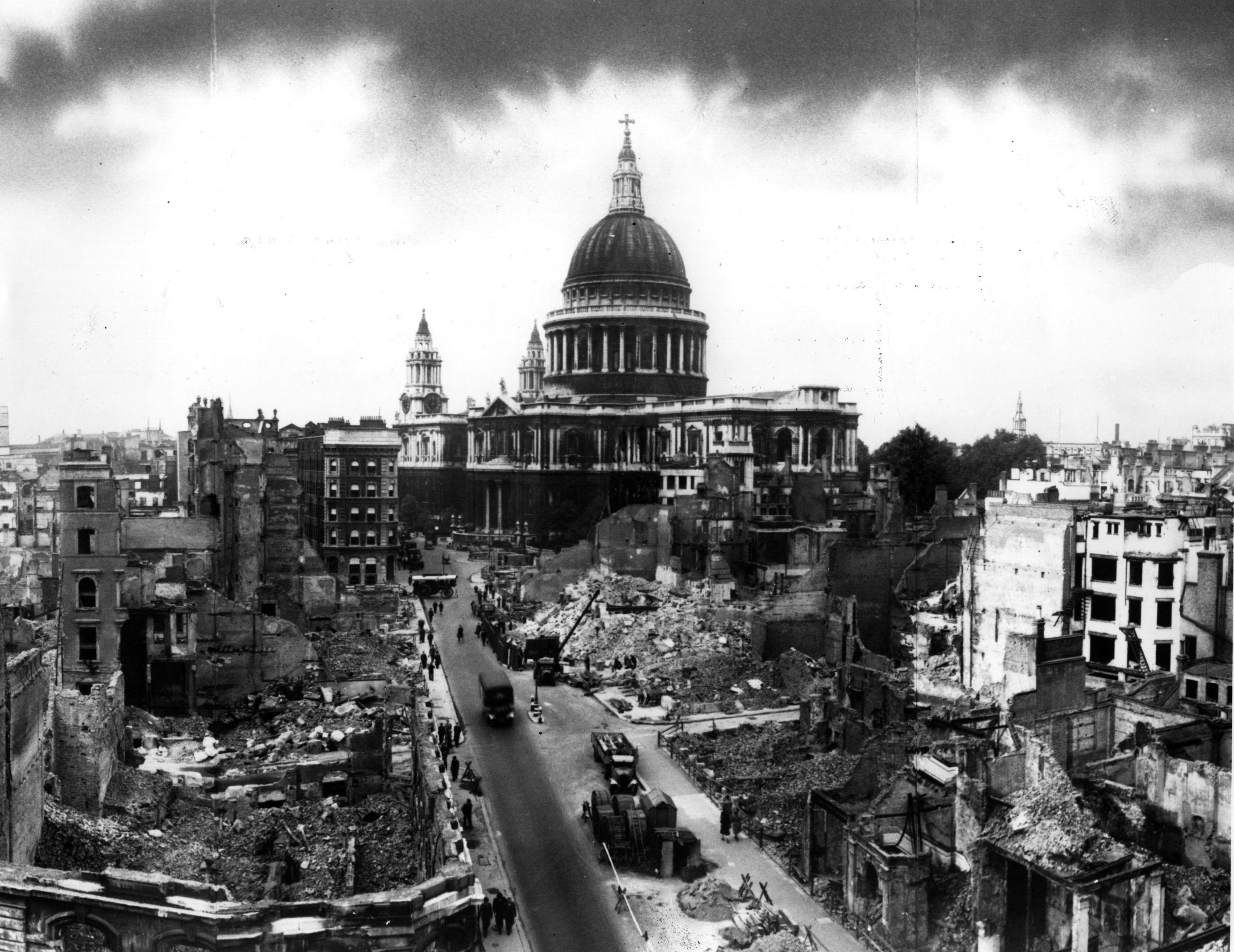
London (1940)
Germany had planned to use the nightly bombings to turn London into a city of rubble and ashes—crippling local infrastructures and terrorizing the British population. During the Blitz, London was considered ; as a result hundreds of homes and buildings were destroyed.
London (1941)
The London Blitz refers to a period of World War II when Nazi Germany led nighttime bombing raids on the city. Great Britain , and as a result, London was subjected to 76 consecutive attacks—killing around 43,000 British citizens.
London (2017)
After the war ended, city planners brainstormed ways to reconstruct the city, balancing housing, industrial, and open spaces, which gave way to estates such as Lansbury in Poplar and Loughborough in Brixton. Planner Patrick Abercrombie proposed constructing “satellite towns” outside of the city’s main ring and after the Blitz.
London (2017)
At the Festival of Britain in 1951, the country proclaimed that it had recovered from the war thanks in part to the passage of . These gave authorities the power to control and purchase land and development. In the following decades, the , constructing new houses, and improving services.
Dresden (1945)
Toward the end of World War II in February 1945, Allied forces bombed Dresden and decimated the entire city leaving it in ruins and killing between 35,000 and 135,000 people. Before the war, the German city was and was known for its intricate architecture and museums.
Dresden (1958)
By the end of the February raid, the U.S. Eighth Air Force dropped more than 950 tons of high-explosive bombs; by the end of the war, it had dropped 2,800 more tons of bombs on Dresden in ensuing raids. When the war ended, the . American author Kurt Vonnegut described the bombing in his acclaimed novel “Slaughterhouse Five.”
Dresden (2006)
After the war survivors and volunteers spent years clearing rubble from the city. Architects and city planners were tasked with deciding which features of Dresden should be rebuilt and what parts of the city should be created anew. The Semper Opera House and Zwinger Palace were among the historic buildings that were reconstructed, but to make way for buildings designed in a style known today as .
Dresden (2011)
Beginning in the 1990s, people began to push for the reconstruction of the Dresden Frauenkirche, the city’s famous Lutheran church. In 1993 people began sorting through the rubble; the in 2005.
Warsaw (1939)
After the Warsaw uprising only a few thousand people were left in the city. The wreckage was so widespread that authorities even considered .
Warsaw (1944)
Before the war Warsaw was home to 1 million people. However at the end of World War II, 90% of Warsaw’s infrastructure had been demolished and the majority of its population murdered. , “Warsaw has to be pacified that is razed to the ground.”
Warsaw (2012)
One plan was to leave Warsaw as it stood as a memorial to the devastation caused by the war. But even during the occupation, Polish city planners and architects had already begun plans to rebuild the city. Officials used 22 done by a Venetian painter in the 1770s to recreate the city’s buildings.
Warsaw (2013)
The reconstruction of Warsaw was paid for using donations; today monuments memorials and plaques dot the city to remind visitors of what it once used to be. However Warsaw is still coming to terms with its past: The in public memorials.
Manila (1945)
Before World War II, Manila was considered “the Pearl of the Orient.” Over the course of February 1945, about 100,000 Filipino citizens were killed when the U.S. sought to take the country from the Japanese. At the end of the war, of World War II.
Manila (1945)
Manila’s entire business district—along with 75% of factories and 80% of the southern residential district—were completely destroyed. While the city did not suffer airstrikes, U.S. ground in areas of the city to weaken the Japanese.
Manila (2015)
After the war the remnants of historic buildings remained standing until they were bulldozed in the 1950s. In 1946 the Philippines gained its independence and the country had seen following the war, replacing street signs named after U.S. states with guerrilla leaders and revolutionaries.
Manila (2015)
Three days after Manila fell to the U.S. and the president relinquished control, he announced that the rehabilitation of the city was the forefront of his concern. Estimates of total property destruction at the time were , and 300 ships carrying vessels weighing 2,000 tons were sunk in Manila’s harbor.
Saigon (1965)
Many Chinese left Cholon after the war ended and Saigon was renamed Ho Chi Minh City. But the district still maintains its Chinese heritage and history—today this Chinatown is among the largest in the world and is home to Chinese temples churches and markets.
Saigon (1968)
On Jan. 31, 1968 when Vietnamese were celebrating the Lunar New Year, communist forces launched a series of coordinated attacks in Southern Vietnam that became known as the Tet Offensive. Particularly heavy fighting , a district mostly inhabited by ethnic Chinese.
Ho Chi Minh City, formerly Saigon (2003)
After the war the site of the former U.S. Embassy was occupied by a Vietnamese petroleum company but was demolished in 1998. Today the site is now a for the U.S. consulate.
Ho Chi Minh City, formerly Saigon (2015)
During the Tet Offensive, a made its way into the U.S. Embassy in Saigon and American audiences watched live on television as the complex was destroyed. The U.S. Embassy had been attacked before—in 1965 outside the structure killing 22 people.
Beirut (1982)
The Siege of Beirut began in June 1982 and lasted until September of the same year. Israeli forces bombed the city in response to an assassination attempt on the Israeli ambassador in London. the Palestinian Liberation Organization; at the end of the siege, the PLO was forced to move its political leadership to other Arab countries.
Beirut (1982)
Beirut was once known as the Paris of the Middle East, but both the Lebanese Civil War and the siege by Israel changed that reputation quickly. Many and streets were cleared of intact buildings in the wake of the violence. A new president Bashir Gemayel was elected in August of 1982 but was assassinated just a few weeks later.
Beirut (2003)
In order to finance the city’s reconstruction, Lebanon entered into a deep debt; today the interest payment adds up to a third of the government’s annual spending. Though the city has made significant efforts toward reconstruction, it : There are daily blackouts in Beirut, water service is unreliable, and a private company is responsible for trash collection.
Beirut (2008)
Just two months after the Siege of Beirut ended, a design competition was held to develop a game plan to redesign an area in the city known as Martyrs’ Square. A Greek team ended up winning the competition who claimed because the two countries shared the Mediterranean Sea.
Milan (1943)
Because Milan was an industrial and commercial center, it was an Allied target during World War II. The city was subject to 60 air raids killing tens of thousands of people and destroying a third of its buildings. Thanks to sand reinforcements and struts, the Ciborium of St. Ambrose was saved, as well as Leonardo da Vinci’s “The Last Supper,” but
Milan (1943)
By 1943 Milan had been turned into a city of rubble. Historians say that the bombing campaigns led directly to a decrease in Italian morale and war weariness though Italians while they were under attack.
Milan (2011)
During the war the Virgin Mary statue in Milan’s famous Duomo was covered with rags so enemy bombers wouldn’t be able to see it. After the war ended, the cathedral was completely renovated and its wooden doors were replaced with marble doors. In 1969 it was closed for further repairs; it .
Milan (2013)
Both the effects of the war and real estate speculation led to a complete redesign of entire areas of Milan and erased popular and wealthy neighborhoods and streets. Italians in the city were faced with the question of whether to reconstruct historic areas or build a new city entirely. This led to the including the Pirelli skyscraper.
Stalingrad (1942)
As winter began Hitler refused to surrender—even though his army was struggling in the brutal Russian cold, starving, and running out of ammunition. By February 1943 Russians had captured almost 100,000 German soldiers and Hitler admitted defeat. Historians believe this battle to be a in World War II.
Stalingrad (1943)
During World War II the Battle of Stalingrad in the then-Soviet Union was one of the largest longest and bloodiest periods in modern warfare; it lasted from August 1942 to February 1943 and killed or injured more than 2 million people. Stalin infamously instructed his forces not to retreat—those who surrendered .
Volgograd, formerly Stalingrad (2013)
At the end of the battle, more than 90% percent of the residential areas in Stalingrad had been destroyed. Though it would have been cheaper to build a new city Joseph Stalin . Architects redesigned the city using a style that has come to be known as Stalinist neoclassicism.
Volgograd, formerly Stalingrad (2013)
Stalingrad was officially renamed Volgograd in 1961; today the city has a population of about 1 million. The city’s once-famous Children’s Circle Dance Fountain was destroyed during the Battle of Stalingrad but a near its original location in 2013.