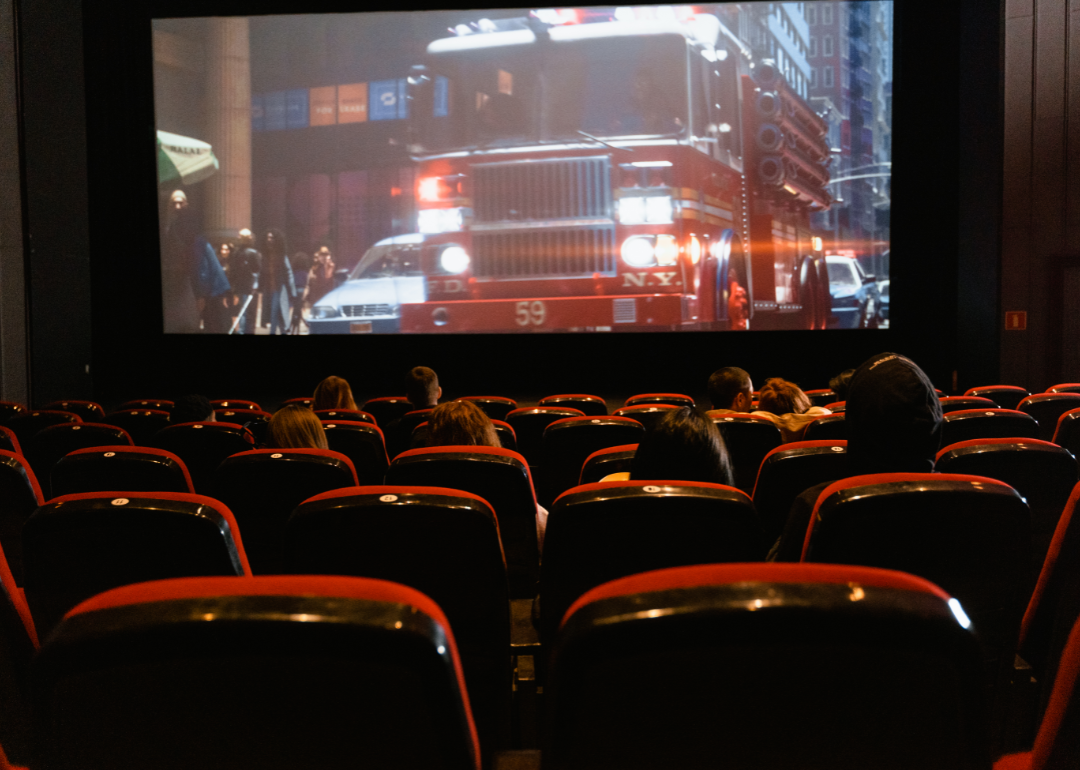
Famous moments in movie history from the year you were born
Famous moments in movie history from the year you were born
Film history—with its star-studded blockbusters, celebrity triumphs and tragedies, and mind-blowing technological advances—is as dramatic as the medium itself. From the earliest days of the silent film era through the advent of today's stunning computer-generated imagery, audiences around the world have been captivated by the silver screen. According to Nielsen ratings, more than 26 million Americans tuned in to watch the, and in recent years, exceeded $11 billion in the U.S. alone. Fans cannot get enough of their favorite films and actors, and routinely packed with little-known facts and photos.
Â鶹ԭ´´ sifted through sources, including film and history databases, critics' compilations, and entertainment news to compile this list of most memorable movie moments from 1918 through 2017. What was happening in Hollywood the year you were born? Click through the list to find out!
RELATED:
1918: Warner Bros. is born
Warner brothers Harry, Albert, Sam, and Jack, , purchased property on Sunset Boulevard for $25,000 and relocated their Pennsylvania-based film company to sunny Hollywood. Warner Bros. West Coast Studios would evolve into one of the world's largest and most innovative film companies.
1919: Erich von Stroheim, triple threat
Austrian native Erich von Stroheim made his Hollywood with his feature "Blind Husbands." Notoriously difficult to work with, this legendary silent screen director went on to produce . In later years, Stroheim starred alongside Gloria Swanson as her devoted servant in "Sunset Boulevard."
1920: Pickfair
Before Brangelina or Kimye, there was Pickfair. Silent screen film star Douglas Fairbanks Sr. presented his sweetheart Mary Pickford with a lavish estate (appropriately christened Pickfair) as a wedding gift. The property boasted 22 rooms and what is thought to be .
1921: The original 'Latin Lover'
Rudolph Valentino, an Italian immigrant who became famous as ," made his mark in 1921 with not one but two blockbuster films. "The Four Horsemen of the Apocalypse" became the , while "The Sheik" cemented Valentino's .
1922: The first vampire flick
Inspired by Bram Stoker's "Dracula," director F.W. Murnau's "Nosferatu" is the , considered by many to be a . Max Schreck stars as the chisel-toothed Count Orlok.
1923: 'The Ten Commandments'
At 70 years old, director Cecil B. DeMille embarked on the most challenging project of his career, "The Ten Commandments." A breathtaking spectacle renowned for its lavish sets, "The Ten Commandments" was the at the time of its release. DeMille, in conjunction with the Los Angeles Times, had offered a . The winner, F.C. Nelson—a lubricating oil manufacturer from Michigan—submitted the biblical theme along with an ominous warning: "You Cannot Break the Ten Commandments—they will break you."
1924: Walt Disney's first animated film
Walt Disney's "," is the first of 56 inspired by Lewis Carroll's "Alice in Wonderland." The black-and-white short was 11 minutes long, completely silent, and has a .
1925: Silence is golden
is Charlie Chaplin's most beloved comic creation, and the central character in "The Gold Rush," which Chaplin also produced and directed. This would become ever made.
1926: 'Battleship Potemkin' sets sail for America
Russian director Sergei Eisenstein's revolutionary tale of mutiny on the Black Sea, "," where its Marxist message was subject to censorship. More action than art film, "Battleship Potemkin," exerted a profound .
1927: Talkies take over
Warner Bros. released "" in 1927, bringing the silent screen era to an abrupt end. The film features several musical numbers by Al Jolson, a popular Vaudeville entertainer. In addition to being —a movie with a soundtrack—"The Jazz Singer" is also notable for its considerable ad-libbing, including Jolson's famous line:
1928: Meet Mickey Mouse
became the mouse everyone knows and loves by adapting an earlier Disney character, . When in a contract dispute, Walt Disney rebounded with Mickey, who made his silver screen debut in the 1928 short "Plane Crazy." He hit it big with his appearance in "Steamboat Willie" that same year.
1929: Introducing Oscar
Although the Oscar until almost a decade later, the statuettes have been presented to talented recipients since 1929. Paramount's "Wings" took home the Best Picture award at the banquet at Hollywood's Roosevelt Hotel, while Emil Jannings and Janet Gaynor walked away with Best Actor and Best Actress honors.
1930: The Blonde Bombshell
Jean Harlow, famous for her luminous platinum locks, famous for her luminous platinum locks, made Hollywood history in eccentric director and aviator Howard Hughes' "Hell's Angels." In the film, she utters the immortal phrase: "" Harlow, also known as "The Blonde Bombshell," was signed by MGM and enjoyed major Hollywood stardom until her . She was just 26.
1931: Crawford meets Gable
MGM luminaries Clark Gable and Joan Crawford lit up the screen in "," the first of eight films the duo made together. Gable and Crawford were not just co-stars; they were real-life lovers. When their adulterous affair became public, producer and MGM co-founder Louis B. Mayer demanded they end it. The couple parted ways, but with much difficulty judging from : "The electricity between us sparked on-screen. It wasn't just acting; we meant every damn kiss and embrace."
1932: Shirley Temple and the 'Baby Burlesques'
Shirley Temple, the little girl with the curly hair and the dimpled grin, was a breath of fresh air for audiences during the Great Depression. The 4-year-old talent made her big-screen debut in a series of low-budget shorts known as the "" in which toddlers played roles intended for adults and dressed the part. Later that same year, Shirley appeared in her first feature film, "," and would soon become one of the .
1933: "It was beauty killed the beast."
King Kong, the legendary giant ape, made his in 1933. Merian C. Cooper and Ernest B. Schoedsack—documentarians and adventure enthusiasts—conceived the story and created the film on a shoestring budget. Only the petite could tame King Kong, and the scene in which Wray rests in his upturned hand became one of the most iconic in sci-fi film history.
1934: Enter Larry, Moe, and Curly
made their big screen debut in the short "," performing all of the dialogue in rhymes. Larry, Moe, and Curly went on to sign a deal with Columbia and appear in 190 slapstick classics.
1935: The dawn of Technicolor
RKO released "," a dramatization of William Thackeray's 19th-century novel, and movies would never look the same again as this was the first film to be . Director Rouben Mamoulian understood the power of the palette and when filming.
1936: Chaplin's last silent film
As talkies grew in popularity, even the great Charlie Chaplin found himself confronting the challenges of technology—a theme he addressed in his final silent film, "." Although Chaplin's initial attempts to transition to the world of sound were hit and miss, he eventually found success with the release of "The Great Dictator" in 1940, avoiding the same fate of many silent film stars whose careers faded into oblivion.
1937: 'Heigh ho, heigh ho'
In 1937, Walt Disney released "," the first full-length animated feature. Adapted from the original Grimm's fairy tale, the film and spawned a never-ending parade of enormously popular Disney princesses.
1938: Box office poison
Howard Hawk's "Bringing Up Baby" flopped at the box office in 1938, only to be rediscovered years later and hailed as . Consequently, the film's star, Katherine Hepburn, was deemed "box office poison" and her . Hepburn returned to the stage for a few years before with "The Philadelphia Story."
1939: 'Frankly, my dear...'
Adapted from Margaret Mitchell's best-selling Civil War novel by the same name, "," starred Clark Gable and Vivien Leigh as star-crossed lovers. The movie hit the big screen in 1939 and went on to become , raking in $192 million. It was also one of the longest films ever made at the time, with a running time of 231 minutes.
1940: 'Fantasia' in Fantasound
Disney followed up its "Snow White" success with a slate of animated features, with an orchestral score and complex themes. It was the first film released in . Only a limited number of audiences were able to enjoy this enhanced sound technology, as the equipment was prohibitively expensive and available at only six theaters nationwide.
1941: The most recognizable movie prop is established
The Maltese Falcon is one of the most recognizable props in film history. According to Detective Sam Spade, played by Humphrey Bogart, the statuette symbolized "the stuff that dreams are made of," a line as iconic as the Maltese Falcon itself. In 1994, a collector's dream came true when the falcon was purchased at an auction for a whopping : the most a movie prop had ever sold for up to that point.
1942: 'Play it again, Sam.'
"Play it again, Sam" is of the of all time, as it was never actually spoken by Humphrey Bogart's character Rick Blaine in the 1942 classic "Casablanca." The Academy Award-winning film about mismatched lovers in Morocco was a huge success with audiences and critics alike.
1943: The Caped Crusader
Batman made his film debut in , which featured several elements familiar to fans of the comic book series including the Bat Cave and stately Wayne Manor The limited budget forced production to , which was a stock 1939 Cadillac convertible that also served as Bruce Wayne's everyday ride.
1944: Lauren Bacall's debut
Born Betty Jane Perske, Lauren Bacall when the wife of Howard Hughes saw her photo on the cover of Harper's Bazaar and encouraged her husband to give the young actress a screen test. Hughes cast Bacall as the ," which would forever change the 19-year-old's life and name.
1945: Laura's adios to Alec
"," based on the play by Noel Coward, is one of the most popular British films ever created—and one of the most heartbreaking. Laura and Alec engage in a furtive, adulterous love affair against a backdrop of mid-20th-century English propriety. When their doomed relationship must come to an end, the couple is robbed of a .
1946: Cannes Film Festival
The was originally scheduled for the fall of 1939 but was postponed for seven years because of World War II. In 1946, the mood in France was jubilant and the well-attended festival introduced European films to an international audience.
1947: Hollywood Red Scare
(HUAC) subpoenaed more than 40 members of the film industry, believing them to harbor communist sympathies. A group of writers and directors known as the challenged the committee and was consequently blacklisted. Many continued to write under pseudonyms until the ban was lifted in the 1960s.
1948: 'Snake Pit' shines a light on mental illness
Olivia de Havilland starred in this early effort to call attention to the plight of those suffering from mental illness. While the heroine's "cure"—embracing life as a wife and mother—has been denounced in recent years, "" nevertheless , calling attention to the abominable conditions prevalent in U.S. mental health institutions at the time.
1949: Blacklisted
On June 8, 1949, the FBI, lacking any substantive evidence, accused several American celebrities of being communists. The , like two-time Oscar winner Frederic March, "Little Caesar" and "Key Largo" tough guy gangster Edward G. Robinson, and stage and film actor and activist Paul Robeson.
1950: Betty Davis scores Best Actress Oscar
took home the Best Actress Oscar for her performance as aging theater diva Margot Channing in "." The film also won the Oscar for Best Picture.
1951: 'Streetcar' incites the Legion of Decency
Tennessee Williams adapted his play, "," for the silver screen, refusing to spare censors in the process. The film openly tackles controversial, taboo topics and themes like mental illness, domestic violence, and sexual assault, and consequently ignited the ire of the . Directed by Elia Kazan, "A Streetcar Named Desire" tells the story of former Southern belle Blanche Dubois, who resides in a squalid New Orleans apartment with her sister and earthy brother-in-law (Marlon Brando).
1952: 'Singin' In the Rain'
Gene Kelly made movie musical history with his joyfully infectious performance of "" while suffering from a 101-degree fever. A clever satire on the transition from the silent film era to the age of talkies, "Singin' in the Rain" , including the title track, written by lyricist Arthur Freed and composer Nacio Herb Brown for MGM's "Hollywood Revue of 1929."
1953: Lovers on the beach
Love scenes are a cinema staple. Yet few are as memorable as the image of locked in a passionate embrace on a moonlit Hawaiian beach in "."
1954: Elia Kazan's 'On the Waterfront'
Filmed in just 36 days on location in Hoboken, N.J., director Elia Kazan's gritty drama "On the Waterfront" packs a powerful political punch. The story follows Terry Malloy, a longshoreman who inadvertently betrays his union brothers. The film has been , whose names he game up while under interrogation by The House Un-American Affairs Committee 30 years prior.
1955: Marilyn Monroe and the subway grate
There is perhaps no image more iconic than that of Marilyn Monroe standing above a subway grate good-naturedly struggling to maintain a sense of decency as a subway train rushes by, creating a wind-tunnel beneath her white halter dress. Twentieth Century Fox turned the filming of the scene for the "" into a , leaking the date and time of the shoot to the public. Thousands of fans turned out to see Monroe, and as much of her as possible, at the expense of her who was less than thrilled by the spectacle.
1956: Hollywood's princess
transitioned from Hollywood royalty to actual royalty when she on April 18, 1956. Kelly won the Best Actress Oscar for her performance in "The Country Girl" in 1954, and served as Alfred Hitchcock's muse in "Dial M for Murder," "Rear Window," and "To Catch a Thief." She retired from acting after her marriage, concentrating instead on her duties as princess consort.
1957: 'I Was A Teenage Werewolf'
Camp classic "" featured Michael Landon, who later starred in "Bonanza" and "Little House on the Prairie," as an all-American boy who is transformed into a werewolf when a science experiment goes awry. "I Was A Teenage Werewolf" was the of its time, and also one of the first—if not the first—rock 'n' roll horror film.
1958: The first Asian woman to win an Oscar
won the for her role in "." Against the will of her family and community, Umeki's character marries American airman Joe Kelly, played by Red Buttons. The young bride and her serviceman husband commit suicide when they are unable to return to the United States together. Umeki was the first woman of Asian descent to win an Oscar.
1959: Too hot for words
, "" features Tony Curtis and Jack Lemmon as struggling musicians who disguise themselves as members of an all-girl band after accidentally witnessing a mob hit. Marilyn Monroe stars as the band's lead singer. Inspired by the 1935 French farce "Fanfare d'Amour," "Some Like it Hot" was the highest-grossing comedy of its day.
1960: 'Psycho' shower scene
Master of suspense Alfred Hitchcock set a new bar for fear with the release of ," his first hardcore horror film. In the , the audience is never privy to the actual stabbing of Janet Leigh's character. Instead, Hitchcock makes viewers' blood run cold with closeup shots of the instrument of death, Janet Leigh's piercing scream, and the grisly aftermath of the murder swirling down the shower drain.
1961: '60s style icon Audrey Hepburn
Style icon Audrey Hepburn turned heads around the world as Holly Golightly in "," based on the novel by Truman Capote. Legendary created Holly Golightly's quirky-yet-classic look, which continues to be emulated by women around the globe.
1962: Bond. James Bond.
Sean Connery became the first actor to play James Bond in the 1962 film "." The movie is set in Jamaica and features Ursula Andress as the original Bond Girl.
1963: First female star to receive $1 million
Elizabeth Taylor became the first woman to command $1 million dollars for a single film when she signed on to play the lead in "." The film bombed at the box office, but the fire ignited between burned for years.
1964: First black American wins Best Actor Oscar
Sidney Poitier was honored for his performance in "," becoming the first person of color to win the Academy Award for Best Actor.
1965: The hills are alive
Julie Andrews dominated the in "" as nun-turned-nanny Maria von Trapp, spinning on a hilltop somewhere in the Swiss Alps. Inclement weather plagued the production, and the sequence was shot during a 20-minute break from chronic wind and rain on the final day of filming.
1966: Governor Ronald Reagan
Just two years after his final film role in "," made the seemingly seamless transition from movie star to politician. Running on the Republican ticket, Reagan galvanized the right and was elected governor of California in 1966, defeating Democratic incumbent Pat Brown.
1967: First major film to drop the F-bomb
Although attitudes toward profanity in film began to loosen up in the early '60s, the f-word was not uttered on screen until British director " in 1967. The honor was bestowed on .
1968: Kubrick's sci-fi special effects
Stanley Kubrick's sci-fi epic "" at the time of production boasted the largest budget for special effects for any movie ever made, dedicating more than 60% of the film's budget to high-tech imagery. Kubrick oversaw the special effects team himself, which included heavyweights Con Pederson, Wally Veevers, and Douglas Trumbull, who later worked on "Blade Runner" and "Close Encounters of the Third Kind." Just some of the special effects featured in "2001" were front projection, developed by Trumbull, an innovative rotoscoping setup, and achieving the weightlessness of space by suspending stunt actors from wires.
1969: 'Midnight Cowboy' walks on the wild side
An X rating ordinarily would have sunk an Oscar contender, but "" defied the odds and took the award for despite its explicit content. The film chronicles the unlikely friendship between a Texas gigolo (Jon Voight), and a con artist (Dustin Hoffman). This marked the dawn of a new, hard-hitting era in American film that tackled issues relating to sex and drugs head-on.
1970: Decade of disaster
"Airport" kicked off a decade-long . The era spawned fatalistic features such as "The Poison Adventure," "Airport 1975," "Airport 77," "Earthquake," and "Avalanche."
1971: George C. Scott snubs Oscar
George C. Scott was recognized for his brilliant turn as in the eponymous film "Patton" at the 1971 Academy Awards. He , comparing the competition to a meat market.
1972: 'Make him an offer he can't refuse.'
The , directed by Francis Ford Coppola arrived in 1972. The famous quote "" can be heard twice in the film. Michael Corleone uses the phrase when relating a story to his wife, Kay. The second time the line is spoken by Don Vito Corleone, promising his godson a covert role in an upcoming film.
1973: 'Westworld' incorporates CGI
The 1973 feature-film precursor to HBO's acclaimed series "" was written and directed by Michael Crichton, who went on to write the "Jurassic Park" series. "Westworld" was groundbreaking in its day, incorporating (CGI) with the first use of pixelation. The tech was used to as it stalks human visitors at fantasy frontier resort Westworld.
1974: Make it a double for Francis Ford Coppola
Director Francis Ford Coppola personally took home not one, but" in the categories "Best Director" and "Best Writing, Screenplay Adapted From Other Material." He also for "Best Writing, Original Screenplay" in "The Conversation."
1975: 'Jaws' opens in wide-release
Universal premiered "Jaws" at an , making wide-release the norm for summer blockbusters.
1976: 'Bound for Glory' introduces Steadicam
Academy Award-winning Steadicam technology is a method of achieving smooth, sustained shots in film . The movie-making breakthrough, , involved mounting a camera to a wearable vest so camera operators could follow movement seamlessly. "Bound for Glory" represents the first use of Steadicam, which became mainstream later that year as a cameraman kept crisp, smooth pace with Rocky Balboa as he .
1977: 'The Spy Who Loved Me' ski chase
Roger Moore played the British spy James Bond for the third time in "The Spy Who Loved Me," which opens with . Moore's stuntman Rick Sylvester evades would-be assassins by skiing down a particularly challenging trail, off a cliff, only to land safely by deploying a .
1978: 'Food fight!'
" pushed gross-out comedy, which was aimed specifically at the youth market, to new extremes. The film chronicled the bawdy antics—drunken toga parties, graphic food fights, and a morally questionable road trip—of a particularly outrageous college fraternity. Inspired by screenwriter Chris Miller's at Dartmouth, "Animal House" was the first comedy to break $100 million dollars at the box office.
1979: The smell of napalm in the morning
In 1979, director Francis Ford Coppola released "," his groundbreaking Vietnam War film inspired by Joseph Conrad's 1899 novella, "Heart of Darkness." Showered with numerous accolades and awards, the movie belies the fact that the including inclement weather, Marlon Brando's unforeseen weight gain, and Martin Sheen's heart attack on set.
1980: Daddy dearest
After waiting three long years for "," fans gasped when arch-villain Darth Vader reveals that he is, in fact, .
1981: British invasion
"," a low-budget British film chronicling the trials and tribulations of two university students running in the 1924 Olympics, shook up Hollywood when it unexpectedly won Best Picture in 1981. The Brits dominated again the following year .
1982: Improved child labor Laws
After child actors My-Ca Dinh Le, 7, and Renee Shin-Yi Chen, 6, were ," U.S. child labor laws were reformed and greater safety precautions were adopted. Director John Landis, initially charged with , was acquitted in 1987.
1983: 'Risky Business' dance scene
Tom Cruise made movie history in "" with his lip-syncing rendition of Bob Seger's "Old Time Rock 'n' Roll" while wearing nothing but a button-down shirt, tighty whiteys, and a pair of white socks. The movie script called for Cruise's character to dance in his underwear, —the candlestick microphone, the popped collar, and jumping on the bed—were all Cruise.
1984: The age of the mockumentary
"This Is Spinal Tap," a satirical film about a mythical British band, . The film was entirely improvised by the cast led by Christopher Guest and Michael McKeon. Guest and McKeon went on to make several other , including "Best in Show," "Waiting for Guffman," and "A Mighty Wind."
1985: Be kind, rewind
Back in the 80s, before Netflix and Amazon Prime, people got in their cars and drove to stores where they rented movies on VHS tapes and could be fined for forgetting to rewind the tape. of neighborhood video stores and opened its first outpost in Dallas in 1985.
1986: 'Life comes at you pretty fast'
Matthew Broderick entered the American consciousness as the eponymous hero of writer and director John Hughes' "." Ferris Bueller, his girlfriend, and his best friend knock off school for the day and treat Chicago as their own personal playground. Bueller's rationale for skipping school? "
1987: Johnny and Baby have the time of their lives
"," starring Patrick Swayze and Jennifer Grey as a pair of unlikely summer lovers holed up at a Borscht Belt resort, was the sleeper hit of 1987. Writer Eleanor Bergstein based the screenplay . The chemistry between the couple sizzled, particularly in the when Johnny lifts Baby in the air to the strains of "." Patrick Swayze, a trained dancer, was a natural fit for the role.
1988: 'The Last Temptation of Christ' sparks protests
When "" opened in the U.S., it was met with vociferous objections from numerous religious groups. The dream sequence in which Jesus, played by Willem Dafoe, leads a parallel existence as the husband of prostitute Mary Magdalene was found to be particularly objectionable. Despite the outcry, .
1989: 'When Harry Met Sally'
"" resuscitated the romantic comedy—a genre which had been on life support for decades. The classic follows unlikely friends, played by Meg Ryan and Billy Crystal, as their relationship blossoms into something much more serious. Nora Ephron's crisp, inventive dialogue keeps the film fresh, despite the sentimental subject matter. Meg Ryan in a New York City pastrami palace became an iconic moment in the history of comedy.
1990: Mob rule
Director Martin Scorsese struck gold yet again with "," based on the true story of former mobster Nicholas Pileggi. Starring Ray Liotta, the film has been described as "."
1991: Slacking in Austin
"," Richard Linklater's low-budget, meandering debut film, follows a motley group of Austin 20-somethings over a 24-hour period. The term "slacker," used to identify Linklater's underachievers, immediately entered the American lexicon.
1992: "Malcolm X" films in Mecca
"Malcolm X," directed by Spike Lee, was the . The filming was performed entirely by Muslim actors, as those outside the faith are banned from the holy site. The movie contains a when Nelson Mandela appears as a South African school teacher.
1993: Schindler's girl in the red coat
There are only a handful of colorized images in Steven Spielberg's harrowing Holocaust film, "Schindler's List," which was shot almost exclusively in monochrome. The now-iconic image of a running across the street as Nazi soldiers decimate the Krakow ghetto is an important turning point in the film. When , sees the girl in the red coat, he realizes that he must save as many Jews as possible.
1994: Forrest Gump's groundbreaking special effects
While most CGI and special effects get used in action and sci-fi flicks, "Forrest Gump" used them to bring history to life. Whether shaking hands with JFK, dancing with Elvis, or inspiring John Lennon with the lyrics for "Imagine," the film utilized a number of techniques including compositing, chroma key, image warping, rotoscoping, and other technologies to seamlessly integrate famous historical figures into shots with Forrest (Tom Hanks) and his fellow characters. The stunning special effects helped to make the film one of the biggest box office earners of all time and among the most cherished of all American movies.
1995: 'To infinity... and beyond!'
"" was the first entirely digital feature-length film, and revolutionized the animation industry. Working with Disney, computer scientists at that enabled animators to bring Woody and Buzz Lightyear's 3D world by to life.
1996: 'Show me the money!'
director Cameron Crowe's wildly successful rom-com spawned several time-tested catch phrases, including "Show me the money!" "You complete me," and "You had me at hello." The film stars Tom Cruise as an ethically challenged sports agent and newcomer as his love interest. Zellweger nabbed the Best Actress honor for her performance
1997: 'Titanic' is first to gross $1 billion
When the screenplay for "Titanic" reached the desk of legendary , she immediately recognized the story's potential. Leonardo DiCaprio and Kate Winslet were cast as the doomed lovers, and Lansing's instincts proved correct: "Titanic" was a huge hit with fans. At more than $1 billion in sales, it was the highest-grossing film in history at the time.
1998: 'Let's go bowling'
The Coen brothers, noted for their quirky independent vision, followed up the critically acclaimed "Fargo" with "." Starring Jeff Bridges, John Goodman, and Steve Buscemi as bowling buddies caught up in a case of mistaken identity. The film, with its endlessly quotable dialogue, became a cult classic.
1999: 'I see dead people'
Thriller writer and director M. Night Shyamalan's "" contains not only one of the best plot twists in movie history, but also one of the most frequently quoted lines. Six-year-old Cole, played by Haley Joel Osment, is gifted with psychic abilities; and his famous line, "I see dead people," has been immortalized and
2000: First foreign-language film surpasses $100 million
"Crouching Tiger, Hidden Dragon" transcended audience demographics to appeal to everyone from "." The movie, filmed in Mandarin-Chinese, and took home four Oscars.
2001: 'There’s a lot more to ogres than people think.'
"," DreamWorks laugh-out-loud, larger-than-life homage to fairy tales, became the first film to win an Oscar for Best Animated Feature—a brand-new category introduced by the Academy in 2001. The lovable ogre, voiced by Mike Meyers, spawned four sequels—with a fifth scheduled .
2002: First black woman wins Best Actress Oscar
The Academy awarded the Best Actress honor to Halle Berry for her portrayal of Leticia Musgrove, the long-suffering wife of a death row inmate who finds comfort in the arms of a prison guard in "." Berry became the first black woman to take home the Oscar in the Best Actress category, and her acknowledged many of the great black actresses who came before her, including Dorothy Dandridge and Lena Horne.
2003: Disney announces end of 2D animation
As CGI became the animation technique of choice, Disney announced that "" would be its . The studio did not quite keep its word, though; another feature, 2004's "," would be Disney's actual final 2D movie.
2004: 'That is so fetch'
The 2004 hit comedy "," starring Lindsay Lohan as an awkward math geek who becomes popular, spawned a slew of . The majority of the words, including "fetch" and "skeez," were coined by "The Plastics," the superficial clique ruled by Regina George (Rachel McAdams).
2005: 'Brokeback Mountain' paints an alternative picture
Director Ang Lee's "," adapted from the short story by E. Annie Proulx, is a between two Wyoming men played by Heath Ledger and Jake Gyllenhaal. The relationship spans two decades and is rarely discussed by either partner, neither of whom is able to say "I love you." The film gave way to the immortal line,
2006: Streep's sweep
Grand dame of American film received her in 2006 for her performance as icy fashion editor Miranda Priestly in "." Although Streep did not take home the Best Actress award, the two-time winner became the most-nominated performer in the history of the Academy. Since then, Streep has garnered and another win.
2007: Ellen Page is youngest actress nominated for an Oscar
At 20 years old, Canadian actress Ellen Page became the youngest actress ever nominated for Best Actress by the Academy. The nod came for her spunky but sensitive role as a ."
2008: The role that may have killed Heath Ledger
Just a few months before the scheduled release of Christopher Nolan's edgy Batman film "," Heath Ledger, who starred as The Joker, died of a drug overdose in his New York City apartment. Ledger during production, and his mood and sleep cycle suffered. The pills that ultimately killed him were prescribed in an attempt to cope with the effects of filming the most demanding role of his career.
2009: 3D ups its game with 'Avatar'
Director James Cameron's "" reinvented 3D technology with the introduction of , a process which in order to create a more convincing 3D illusion. "Avatar" went on to become , and revolutionized feature film animation.
2010: First woman wins Oscar for Best Director
Kathryn Bigelow became the first woman to take home the Best Director honor for her hard-hitting feature, "," about a group of bomb disposal experts during the Iraq War. Bigelow's ex-husband and " and was sitting behind Bigelow when she was announced as the winner.
2011: 'The Artist' reminds us of our rich cinematic history
French film "" beat out big names and Hollywood blockbusters by sweeping the Oscars in a host of categories, including Best Picture, Best Director, and Best Actor. The movie, which centers on a silent film star struggling to adapt to the introduction of talkies, was . The film, except for a single line of dialogue and dream sequence with sound, is the first silent movie to win Best Picture; and the Best Picture winner to be shot completely in black-and-white .
2012: Edward and Bella
In 2012, "," the fifth and final film in the teen vampire series, hit theaters. It was the in the first few days of release. The supernatural love affair between Kristen Stewart's Bella and Robert Pattinson's Edward proved , upping their clout as an influential box office demographic
2013: Jodie Foster comes out at the Golden Globes
Jodie Foster and is one of few to transition from childhood stardom to a successful adult film career. For the most part, Foster has kept her personal life to herself. It wasn't until she turned 50 that in a very public setting:
2014: Happy 60th to the giant lizard
"," directed by Gareth Edwards, marked the 60th anniversary of giant lizard movies. The ," was released in 1954 in Japan.
2015: Fifty Shades of Grey
"," adapted from E. L. James' erotic novel and starring Dakota Johnson, . Box office revenues were fueled by the film's taboo subject matter: a sadomasochistic love affair between a young woman and a controlling man.
2016: Fish flick breaks the tank
"," the sequel to Pixar's "Finding Nemo," was the ever. The movie commanded a cool $135.1 million.
2017: Girl power
"," directed by Patty Jenkins and starring Israeli newcomer Gal Gadot, performed heroically at the box office. The film raked in $103.3 million opening weekend, making it .