How Germany outfitted half a million balconies with solar panels
was produced by and reviewed and distributed by 麻豆原创.
How Germany outfitted half a million balconies with solar panels
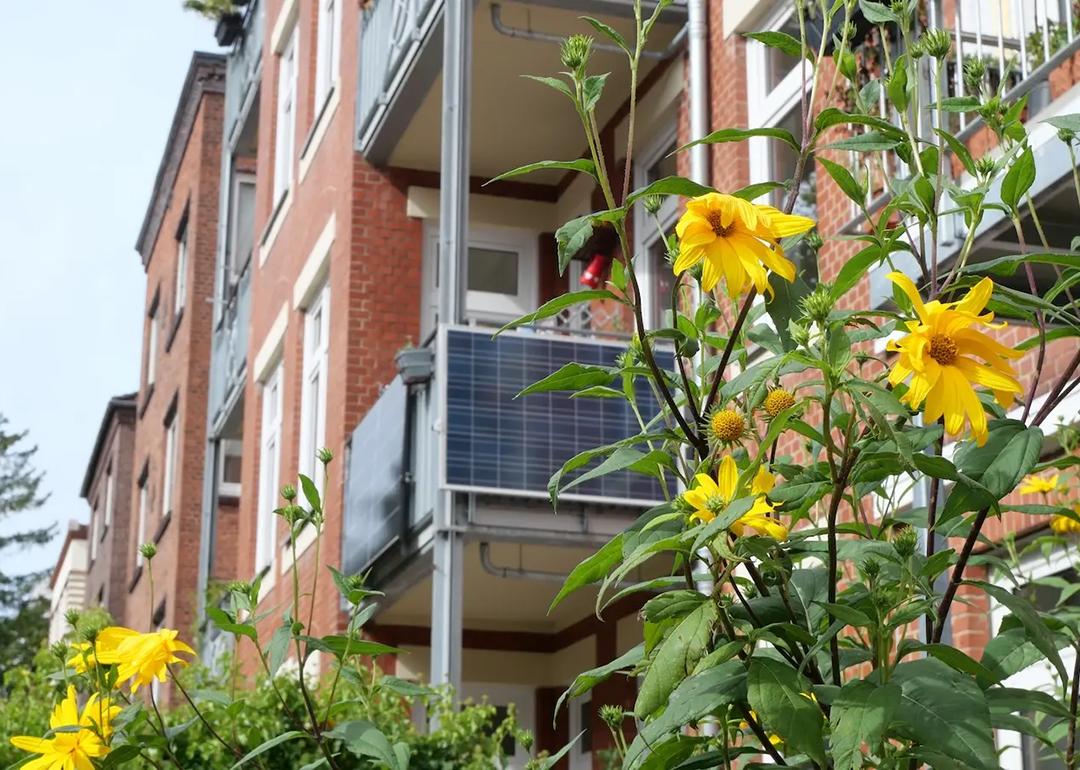
Matthias Weyland loves having people ask about his balcony. A pair of solar panels hang from the railing, casting a sheen of dark blue against the red brick of his apartment building. They're connected to a microinverter plugged into a wall outlet and feed electricity directly into his home. On a sunny day, he'll produce enough power to supply up to half of his family's daily needs.
Weyland is one of hundreds of thousands of people across Germany who have embraced balkonkraftwerk, or balcony solar, reports . Unlike , the technology doesn't require users to own their home, and anyone capable of plugging in an appliance can set it up. Most people buy the simple hardware online or at the supermarket for about $550 (500 euros.)
The ease of installation and a potent mix of government policies to encourage adoption have made the wee arrays hugely popular. More than dot cities and towns nationwide, half of which were installed in 2023. During the first half of this year, Germany added of balcony solar. Regulations limit each system to just 800 watts, enough to power a small fridge or charge a laptop, but the cumulative effect is nudging the country toward its clean energy goals while giving apartment dwellers, who make up of the population, an easy way to save money and address the climate crisis.
"I love the feeling of charging the bike when the sun is shining, or having the washing machine run when the sun is shining, and to know that it comes directly from the sun," Weyland said. "It's a small step you can take as a tenant" and an act of "self-efficacy, to not just sit and wait until the climate crisis gets worse."
Balcony solar emerged around a decade ago, but didn't catch on until four or five years ago, thanks in part to by solar and clean energy advocates for policies to foster its adoption. The German government enacted the first technical regulations for plug-in solar devices in 2019, allowing balcony solar systems to use standard electrical plugs and feed into the grid. That prompted an influx of plug-in devices and advocates to promote the technology.
The pandemic helped fuel the surge in popularity as people spent time at home, working on DIY projects. More recently, the escalating energy prices that followed led more Germans to consider balcony solar. "People just did anything they could to reduce their energy bills," said Wolfgang Gr眉ndinger, who works with the clean energy company Enpal.
Federal and local policymakers have redoubled their efforts to make the technology more accessible. In April, the government , and in July, federal lawmakers passed that prevent landlords from arbitrarily blocking installations. Cities throughout Germany, including Berlin and Weyland's home city of Kiel, have offered in subsidies to install balcony solar.
Gr眉ndinger and experts at the German Solar Industry Association noted that the devices don't generate enough power to strain the grid, and their standardized design and safety features allow them to integrate smoothly and easily.
Despite the hype, most users concede that balcony solar provides modest cost and energy savings. Weyland spent around $530 for his 600-watt-capacity system. While he's happy with how his south-facing panels perform during balmy weather, such days are rare in northern Germany. He estimates that he'll save around $100 in annual electricity costs and recoup his investment in about five years.
That's fairly typical, although advocates of the technology say a system's efficacy鈥攁nd, therefore, payback timeline鈥攙aries widely depending upon the number of panels, their location and direction, and how much shade surrounds them. A household with a "comparatively large well-positioned balcony system in a sunny spot facing south" can produce 15% of its electricity with balcony solar, , head of renewables at German Federal Network Agency, the country's utility regulator.
While that can put a dent in a household's utility bill, its impact on Germany's consumption is far smaller. "Even if we attached panels to all suitable balconies across the country, we'd still only manage to meet 1 percent or less of our overall energy needs," Stratmann told Deutsche Welle.
So if balcony solar doesn't generate a lot of power or save a lot of money, why are so many people flocking to it? Many of them like the idea of producing energy at home and gaining a bit of independence from the grid. It also provides . "It makes the energy transition feel a little more concrete and not so abstract," said Helena Holenweger of the nonprofit Deutsche Umwelthilfe, or Environmental Action Germany. She installed a balcony solar system on top of her garage about a year ago. "You can literally do something about it."
Holenweger and others who have tapped the sun said balcony solar led them to reevaluate their understanding of electricity consumption and take steps to reduce it. "For lots of people, energy is just something that comes out of your socket," Holenweger said. "You never think about how it gets there or how it works." The systems don't include battery storage, so the juice they generate must be used immediately, leading people to plan the best time to, say, run the washing machine to ensure they're using renewable energy. In that way, it becomes something of a game. Many balcony solar kits feature an app to track daily energy generation, providing what has, for many people, become a scorecard. "They screenshot that, they send it around to their Facebook groups, family WhatsApp groups. They're super proud," Gr眉ndinger said.
Germany is unique in its rabid embrace of the tech. Although increasingly popular in , , and elsewhere in Europe, plug-in solar devices aren't viable in the United States . Beyond that, most systems are designed to meet European electrical standards, making them .
But even in Germany, balcony solar still faces hurdles, including fierce resistance from landlords worried about electrical fires or put off by the aesthetics of the panels. Last year, Weyland sued his building's property management company for imposing what he deemed unreasonable requirements to install a system, including a formal inspection of the building's electrical system.
A court , but similar cases pop up regularly.
Weyland hopes that as more people adopt balcony solar, that will soon change. Already, people in his life regularly ask him about his panels, and two friends are buying systems of their own.
"So many people talk to me in our neighborhood and ask about the system when they see it," Weyland said. "It's kind of like a snowball that gets bigger and bigger."