More police are using your cameras for video evidence
was produced by , a nonpartisan, nonprofit news organization that seeks to create and sustain a sense of national urgency about the U.S. criminal justice system, and reviewed and distributed by 麻豆原创 Media.
More police are using your cameras for video evidence
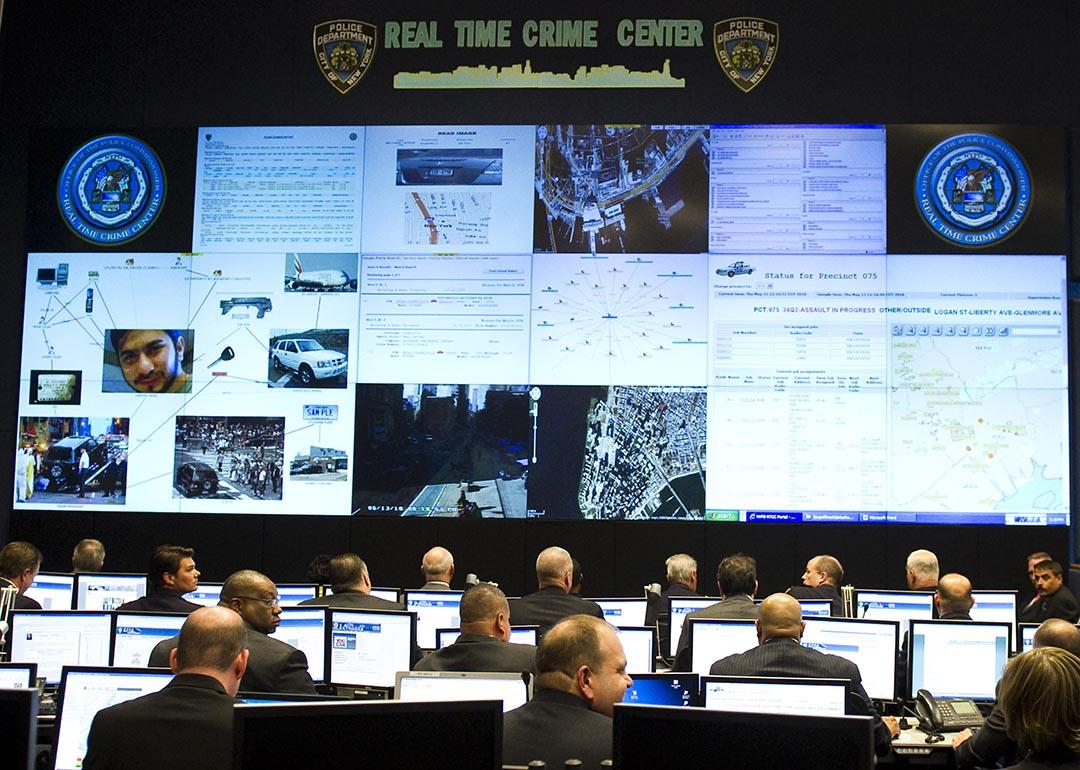
and , are among major cities slated to launch a Real-Time Crime Center later this year, billed as a kind of "nerve center" for the integration of police technology and data. looks at how these centers are blurring the line between public and private surveillance.
These "nerve centers" vary, but tend to integrate public surveillance video with other police technology like license plate readers, , , and . As Wired Magazine the centers have been popping up across the country, with at least 135 now running, .
Proponents say the centers make it easier for police to and . Opponents worry both about the invasion of privacy, and that increased surveillance will disproportionately .
Increasingly, most of these facilities functionally blur the lines between private and public surveillance sources. According to , a digital rights advocacy non-profit, in and the number of private cameras providing data to law enforcement dramatically outnumber public ones.
Private security footage is nothing new to criminal investigations, but two factors are rapidly changing the landscape: huge growth in the number of devices with cameras, and the fact that footage usually lands in a cloud server, rather than on a tape.
When a third party maintains the footage on the cloud, it gives police the ability to seek the images directly from the storage company, rather than from the resident or business owner who controls the recording device. In 2022, the Ring security company, owned by Amazon, admitted that it had provided to police without user consent at least 11 times. The company cited "exigent circumstances."
In another case, police served a search warrant on Ring, rather than on Michael Larkin, an Ohio homeowner whose camera footage officers wanted. The company informed him that it was from more than 20 cameras, "whether or not Larkin was willing to share it himself," Politico reported.
In , camera owners can access to their camera footage 鈥� , sometimes after a specific request by police.
That footage can, in turn, help pull other novel kinds of surveillance into the mix. In San Francisco, investigators trying to solve a hit-and-run were reviewing doorbell camera footage when they noticed a Waymo self-driving vehicle 鈥� which records video 鈥� nearby and around the time of the incident. The case was one of 10 discovered by Bloomberg News, where to the operators of self-driving taxi services 鈥� an avenue that will be increasingly possible as the cars .
Cars aren't the only autonomous machines that could be recruited for surveillance. The tech outlet 404 Media found that in Los Angeles, robot as evidence in at least one criminal case. The robot itself was the target of the crime 鈥� an attempted "bot-napping" 鈥� but the company's policies are vague, 404 reported, and could allow for footage to be shared in cases where the bots just happen to capture something of interest.
While some private cameras may stumble upon something relevant to the police, others go looking for it. This week, the city of St. Louis over an entrepreneur's plan to operate a private drone security program pitched as a crime deterrent.