Trump’s vow to arrest immigrants lifted private prison stocks. Then why did they tank?
Trump’s vow to arrest immigrants lifted private prison stocks. Then why did they tank?
The GEO Group and CoreCivic, the largest companies that provide detention space for Immigration and Customs Enforcement, seemed likely to reap a windfall after their stocks soared in the weeks leading up to last year’s inauguration of President Donald Trump.
But while Trump’s deportation machine had explosive growth, its reach hasn’t lived up to Wall Street expectations. Stock prices for both companies slumped. Despite a series of immigration blitzes and high-profile raids, the government didn’t use as much detention space as investors expected.
Detention industry experts and other observers believe all that could change this year, with the immigration system — and privately run holding facilities — expected to grow even larger.
“Once Trump was elected, there was a rush and belief that all this was going to occur at the snap of a finger,” said Joe Gomes, an equity analyst for Noble Capital Markets, an investment bank. “It’s just taken a little longer than many investors thought to see these numbers really jump up,” he told .
On his first day in office, Trump reversed an executive order from former President Joe Biden to curb the use of private companies to operate federal prisons for the Justice Department — though they continued to be used for immigration detention. Contractors like GEO Group and its primary competitor, CoreCivic, welcomed the news. Days later, the first piece of legislation Trump signed into law, the , made it easier to detain undocumented immigrants accused of low-level crimes.
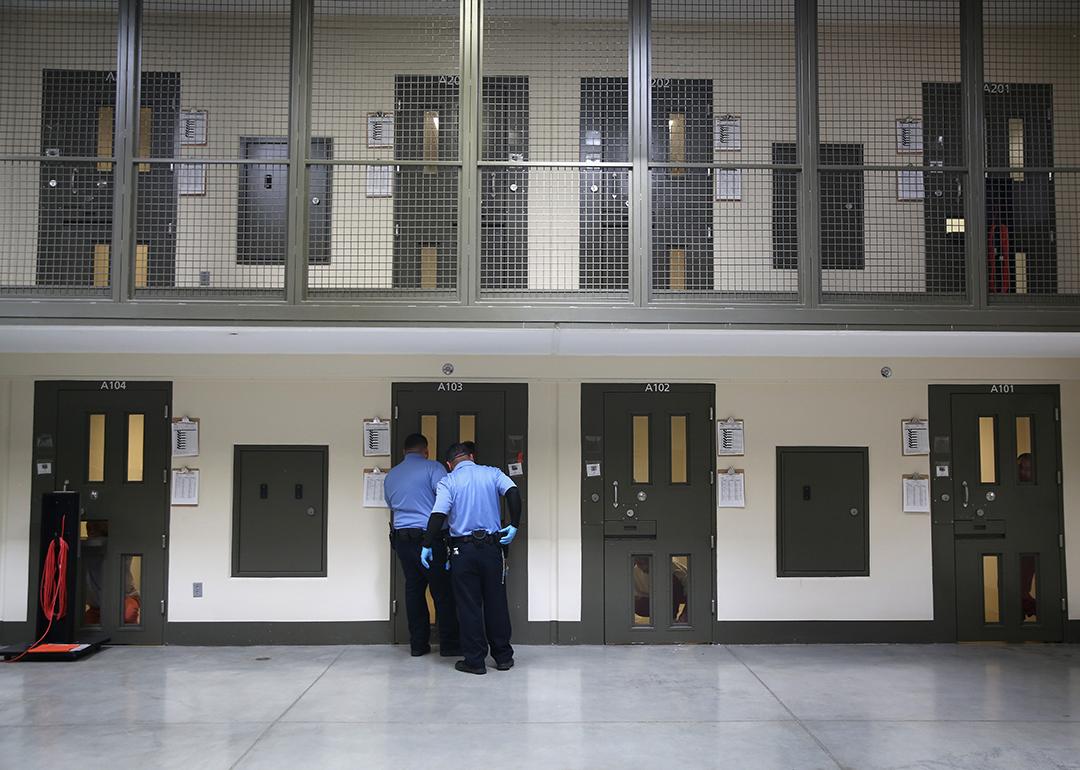
At the beginning of 2025, the companies had about a dozen prison facilities sitting empty, . GEO Group, based near Mar-a-Lago, Trump’s home in Florida, seemed particularly well-suited.
“This is a unique moment in our company’s history, and we believe we are well-positioned to scale up our diversified segments — in secure housing, transportation, electronic monitoring — to meet the changing needs of this new administration, and to continue to enhance value for our shareholders,” George Zoley, the of GEO Group, said during a quarterly earnings call in February.
By summer, Trump’s “One Big Beautiful Bill Act” was signed into law, in new funding for immigration enforcement.
Oddly enough, the price of GEO Group’s stock, which had nearly tripled between the waning months of the presidential campaign and Inauguration Day, then plummeted. At the end of 2025, GEO Group’s stock was trading around $16 per share, down from a high of $36.46 on Trump’s second day in office. Stock prices also fell for CoreCivic, formerly known as Corrections Corporation of America.
“Investors got over their skis,” said Gomes, the analyst.
The Trump administration has said it intends to deport 1 million people a year. In December, the Department of Homeland Security, which includes ICE, claimed it had deported 605,000 people since Trump was elected and that an additional 1.9 million people self-deported. The department dangled financial carrots like a “.”
Immigrant arrests climbed. In December, nationwide, up from about 40,000 at the beginning of the year. That’s , yet only a quarter of those people had been convicted of a crime, including low-level offenses. Another 25% had criminal cases pending.
Detention capacity is still far from ICE’s stated goal of having access to more than .
Early last year, GEO Group said it expected to provide 32,000 beds for ICE, more than double the amount at the end of the Biden administration. In doing so, the firm told investors that it was likely that all of its idle prisons would be activated by the end of the year.
GEO Group resumed admitting immigrants at its 1,940-bed Adelanto ICE Processing Center in California after a COVID ban was lifted. On the East Coast, in Newark, New Jersey, GEO Group’s 1,000-bed Delaney Hall Facility opened with the help of an ICE contract valued at $1 billion. In the Midwest, North Lake Processing Center, in Baldwin, Michigan, .
As of Dec. 15, GEO Group had idle facilities with nearly 4,700 empty beds in California, Colorado, North Carolina and Texas, according to .
CoreCivic also ramped up, but not as quickly as investors expected. Notably, in March, the Tennessee-based firm said it resumed “operations and care” for up to 2,400 people, including families, at the Dilley Immigration Processing Center in South Texas, expected to generate $180 million in annual revenue.
“Never in our 42-year company history have we had so much activity and demand for our services as we are seeing right now,” CoreCivic CEO Damon Hininger, a former correctional officer himself, said during an earnings call in May.
At the end of September, CoreCivic that it had idle facilities with more than 7,000 empty beds.
Adding pressure to stock prices, the federal government apprehended fewer people , lowering the number of new arrivals to detain or monitor. Still, , GEO Group touted that the “alien population” in the United States holds strong at 16.8 million, citing from the Federation for American Immigration Reform, a nonprofit seeking to reduce immigration. GEO Group also said that 182,000 people were being monitored in the community for ICE’s Intensive Supervision Appearance Program (down from about 370,000 under the Biden administration).
Zoley said GEO Group subsidiary BI Incorporated could scale up its monitoring contract to serve millions of people for ICE.
The Trump administration is also still ramping up. And investors and observers expect the system to keep growing this year.
“As they expand their infrastructure — that includes officers, buildings, fleets, buses, planes, technology — then that’s when we are probably going to see more people, more numbers captured into all of this,” said Bianca Tylek, executive director of Worth Rises, a national human rights nonprofit that monitors the prison industry.
The Department of Homeland Security recently signed a $140 million contract to buy planes from Boeing for . Thousands of new ICE and Border Patrol agents are being recruited, with others offered to come out of retirement. More local police and have formal agreements to support national immigration enforcement efforts.
The White House and ICE see publicly traded private prison companies like GEO Group and CoreCivic as “allies and assets” to their ongoing efforts to deport many more people, said David Bier, director of immigration studies at the Cato Institute, a libertarian think tank.
“The contractors are the consequence of the policy choice made by this administration,” he said.
And as a libertarian, he said he views illegal immigration as the consequence of a broken immigration system. He described the Trump administration’s immigration policy as “indiscriminate mass deportation.”
“If you go down the list, it’s hard to find a right that they haven’t violated in the Constitution,” he said. “I find it incredibly troubling that they are getting away with it so far.”
He said trying to open 100,000 ICE detention beds nationwide is an “absurd goal” that has required the government to arrest people for a far broader set of reasons than previous administrations have used.
“There aren’t enough criminal immigrants in the United States that they can catch to fill those facilities, so this is all about caging a bunch of peaceful people who aren’t bothering anyone,” Bier said.
He expects the Trump administration to surpass its detention bed goal.
“They could easily be at 200,000 by the end of this term,” he said. “The main limitation would just be the personnel to man that. You have to find actual people willing to do this work. But in terms of just paying for it, they got way more money than they could possibly spend on this.”
Gomes, the analyst, said that as ICE brings more people into work, it could improve the financial results of GEO Group and CoreCivic.
“As those employees come on, you will see the number of detentions increase,” he said.
was produced by and reviewed and distributed by Â鶹ԭ´´.