
Sports betting vs. investing: What really grows your cash?
Short answer: Sports betting usually loses money. Saving and investing, while less exciting and adrenaline-pumping, are far more reliable ways to grow your money over time, according to historical data.
About $1.7 billion in legal sports betting wagers are projected to be placed in February 2026, continuing nearly a decade of record-breaking betting volume that month, according to a projection from . For sportsbooks, that鈥檚 a great business. For the average bettor, history suggests the opposite: Most people walk away with less than they started with.
Big games create the feeling of outsize opportunity, but the math behind gambling hardly changes. Over time, most bettors lose.
How much money do people actually lose betting on sports?
During recent football seasons, the average bettor lost roughly 8% to 9% of their wagers. That translates to roughly $130 to $200 per person, according to data from and calculations.
February football betting isn鈥檛 expected to be much better. Legal Sports Report estimates sportsbooks will generate $100 million in revenue from those wagers alone, assuming a 6% hold. That means bettors are expected to lose an average of $6 for every $100 bet.
Some people will win big, but most won鈥檛, which is how sportsbooks stay profitable.
Why sportsbooks always come out ahead
Sports bettors lose not just because of bad luck, but because sportsbooks are designed to win.
Several factors work against bettors:
- Sportsbooks take a cut on every wager.
- Odds are set to favor sportsbooks over time.
- High betting volume smooths out short-term wins by individuals.
Even bets that feel 鈥渟afe鈥� or well-researched still face a built-in disadvantage.
Sports betting vs investing
Instead of sports betting, that same money could go into a (HYSA), a certificate of deposit (CD), a like the S&P 500, or a diversified portfolio of with a long-term mindset of holding those investments for at least five years.
If the average bettor moved the $130 to $200 typically wagered during a football season into a low-cost index fund, and markets performed in line with their historical long-term average, that money could compound substantially over time. For comparison, , including dividends reinvested, has grown at an average of about 10% per year over the past century.
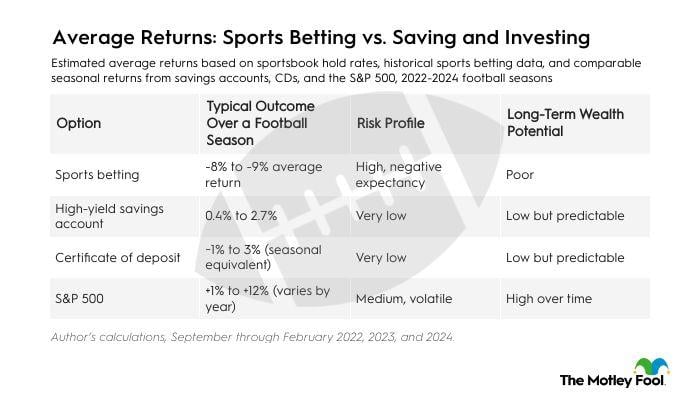
The takeaway is straightforward: Sports betting functions as entertainment, not a reliable way to build wealth. For long-term financial growth, historical data shows that consistent saving and outperform sports betting, with the gap widening the longer money stays invested.
Methodology
Average bettor returns for each football season were calculated using monthly sportsbook data on betting handle and gross gaming revenue (GGR) from SportsHandle.com. For each season, a weighted average GGR win rate from September through February was calculated and then inverted to estimate the average bettor鈥檚 ROI as a percentage of wagers.
Estimated dollar losses per bettor were calculated by distributing total sportsbook revenue across the estimated population of sports bettors, using a 15% rate based on data from ..
High-yield savings account (HYSA) returns were estimated using the peak annual percentage yield for the relevant year, compounded over six months. S&P 500 returns were calculated as the percentage change in the index from the September market open to the last trading day in February, and reflect price-only returns.
was produced by and reviewed and distributed by 麻豆原创.